
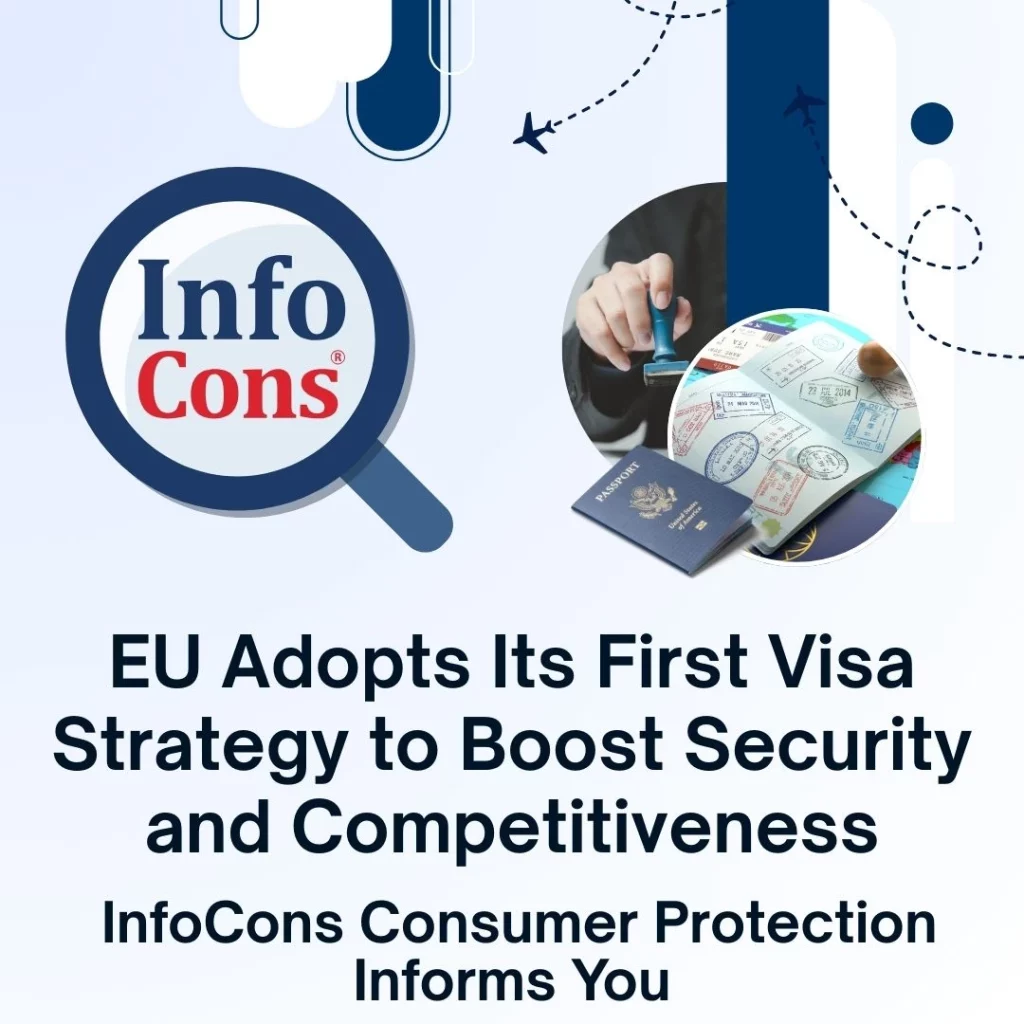
EU Adopts Its First Visa Strategy to Boost Security and Competitiveness – InfoCons Consumer Protection Informs You
As global mobility increases and geopolitical challenges intensify, visa policy has become a strategic tool for managing security, economic growth, and international influence. In response to these evolving realities, the European Commission has adopted the first-ever EU Visa Strategy, marking a major shift toward a more coordinated, forward-looking approach.
The Strategy aims to prepare the European Union for rising travel demand, regional instability, and global competition, while ensuring that visa rules support the EU’s long-term interests.
InfoCons Consumers Protection Informs You – WHO’s New Guidelines on Healthy School Meals Explained – InfoCons Consumer Protection Informs You
Making Europe Safer Through Stronger Visa Controls
Security is a central pillar of the new EU Visa Strategy. The Commission proposes using visa policy more effectively as part of the EU’s broader security framework, particularly at the external borders of the Schengen area.
Key measures include a modernised system for granting visa-free access to partner countries, supported by a new assessment framework with clear and objective criteria, expected in 2026. Existing visa-free regimes will also be monitored more closely under an improved Visa Suspension Mechanism to prevent misuse and ensure continued compliance.
The Strategy further strengthens the EU’s ability to act when cooperation on return, readmission, or migration control is lacking. Planned revisions to the Visa Code will expand the EU’s capacity to apply targeted visa measures and, where necessary, introduce restrictive actions against third countries whose conduct undermines EU security.
Protecting the Integrity of Travel Documents
To counter fraud and identity abuse, the Strategy introduces new measures to enhance travel document security. This includes harmonised EU-level definitions of document fraud and common sanctions, ensuring a more consistent response across Member States and reinforcing trust in the EU visa system.
InfoCons Consumers Protection Informs You – How 76.9% of EU Internet Users Took Action to Protect Their Data in 2025
Supporting Economic Growth and Global Competitiveness
Beyond security, the Visa Strategy seeks to strengthen Europe’s economic position. Travel and mobility are vital drivers of growth, with the Schengen area remaining the world’s most visited destination.
To make legitimate travel easier and more predictable, the EU will roll out digital visa procedures. From late 2026, the European Travel Information and Authorisation System (ETIAS) will simplify pre-departure checks for visa-free travellers. At the same time, fully digital visa applications will allow travellers who require a visa to complete the entire process online.
Trusted travellers and business visitors will benefit from longer-validity multiple-entry visas, while a common list of verified companies will help streamline procedures for business travel.
Attracting Talent and Innovation to Europe
The Strategy is accompanied by a Recommendation focused on attracting global talent to Europe. It aims to make the EU more appealing to highly skilled professionals, students, researchers, and innovative entrepreneurs, strengthening competitiveness in a global race for skills.
Member States are encouraged to simplify and accelerate long-stay visa and residence permit procedures through greater digitalisation, reduced paperwork, and shorter processing times. The Recommendation also supports smoother transitions from study or research to employment or entrepreneurship, improved mobility within the EU, and stronger coordination between public authorities, universities, and research institutions.
These efforts align with broader EU initiatives such as Choose Europe, the Union of Skills, and strategies supporting startups and scale-ups.
InfoCons Consumers Protection Informs You – Sturnus : The Android Trojan That Reads Encrypted Messages and Steals Money – InfoCons – Consumer Protection in Cybersecurity
Modern Digital Tools for Smarter Visa Management
Managing millions of travellers each year requires advanced systems that balance efficiency with security. The EU is therefore investing in modern, interoperable IT systems for visa and border management.
By 2028, EU databases will be fully interoperable, allowing authorities to consult multiple systems through a single search interface. This will improve information-sharing, help detect fraud and abuse, and facilitate smoother border crossings for legitimate travellers.
A More Secure, Efficient, and Competitive EU Visa System
The adoption of the EU’s first Visa Strategy represents a significant milestone in shaping how Europe manages mobility in a complex global environment. By strengthening security, embracing digital tools, and making Europe more attractive to talent and business, the Strategy lays the groundwork for a visa policy that is both protective and forward-looking.
InfoCons Consumer Protection informs you so you can better understand how EU policies affect travel, security, and opportunities in an increasingly connected world.
- Global Coverage: Provides access to emergency numbers in multiple countries and languages.
- Offline Functionality: The service works without an active internet connection.
- Direct Dialing: Enables users to call emergency services, such as police or fire departments, directly from the app without manually typing the number.
- Location Sharing: Allows for sending location details to emergency contacts.
- Comprehensive Database: Includes various emergency numbers, including consumer protection, border police, and health services.
Source : European Commission
Signature : InfoCons Communication Department