
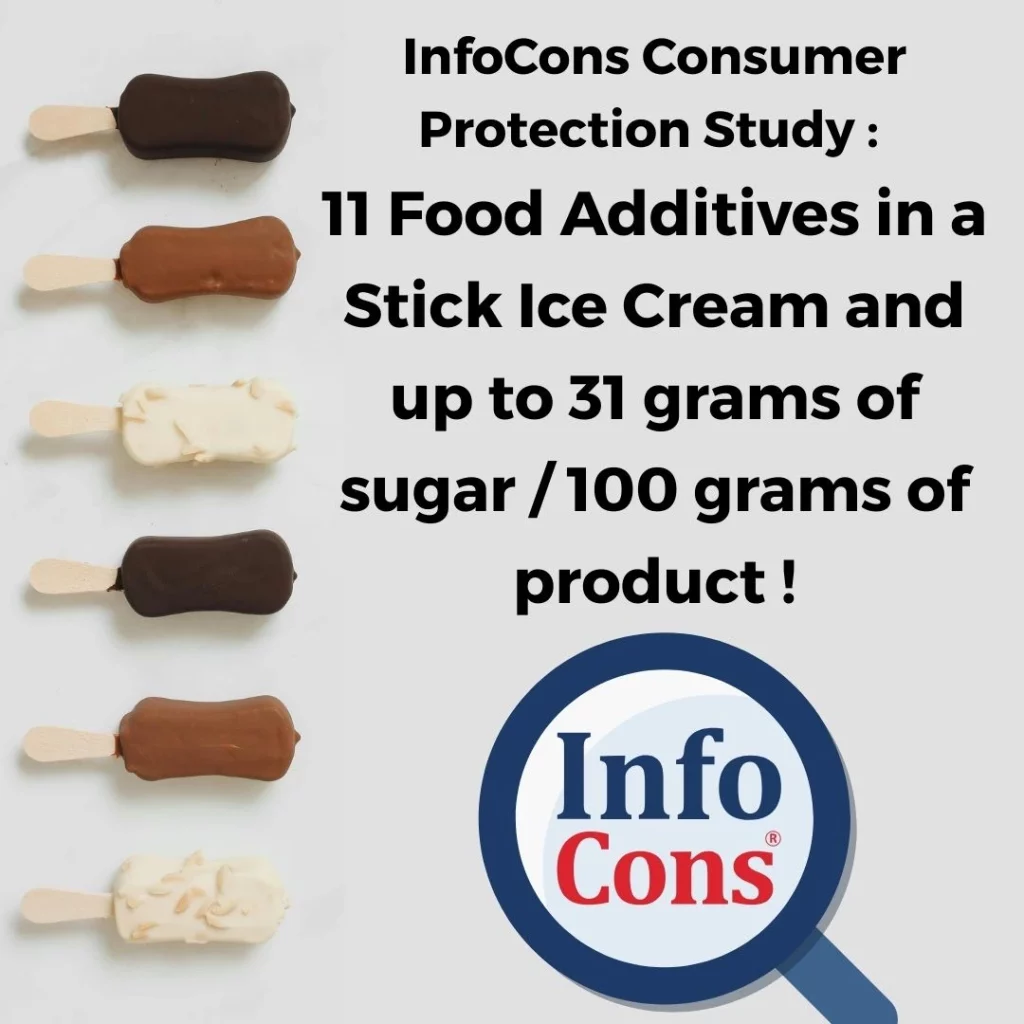
InfoCons Consumer Protection Study : 11 Food Additives in a Stick Ice Cream and up to 31 grams of sugar / 100 grams of product !
InfoCons conducted a study based on the labels of boxed stick ice cream products available on the Romanian market.
A total of 19 stick ice cream products were analyzed, from 14 manufacturers/distributors of stick ice cream present in Romania.
InfoCons Consumer Protection informs you about stick ice cream products – As a result of collecting and analyzing the information found on the labels of stick ice cream products, the following conclusions were drawn:
Weight of Stick Ice Cream Products
InfoCons Consumer Protection informs you about stick ice cream products – From the point of view of product weight:
- the weight of stick ice cream products varies between 188–600 grams (g), respectively 255–780 milliliters (ml).
InfoCons Consumers Protection Informs You – What Do Cancer Awareness Ribbon Colors Mean ? InfoCons Consumer Protection Informs You on World Cancer Day
Main Ingredient in Stick Ice Cream Products
InfoCons Consumer Protection informs you about stick ice cream products – From the point of view of the main ingredient contained:
- 78.95% of stick ice cream products have milk derivatives as the main ingredient (skimmed milk, reconstituted skimmed milk, rehydrated skimmed milk, reconstituted skimmed milk powder, reconstituted cream powder);
- 10.53% have water as the main ingredient;
- 5.26% have white chocolate (cocoa butter) as the main ingredient;
- 5.26% have ice cream as the main ingredient.
Main Flavor Mentioned and Its Concentration
InfoCons Consumer Protection informs you about stick ice cream products – From the point of view of the main flavor mentioned in the product description and its concentration:
- 95% of stick ice cream products mention the concentration of the main flavor contained in the product;
- 5% of stick ice cream products do not mention the concentration of the main flavor.
Among the stick ice cream products that mention the concentration of the main flavor in the ingredient list, the situation is as follows:
- 3% contain cocoa flavor, with concentrations ranging between 2.45% and 8%;
- 20% contain milk flavor, with concentrations ranging between 15% and 17%;
- 7% contain vanilla flavor, with a concentration of 1%;
- 7% contain Bourbon vanilla flavor, with a concentration of 0.6%;
- 33% contain coconut flavor, with concentrations ranging between 2% and 3%;
- 66% contain pineapple flavor, with a concentration of 10%;
- 66% contain biscuit flavor, with a concentration of 45%;
- 66% contain mango flavor, with a concentration of 4.5%;
- 66% contain raspberry flavor, with a concentration of 12%;
- 66% contain salted caramel flavor, with a concentration of 12%.
InfoCons Consumers Protection Informs You – Innovative cyber attack : AI + malware – InfoCons Consumer Protection in Cybersecurity
Food Additives in Stick Ice Cream Products – InfoCons Consumer Protection informs you:
- Each analyzed product contains at least 2 E-numbers / food additives.
The number of E-numbers / food additives varies between 2 and 11:
- 5.26% contain 11 E-numbers;
- 5.26% contain 9 E-numbers;
- 10.52% contain 8 E-numbers;
- 10.52% contain 7 E-numbers;
- 10.52% contain 6 E-numbers;
- 21.04% contain 5 E-numbers;
- 15.79% contain 4 E-numbers;
- 15.79% contain 3 E-numbers;
- 5.26% contain 2 E-numbers.
Frequently Found Food Additives (E-numbers)
Guar Gum (E 412) – present in 100% of the analyzed products
Food additive used as an emulsifier, stabilizer, thickening agent, bulking agent, and gelling agent. It is a natural product obtained from the guar shrub.
It is used in quantities provided by recipes in dairy products, sweets, creams, spreadable emulsified fats with or without flavors, sauces, toppings, dressings, ice cream, processed and preserved fruits and vegetables, meat products, fish, eggs, spices, soups, broths, edible casings, vegetable protein products, nutritional supplements, etc.
It is also used as a carrier substance for other food additives.
Mono- and Diglycerides of Fatty Acids (E 471) – present in 2% of products
Food additives acting as thickening agents, emulsifiers, stabilizers, anti-caking agents, and antifoaming agents. They are obtained from animal or vegetable fats and are used in quantities provided by recipes in dairy products, fat-based desserts, emulsified fats, milk- or fruit-based desserts, vegetable and fruit products, pickled vegetables, confectionery and pastry products, ice cream, pasta, rice, cereal- and/or starch-based desserts, fish products, eggs, sauces, spices, soups, salads, dietary products, food supplements, alcoholic and non-alcoholic beverages, etc.
Soy Lecithin (E 322) – present in 42% of products
Food additive classified as an antioxidant, emulsifier, and stabilizer. It is a compound found in the structure of the cell membrane of every living organism.
For industrial use (food and pharmaceutical), it is mainly obtained from soybeans or egg yolk.
It is used in all types of food products.
Locust Bean Gum (E 410) – present in 16% of products
Food additive acting as an emulsifier, stabilizer, thickening agent, bulking agent, and gelling agent. It is a natural product obtained from the carob tree.
It is used in quantities provided by recipes in dairy products, sweets, creams, spreadable emulsified fats with or without flavors, sauces, toppings, dressings, ice cream, processed and preserved fruits and vegetables, meat products, fish, eggs, spices, soups, broths, edible casings, vegetable protein products, nutritional supplements, etc.
InfoCons Consumers Protection Informs You – Everything You Need to Know About the Milano Cortina 2026 Winter Olympic Games – InfoCons Consumers Protection Informs You !
Citric Acid (E 330) – present in 58% of products
Food additive belonging to the category of acidity regulators, also used as a flavoring agent. It enhances the effect of antioxidants and gelling agents and contributes to the formation of emulsions.
Naturally, citric acid is found in every living cell. For industrial use, it is obtained by fermenting molasses or sugar in the presence of the mold Aspergillus niger.
It is used in quantities provided by recipes in fruit-, vegetable-, and milk-based products, non-emulsified and emulsified oils and fats, bakery, pastry, confectionery products, as well as in products intended for infants and healthy young children, within prescribed quantities.
Polyglycerol Polyricinoleate (E 476) – present in 1% of products
Food additive acting as a stabilizer and emulsifier, obtained from polyglycerol and castor oil.
It is mainly used in cocoa- and chocolate-based confectionery products, in emulsions and spreadable pastes with a fat content of up to 41%, and in salad dressings.
Carotenes (E 160a) – present in 79% of products
Food additives belonging to the category of natural colorants, obtained from carrots. They are insoluble in water, and the color range varies from yellow to orange, depending on the solvent used for extraction.
Their use is permitted in all types of food products, in quantities provided by recipes.
Sodium Alginate (E 401) – present in 79% of products
Food additive acting as an emulsifier, stabilizer, thickening agent, and gelling agent. It is the sodium salt of alginic acid.
It is used in quantities provided by recipes in all dairy products, sweets, creams, spreadable emulsified fats with or without flavors, sauces, ice cream, processed and preserved fruits and vegetables, meat products, food supplements, etc.
Pectins (E 440) – present in 79% of products
Food additive acting as an emulsifier, stabilizer, and thickening agent, naturally present in fruits, especially apples, oranges, and quinces.
For industrial use, pectins are obtained from apples and oranges. They are available as:
- E 440(i) – Pectin
- E 440(ii) – Sodium pectate
- E 440(iii) – Potassium pectate
- E 440(iv) – Ammonium pectate
- E 440b – Amidated pectin
Xanthan Gum (E 415) – present in 53% of products
Food additive acting as an emulsifier, stabilizer, thickening agent, bulking agent, and gelling agent. It is a natural product obtained by fermentation of sugar or molasses in the presence of the bacterium Xanthomonas campestris.
It is used in quantities provided by recipes in dairy products, sweets, creams, spreadable emulsified fats with or without flavors, sauces, toppings, dressings, snacks, ice cream, processed and preserved fruits and vegetables, meat products, fish, eggs, spices, soups, broths, edible casings, vegetable protein products, nutritional supplements, etc.
It is also used as a carrier substance for other food additives.
InfoCons Consumers Protection Informs You – How to Stay Warm During a Winter Power Cut and Prevent Cold-Related Risks – InfoCons Consumer Protection Informs You
Lactic Acid Esters of Mono- and Diglycerides (E 472b) – present in 53% of products
Food additives acting as stabilizers, sequestrants, and emulsifiers. They are obtained from animal or vegetable fats and are used in quantities provided by recipes in milk-based products (flavored or unflavored yogurt, sour cream, cheese, milk powder), pastry and confectionery products, ice cream, egg-, cereal-, starch- or fruit-based desserts, vegetables and fruits preserved in vinegar or pasteurized, meat products, fish, sauces, soups, broths, spices, salads, margarines, mayonnaise and other emulsified fats, doughs, dietary products, food supplements, flavored soft drinks, beer, cider, fruit wines, and other alcoholic beverages.
Sodium Citrates (E 331) – present in 53% of products
Food additive belonging to the category of antioxidants, also functioning as an acidity regulator, preservative, flavoring agent, and sequestrant.
They are available as:
- E 331(i) – Monosodium citrate
- E 331(ii) – Disodium citrate
- E 331(iii) – Trisodium citrate
All are sodium salts of citric acid.
They are used in quantities provided by recipes in milk-based products, vegetables, fruits, emulsified and non-emulsified animal or vegetable oils and fats, partially or totally dehydrated milk, fresh minced meat preparations.
Ammonium Carbonate (E 503) – present in 53% of products
Food additive acting as a stabilizer, acidity regulator, and leavening (raising) agent, obtained from ammonium sulfate and calcium carbonate, which are natural minerals.
It is available as:
- E 503(i) – Ammonium carbonate
- E 503(ii) – Ammonium bicarbonate
It is added in quantities provided by recipes to dairy products, cheeses, milk-based desserts, ice cream, spreadable emulsified fats, vegetable, fruit, meat, fish, egg, cereal products, pasta, doughs, pastry, confectionery and bakery products, sauces, spices, salads, soups, broths, dietary products, food supplements, alcoholic and non-alcoholic beverages, etc.
Sodium Carbonate (E 500) – present in 53% of products
Food additive acting as a stabilizer, acidity regulator, leavening (raising) agent, anti-caking agent, and base, obtained from salt or seawater.
It is available as:
- E 500(i) – Sodium carbonate
- E 500(ii) – Sodium bicarbonate
- E 500(iii) – Sodium sesquicarbonate
It is added in quantities provided by recipes to dairy products, cheeses, milk-based desserts, ice cream, spreadable emulsified fats, vegetable, fruit, meat, fish, egg, cereal products, pasta, doughs, pastry, confectionery and bakery products, sauces, salads, food supplements, alcoholic and non-alcoholic beverages, etc.
Sucrose Esters of Fatty Acids (E 473) – present in 26% of products
Food additives acting as stabilizers, thickening agents, and emulsifiers. They are obtained from animal or vegetable fats and sugars and are used as additives in packaged liquid coffee.
Calcium Phosphate (E 442) – present in 26% of products
Food additive acting as an emulsifier and stabilizer, obtained from ammonia and phosphorylated fatty acids, mainly used in chocolate- and cocoa-based confectionery and pastry products.
Potassium Carbonate (E 501) – present in 26% of products
Food additive acting as a stabilizer and acidity regulator, obtained from salt or seawater.
It is available as:
- E 501(i) – Potassium carbonate
- E 501(ii) – Potassium bicarbonate
It is also used as a carrier for other additives and added in quantities provided by recipes to dairy products, cheeses, milk-based desserts, ice cream, spreadable emulsified fats, vegetable, fruit, meat, fish, egg, cereal products, pasta, doughs, pastry, confectionery and bakery products, sauces, spices, salads, soups, broths, dietary products, food supplements, alcoholic and non-alcoholic beverages, etc.
InfoCons Consumers Protection Informs You – InfoCons App : A Consumer – Oriented Digital Tool for Product Transparency and Informed Everyday Choices
Modified Starch (E 1422) – present in 26% of products
Food additive acting as a gelling agent, thickening agent, stabilizer, emulsifier, and carrier substance for other food additives.
It is a so-called “modified starch”, meaning a starch subjected to a specific chemical process aimed at improving and adapting its properties to certain requirements, such as:
- increased stability at very high or very low temperatures;
- stability in acidic or alkaline environments;
- lengthening or shortening coagulation or gelation time;
- ability to gel when cold;
- texture modification, etc.
Modified starch has a greater capacity to absorb water, to partially substitute fats, to form emulsions, and is used in milk-, meat-, egg-, fat-, and cereal-based products, confectionery, bakery and pastry products, fruit, vegetable and fish preserves, sauces, spices, concentrated soups, creams, puddings, various desserts, flavored alcoholic and non-alcoholic beverages, etc.
Nutritional Information (per 100 g product)
All analyzed stick ice cream products had nutritional information listed on the label:
- Energy value: between 81 kcal and 420 kcal
- Saturated fatty acids: between 0 g and 22 g
- Protein: between < 5 g and 6.2 g
- Sugars: between 17 g and 31 g
- Salt: between < 0.1 g and 0.78 g
Signature: InfoCons Communication Department
Call responsibly using the emergency numbers!
The Consumers Protection platform offers quick, centralized access to essential and emergency contacts worldwide, helping users connect with services such as Consumer Protection, Ambulance, Fire Brigade, Police, and Tourist Information across all continents.
The UNIQUE Consumer Protection App – InfoCons App !
The InfoCons App is a free, multilingual tool available in 33 languages, empowering consumers worldwide with fast access to consumer protection resources and useful emergency services.