
Denmark Is Europe’s No. 1 for Consumer-Rights Knowledge in 2025 – And Here Is How It Ranks on the Other Two Consumer Pillars
InfoCons Consumer Protection & Product Safety Department • Country Briefing • Denmark (DK)
Denmark Is Europe’s #1 for Consumer-rights knowledge in 2025 — And Here Is How It Ranks on the Other Two Consumer Pillars
Thinking of moving to, studying in, or teaching in Denmark? Here is what the European Commission’s Consumer Conditions Scoreboard 2025 reveals about how protected, informed and safe consumers feel in Denmark – and exactly where the country stands against the other 28 markets in Europe. Across the three pillars of the Scoreboard’s Knowledge, Trust & Product Safety chapter, Denmark ranks 6th for trust, 1st for rights knowledge and 7th for product safety, out of 29 markets.
The Big Picture: Denmark vs. the EU27, Europe’s Best and Europe’s Lowest
The chart below sets Denmark side by side with the EU27 average, with Europe’s top-scoring market and with Europe’s lowest-scoring market on each of the three consumer pillars. It is the quickest way to see whether Denmark is closer to the European front-runners or to the back of the pack.
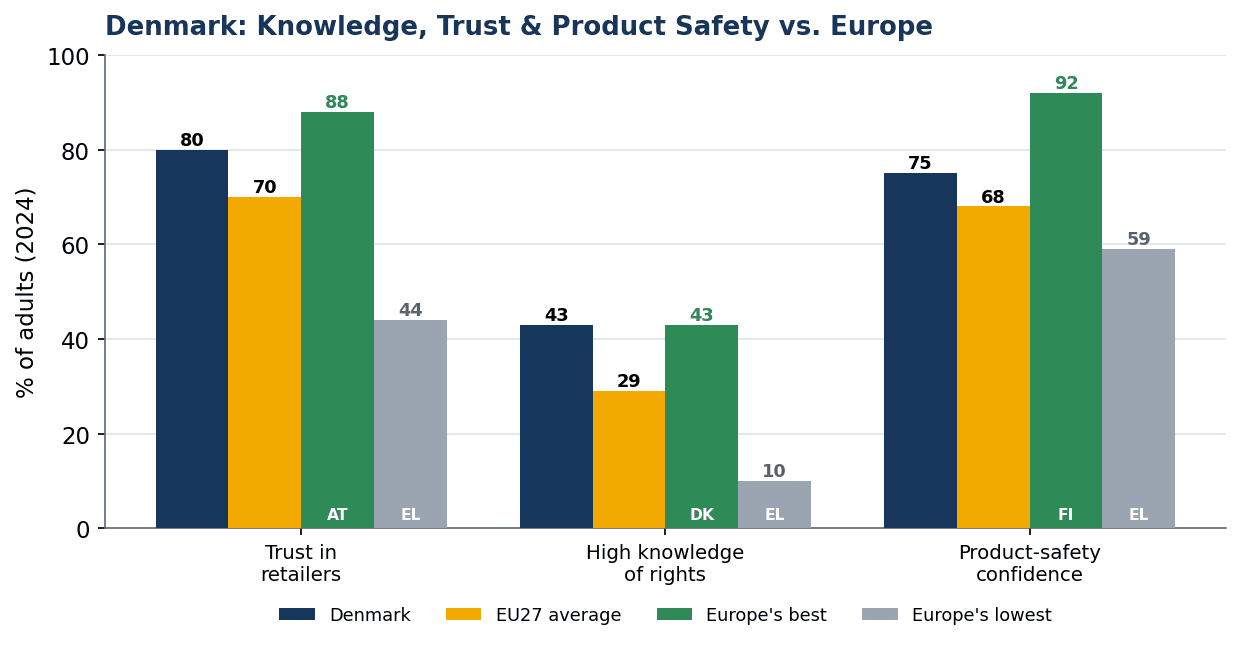
Figure 1: Denmark compared with the EU27 average, the European leader and the European lowest score on each pillar (% of adults, 2024).
What Figure 1 shows, in numbers:
- Trust in retailers: Denmark 80% vs. EU27 70% (10 percentage points above the EU27 average). Europe’s best is Austria at 88%; the lowest is Greece at 44%.
- High knowledge of rights: Denmark 43% vs. EU27 29% (14 percentage points above the EU27 average). Europe’s best is Denmark at 43%; the lowest is Greece at 10%.
- Product-safety confidence: Denmark 75% vs. EU27 68% (7 percentage points above the EU27 average). Europe’s best is Finland at 92%; the lowest is Greece at 59%.
Where Denmark Ranks Among Europe’s 29 Markets
The next infographic plots all 29 markets on a single scale for each pillar. The large navy dot is Denmark; the gold diamond is the EU27 average; the grey ticks are the other markets. The further right Denmark sits, the better it scores.
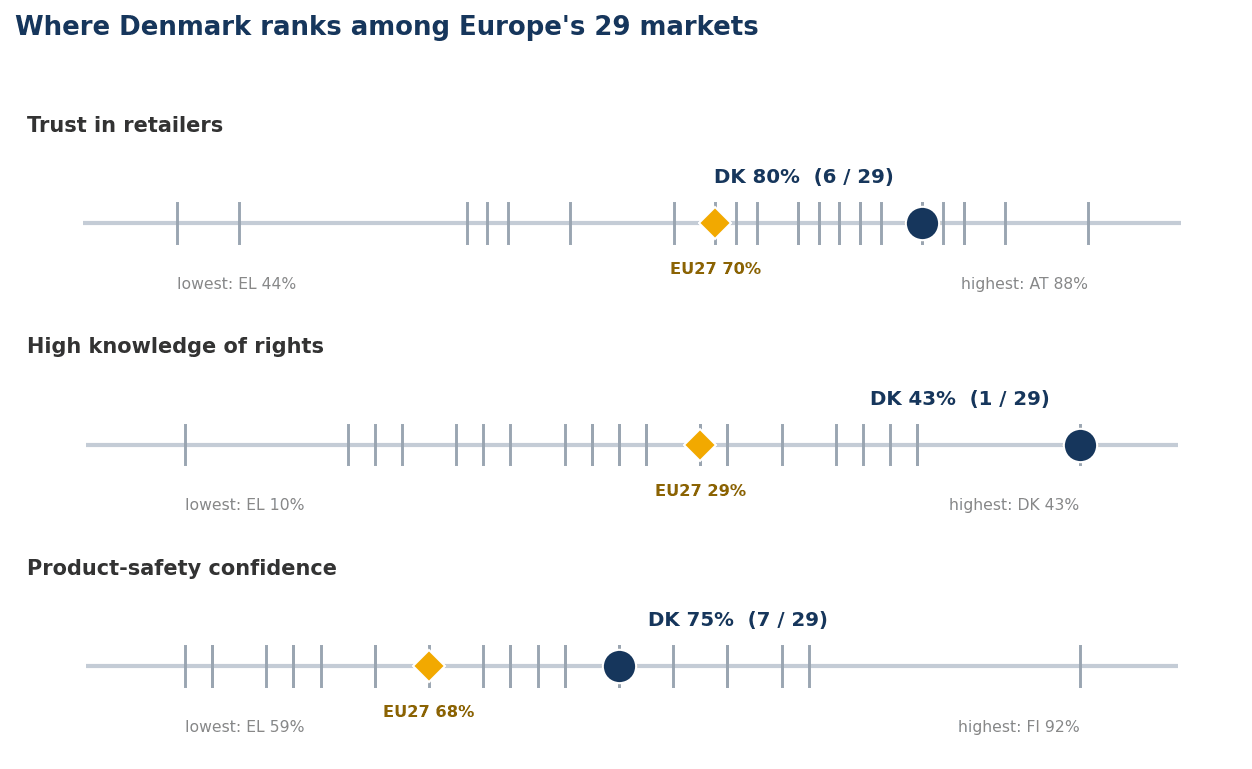
Figure 2: Denmark’s position on each pillar relative to the full European field and the EU27 average (% of adults, 2024).
What Figure 2 shows, in numbers:
- Trust: 6th of 29 at 80%, just behind Netherlands (81%) and ahead of Finland (80%). The EU27 average is 70%.
- Rights knowledge: 1st of 29 at 43%, ahead of Czech Republic (37%) at the foot of the table. The EU27 average is 29%.
- Product safety: 7th of 29 at 75%, just behind Slovakia (77%) and ahead of Latvia (75%). The EU27 average is 68%.
Trust in Traders: Do Retailers in Denmark Respect Your Rights?
In Denmark, 80% of consumers agree that retailers and service providers respect their rights – 10 percentage points above the EU27 average. That is the 6th-strongest trust score of the 29 European markets surveyed. For everyday shopping that is encouraging: most people here expect fair treatment from traders. Across the EU as a whole, trust in retailers returned to its pre-pandemic level of 70% in 2024, while trust in public authorities to protect consumers stood at 61% and trust in consumer NGOs also at 61%. Trust tends to be higher among younger consumers and lower among those in a difficult financial situation.
Consumer-Rights Knowledge: How Well-Informed Are Shoppers in Denmark?
43% of consumers in Denmark reach the Scoreboard’s HIGH knowledge band – correctly answering at least three of four core questions – 14 percentage points above the EU27 average, ranking Denmark 1st of 29. This is the pillar where Europe is weakest overall: across the EU27 only 29% qualify as highly knowledgeable, while 35% fall into the LOW band. At EU level, 59% know the 14-day cooling-off right for distance purchases, 56% know a contract cannot raise prices one-sidedly without a cancellation option, just 44% know about the two-year legal guarantee for faulty goods, and only 31% know they are not obliged to pay for unsolicited products. Denmark’s above-average score is a genuine asset – but the low EU baseline means even here many consumers under-use rights they actually hold.
Product Safety, Recalls & the Safety Gate in Denmark
75% of consumers in Denmark are confident that the non-food products on the market are safe, 7 percentage points above the EU27 average and 7th of 29. Product safety is the most reassuring pillar across Europe, averaging 68% in the EU27 – broadly stable since 2018. At EU level, 56% of consumers had seen a product recall in the past two years and 13% had owned a recalled product; 14% experienced a product-safety issue (more than half did not complain about it); and 2% reported an injury from a dangerous product. Behind the scenes, the EU’s Safety Gate rapid-alert system exchanged 4,137 alerts on dangerous non-food products in 2024 – up 22% on 2023 and 95% on 2022 – with products from China making up 40% of alerts and chemical risks the most common hazard at 49%.
The Bottom Line for Expats, Students & Faculty in Denmark
Denmark’s relative strength is high knowledge of rights (1st in Europe), and its weakest pillar is product-safety confidence (7th of 29). Wherever you settle, the same EU-wide protections travel with you: the two-year legal guarantee on goods, the 14-day cooling-off period for distance and online purchases, out-of-court (ADR) and online dispute resolution, the European Consumer Centres Network for cross-border problems, and the Safety Gate for dangerous products. In markets like Denmark where product-safety confidence ranks lower, knowing these rights is your single most powerful tool as a consumer.
Signature
InfoCons Consumer Protection & Product Safety Department
Data source: European Commission, Directorate-General for Justice and Consumers, Consumer Conditions Scoreboard 2025 (Knowledge, Trust & Product Safety chapter and Annex I country summaries). Analysis, ranking and visualisation by the InfoCons Consumer Protection & Product Safety Department. Country values are read from the Scoreboard’s country-summary charts; where two markets sit very close, the ordering is indicative.