
Energy, Food, Transport : Which Everyday Costs Have Hit European Consumers Hardest Since 2021
Energy, Food, Transport: Which Everyday Costs Have Hit European Consumers Hardest Since 2021?
Cost of Living · Based on the data from the Consumer Conditions Scoreboard 2025
When prices rose across Europe, they did not all rise at the same speed. Some everyday costs jumped far more than others, and that changed how the crisis was felt in real life. This InfoCons Consumer Protection guide looks at the main groups of products – energy, food, transport and the overall shopping basket – and shows how much each has gone up since the start of 2021.
InfoCons Consumer Protection Explains: How to Read These Numbers
All the figures use January 2021 as the starting point (set at 100). A value of +44% means prices in that group were 44% higher than in January 2021. This makes it easy to compare how different parts of the household budget have changed over the same period, up to December 2024.
Source: Eurostat (HICP) & EU-SILC. Based on the data from the Consumer Conditions Scoreboard 2025.
InfoCons Consumer Protection – The Full Picture: Price Rises by Product Group
Here is how much each group of everyday costs rose between January 2021 and December 2024 across the EU:
- Energy – about +44.3%
- Food and non-alcoholic beverages – about +31.9%
- The overall “all-items” basket – about +23.1%
- Transport – about +21.7%
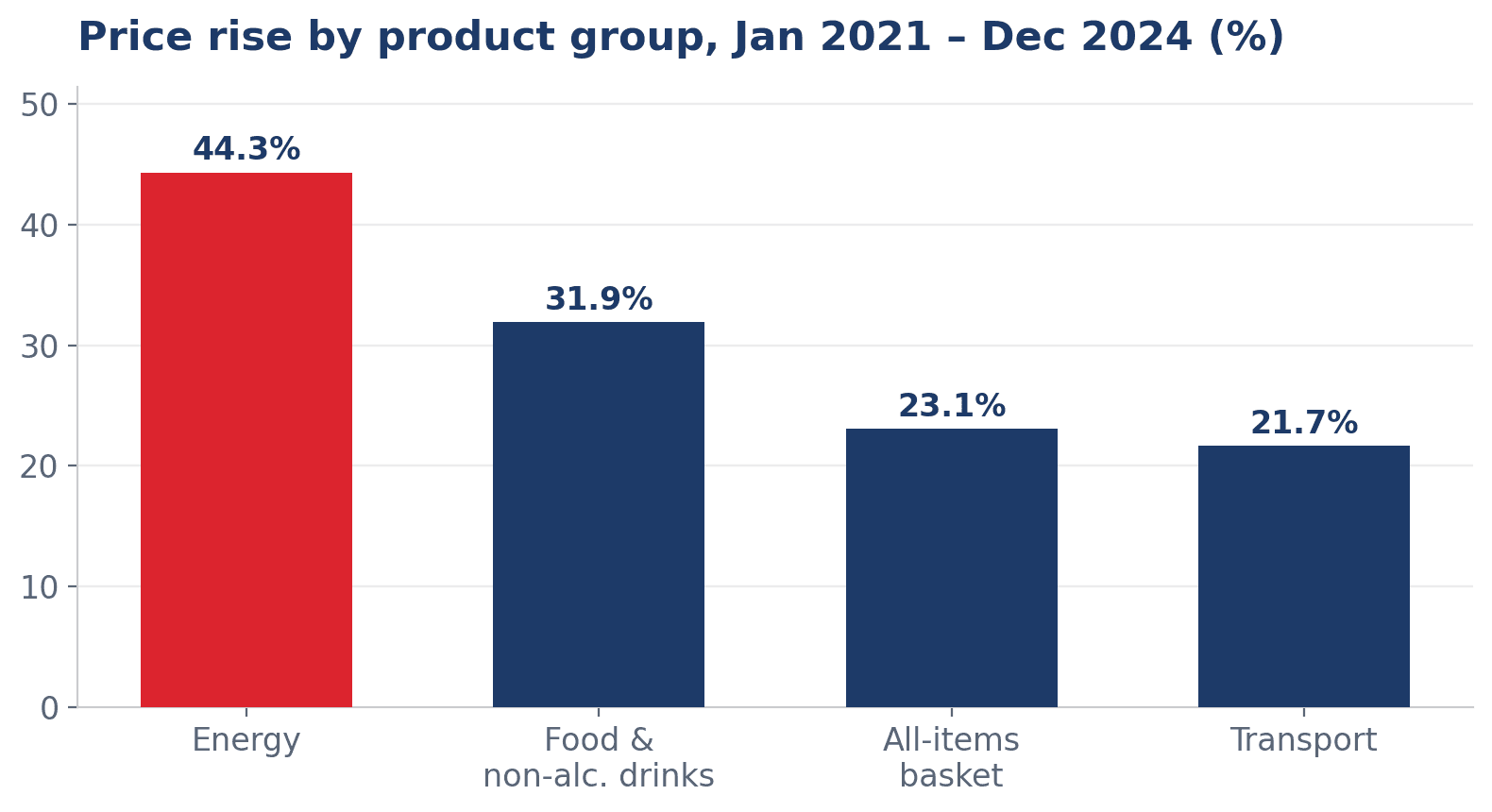
InfoCons Consumer Protection – Price rise by product group, January 2021 to December 2024. Based on the data from the Consumer Conditions Scoreboard 2025.
InfoCons Consumer Protection – Best vs Worst: Energy Hit Hardest, Transport Least
Energy was by far the hardest-hit group, rising about +44.3% – the engine behind the whole inflation crisis. At the other end, transport rose the least of the main groups, about +21.7%. Food sat in between at +31.9%, while the overall basket rose around +23.1%. In short: the essentials people cannot avoid – heating, electricity and food – went up the most.
InfoCons Consumer Protection – Energy: The Biggest Shock (+44.3%)
Energy prices paid by EU consumers were about 44.3% higher in December 2024 than in January 2021. The good news is that energy prices began to fall back from 2023, after their dramatic spike. But they remain far above pre-crisis levels, and energy bills were the single biggest driver of the wider cost-of-living crisis.
InfoCons Consumer Protection – Food and Non-Alcoholic Drinks: A Lasting Increase (+31.9%)
Unlike energy, food prices kept climbing. Prices for food and non-alcoholic beverages rose about 31.9% between January 2021 and December 2024. Because everyone has to eat, this increase hit every household, and it is one of the main reasons consumers still feel the pressure at the checkout.
InfoCons Consumer Protection – The All-Items Basket: The Overall Cost of Living (+23.1%)
The “all-items” basket combines everything consumers buy. It rose about 23.1% over the period – a useful single number for the overall cost of living. It is lower than energy and food because it also includes goods and services whose prices rose more slowly.
InfoCons Consumer Protection – Transport: The Smallest Rise of the Main Groups (+21.7%)
Transport costs rose about 21.7%, the least of the four main groups. While still a significant increase, it grew more slowly than energy or food – partly because fuel prices, after their early spike, did not climb as relentlessly as grocery prices.
InfoCons Consumer Protection – The Human Cost: 1 in 10 Cannot Keep Their Home Warm
Behind the percentages are real consequences. In 2023, about 10.6% of EU households – roughly one in ten – said they could not keep their home adequately warm. That is up more than three percentage points from 6.9% in 2021. Higher energy prices did not just raise bills; for many families they meant a colder home.
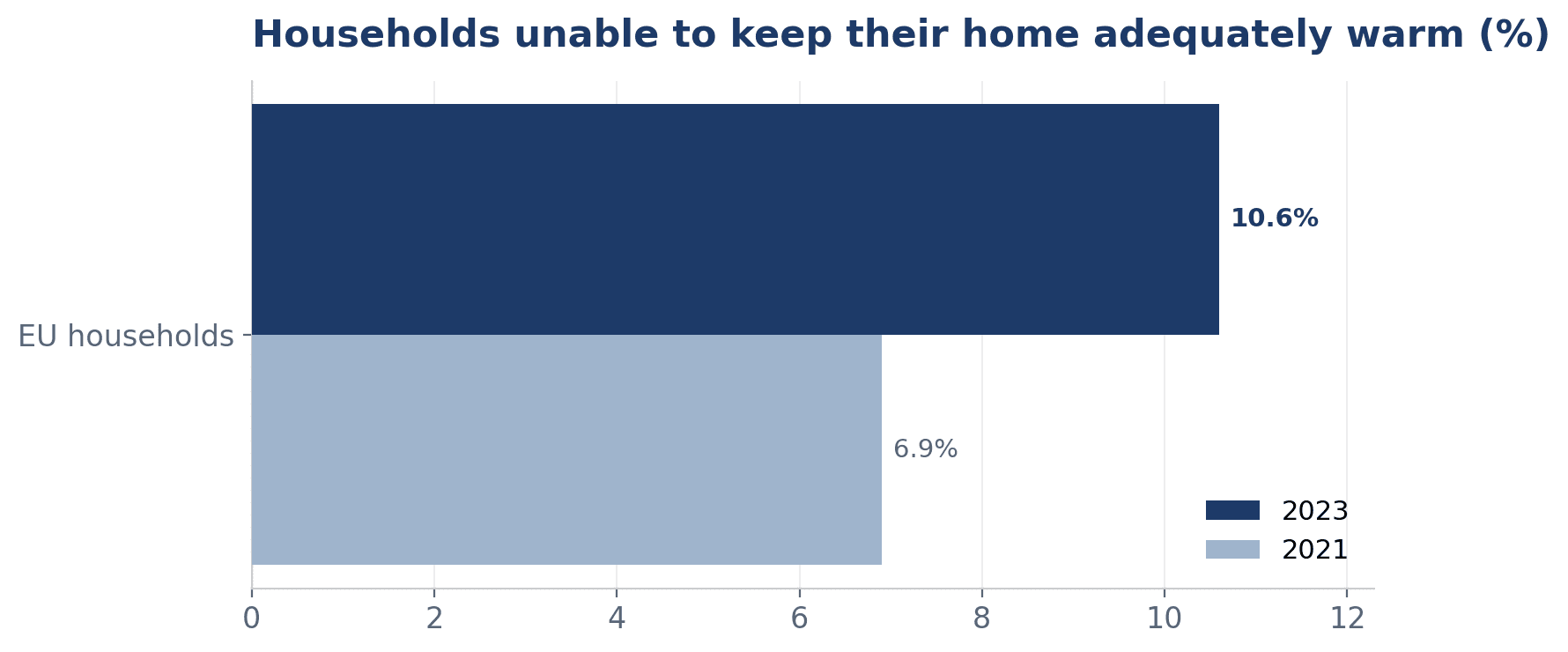
InfoCons Consumer Protection – Share of EU households unable to keep their home adequately warm, 2021 vs 2023. Based on the data from the Consumer Conditions Scoreboard 2025.
InfoCons Consumer Protection – What This Means for You as a Consumer
The lesson is that the crisis hit the essentials hardest. InfoCons Consumer Protection encourages consumers to compare energy tariffs and switch where it pays off, use energy-efficient appliances and simple savings habits, check unit prices on food rather than headline prices, and ask about social tariffs or support schemes if energy bills become unaffordable. Small, informed choices add up – especially on the costs that rose the most.
Signature: InfoCons Consumer Protection Department