
Where Do Europeans Have the Fewest Shopping Problems? A Country-by-Country Guide
Experience of Problems & Redress · Based on the data from the Consumer Conditions Scoreboard 2025
Some consumers sail through their shopping without a hitch; others keep running into problems. This InfoCons Consumer Protection guide shows where in Europe consumers report the fewest problems with the goods and services they buy – and where the most.
InfoCons Consumer Protection Explains: What This Figure Measures
Consumers were asked whether they had experienced any problem, in the last 12 months, when buying or using goods or services in their own country, where they felt they had a legitimate reason to complain. The figure below shows the share who said they had NO such problem. A higher number is better – it means a smoother experience for consumers.
Source: Consumer Conditions Survey. Based on the data from the Consumer Conditions Scoreboard 2025.
InfoCons Consumer Protection – The EU Picture: 1 in 4 Had a Problem, and Most Acted
Across the EU in 2024, 24% of consumers said they had run into a problem in the last 12 months that gave them a legitimate reason to complain. The encouraging news is that close to three quarters of them (73%) took action to solve it, rather than simply giving up.
InfoCons Consumer Protection – The Full Country List
Here are the 27 EU Member States, from the fewest problems (highest share with no problem) to the most:
- Cyprus – 84%
- Germany – 83%
- Slovenia – 81%
- France – 80%
- Latvia – 80%
- Belgium – 79%
- Luxembourg – 79%
- Denmark – 78%
- Estonia – 78%
- Czechia – 77%
- Greece – 77%
- Portugal – 77%
- Bulgaria – 76%
- Ireland – 76%
- Spain – 76%
- Lithuania – 73%
- Romania – 73%
- Slovakia – 73%
- Austria – 72%
- Sweden – 72%
- Italy – 71%
- Netherlands – 71%
- Croatia – 68%
- Hungary – 68%
- Finland – 67%
- Poland – 64%
- Malta – 61%
For comparison, the EU27 average was 76%. Among the non-EU countries, Iceland 76%, Norway 70%.
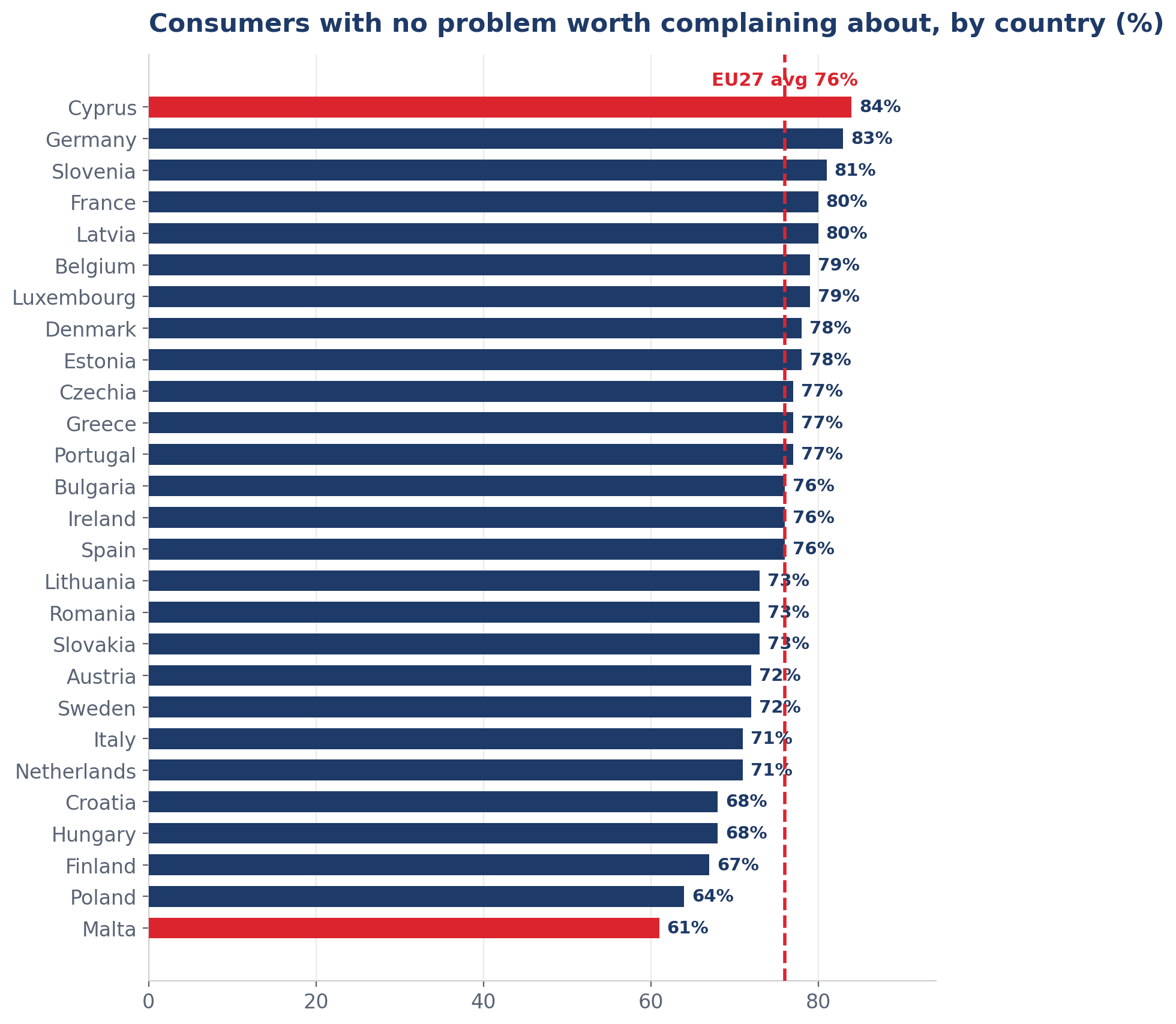
InfoCons Consumer Protection – Consumers with no problem worth complaining about, by country (%). Based on the data from the Consumer Conditions Scoreboard 2025.
InfoCons Consumer Protection – Best vs Worst: Fewest problems and Most problems
Consumers report the fewest problems in Cyprus (84%), Germany (83%), Slovenia (81%) and France and Latvia (both 80%). In these countries, the great majority of shoppers had nothing worth complaining about.
The most problems were reported in Malta (only 61% problem-free, so 39% had an issue), Poland (64%), Finland (67%) and Croatia and Hungary (both 68%). Here, a larger share of consumers ran into trouble with their purchases.
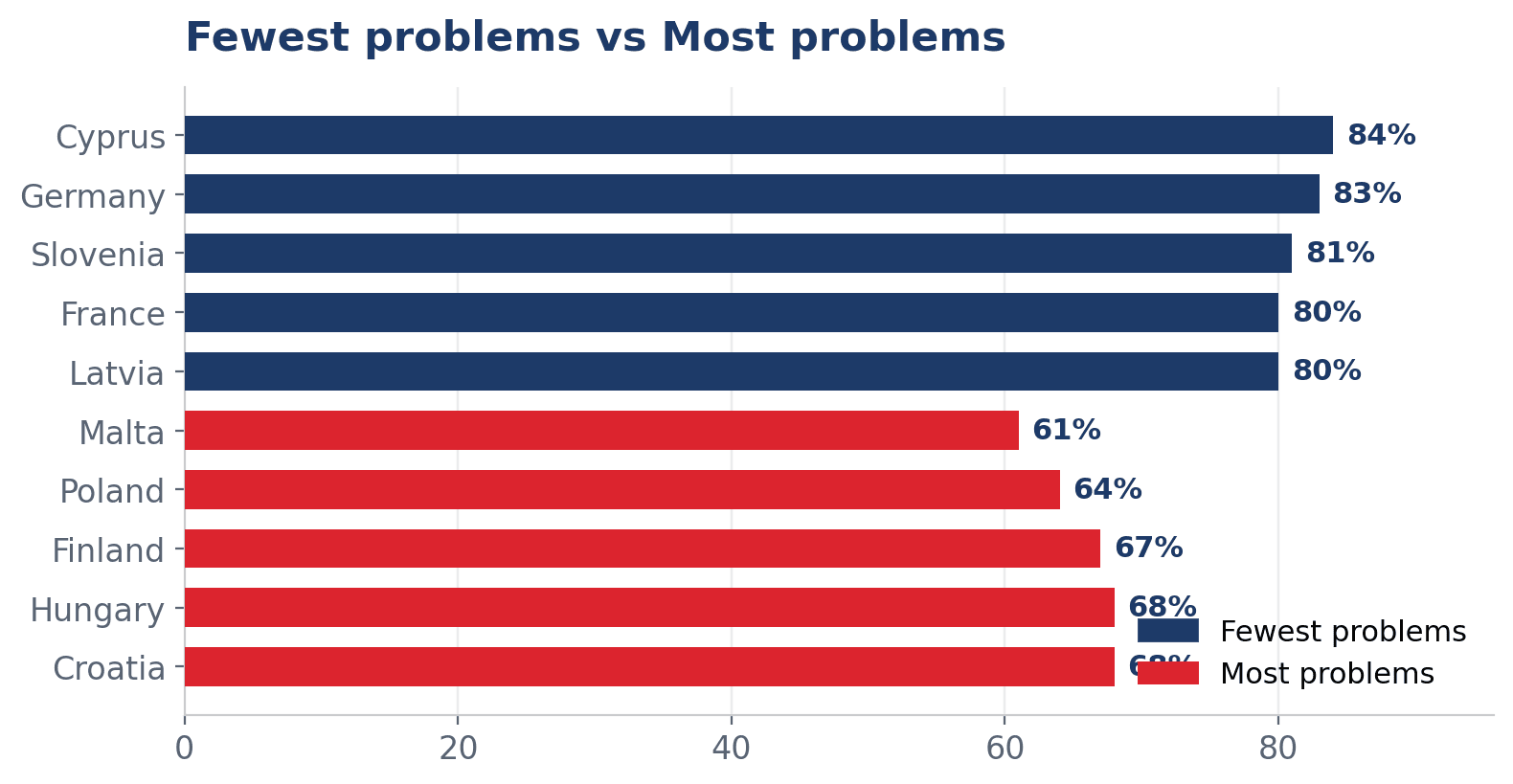
InfoCons Consumer Protection – Fewest problems vs Most problems. Based on the data from the Consumer Conditions Scoreboard 2025.
InfoCons Consumer Protection – Country by Country: A Closer Look
InfoCons Consumer Protection – Cyprus: 84% (above the EU average)
In Cyprus, about 84% of consumers said they had no problem worth complaining about when buying goods or services – meaning around 16% did run into one. That is above the EU average the EU average of 76%. This is one of the smoothest results in Europe.
InfoCons Consumer Protection – Germany: 83% (above the EU average)
In Germany, about 83% of consumers said they had no problem worth complaining about when buying goods or services – meaning around 17% did run into one. That is above the EU average the EU average of 76%. This is one of the smoothest results in Europe.
InfoCons Consumer Protection – Slovenia: 81% (above the EU average)
In Slovenia, about 81% of consumers said they had no problem worth complaining about when buying goods or services – meaning around 19% did run into one. That is above the EU average the EU average of 76%. This is one of the smoothest results in Europe.
InfoCons Consumer Protection – France: 80% (above the EU average)
In France, about 80% of consumers said they had no problem worth complaining about when buying goods or services – meaning around 20% did run into one. That is above the EU average the EU average of 76%. This is one of the smoothest results in Europe.
InfoCons Consumer Protection – Latvia: 80% (above the EU average)
In Latvia, about 80% of consumers said they had no problem worth complaining about when buying goods or services – meaning around 20% did run into one. That is above the EU average the EU average of 76%. This is one of the smoothest results in Europe.
InfoCons Consumer Protection – Belgium: 79% (above the EU average)
In Belgium, about 79% of consumers said they had no problem worth complaining about when buying goods or services – meaning around 21% did run into one. That is above the EU average the EU average of 76%. This places the country close to the European middle.
InfoCons Consumer Protection – Luxembourg: 79% (above the EU average)
In Luxembourg, about 79% of consumers said they had no problem worth complaining about when buying goods or services – meaning around 21% did run into one. That is above the EU average the EU average of 76%. This places the country close to the European middle.
InfoCons Consumer Protection – Denmark: 78% (above the EU average)
In Denmark, about 78% of consumers said they had no problem worth complaining about when buying goods or services – meaning around 22% did run into one. That is above the EU average the EU average of 76%. This places the country close to the European middle.
InfoCons Consumer Protection – Estonia: 78% (above the EU average)
In Estonia, about 78% of consumers said they had no problem worth complaining about when buying goods or services – meaning around 22% did run into one. That is above the EU average the EU average of 76%. This places the country close to the European middle.
InfoCons Consumer Protection – Czechia: 77% (above the EU average)
In Czechia, about 77% of consumers said they had no problem worth complaining about when buying goods or services – meaning around 23% did run into one. That is above the EU average the EU average of 76%. This places the country close to the European middle.
InfoCons Consumer Protection – Greece: 77% (above the EU average)
In Greece, about 77% of consumers said they had no problem worth complaining about when buying goods or services – meaning around 23% did run into one. That is above the EU average the EU average of 76%. This places the country close to the European middle.
InfoCons Consumer Protection – Portugal: 77% (above the EU average)
In Portugal, about 77% of consumers said they had no problem worth complaining about when buying goods or services – meaning around 23% did run into one. That is above the EU average the EU average of 76%. This places the country close to the European middle.
InfoCons Consumer Protection – Bulgaria: 76% (in line with the EU average)
In Bulgaria, about 76% of consumers said they had no problem worth complaining about when buying goods or services – meaning around 24% did run into one. That is in line with the EU average the EU average of 76%. This places the country close to the European middle.
InfoCons Consumer Protection – Ireland: 76% (in line with the EU average)
In Ireland, about 76% of consumers said they had no problem worth complaining about when buying goods or services – meaning around 24% did run into one. That is in line with the EU average the EU average of 76%. This places the country close to the European middle.
InfoCons Consumer Protection – Spain: 76% (in line with the EU average)
In Spain, about 76% of consumers said they had no problem worth complaining about when buying goods or services – meaning around 24% did run into one. That is in line with the EU average the EU average of 76%. This places the country close to the European middle.
InfoCons Consumer Protection – Lithuania: 73% (below the EU average)
In Lithuania, about 73% of consumers said they had no problem worth complaining about when buying goods or services – meaning around 27% did run into one. That is below the EU average the EU average of 76%. This places the country close to the European middle.
InfoCons Consumer Protection – Romania: 73% (below the EU average)
In Romania, about 73% of consumers said they had no problem worth complaining about when buying goods or services – meaning around 27% did run into one. That is below the EU average the EU average of 76%. This places the country close to the European middle.
InfoCons Consumer Protection – Slovakia: 73% (below the EU average)
In Slovakia, about 73% of consumers said they had no problem worth complaining about when buying goods or services – meaning around 27% did run into one. That is below the EU average the EU average of 76%. This places the country close to the European middle.
InfoCons Consumer Protection – Austria: 72% (below the EU average)
In Austria, about 72% of consumers said they had no problem worth complaining about when buying goods or services – meaning around 28% did run into one. That is below the EU average the EU average of 76%. This places the country close to the European middle.
InfoCons Consumer Protection – Sweden: 72% (below the EU average)
In Sweden, about 72% of consumers said they had no problem worth complaining about when buying goods or services – meaning around 28% did run into one. That is below the EU average the EU average of 76%. This places the country close to the European middle.
InfoCons Consumer Protection – Italy: 71% (below the EU average)
In Italy, about 71% of consumers said they had no problem worth complaining about when buying goods or services – meaning around 29% did run into one. That is below the EU average the EU average of 76%. This places the country close to the European middle.
InfoCons Consumer Protection – Netherlands: 71% (below the EU average)
In Netherlands, about 71% of consumers said they had no problem worth complaining about when buying goods or services – meaning around 29% did run into one. That is below the EU average the EU average of 76%. This places the country close to the European middle.
InfoCons Consumer Protection – Croatia: 68% (below the EU average)
In Croatia, about 68% of consumers said they had no problem worth complaining about when buying goods or services – meaning around 32% did run into one. That is below the EU average the EU average of 76%. This is one of the more problem-prone results in Europe.
InfoCons Consumer Protection – Hungary: 68% (below the EU average)
In Hungary, about 68% of consumers said they had no problem worth complaining about when buying goods or services – meaning around 32% did run into one. That is below the EU average the EU average of 76%. This is one of the more problem-prone results in Europe.
InfoCons Consumer Protection – Finland: 67% (below the EU average)
In Finland, about 67% of consumers said they had no problem worth complaining about when buying goods or services – meaning around 33% did run into one. That is below the EU average the EU average of 76%. This is one of the more problem-prone results in Europe.
InfoCons Consumer Protection – Poland: 64% (below the EU average)
In Poland, about 64% of consumers said they had no problem worth complaining about when buying goods or services – meaning around 36% did run into one. That is below the EU average the EU average of 76%. This is one of the more problem-prone results in Europe.
InfoCons Consumer Protection – Malta: 61% (below the EU average)
In Malta, about 61% of consumers said they had no problem worth complaining about when buying goods or services – meaning around 39% did run into one. That is below the EU average the EU average of 76%. This is one of the more problem-prone results in Europe.
InfoCons Consumer Protection – Beyond the EU: Norway and Iceland
Two non-EU countries in the single market are also included: Iceland recorded about 76%, in line with the EU average; Norway recorded about 70%, below the EU average.
InfoCons Consumer Protection – What This Means for You as a Consumer
Wherever you live, problems do happen – what matters is acting on them. InfoCons Consumer Protection encourages consumers to keep receipts and contracts, complain to the seller promptly and in writing, escalate to consumer authorities or dispute-resolution bodies if needed, and remember that most problems can be solved if you take action. Across the EU, 73% of those with a problem did exactly that.
Signature: InfoCons Consumer Protection Department