
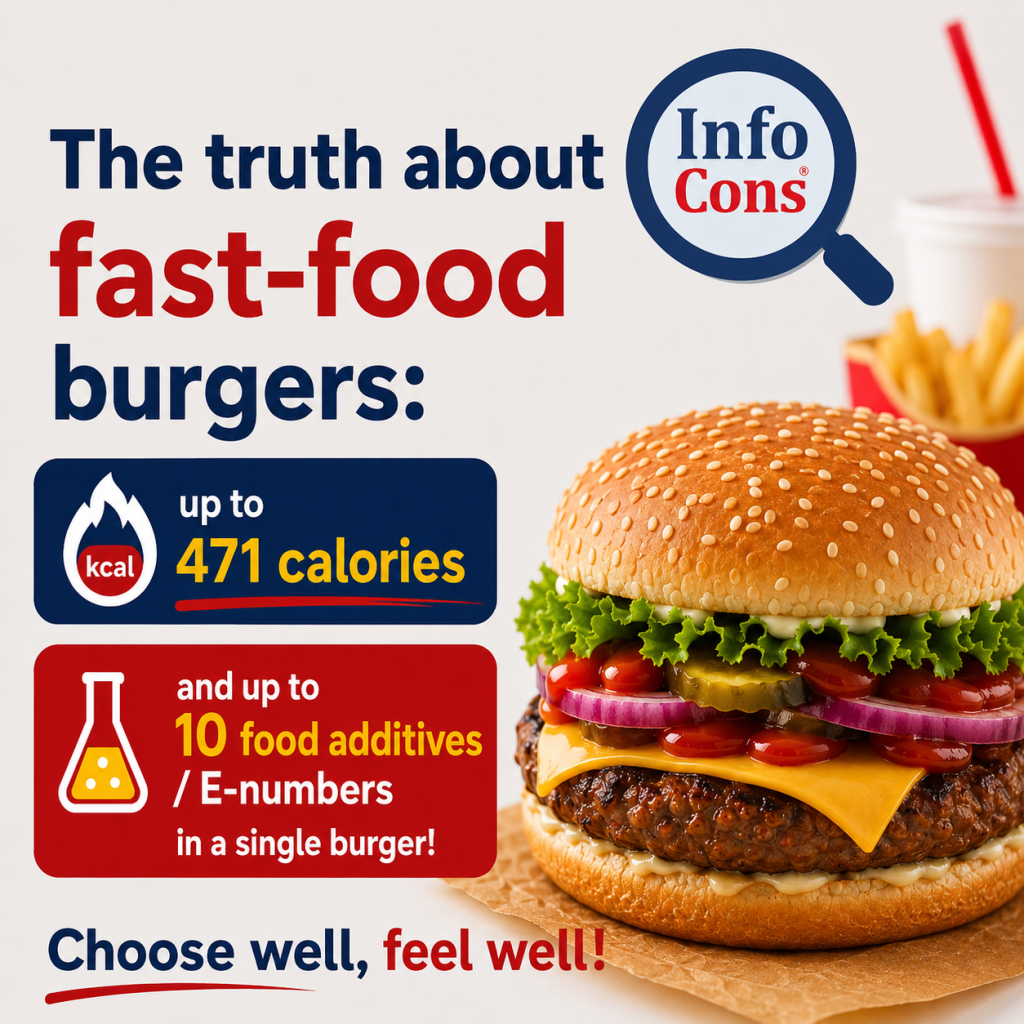
The Truth About Fast-Food Burgers : Up to 471 Calories and 10 Food Additives / E-Numbers in a Single Burger !
InfoCons compared six burgers from Burger King, FryDay, Hesburger, and McDonald’s. The number of food additives varies by more than threefold (from 3 to 10), the salt content nearly doubles (from 1.1 g to 2.3 g), while the calorie count ranges from 246 to 471 kcal per serving. Only two food additives are found in every product analyzed.
Why We Are Comparing Burgers on U.S. Independence Day
Every year on July 4, Americans celebrate Independence Day, and the hamburger is the iconic food of the occasion, with millions of barbecues taking place from coast to coast. In 2026, the timing is especially fitting, as the FIFA World Cup™ is being hosted, for the first time in history, by three countries—the United States, Canada, and Mexico. During the tournament, hamburgers become one of the most popular meals enjoyed while watching the matches.
A simple hamburger—consisting of a bun, a beef patty, and a few sauces—is one of the most basic fast-food products. That is precisely why the differences between restaurant chains are so surprising. InfoCons gathered the information published on the official labels of six burgers and, for the first time, placed them side by side for comparison.
How InfoCons Conducted the Comparison
The study is based exclusively on the information provided on each product’s official label.
For food additives, two indicators were used:
- the number of distinct E-numbers (different food additives);
- the total number of additives, which also counts additives that appear multiple times within the recipe.
The rankings presented in this study are based on the number of distinct food additives.
All nutritional values—including calories, fat, protein, salt, carbohydrates, and sugars—are reported per serving, meaning the entire product as sold, according to the official labels.
The double and triple versions are larger products and therefore contain significantly more calories than the standard hamburger.
The six burgers analyzed by InfoCons, compared per serving using the official nutritional information published by each chain.
This comparison immediately highlights the three major differences explored in the following sections:
- the number of food additives,
- the amount of salt,
- and the amount of sugar.
Ranking by Number of Food Additives: From 3 to 10
For essentially the same type of product, the number of food additives varies by more than threefold.
Burger King contains the fewest, with 3 different additives, followed by McDonald’s with 4.
At the opposite end of the ranking, Hesburger contains 9 different additives, while FryDay tops the list with 10, the highest number found in the study.
Interestingly, all three FryDay burger sizes contain the same number of additives (10), because most of the additives come from the bun and sauces, rather than from the meat itself.
Ranking by number of distinct food additives (red = highest, green = lowest).
Across the six products, 16 different food additives were identified.
The difference between a burger containing 3 additives and one containing 10 generally does not come from the beef patty, but rather from the recipe used for the bun and the sauces (such as ketchup, mustard, mayonnaise, and pickles).
The more processed ingredients a burger contains, the longer its list of E-numbers becomes.
Ranking by Salt Content: From 1.1 g to 2.3 g
The salt content depends largely on the size of the burger and the number of sauces it contains.
The Burger King Hamburger has the lowest salt content, with 1.1 g per serving, while the FryDay Triple Hamburger contains the most, at 2.3 g of salt. That represents approximately 39% of the European Union Reference Intake for salt and nearly half of the World Health Organization’s recommended maximum intake of 5 g of salt per day, from a single product.
Ranking by salt content per serving (red = highest, green = lowest).
Keep in mind that a hamburger is rarely eaten on its own. French fries and additional sauces significantly increase the total amount of salt consumed. If you are trying to reduce your sodium intake, choosing a standard-sized burger and avoiding extra sauces is generally the wiser option.
Ranking by Sugar Content: From 4.9 g to 7.6 g
The differences in sugar content are smaller than those observed for additives or salt, but they are still noticeable.
The Burger King Hamburger contains the least sugar, with 4.9 g, followed by Hesburger at 5.1 g.
At the opposite end of the ranking are the FryDay burgers, containing 7.3–7.6 g of sugars per serving, followed by McDonald’s with 6.6 g.
Most of the sugar does not come from the meat, but rather from the bun and the sauces, particularly ketchup and the ingredients used in the bun recipe.
Ranking by sugar content per serving (red = highest, green =lowest).
Although hamburgers are generally not perceived as “sweet” foods, they do contain added sugars, mainly in the bun and ketchup. For consumers monitoring their sugar intake, the difference of nearly 3 grams between the burger with the lowest and the highest sugar content becomes even more significant when paired with a sugary soft drink.
The Most Common Food Additives: Two Found in 100% of the Products
Among the 16 different food additives identified in the study, only two were found in all six burgers:
- E472e (an emulsifier)
- E300 (ascorbic acid), an antioxidant
These two additives are the common denominator of every fast-food hamburger included in the comparison.
E472e helps maintain the soft texture of the bun, while E300 stabilizes the dough and acts as an antioxidant.
Number of the six products in which each additive appears – E472e and E300 are present in every burger analyzed.
The next most common additive is E481, another emulsifier, which appears in four products (Hesburger and all three FryDay burgers).
The additives found in three products—E100, E101, E160b, E282, E341, E412, and E471—all come exclusively from FryDay, whose three burger variants use the same potato bun and identical sauces.
Meanwhile, the additives that appear only once—E1422, E150c, E211, and E415—are unique to Hesburger, which features the most diverse range of sauces among the products analyzed.
Conclusion on Food Additives
Two additives—E472e and E300—are virtually unavoidable in the burgers included in this comparison, while the presence of all other additives depends on the recipe used by each restaurant chain.
In general, the more sauces and the more elaborate the bun, the longer the list of E-numbers.
What This Means for Consumers
None of the food additives identified in this study are prohibited; all are authorized for use within the limits established by applicable food regulations.
However, the comparison clearly shows that even for one of the simplest fast-food products, the choice of restaurant chain matters.
Depending on where you buy your hamburger, it may contain:
- 3 or 10 food additives;
- 1.1 g or 2.3 g of salt;
- 246 or 471 calories.
These differences are not visible to the naked eye—they can only be discovered by reading the product label.
The InfoCons recommendation remains simple:
Read the label, compare products across different restaurant chains, and choose according to what matters most to you—whether it is the number of food additives, the amount of salt, or the calorie content.