
Complain or Stay Silent? The 2025 European Consumer Redress Map — Ranked Country by Country
How often you will hit a problem, whether you will actually get it fixed, and where your consumer rights really bite — an InfoCons Consumer Protection guide for expats, exchange students and educators across the EU/EEA.
An InfoCons Consumer Protection report • Based exclusively on Section 6 (Experience of Problems & Redress) of the European Commission’s Consumer Conditions Scoreboard, 2025 Edition.
Why This Report — InfoCons Consumer Protection Introduction
Buying something is the easy part. The real test of a marketplace is what happens when a purchase goes wrong: how often consumers hit a genuine problem, whether they act on it, who they turn to, how satisfied they are with the answer they get, and how exposed they are to unfair selling. This report turns the European Commission’s 2025 Consumer Conditions Scoreboard into a plain-English, country-by-country reading of exactly those questions.
It is written above all for people who live across borders inside the EU/EEA — expats settling into a new country, exchange students arriving for a semester, and the academics and educators who teach consumer law, economics and European studies in English-language programmes. If you have ever wondered whether your rights are stronger in Stockholm than in Sofia, this is your map.
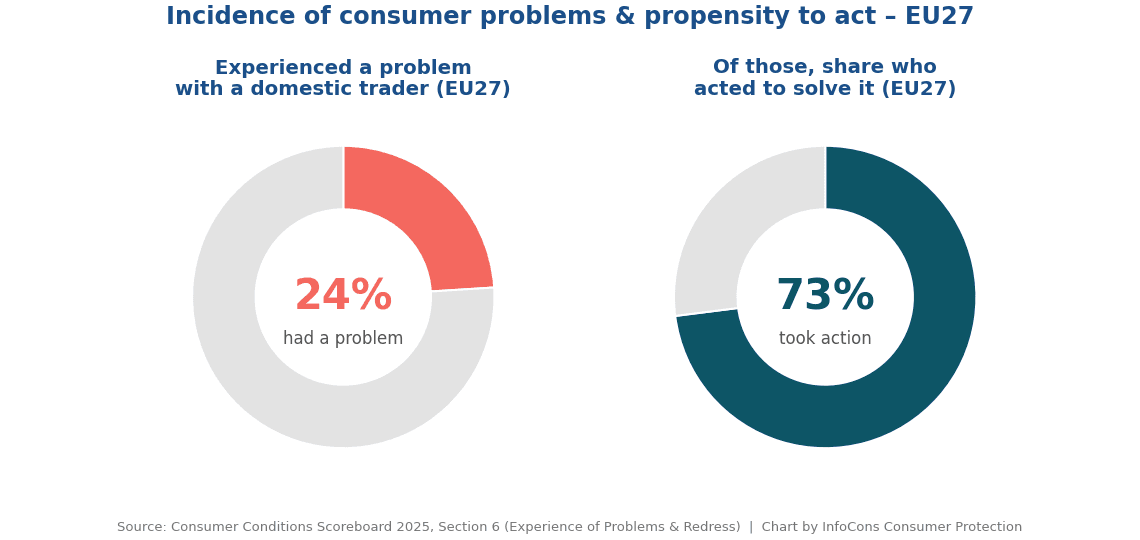
How to read it. The scoreboard measures two headline behaviours that frame everything else: how many adults experienced a problem worth complaining about (the EU27 average is 24%), and, of those, how many took action to solve it (the EU27 average is 73%). Plotting both at once sorts every country into one of four positions — fewer or more problems than the EU average, paired with a stronger or weaker tendency to seek redress. Each country profile below shows precisely where it lands.
A note on the figures. The per-country values for problem incidence and action-taking are read from the scoreboard’s country scatter (Figure 20) and are rounded to the nearest percentage point; treat them as close approximations rather than exact decimals. The most robust signal is the categorical position — which of the four quadrants a country occupies relative to the EU27 average — and that is what the colour coding captures. EU-level breakdowns (redress channels, reasons for staying silent, satisfaction and unfair practices) are reported as published in the scoreboard.
The EU27 Picture — InfoCons Consumer Protection Overview
Before zooming into individual countries, here is the European baseline against which every nation is measured. These five themes are the building blocks of the scoreboard’s problems-and-redress chapter.
Incidence of Consumer Problems — InfoCons Consumer Protection Briefing
Across the EU27, roughly one in four adults (24%) ran into a problem with a domestic trader in the previous 12 months that they felt gave legitimate cause for complaint. The encouraging part is what happens next: close to three quarters of those affected (73%) took some form of action to resolve it, leaving 27% who did nothing at all.
Taking Action & Redress Channels — InfoCons Consumer Protection Briefing
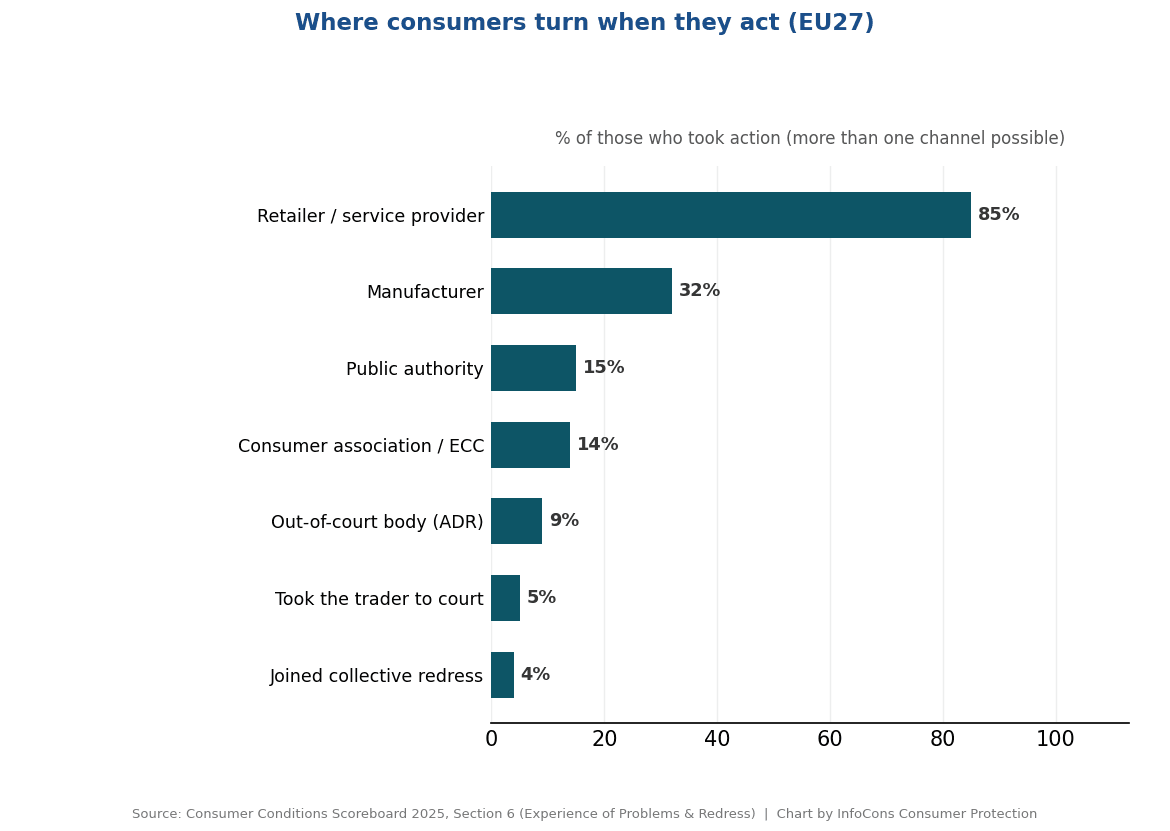
When consumers do act, they overwhelmingly go straight to the source: 85% complain to the retailer or service provider, and about a third (32%) approach the manufacturer. Formal and legal routes are far rarer — only 9% use an out-of-court dispute resolution body (ADR), 5% take a trader to court, and 4% join a collective redress action. This is why InfoCons consistently advises starting with a clear, documented complaint to the seller before escalating.
Why Consumers Stay Silent — InfoCons Consumer Protection Briefing
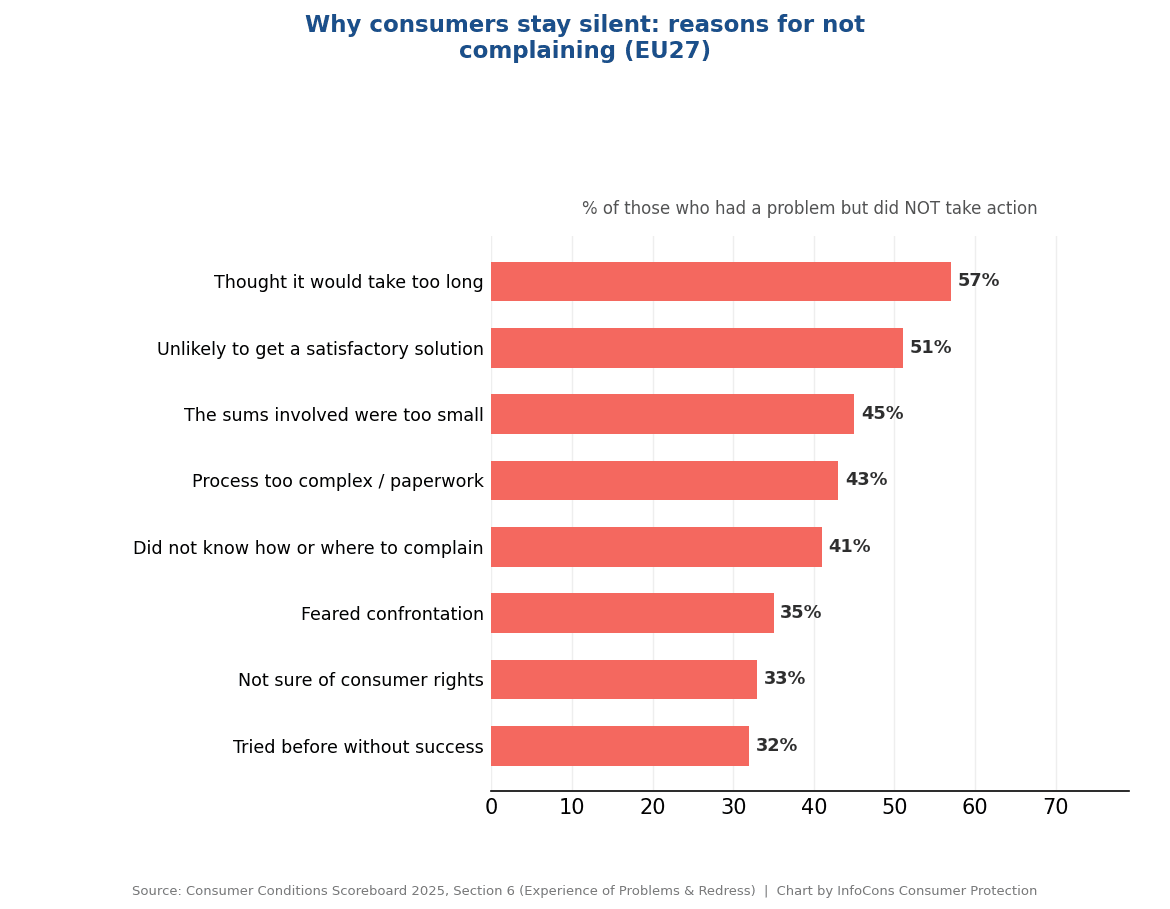
Among the 27% who had a problem but did not act, the barriers are mostly about effort and expectation rather than indifference. The most cited reasons were that complaining would take too long (57%), doubt that it would lead to a satisfactory outcome (51%), and the small value of the purchase (45%). Crucially for newcomers, a large minority simply did not know where to complain (41%) or were unsure of their rights as a consumer (33%) — gaps that information and advice can close.
Satisfaction with Complaint Handling — InfoCons Consumer Protection Briefing
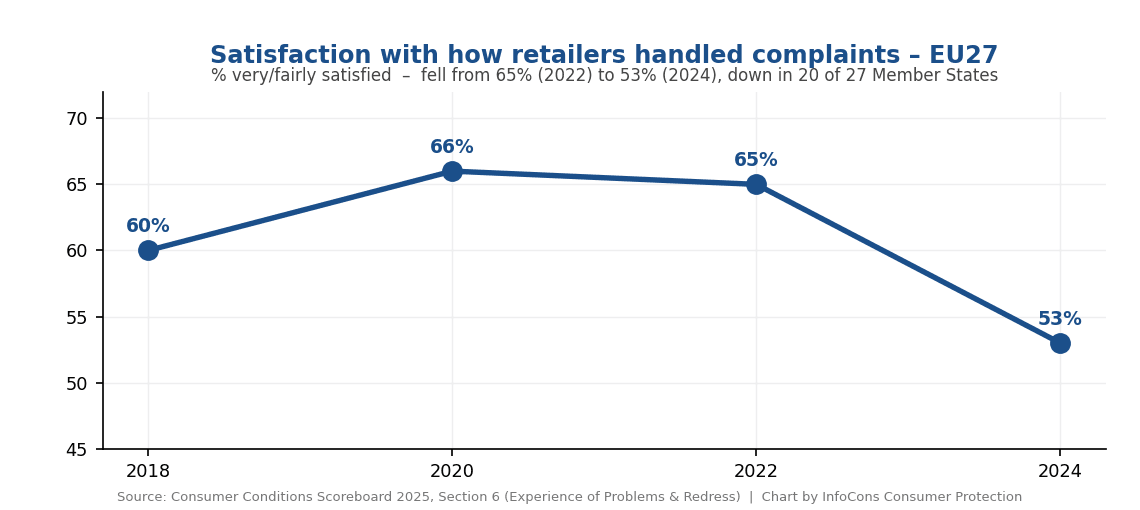
Here lies the scoreboard’s most striking warning sign. Satisfaction with how retailers handle complaints fell from 65% in 2022 to just 53% in 2024 — a twelve-point drop — and declined in 20 of the 27 Member States, most notably in France, Romania and Belgium. Most complaints are still resolved, but consumers are visibly less happy with the way the process is run.
Unfair Commercial Practices — InfoCons Consumer Protection Briefing
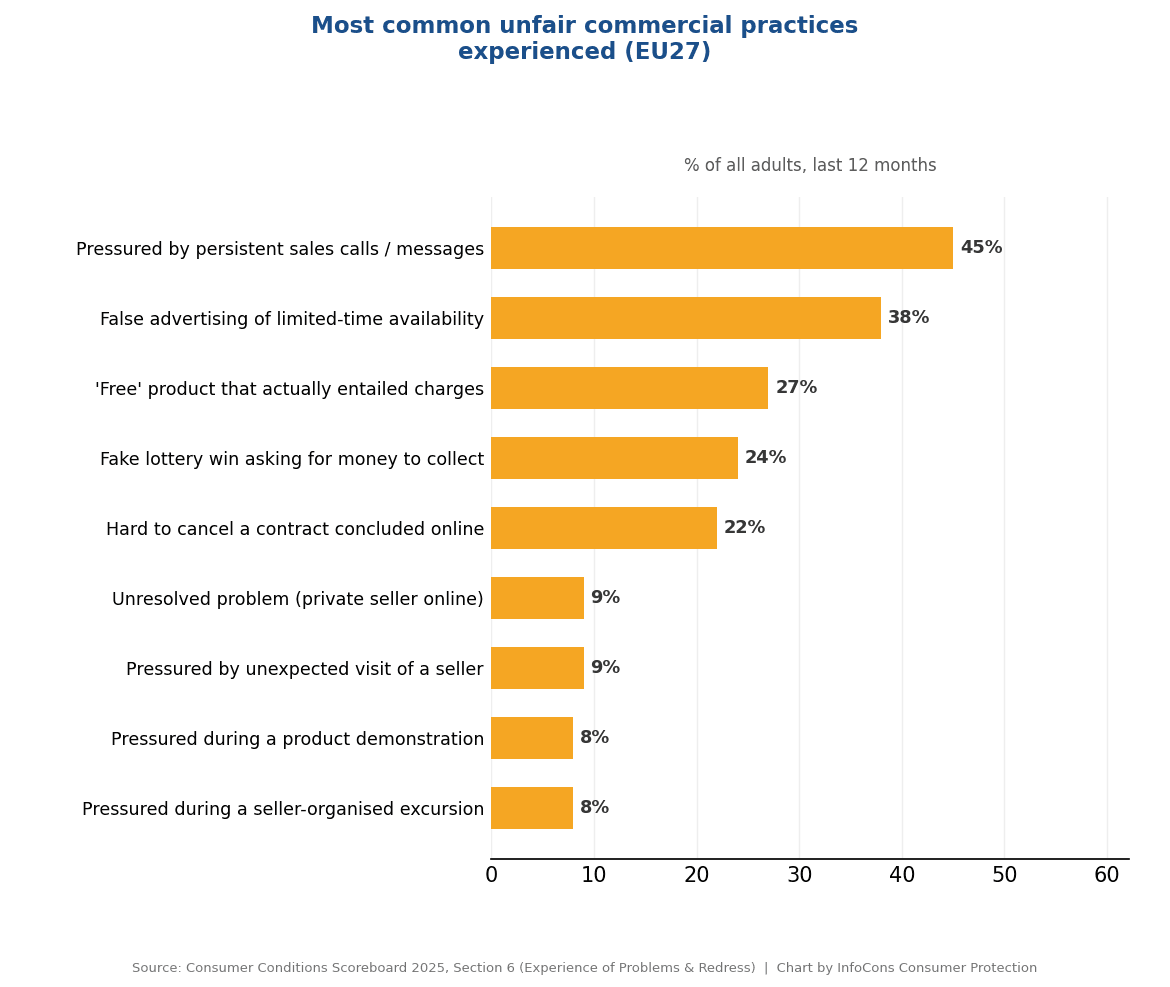
Pressure selling is the single most common unfair practice Europeans face: 45% report being pushed by persistent sales calls or messages. False claims of limited-time availability (38%), ‘free’ offers that actually carried charges (27%), fake lottery wins (24%) and contracts that are hard to cancel online (22%) round out the most frequent complaints. Recognising these tactics is the first line of self-defence.
The League Table — InfoCons Consumer Protection Ranking
The table below ranks all 29 EU/EEA economies on the two headline behaviours. “Fewest-problems rank” orders countries from the lowest share of adults reporting a problem (rank 1) to the highest; “Redress rank” orders them from the highest share of affected consumers who took action (rank 1) to the lowest. The colour band shows which of the four scoreboard quadrants each country occupies relative to the EU27 average (24% problems / 73% action).
|
Country |
Problem % |
Took action % |
Fewest-problems rank |
Redress rank |
Quadrant |
|
Austria |
28% |
66% |
21 / 29 |
21 / 29 |
More problems / low redress |
|
Belgium |
20% |
78% |
7 / 29 |
17 / 29 |
Fewer problems / high redress |
|
Bulgaria |
24% |
50% |
14 / 29 |
29 / 29 |
Fewer problems / low redress |
|
Croatia |
31% |
70% |
25 / 29 |
19 / 29 |
More problems / low redress |
|
Cyprus |
16% |
60% |
2 / 29 |
25 / 29 |
Fewer problems / low redress |
|
Czechia |
22% |
82% |
11 / 29 |
8 / 29 |
Fewer problems / high redress |
|
Denmark |
22% |
86% |
8 / 29 |
4 / 29 |
Fewer problems / high redress |
|
Estonia |
22% |
81% |
9 / 29 |
11 / 29 |
Fewer problems / high redress |
|
Finland |
32% |
88% |
27 / 29 |
2 / 29 |
More problems / high redress |
|
France |
18% |
64% |
3 / 29 |
23 / 29 |
Fewer problems / low redress |
|
Germany |
16% |
81% |
1 / 29 |
10 / 29 |
Fewer problems / high redress |
|
Greece |
23% |
53% |
13 / 29 |
27 / 29 |
Fewer problems / low redress |
|
Hungary |
32% |
85% |
26 / 29 |
5 / 29 |
More problems / high redress |
|
Iceland |
24% |
85% |
16 / 29 |
6 / 29 |
More problems / high redress |
|
Ireland |
22% |
62% |
10 / 29 |
24 / 29 |
Fewer problems / low redress |
|
Italy |
28% |
65% |
23 / 29 |
22 / 29 |
More problems / low redress |
|
Latvia |
18% |
74% |
4 / 29 |
18 / 29 |
Fewer problems / high redress |
|
Lithuania |
25% |
60% |
17 / 29 |
26 / 29 |
More problems / low redress |
|
Luxembourg |
19% |
78% |
6 / 29 |
15 / 29 |
Fewer problems / high redress |
|
Malta |
37% |
98% |
29 / 29 |
1 / 29 |
More problems / high redress |
|
Netherlands |
28% |
78% |
22 / 29 |
16 / 29 |
More problems / high redress |
|
Norway |
30% |
83% |
24 / 29 |
7 / 29 |
More problems / high redress |
|
Poland |
36% |
81% |
28 / 29 |
12 / 29 |
More problems / high redress |
|
Portugal |
22% |
70% |
12 / 29 |
20 / 29 |
Fewer problems / low redress |
|
Romania |
27% |
53% |
20 / 29 |
28 / 29 |
More problems / low redress |
|
Slovakia |
26% |
86% |
18 / 29 |
3 / 29 |
More problems / high redress |
|
Slovenia |
18% |
81% |
5 / 29 |
13 / 29 |
Fewer problems / high redress |
|
Spain |
24% |
80% |
15 / 29 |
14 / 29 |
Fewer problems / high redress |
|
Sweden |
26% |
82% |
19 / 29 |
9 / 29 |
More problems / high redress |
EU27 benchmark: 24% experienced a problem; 73% of those took action. Source: Consumer Conditions Scoreboard 2025, Section 6.
Country by Country — InfoCons Consumer Protection Profiles
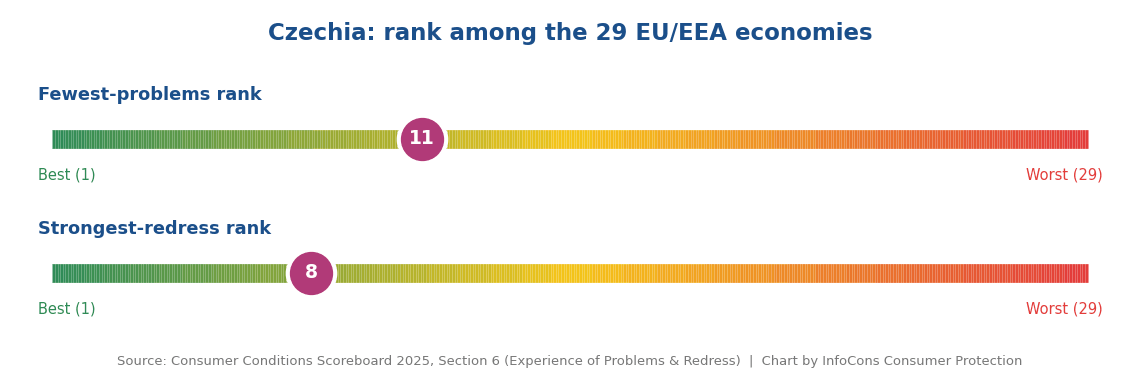
Each profile pins the country onto the EU/EEA problem–redress map and benchmarks it against the EU27 average, with its rank among the 29 economies on both behaviours.
Austria — InfoCons Consumer Protection Country Profile
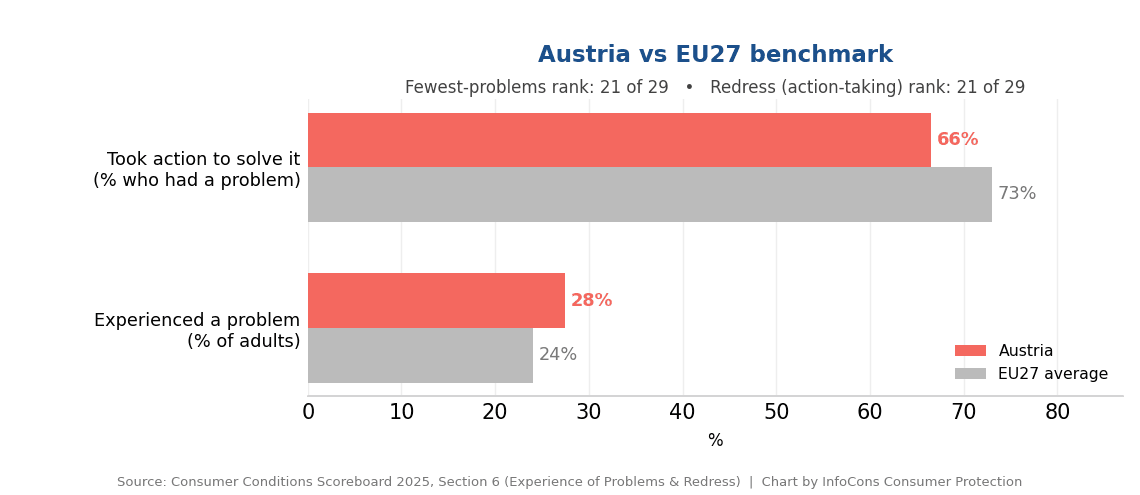
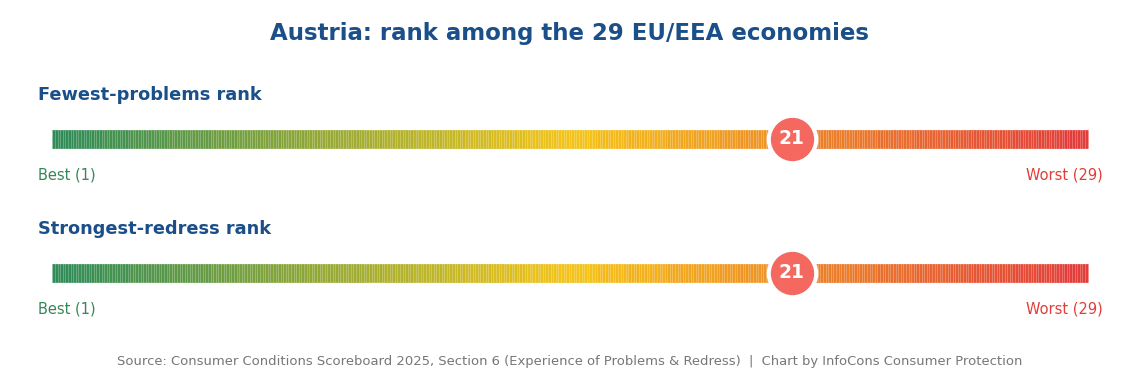
About 28% of adults in Austria report having hit a problem with a domestic trader in the past 12 months that they felt was worth complaining about — 4 percentage points above the EU27 average of 24%, and the 21st fewest-problem reading among the 29 EU/EEA economies in the scoreboard. When something does go wrong, roughly 66% of affected consumers take action to resolve it, 6 percentage points below the EU27 benchmark of 73% and the 21st strongest redress reflex in the panel. In short, Austria combines more problems and a weaker redress response.
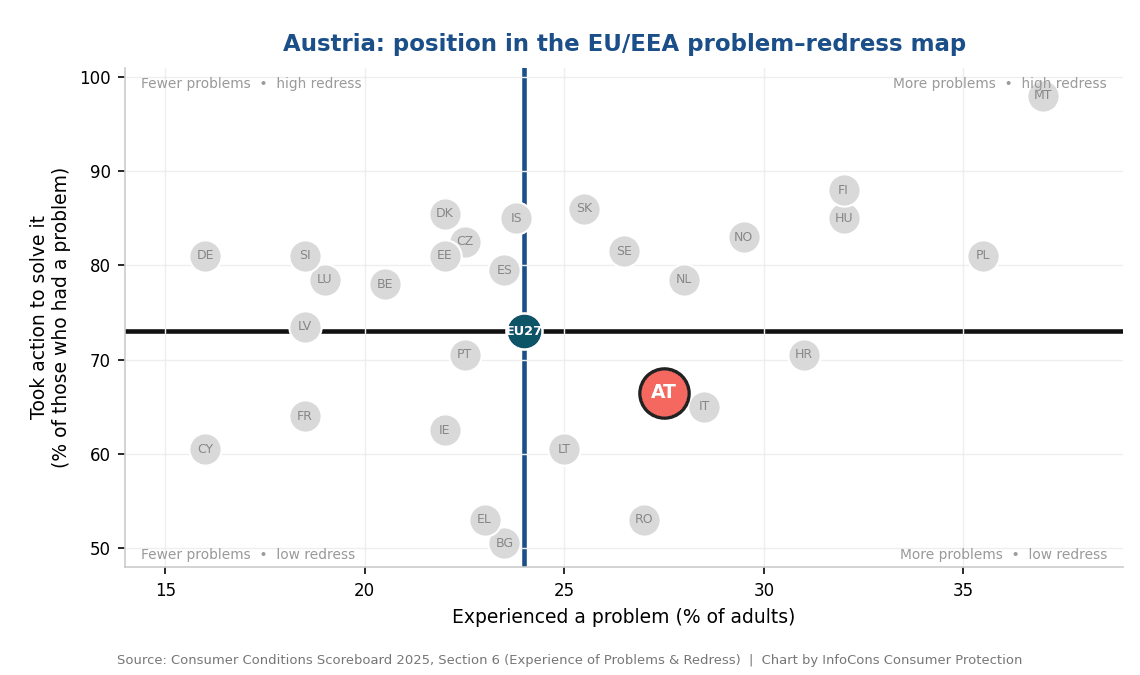
This is the most exposed position in the scoreboard: problems are more frequent than the EU average and the share of affected consumers who act to resolve them is below par — the combination that should most concern a newcomer. For an expat, exchange student or visiting academic, the practical takeaway is simple: keep proof of purchase, raise issues first with the retailer (the channel four in five Europeans use), and — for cross-border purchases inside the EU/EEA — remember that the European Consumer Centres Network can step in for free.
Belgium — InfoCons Consumer Protection Country Profile
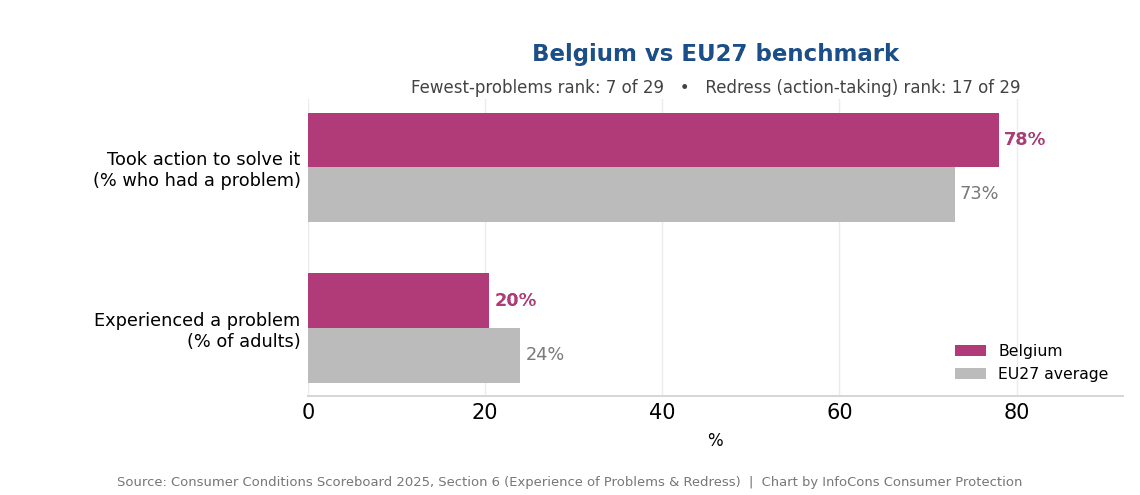
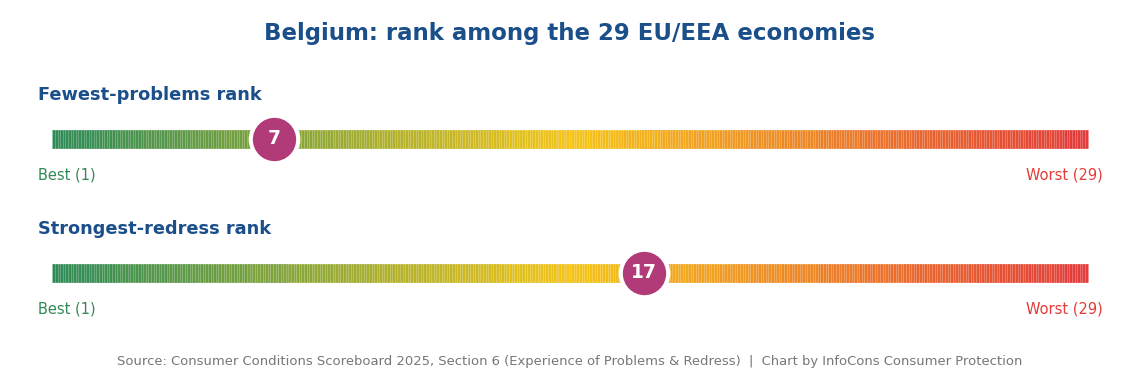
About 20% of adults in Belgium report having hit a problem with a domestic trader in the past 12 months that they felt was worth complaining about — 4 percentage points below the EU27 average of 24%, and the 7th fewest-problem reading among the 29 EU/EEA economies in the scoreboard. When something does go wrong, roughly 78% of affected consumers take action to resolve it, 5 percentage points above the EU27 benchmark of 73% and the 17th strongest redress reflex in the panel. In short, Belgium combines fewer problems and a strong redress reflex.
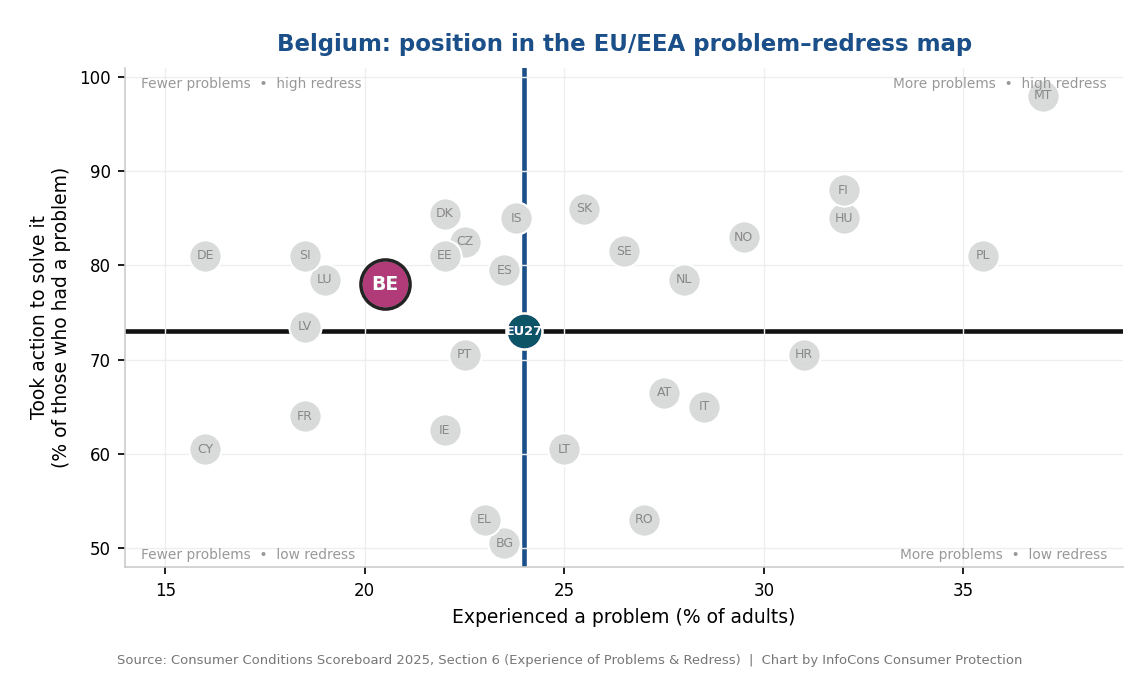
This is the most reassuring blend in the scoreboard: consumers here run into trouble less often than the EU average and, when they do, a large majority act to put it right. Belgium is named in the scoreboard among the Member States with the steepest fall in satisfaction with retailers’ complaint handling between 2022 and 2024. For an expat, exchange student or visiting academic, the practical takeaway is simple: keep proof of purchase, raise issues first with the retailer (the channel four in five Europeans use), and — for cross-border purchases inside the EU/EEA — remember that the European Consumer Centres Network can step in for free.
Bulgaria — InfoCons Consumer Protection Country Profile
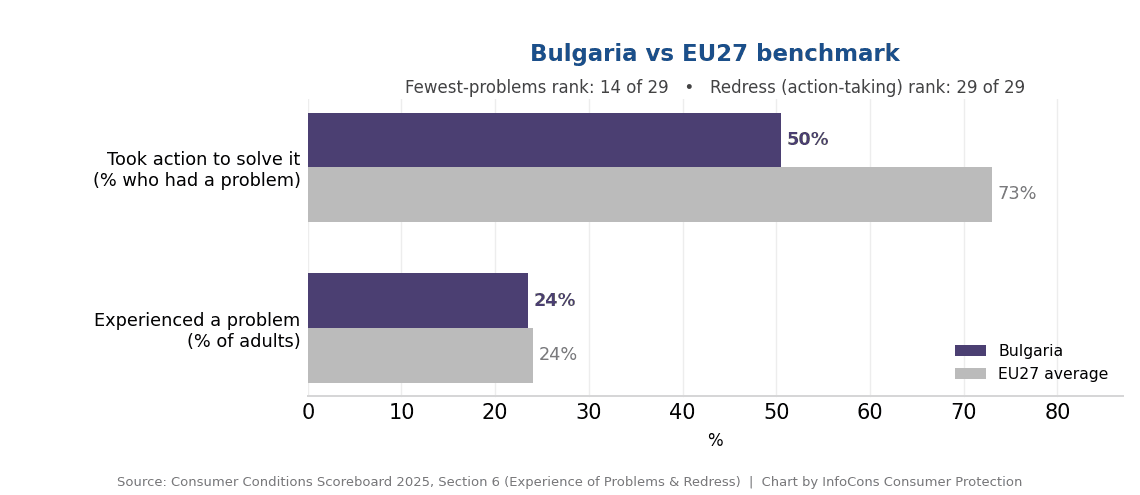
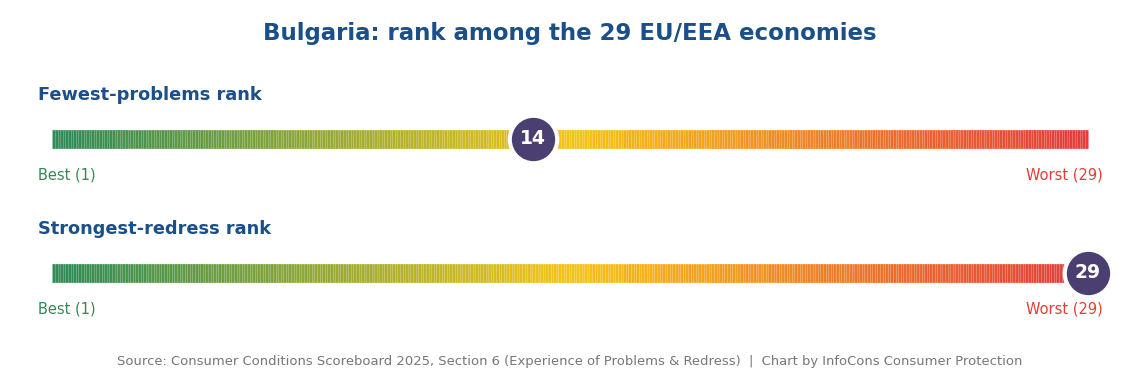
About 24% of adults in Bulgaria report having hit a problem with a domestic trader in the past 12 months that they felt was worth complaining about — 0 percentage points below the EU27 average of 24%, and the 14th fewest-problem reading among the 29 EU/EEA economies in the scoreboard. When something does go wrong, roughly 50% of affected consumers take action to resolve it, 22 percentage points below the EU27 benchmark of 73% and the 29th strongest redress reflex in the panel. In short, Bulgaria combines fewer problems but a weaker tendency to seek redress.
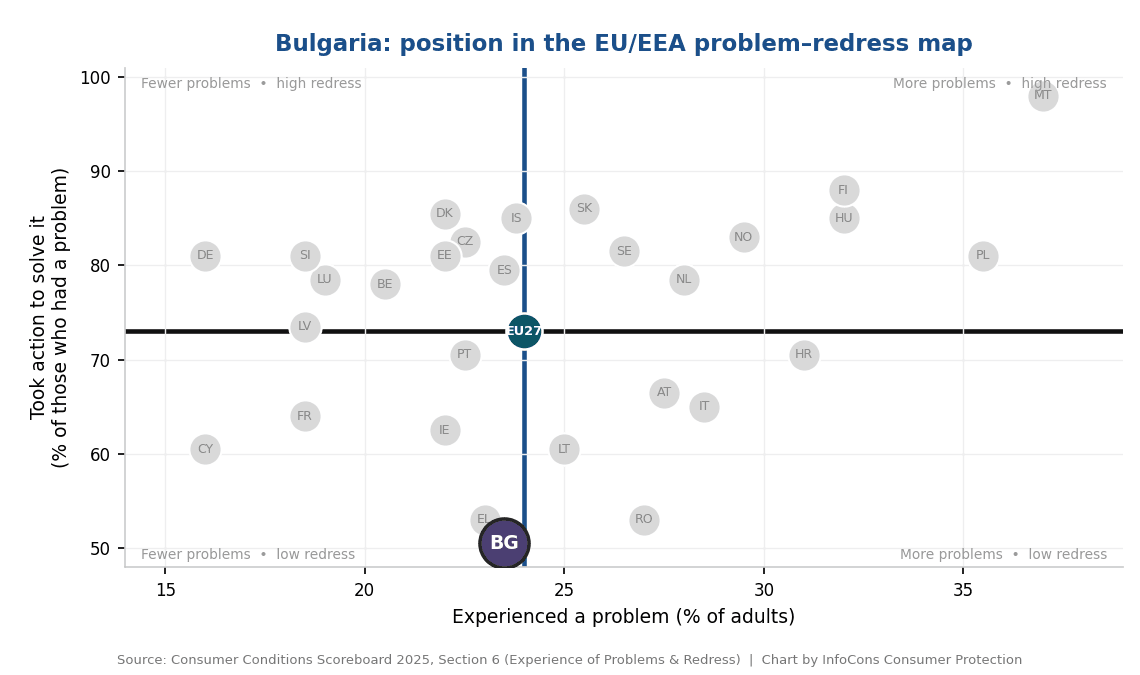
Trouble is comparatively rare here, yet affected consumers are noticeably less likely than the EU average to chase a remedy — a sign that practical or informational barriers may be holding people back. For an expat, exchange student or visiting academic, the practical takeaway is simple: keep proof of purchase, raise issues first with the retailer (the channel four in five Europeans use), and — for cross-border purchases inside the EU/EEA — remember that the European Consumer Centres Network can step in for free.
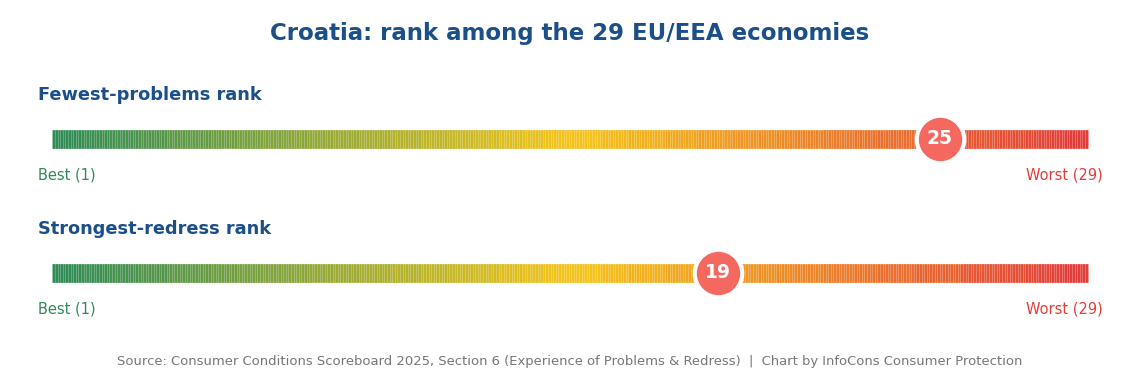
Croatia — InfoCons Consumer Protection Country Profile
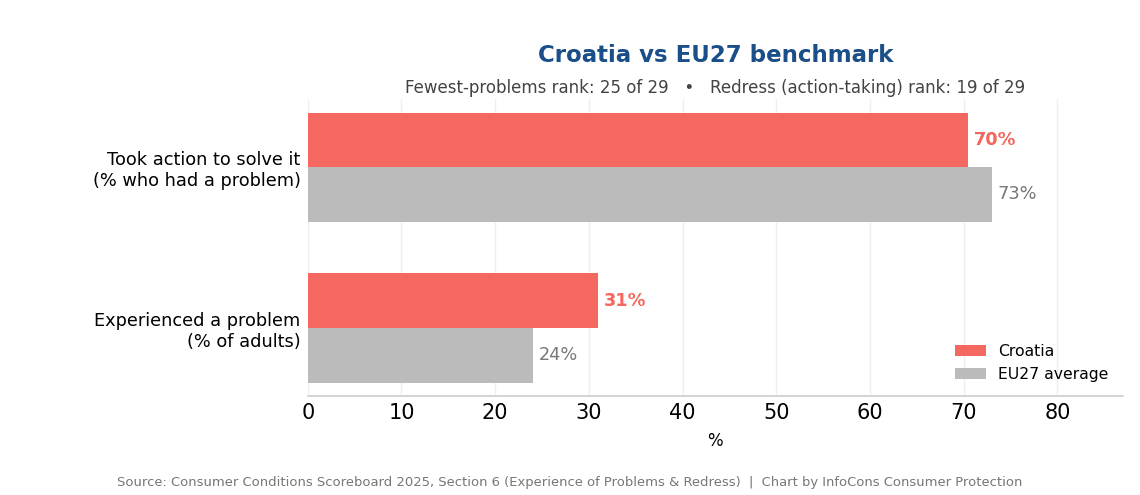
About 31% of adults in Croatia report having hit a problem with a domestic trader in the past 12 months that they felt was worth complaining about — 7 percentage points above the EU27 average of 24%, and the 25th fewest-problem reading among the 29 EU/EEA economies in the scoreboard. When something does go wrong, roughly 70% of affected consumers take action to resolve it, 2 percentage points below the EU27 benchmark of 73% and the 19th strongest redress reflex in the panel. In short, Croatia combines more problems and a weaker redress response.
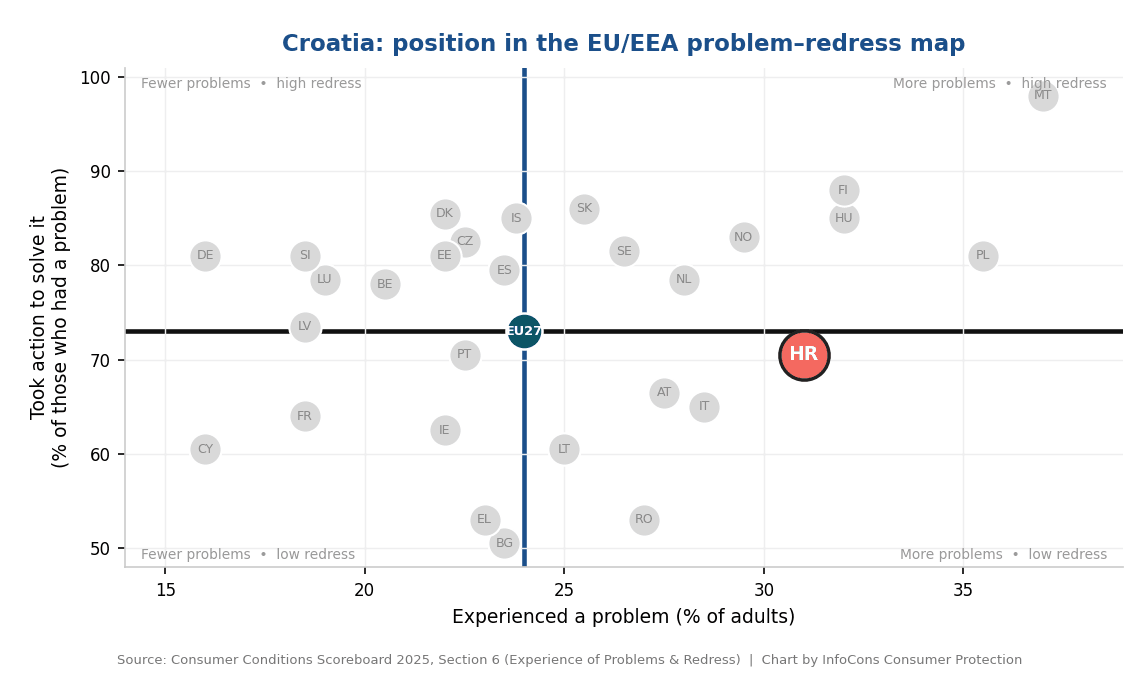
This is the most exposed position in the scoreboard: problems are more frequent than the EU average and the share of affected consumers who act to resolve them is below par — the combination that should most concern a newcomer. For an expat, exchange student or visiting academic, the practical takeaway is simple: keep proof of purchase, raise issues first with the retailer (the channel four in five Europeans use), and — for cross-border purchases inside the EU/EEA — remember that the European Consumer Centres Network can step in for free.
Cyprus — InfoCons Consumer Protection Country Profile
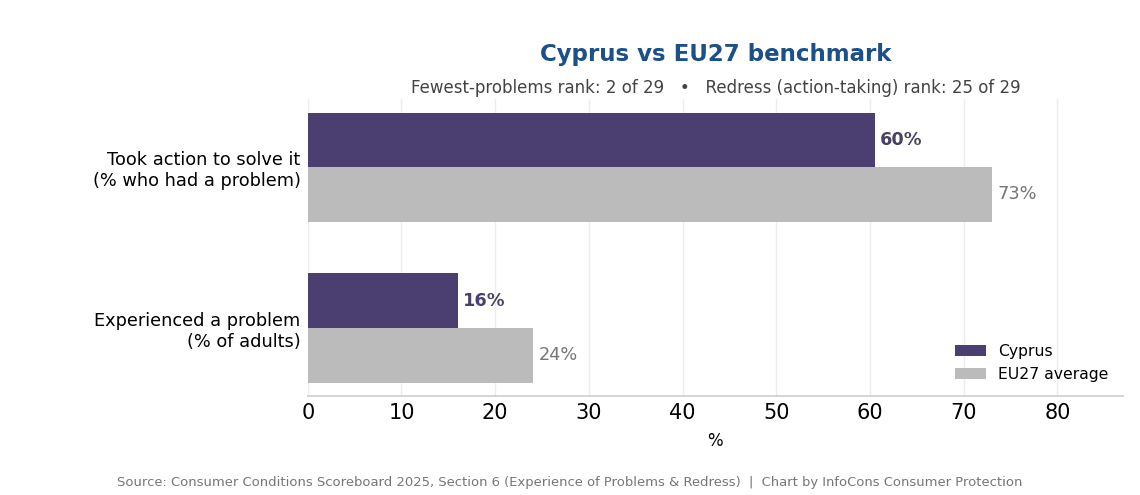
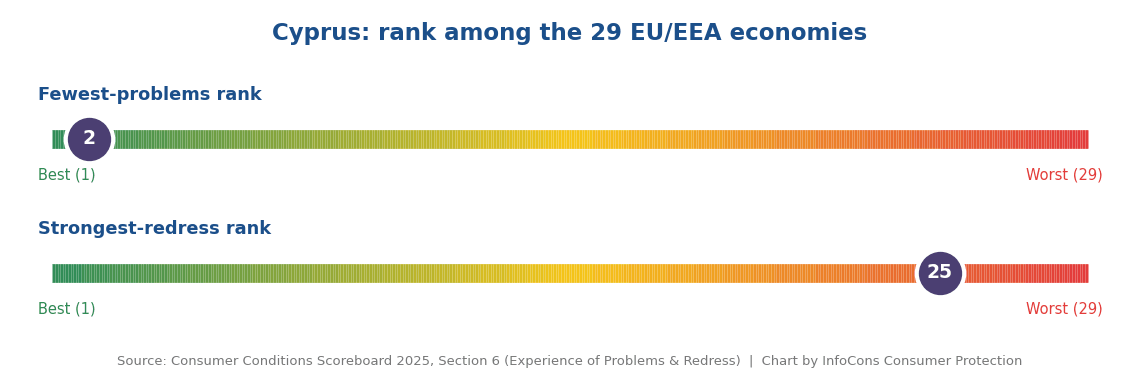
About 16% of adults in Cyprus report having hit a problem with a domestic trader in the past 12 months that they felt was worth complaining about — 8 percentage points below the EU27 average of 24%, and the 2nd fewest-problem reading among the 29 EU/EEA economies in the scoreboard. When something does go wrong, roughly 60% of affected consumers take action to resolve it, 12 percentage points below the EU27 benchmark of 73% and the 25th strongest redress reflex in the panel. In short, Cyprus combines fewer problems but a weaker tendency to seek redress.
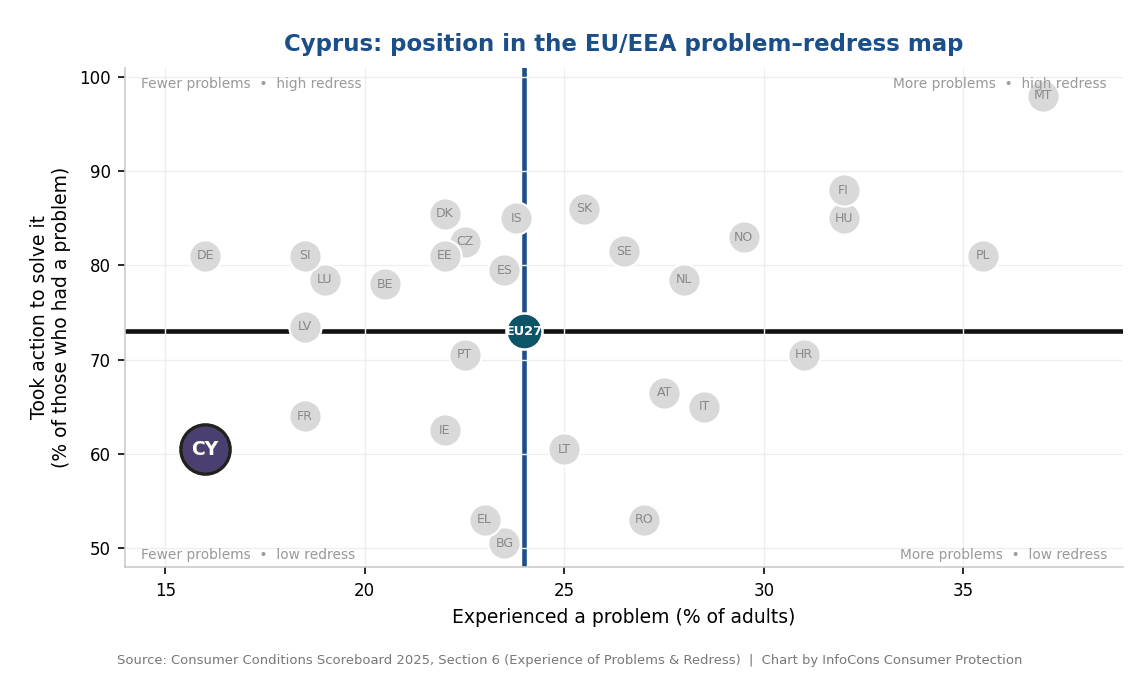
Trouble is comparatively rare here, yet affected consumers are noticeably less likely than the EU average to chase a remedy — a sign that practical or informational barriers may be holding people back. For an expat, exchange student or visiting academic, the practical takeaway is simple: keep proof of purchase, raise issues first with the retailer (the channel four in five Europeans use), and — for cross-border purchases inside the EU/EEA — remember that the European Consumer Centres Network can step in for free.
Czechia — InfoCons Consumer Protection Country Profile
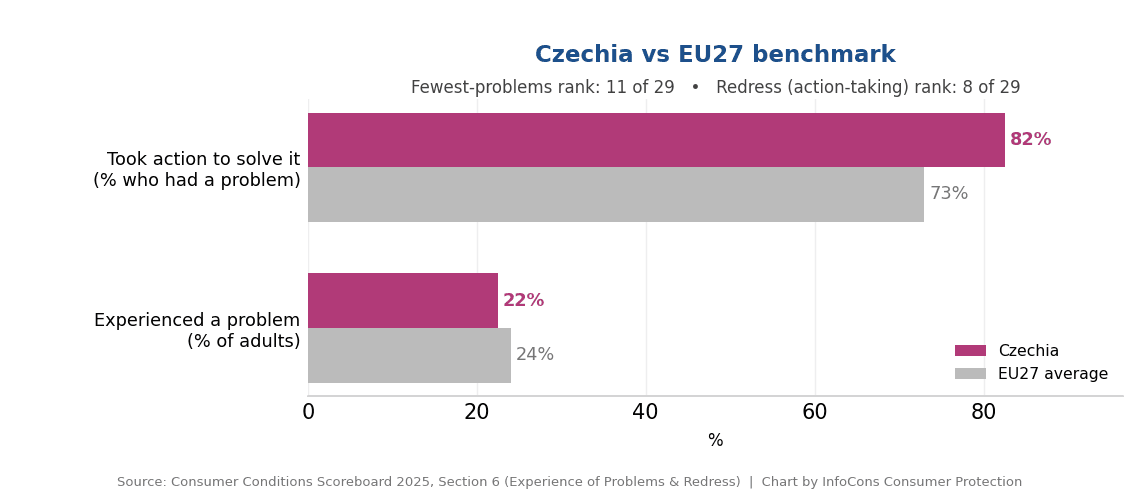
About 22% of adults in Czechia report having hit a problem with a domestic trader in the past 12 months that they felt was worth complaining about — 2 percentage points below the EU27 average of 24%, and the 11th fewest-problem reading among the 29 EU/EEA economies in the scoreboard. When something does go wrong, roughly 82% of affected consumers take action to resolve it, 10 percentage points above the EU27 benchmark of 73% and the 8th strongest redress reflex in the panel. In short, Czechia combines fewer problems and a strong redress reflex.
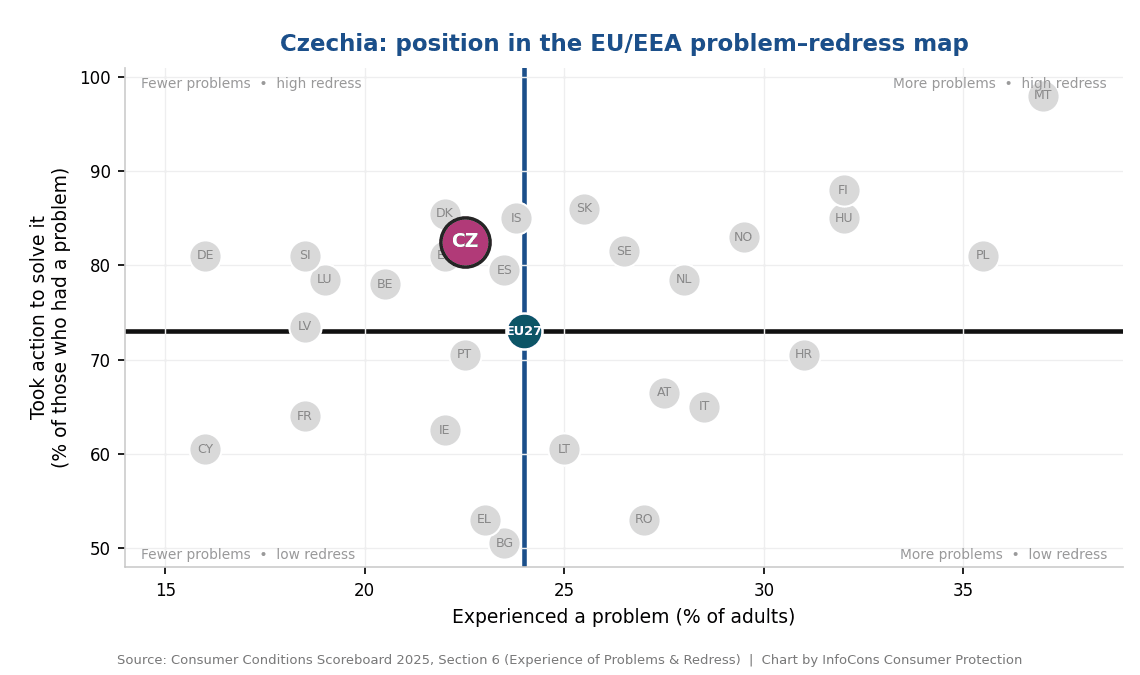
This is the most reassuring blend in the scoreboard: consumers here run into trouble less often than the EU average and, when they do, a large majority act to put it right. For an expat, exchange student or visiting academic, the practical takeaway is simple: keep proof of purchase, raise issues first with the retailer (the channel four in five Europeans use), and — for cross-border purchases inside the EU/EEA — remember that the European Consumer Centres Network can step in for free.
Denmark — InfoCons Consumer Protection Country Profile
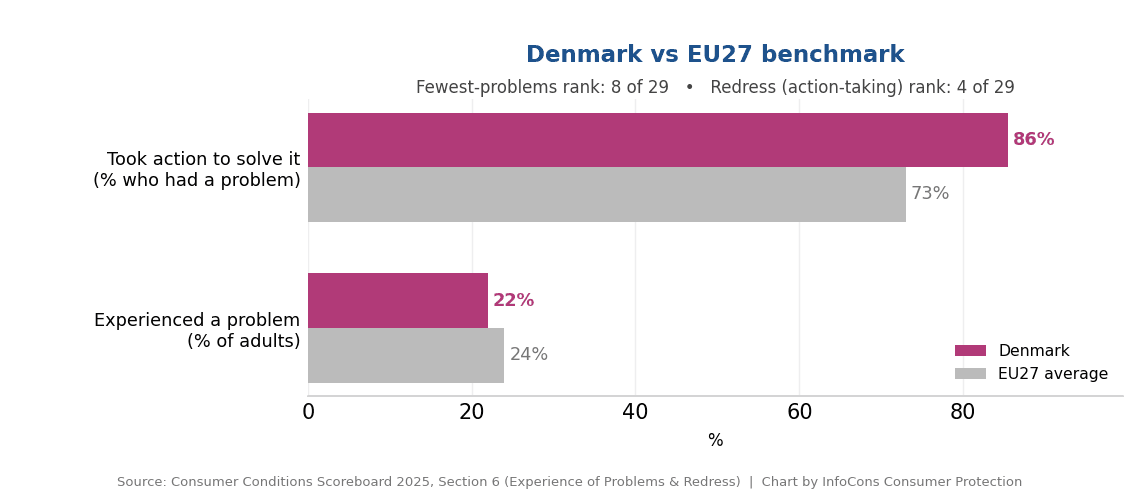
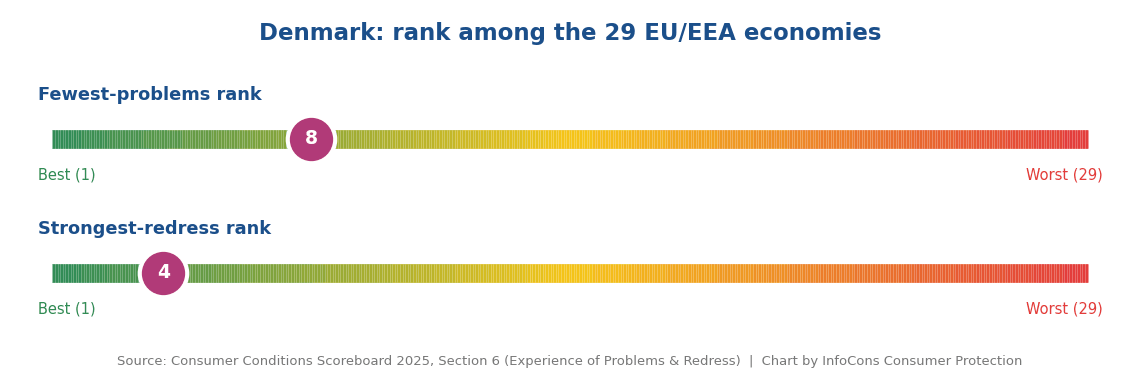
About 22% of adults in Denmark report having hit a problem with a domestic trader in the past 12 months that they felt was worth complaining about — 2 percentage points below the EU27 average of 24%, and the 8th fewest-problem reading among the 29 EU/EEA economies in the scoreboard. When something does go wrong, roughly 86% of affected consumers take action to resolve it, 12 percentage points above the EU27 benchmark of 73% and the 4th strongest redress reflex in the panel. In short, Denmark combines fewer problems and a strong redress reflex.
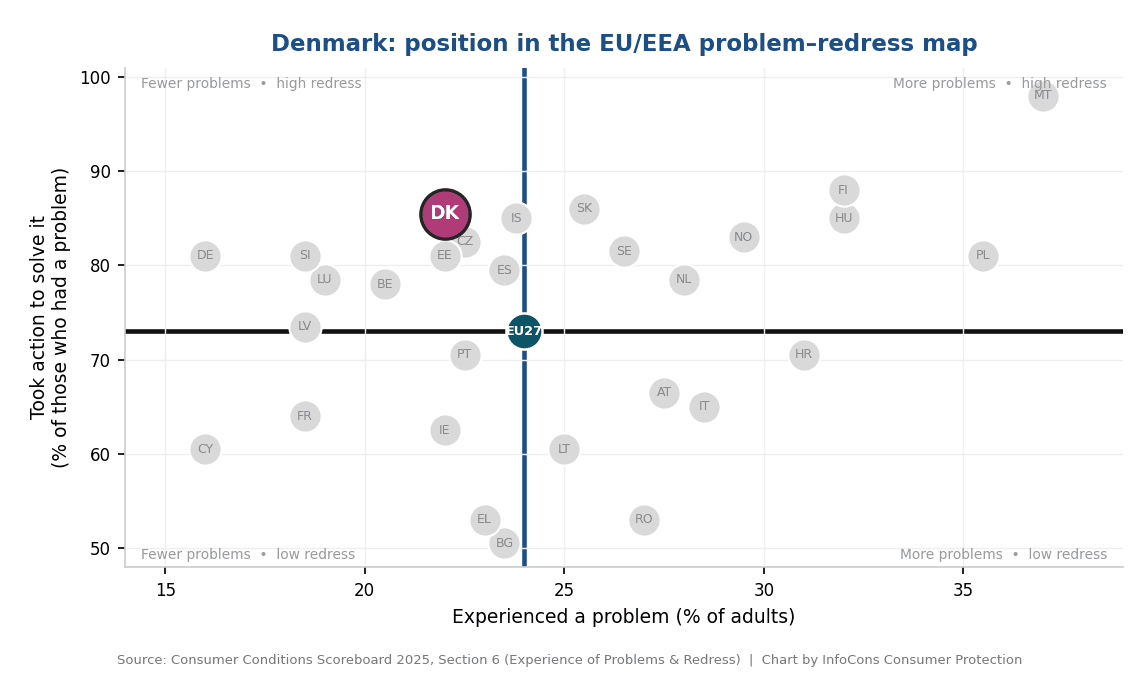
This is the most reassuring blend in the scoreboard: consumers here run into trouble less often than the EU average and, when they do, a large majority act to put it right. For an expat, exchange student or visiting academic, the practical takeaway is simple: keep proof of purchase, raise issues first with the retailer (the channel four in five Europeans use), and — for cross-border purchases inside the EU/EEA — remember that the European Consumer Centres Network can step in for free.
Estonia — InfoCons Consumer Protection Country Profile
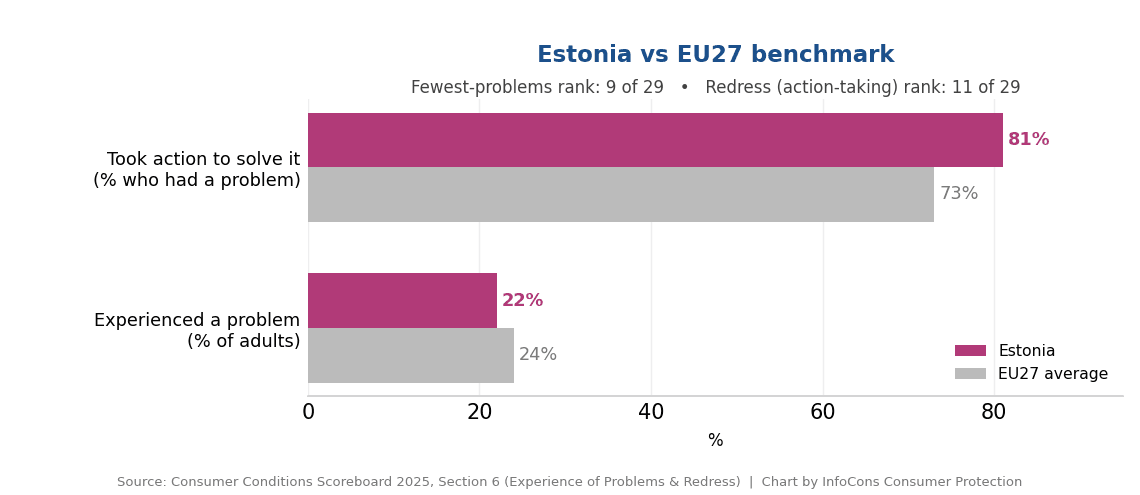
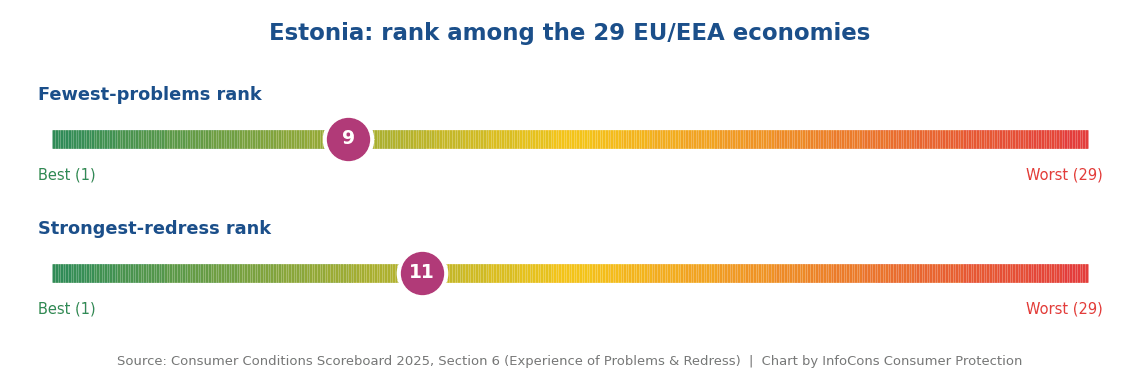
About 22% of adults in Estonia report having hit a problem with a domestic trader in the past 12 months that they felt was worth complaining about — 2 percentage points below the EU27 average of 24%, and the 9th fewest-problem reading among the 29 EU/EEA economies in the scoreboard. When something does go wrong, roughly 81% of affected consumers take action to resolve it, 8 percentage points above the EU27 benchmark of 73% and the 11th strongest redress reflex in the panel. In short, Estonia combines fewer problems and a strong redress reflex.
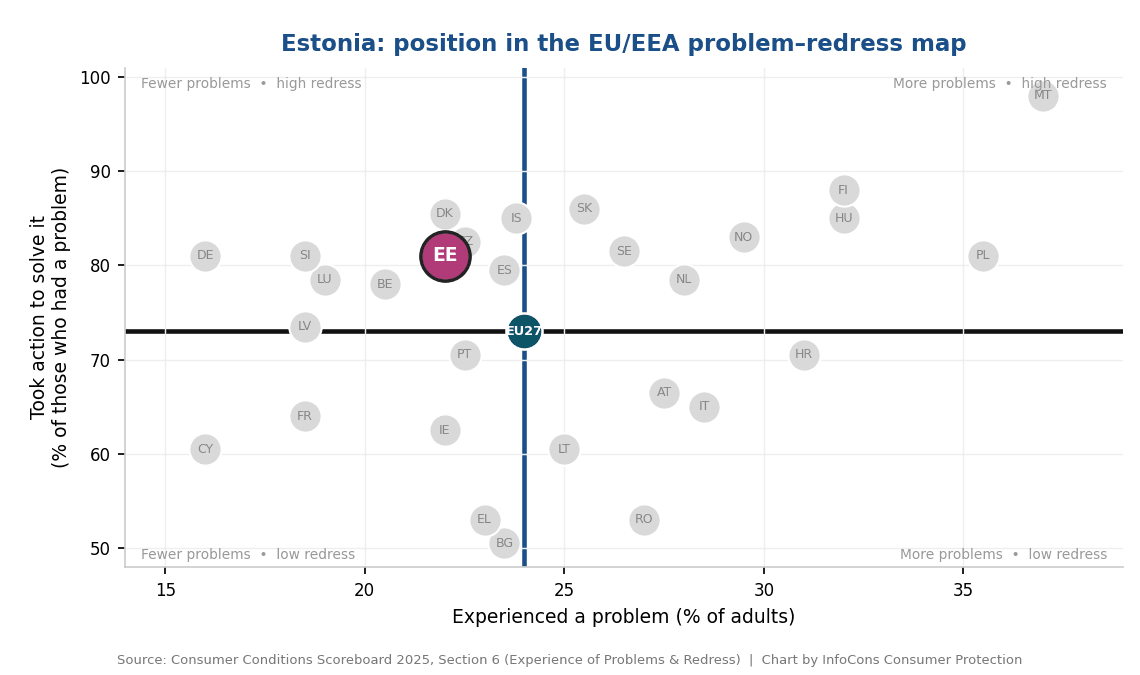
This is the most reassuring blend in the scoreboard: consumers here run into trouble less often than the EU average and, when they do, a large majority act to put it right. For an expat, exchange student or visiting academic, the practical takeaway is simple: keep proof of purchase, raise issues first with the retailer (the channel four in five Europeans use), and — for cross-border purchases inside the EU/EEA — remember that the European Consumer Centres Network can step in for free.
Finland — InfoCons Consumer Protection Country Profile
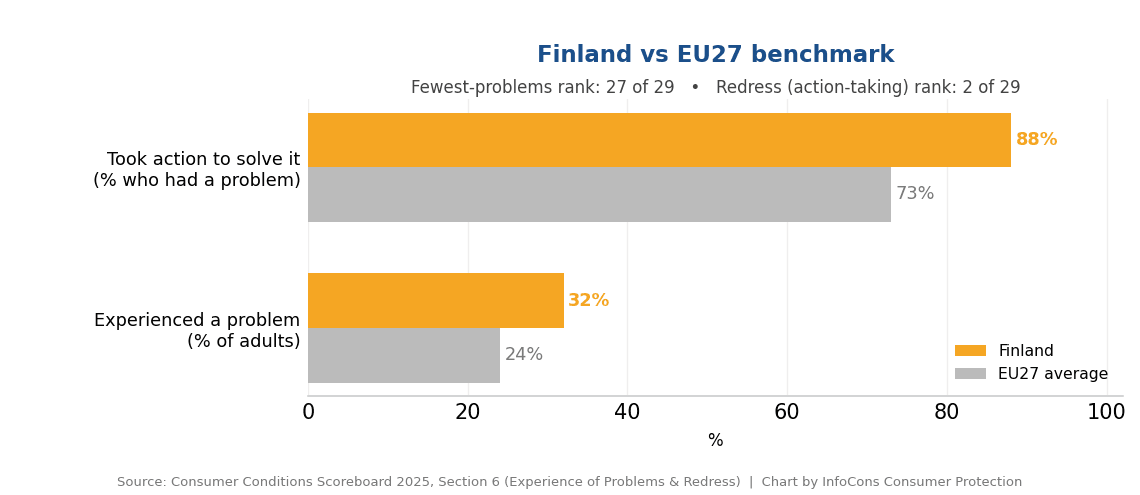
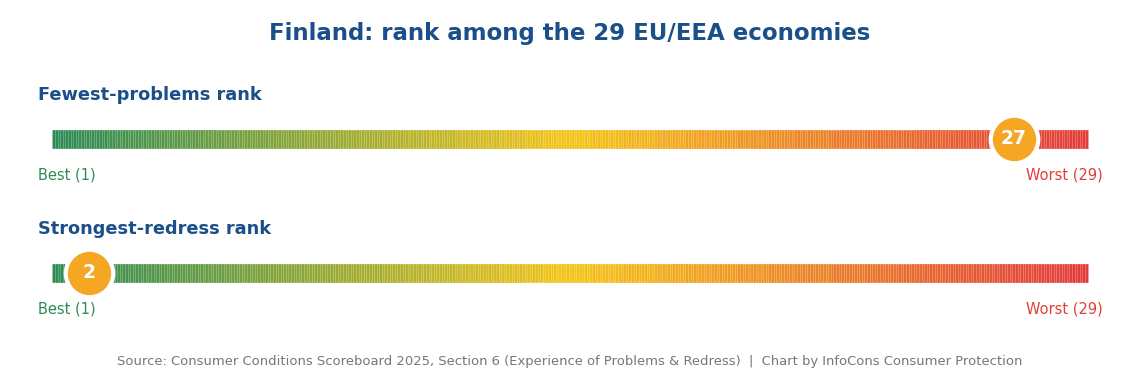
About 32% of adults in Finland report having hit a problem with a domestic trader in the past 12 months that they felt was worth complaining about — 8 percentage points above the EU27 average of 24%, and the 27th fewest-problem reading among the 29 EU/EEA economies in the scoreboard. When something does go wrong, roughly 88% of affected consumers take action to resolve it, 15 percentage points above the EU27 benchmark of 73% and the 2nd strongest redress reflex in the panel. In short, Finland combines more problems but a decisive redress response.
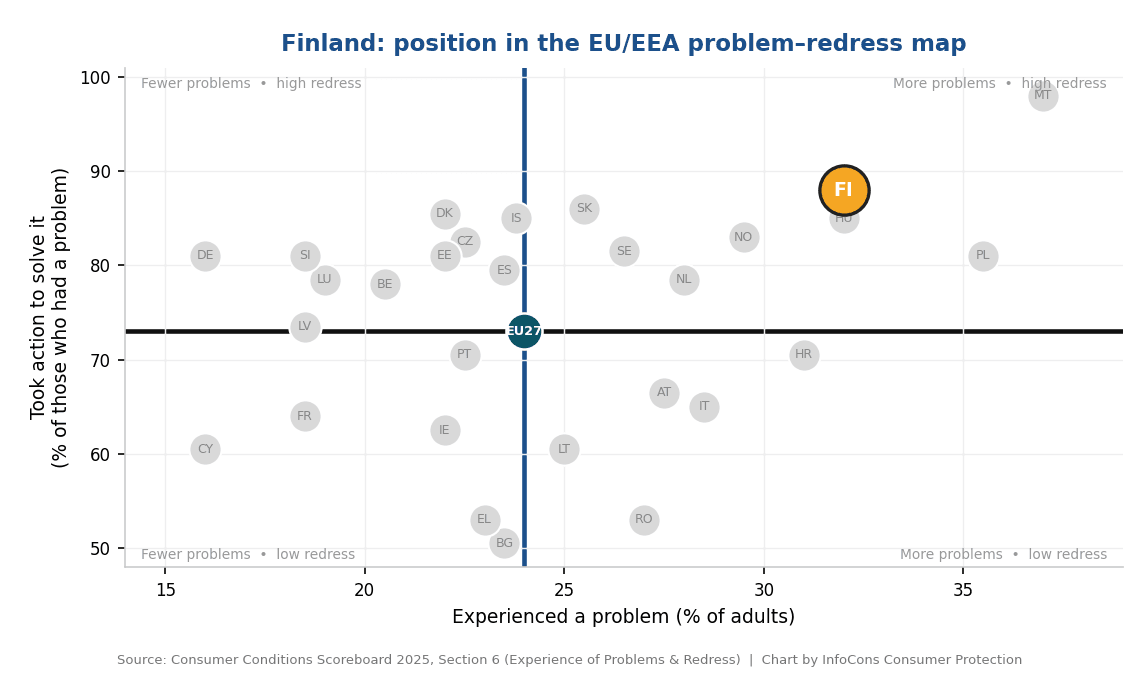
Consumers here report problems more often than the EU average, but they are also among the most likely to act — an active complaint culture that keeps pressure on traders. For an expat, exchange student or visiting academic, the practical takeaway is simple: keep proof of purchase, raise issues first with the retailer (the channel four in five Europeans use), and — for cross-border purchases inside the EU/EEA — remember that the European Consumer Centres Network can step in for free.
France — InfoCons Consumer Protection Country Profile
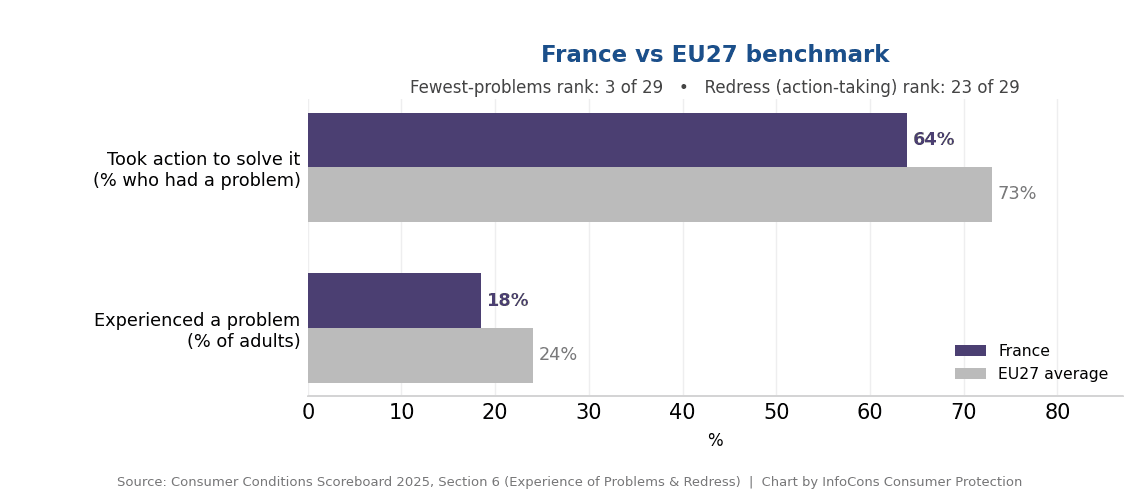
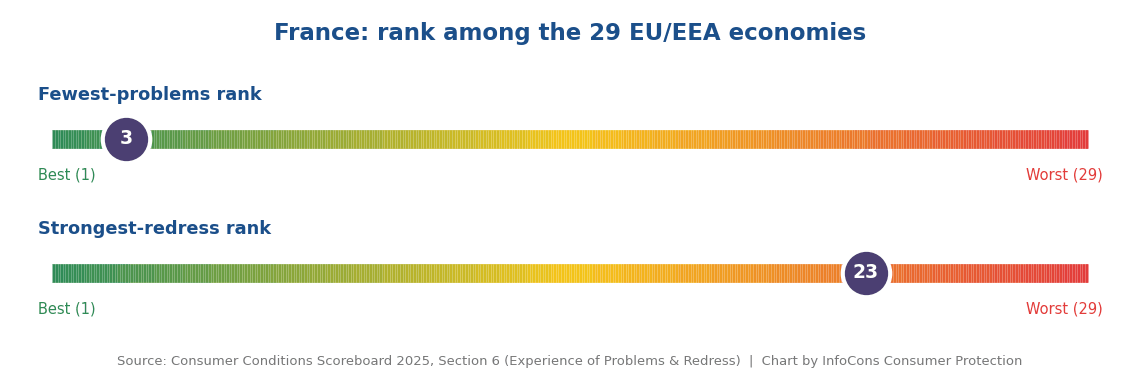
About 18% of adults in France report having hit a problem with a domestic trader in the past 12 months that they felt was worth complaining about — 6 percentage points below the EU27 average of 24%, and the 3rd fewest-problem reading among the 29 EU/EEA economies in the scoreboard. When something does go wrong, roughly 64% of affected consumers take action to resolve it, 9 percentage points below the EU27 benchmark of 73% and the 23rd strongest redress reflex in the panel. In short, France combines fewer problems but a weaker tendency to seek redress.
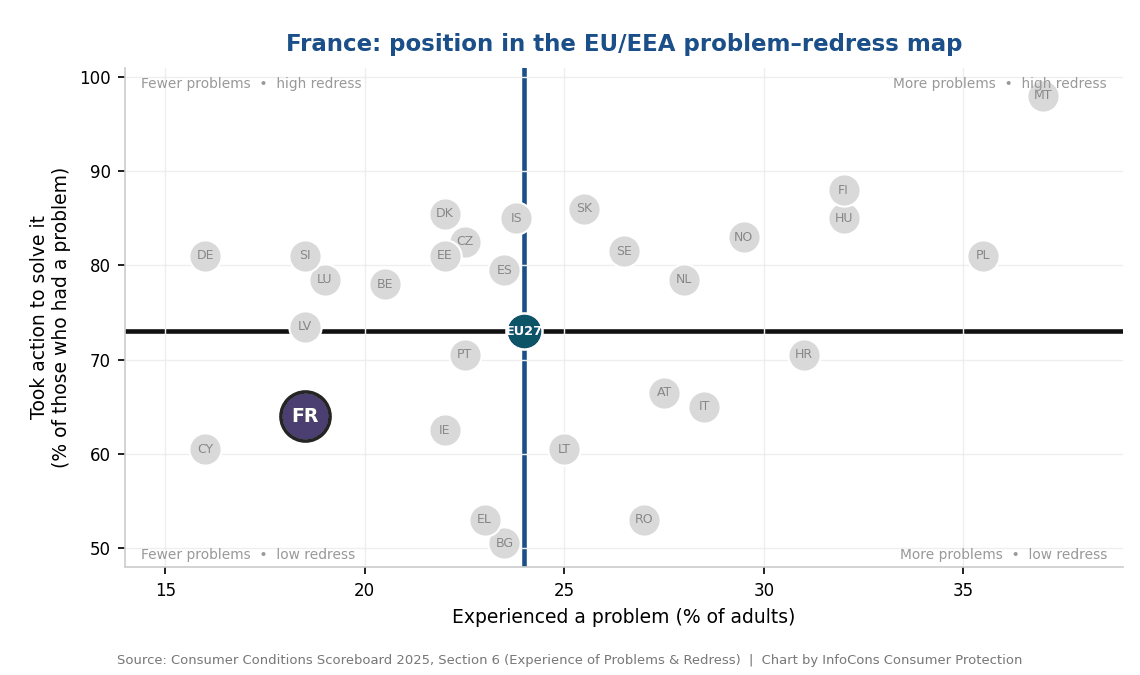
Trouble is comparatively rare here, yet affected consumers are noticeably less likely than the EU average to chase a remedy — a sign that practical or informational barriers may be holding people back. The scoreboard also flags France among the Member States where satisfaction with how retailers handle complaints fell most sharply between 2022 and 2024. For an expat, exchange student or visiting academic, the practical takeaway is simple: keep proof of purchase, raise issues first with the retailer (the channel four in five Europeans use), and — for cross-border purchases inside the EU/EEA — remember that the European Consumer Centres Network can step in for free.
Germany — InfoCons Consumer Protection Country Profile
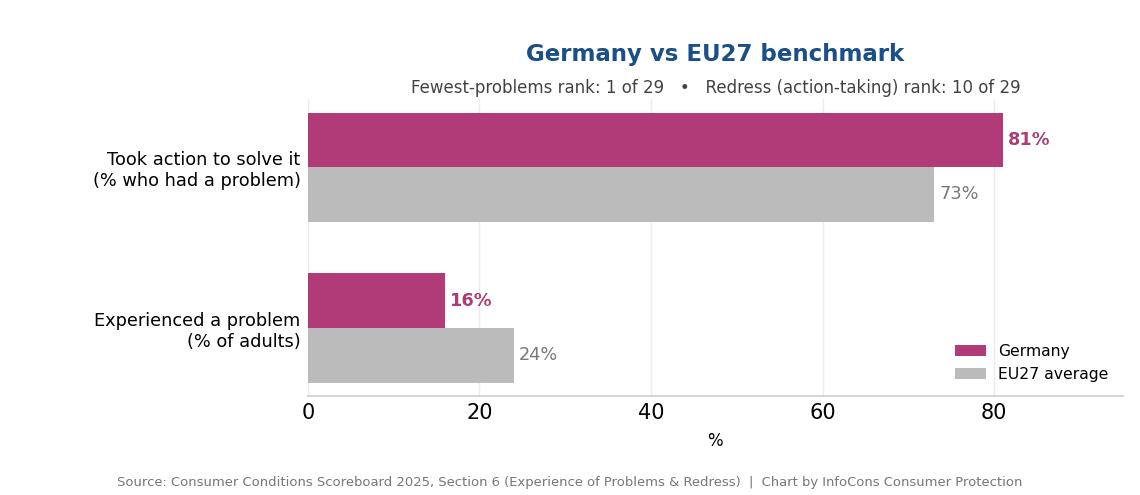
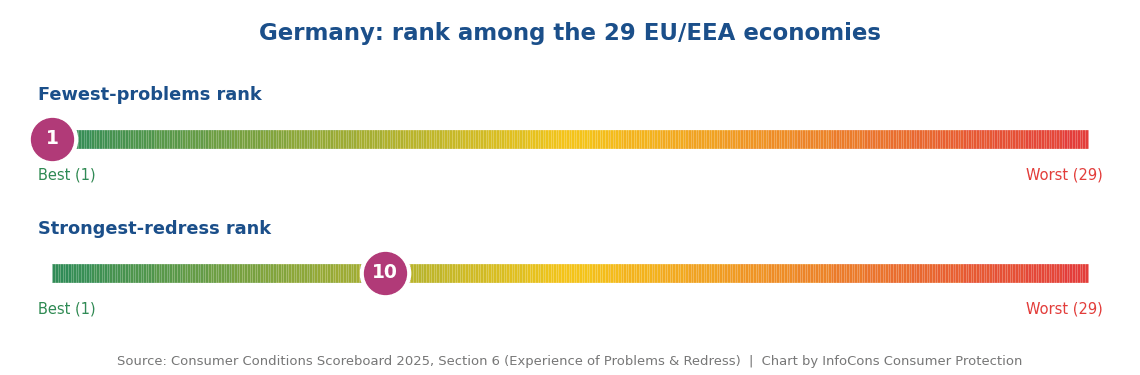
About 16% of adults in Germany report having hit a problem with a domestic trader in the past 12 months that they felt was worth complaining about — 8 percentage points below the EU27 average of 24%, and the 1st fewest-problem reading among the 29 EU/EEA economies in the scoreboard. When something does go wrong, roughly 81% of affected consumers take action to resolve it, 8 percentage points above the EU27 benchmark of 73% and the 10th strongest redress reflex in the panel. In short, Germany combines fewer problems and a strong redress reflex.
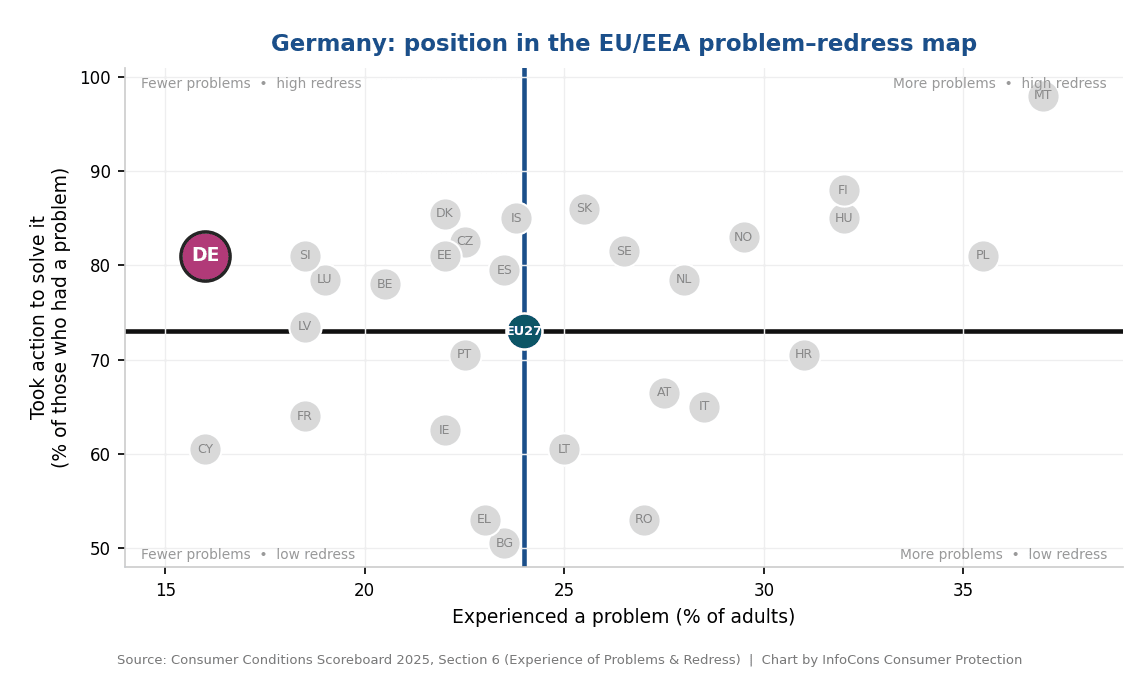
This is the most reassuring blend in the scoreboard: consumers here run into trouble less often than the EU average and, when they do, a large majority act to put it right. For an expat, exchange student or visiting academic, the practical takeaway is simple: keep proof of purchase, raise issues first with the retailer (the channel four in five Europeans use), and — for cross-border purchases inside the EU/EEA — remember that the European Consumer Centres Network can step in for free.
Greece — InfoCons Consumer Protection Country Profile
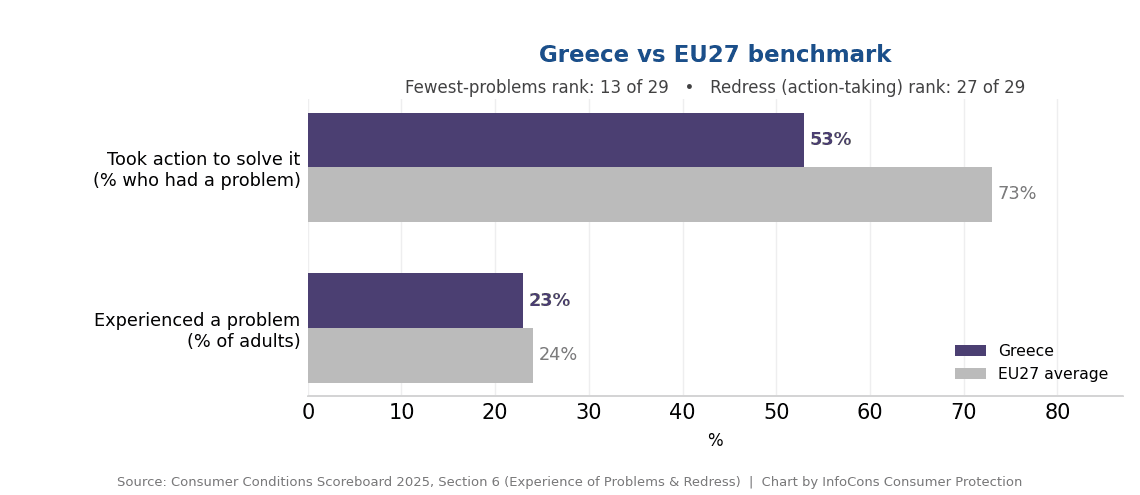
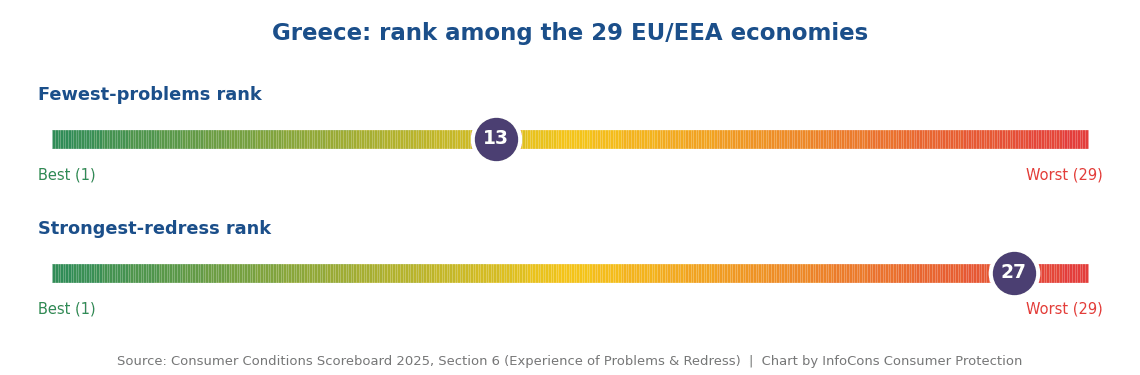
About 23% of adults in Greece report having hit a problem with a domestic trader in the past 12 months that they felt was worth complaining about — 1 percentage point below the EU27 average of 24%, and the 13th fewest-problem reading among the 29 EU/EEA economies in the scoreboard. When something does go wrong, roughly 53% of affected consumers take action to resolve it, 20 percentage points below the EU27 benchmark of 73% and the 27th strongest redress reflex in the panel. In short, Greece combines fewer problems but a weaker tendency to seek redress.
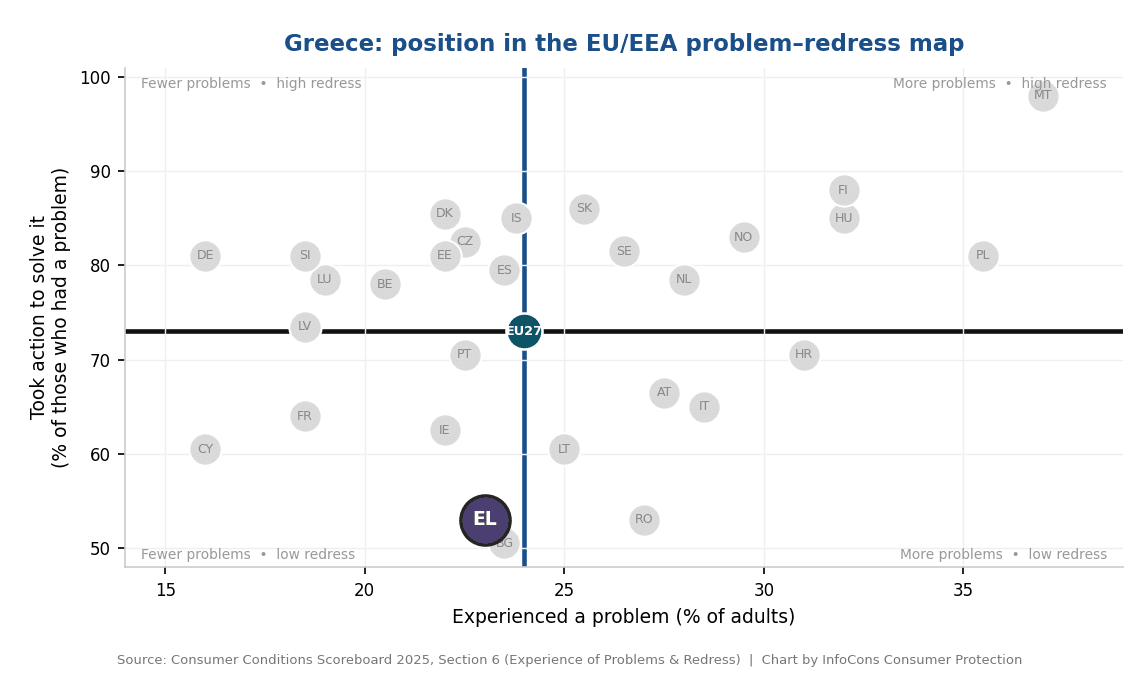
Trouble is comparatively rare here, yet affected consumers are noticeably less likely than the EU average to chase a remedy — a sign that practical or informational barriers may be holding people back. For an expat, exchange student or visiting academic, the practical takeaway is simple: keep proof of purchase, raise issues first with the retailer (the channel four in five Europeans use), and — for cross-border purchases inside the EU/EEA — remember that the European Consumer Centres Network can step in for free.
Hungary — InfoCons Consumer Protection Country Profile
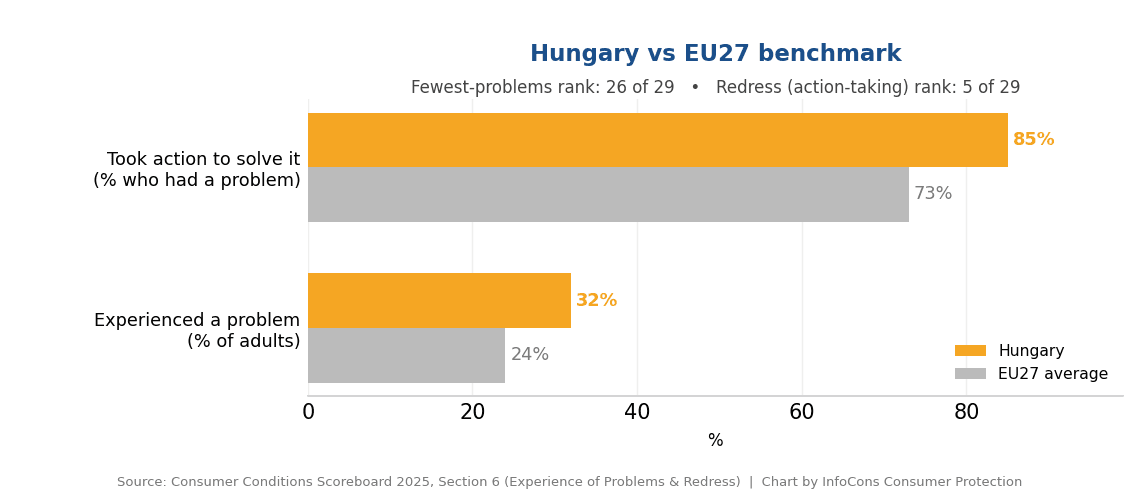
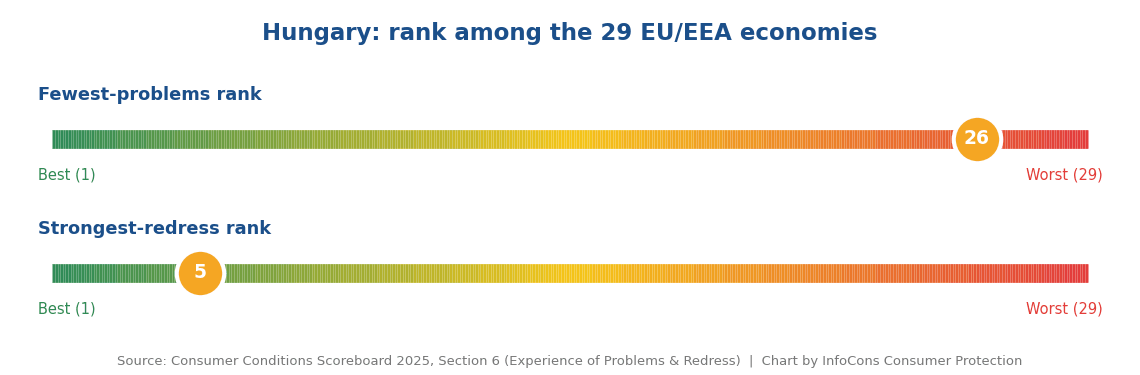
About 32% of adults in Hungary report having hit a problem with a domestic trader in the past 12 months that they felt was worth complaining about — 8 percentage points above the EU27 average of 24%, and the 26th fewest-problem reading among the 29 EU/EEA economies in the scoreboard. When something does go wrong, roughly 85% of affected consumers take action to resolve it, 12 percentage points above the EU27 benchmark of 73% and the 5th strongest redress reflex in the panel. In short, Hungary combines more problems but a decisive redress response.
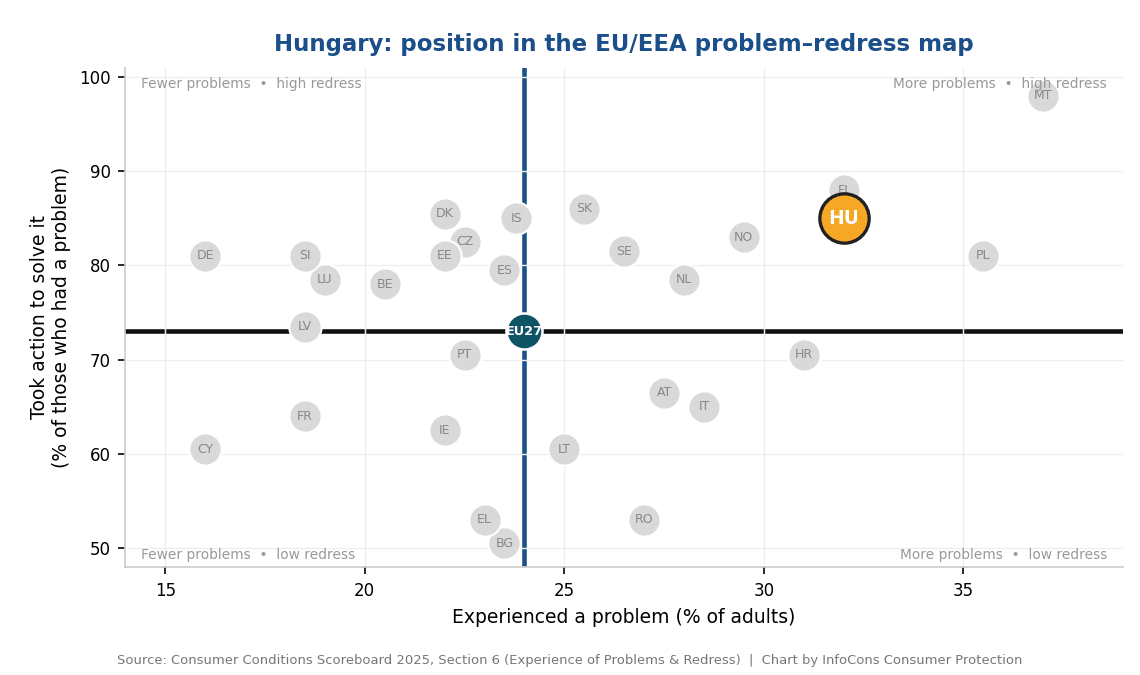
Consumers here report problems more often than the EU average, but they are also among the most likely to act — an active complaint culture that keeps pressure on traders. For an expat, exchange student or visiting academic, the practical takeaway is simple: keep proof of purchase, raise issues first with the retailer (the channel four in five Europeans use), and — for cross-border purchases inside the EU/EEA — remember that the European Consumer Centres Network can step in for free.
Iceland — InfoCons Consumer Protection Country Profile
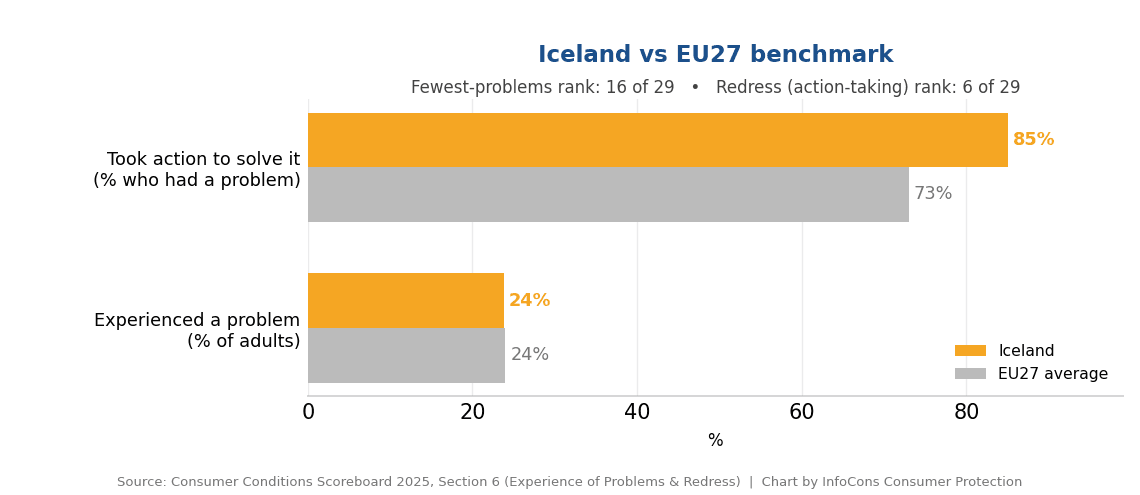
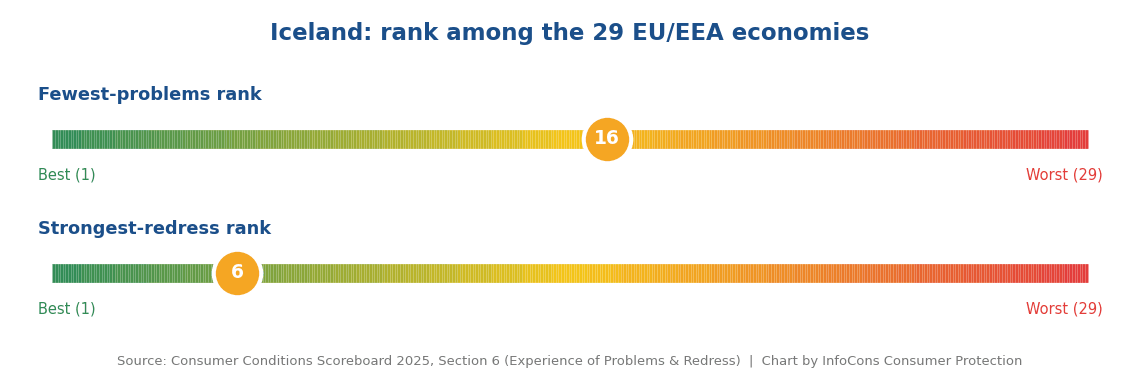
About 24% of adults in Iceland report having hit a problem with a domestic trader in the past 12 months that they felt was worth complaining about — 0 percentage points below the EU27 average of 24%, and the 16th fewest-problem reading among the 29 EU/EEA economies in the scoreboard. When something does go wrong, roughly 85% of affected consumers take action to resolve it, 12 percentage points above the EU27 benchmark of 73% and the 6th strongest redress reflex in the panel. In short, Iceland combines more problems but a decisive redress response.
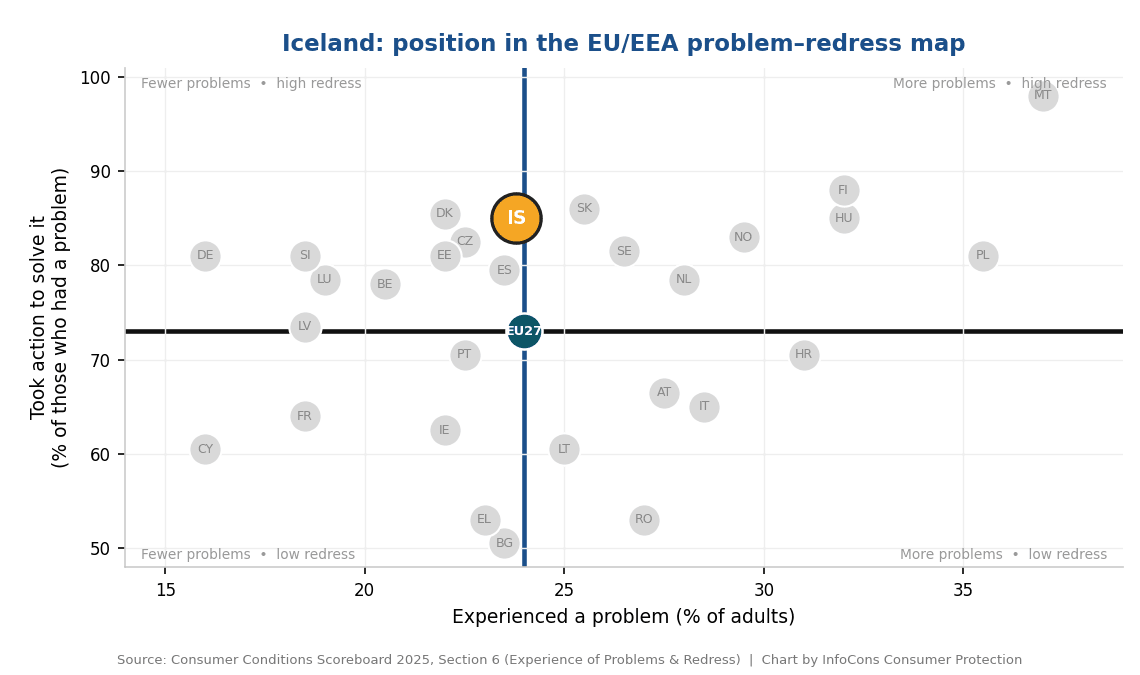
Consumers here report problems more often than the EU average, but they are also among the most likely to act — an active complaint culture that keeps pressure on traders. For an expat, exchange student or visiting academic, the practical takeaway is simple: keep proof of purchase, raise issues first with the retailer (the channel four in five Europeans use), and — for cross-border purchases inside the EU/EEA — remember that the European Consumer Centres Network can step in for free.
Ireland — InfoCons Consumer Protection Country Profile
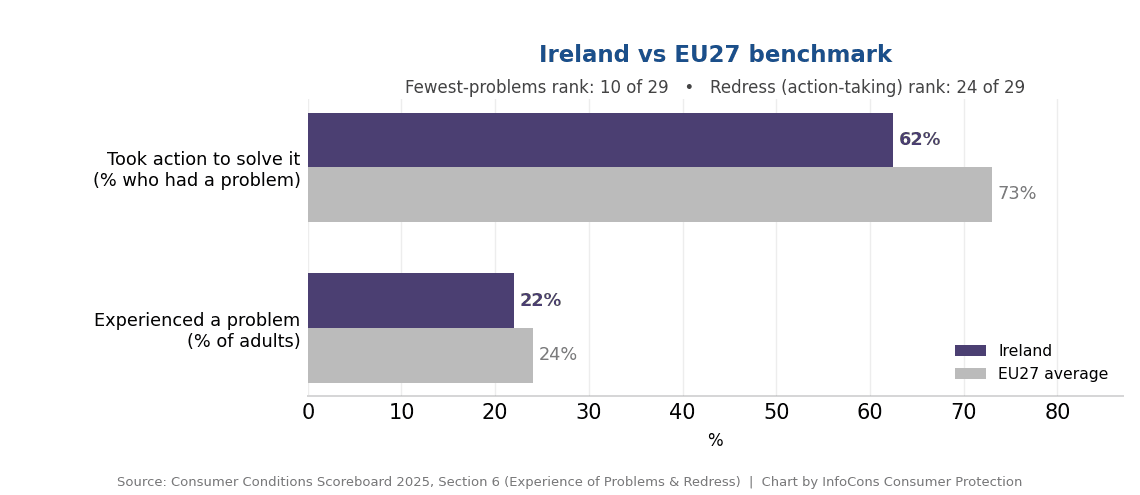
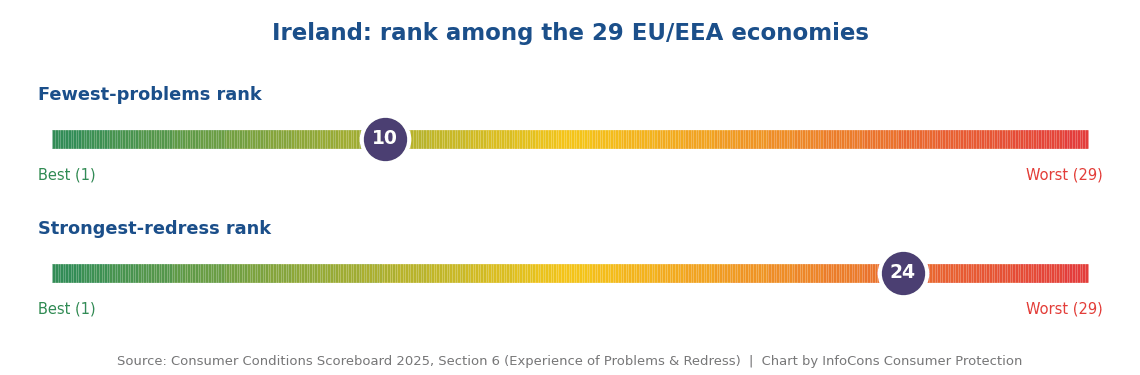
About 22% of adults in Ireland report having hit a problem with a domestic trader in the past 12 months that they felt was worth complaining about — 2 percentage points below the EU27 average of 24%, and the 10th fewest-problem reading among the 29 EU/EEA economies in the scoreboard. When something does go wrong, roughly 62% of affected consumers take action to resolve it, 10 percentage points below the EU27 benchmark of 73% and the 24th strongest redress reflex in the panel. In short, Ireland combines fewer problems but a weaker tendency to seek redress.
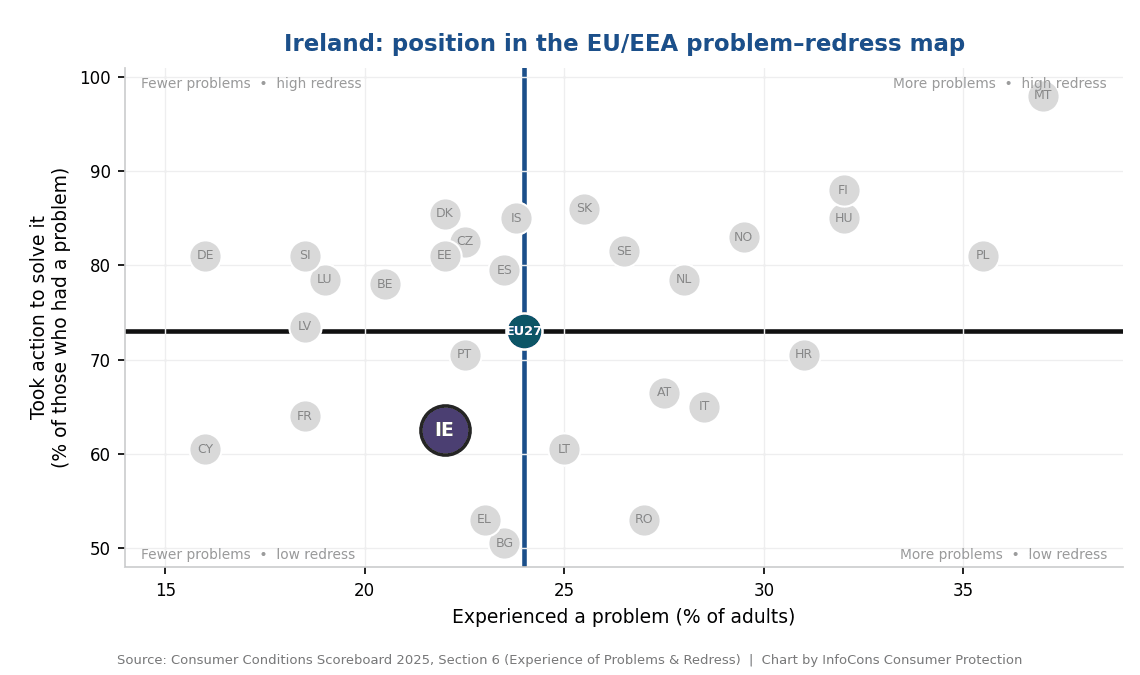
Trouble is comparatively rare here, yet affected consumers are noticeably less likely than the EU average to chase a remedy — a sign that practical or informational barriers may be holding people back. For an expat, exchange student or visiting academic, the practical takeaway is simple: keep proof of purchase, raise issues first with the retailer (the channel four in five Europeans use), and — for cross-border purchases inside the EU/EEA — remember that the European Consumer Centres Network can step in for free.
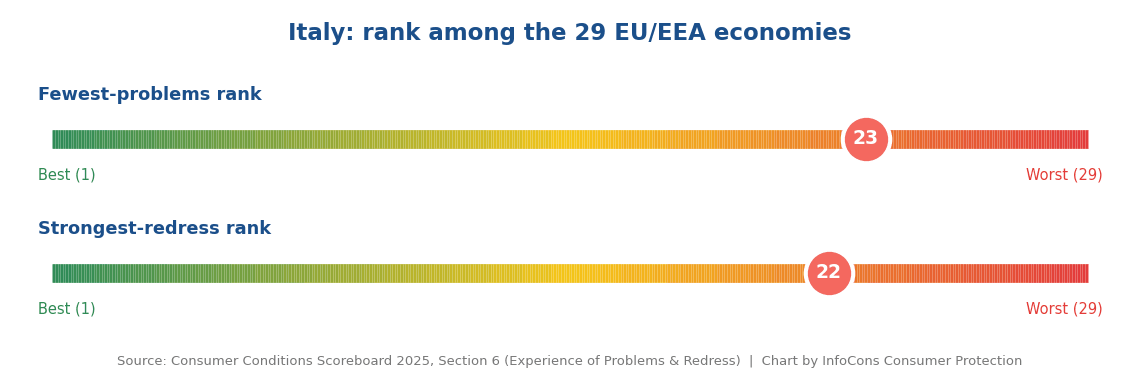
Italy — InfoCons Consumer Protection Country Profile
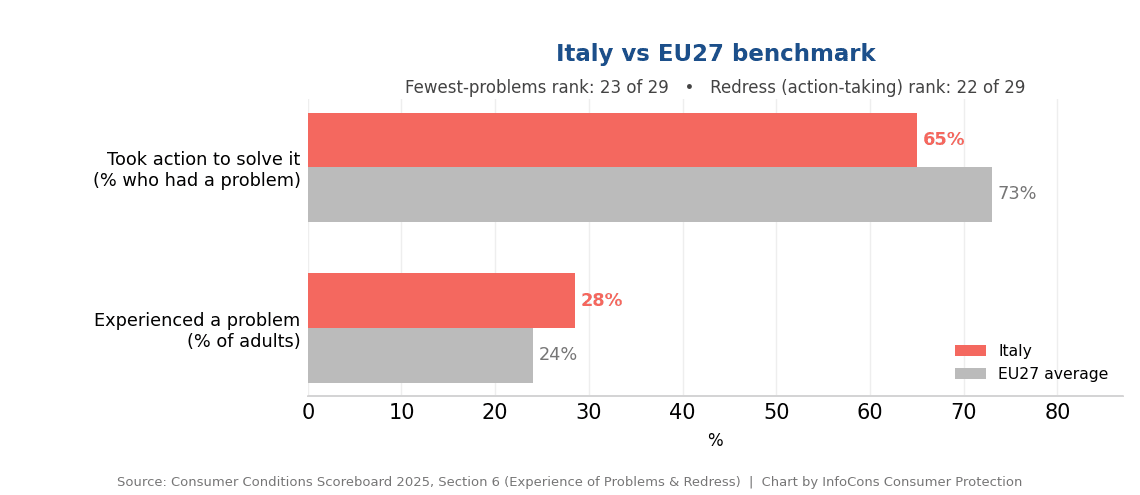
About 28% of adults in Italy report having hit a problem with a domestic trader in the past 12 months that they felt was worth complaining about — 4 percentage points above the EU27 average of 24%, and the 23rd fewest-problem reading among the 29 EU/EEA economies in the scoreboard. When something does go wrong, roughly 65% of affected consumers take action to resolve it, 8 percentage points below the EU27 benchmark of 73% and the 22nd strongest redress reflex in the panel. In short, Italy combines more problems and a weaker redress response.
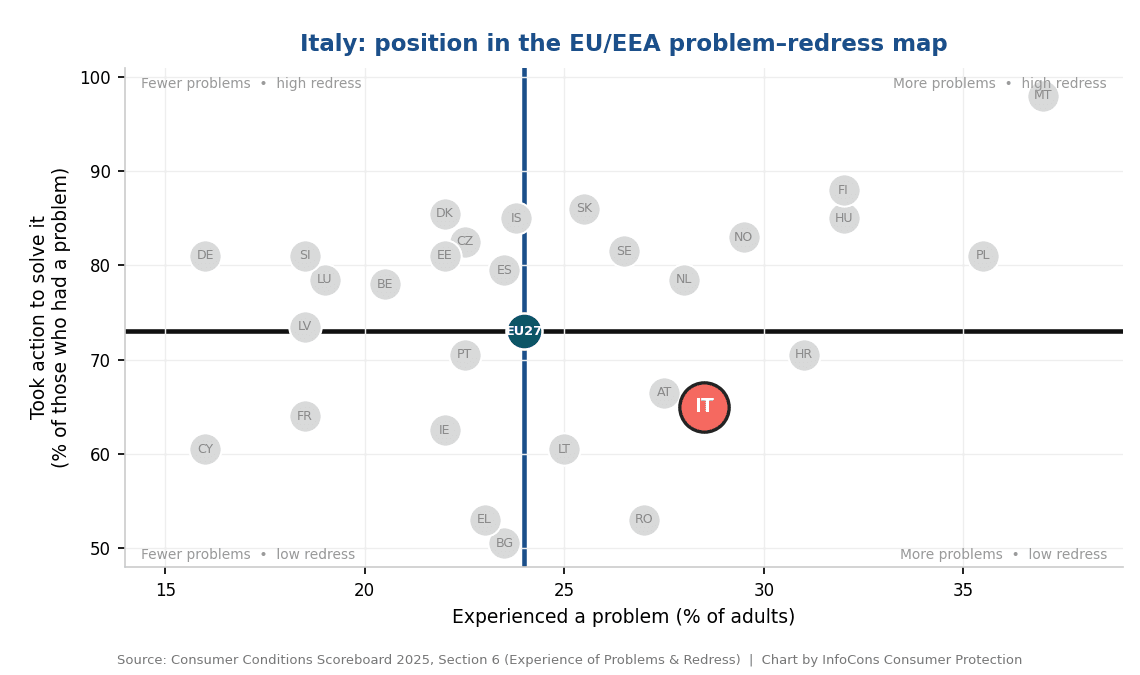
This is the most exposed position in the scoreboard: problems are more frequent than the EU average and the share of affected consumers who act to resolve them is below par — the combination that should most concern a newcomer. For an expat, exchange student or visiting academic, the practical takeaway is simple: keep proof of purchase, raise issues first with the retailer (the channel four in five Europeans use), and — for cross-border purchases inside the EU/EEA — remember that the European Consumer Centres Network can step in for free.
Latvia — InfoCons Consumer Protection Country Profile
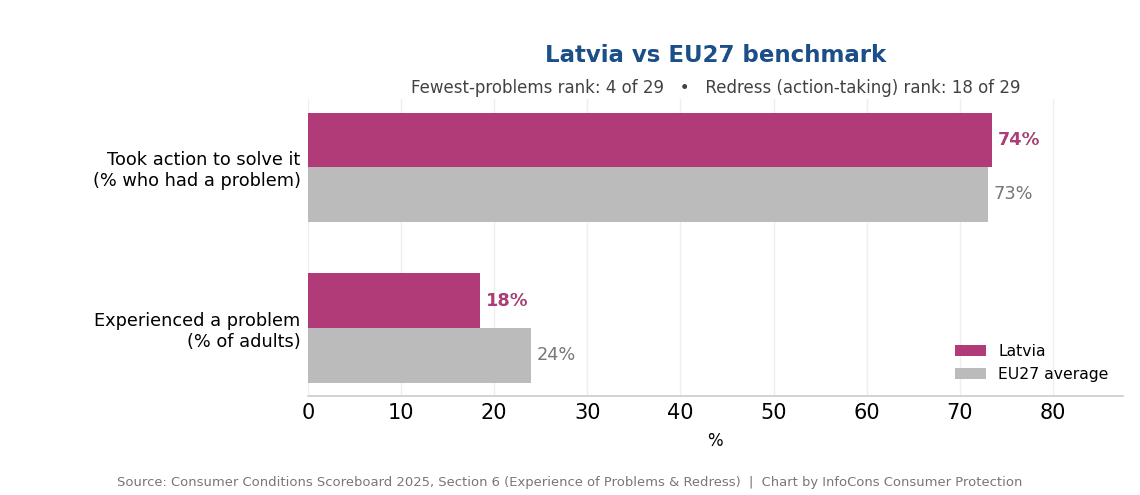
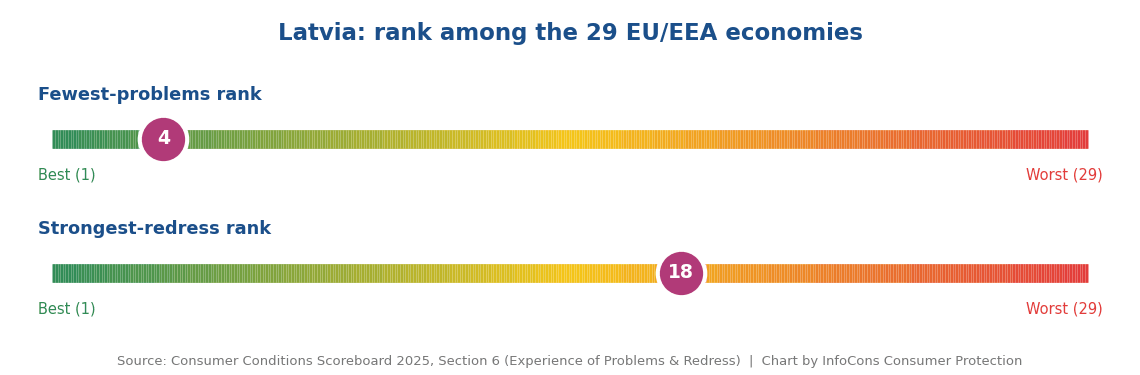
About 18% of adults in Latvia report having hit a problem with a domestic trader in the past 12 months that they felt was worth complaining about — 6 percentage points below the EU27 average of 24%, and the 4th fewest-problem reading among the 29 EU/EEA economies in the scoreboard. When something does go wrong, roughly 74% of affected consumers take action to resolve it, 0 percentage points above the EU27 benchmark of 73% and the 18th strongest redress reflex in the panel. In short, Latvia combines fewer problems and a strong redress reflex.
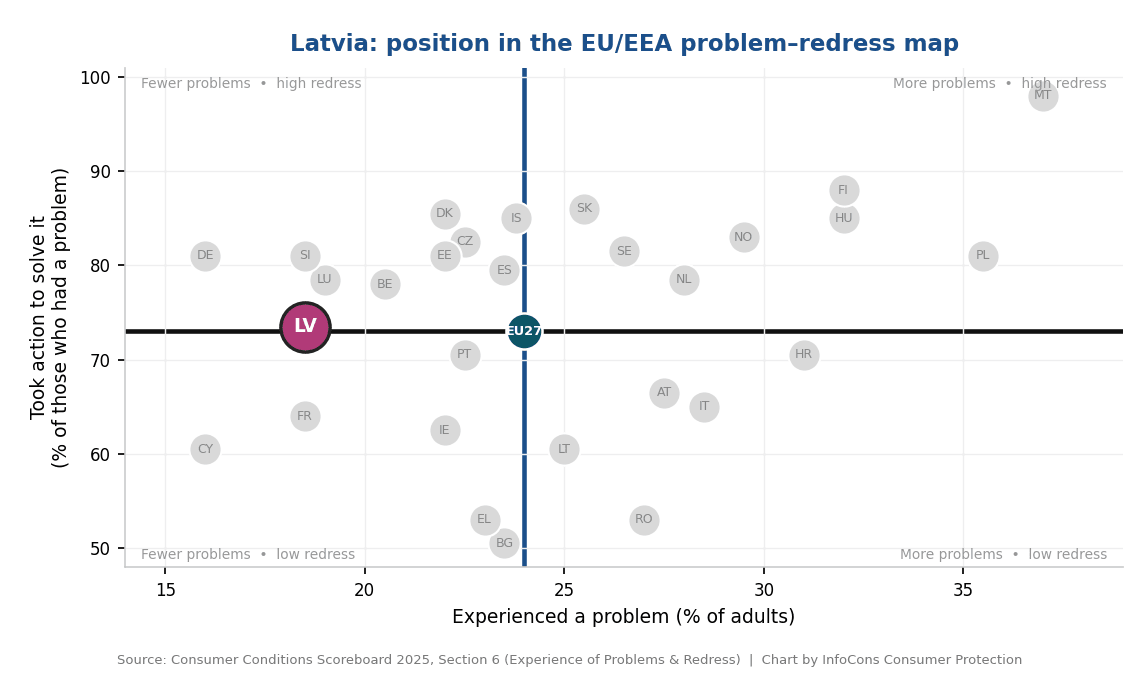
This is the most reassuring blend in the scoreboard: consumers here run into trouble less often than the EU average and, when they do, a large majority act to put it right. For an expat, exchange student or visiting academic, the practical takeaway is simple: keep proof of purchase, raise issues first with the retailer (the channel four in five Europeans use), and — for cross-border purchases inside the EU/EEA — remember that the European Consumer Centres Network can step in for free.
Lithuania — InfoCons Consumer Protection Country Profile
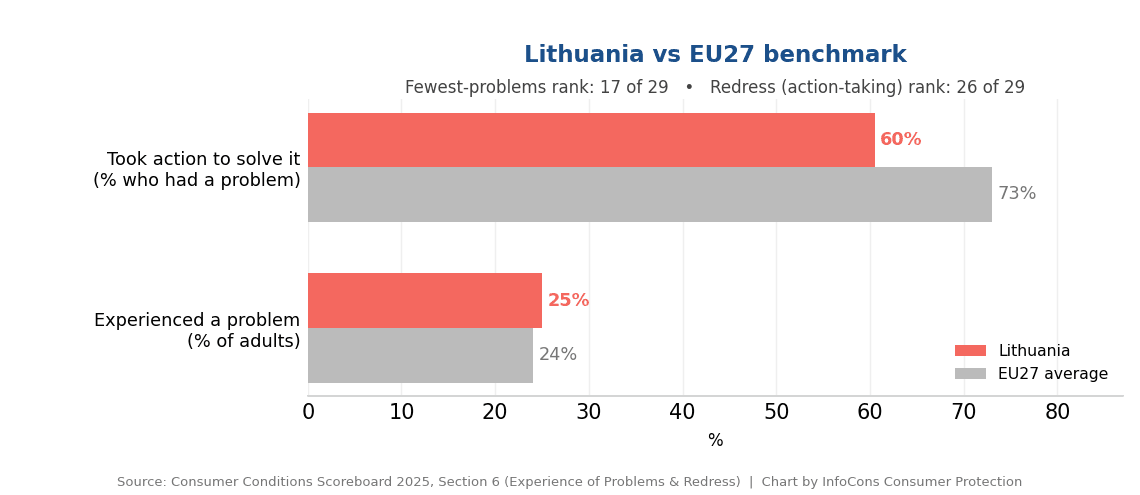
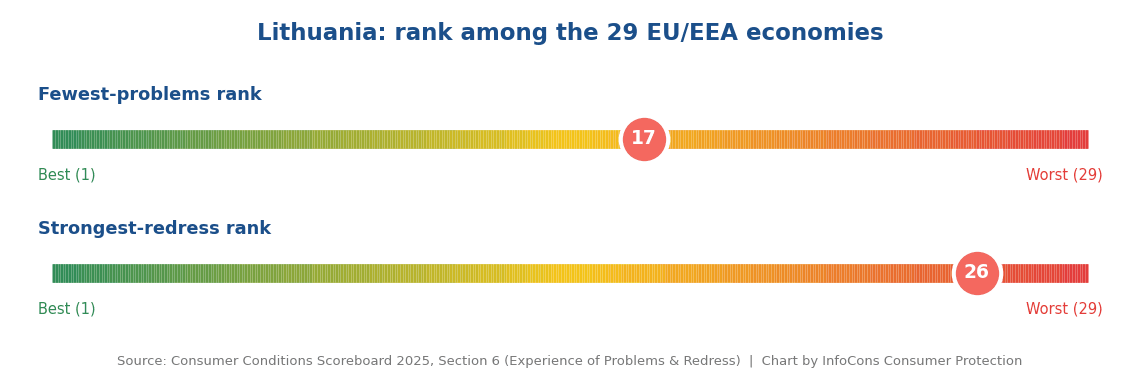
About 25% of adults in Lithuania report having hit a problem with a domestic trader in the past 12 months that they felt was worth complaining about — 1 percentage point above the EU27 average of 24%, and the 17th fewest-problem reading among the 29 EU/EEA economies in the scoreboard. When something does go wrong, roughly 60% of affected consumers take action to resolve it, 12 percentage points below the EU27 benchmark of 73% and the 26th strongest redress reflex in the panel. In short, Lithuania combines more problems and a weaker redress response.
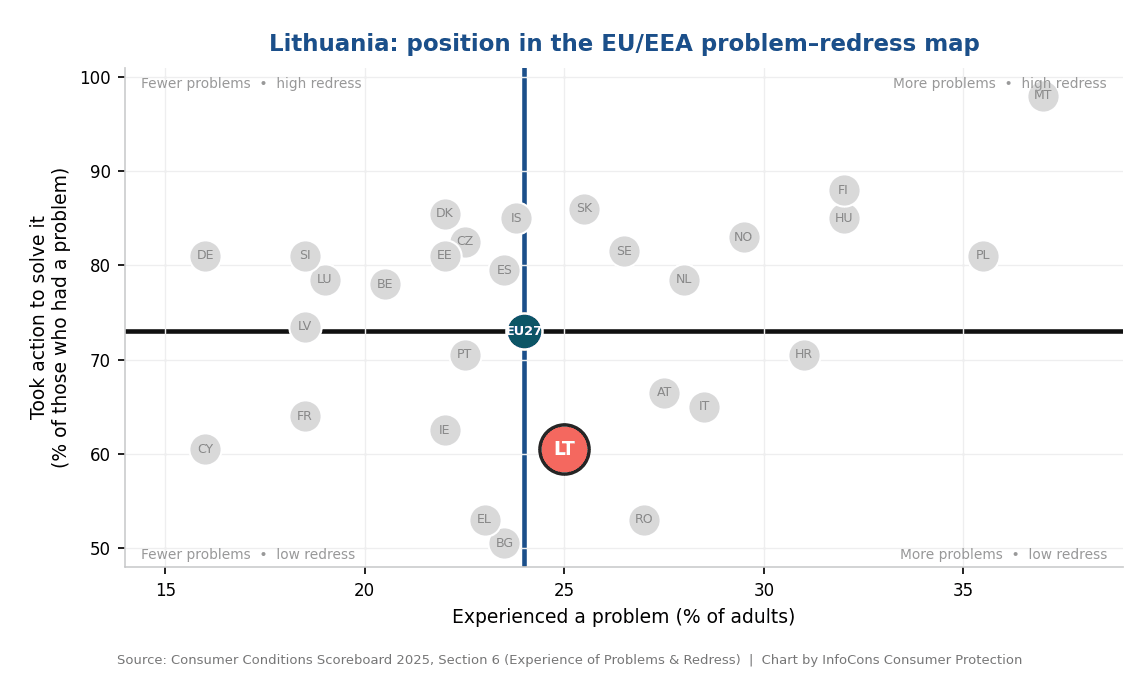
This is the most exposed position in the scoreboard: problems are more frequent than the EU average and the share of affected consumers who act to resolve them is below par — the combination that should most concern a newcomer. For an expat, exchange student or visiting academic, the practical takeaway is simple: keep proof of purchase, raise issues first with the retailer (the channel four in five Europeans use), and — for cross-border purchases inside the EU/EEA — remember that the European Consumer Centres Network can step in for free.
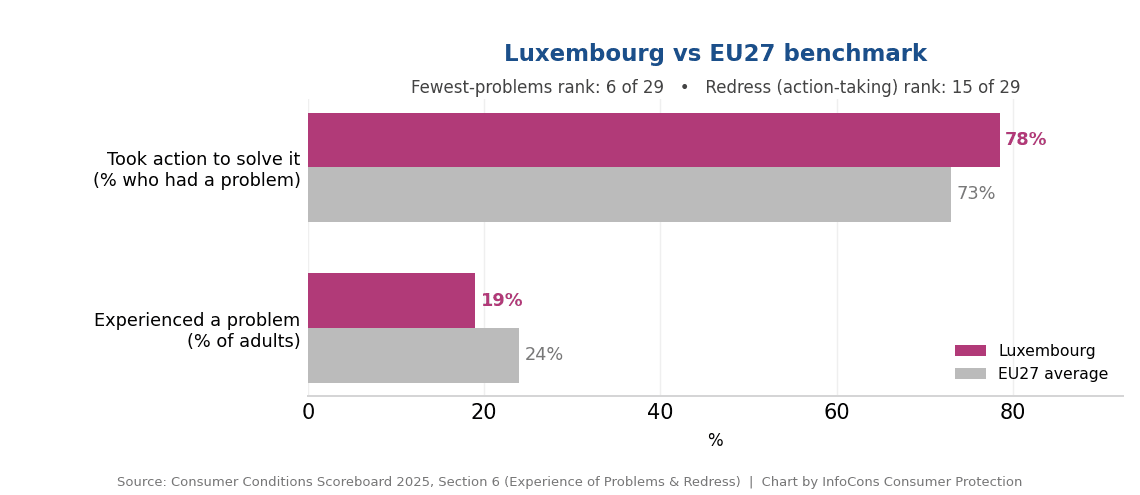
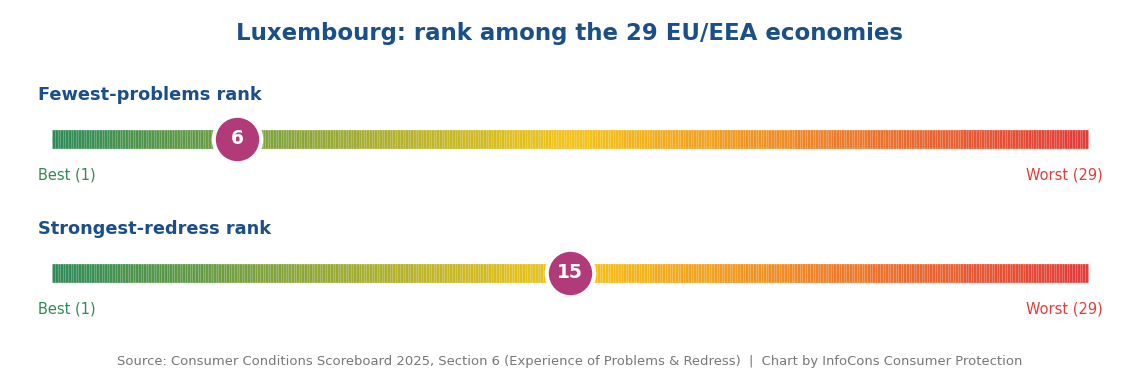
Luxembourg — InfoCons Consumer Protection Country Profile
About 19% of adults in Luxembourg report having hit a problem with a domestic trader in the past 12 months that they felt was worth complaining about — 5 percentage points below the EU27 average of 24%, and the 6th fewest-problem reading among the 29 EU/EEA economies in the scoreboard. When something does go wrong, roughly 78% of affected consumers take action to resolve it, 6 percentage points above the EU27 benchmark of 73% and the 15th strongest redress reflex in the panel. In short, Luxembourg combines fewer problems and a strong redress reflex.
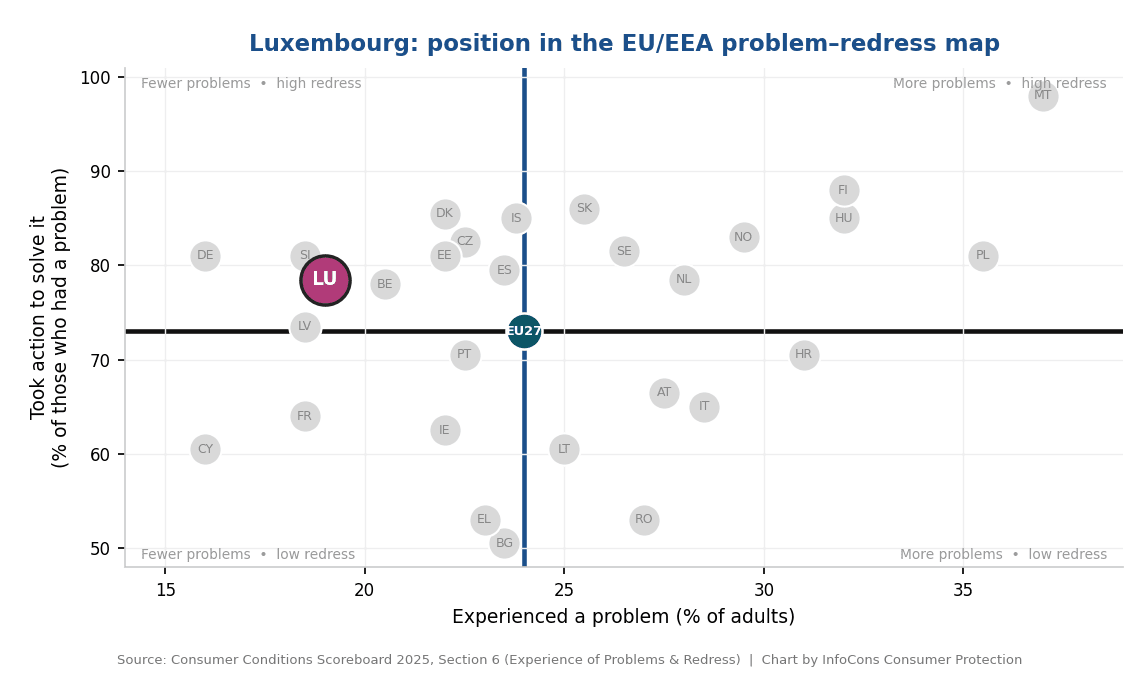
This is the most reassuring blend in the scoreboard: consumers here run into trouble less often than the EU average and, when they do, a large majority act to put it right. For an expat, exchange student or visiting academic, the practical takeaway is simple: keep proof of purchase, raise issues first with the retailer (the channel four in five Europeans use), and — for cross-border purchases inside the EU/EEA — remember that the European Consumer Centres Network can step in for free.
Malta — InfoCons Consumer Protection Country Profile
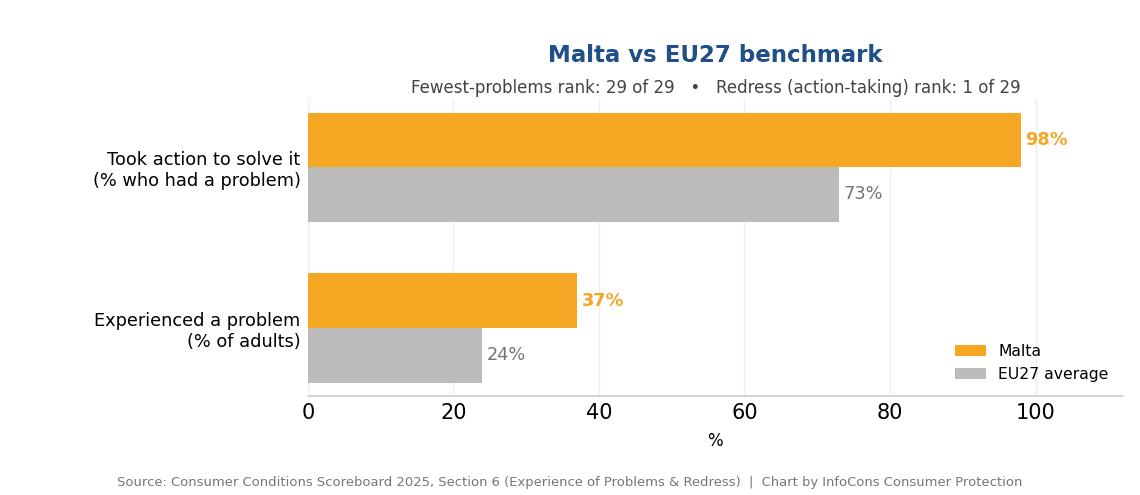
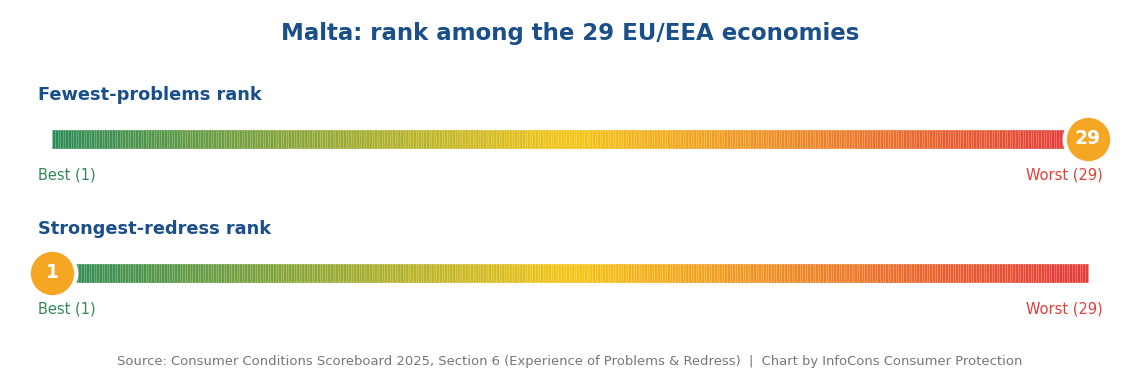
About 37% of adults in Malta report having hit a problem with a domestic trader in the past 12 months that they felt was worth complaining about — 13 percentage points above the EU27 average of 24%, and the 29th fewest-problem reading among the 29 EU/EEA economies in the scoreboard. When something does go wrong, roughly 98% of affected consumers take action to resolve it, 25 percentage points above the EU27 benchmark of 73% and the 1st strongest redress reflex in the panel. In short, Malta combines more problems but a decisive redress response.
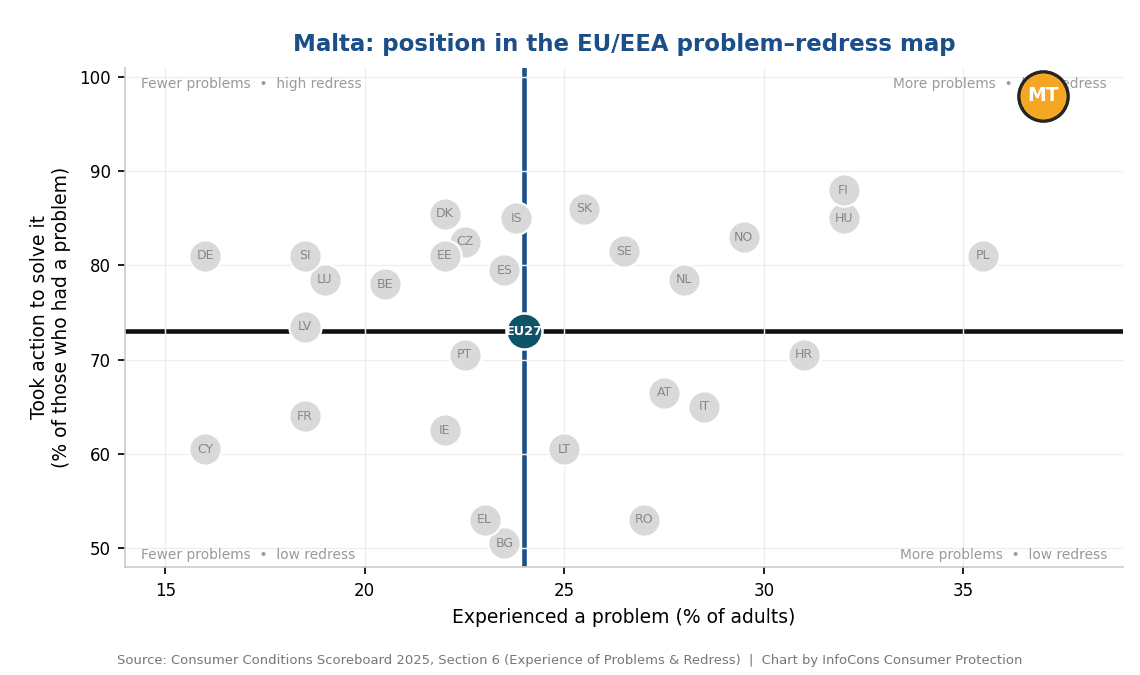
Consumers here report problems more often than the EU average, but they are also among the most likely to act — an active complaint culture that keeps pressure on traders. For an expat, exchange student or visiting academic, the practical takeaway is simple: keep proof of purchase, raise issues first with the retailer (the channel four in five Europeans use), and — for cross-border purchases inside the EU/EEA — remember that the European Consumer Centres Network can step in for free.
Netherlands — InfoCons Consumer Protection Country Profile
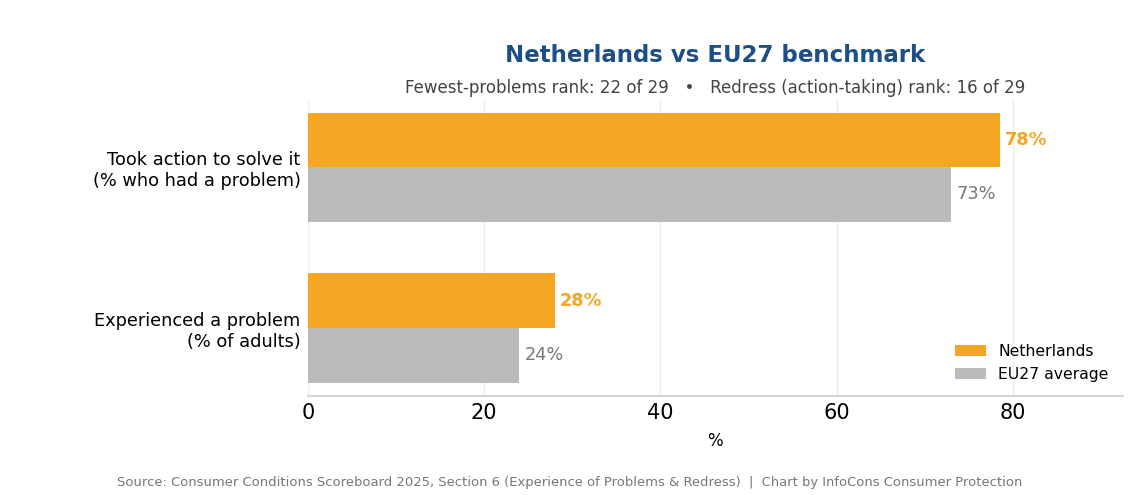
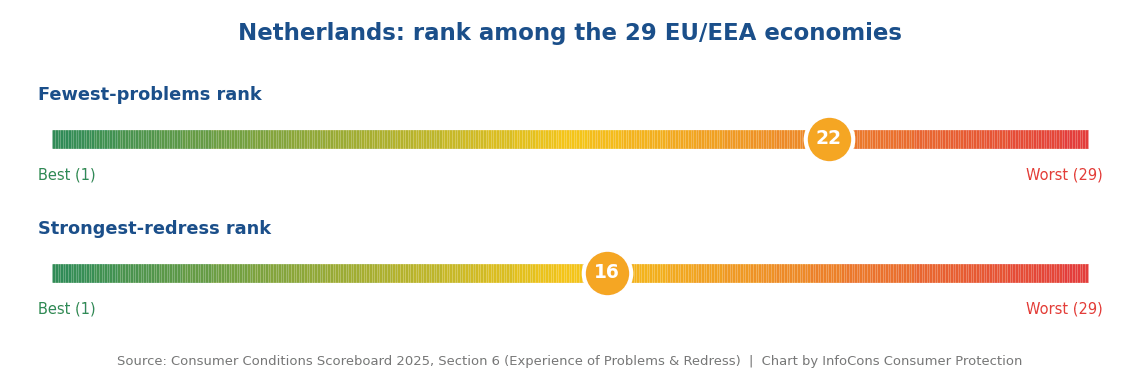
About 28% of adults in Netherlands report having hit a problem with a domestic trader in the past 12 months that they felt was worth complaining about — 4 percentage points above the EU27 average of 24%, and the 22nd fewest-problem reading among the 29 EU/EEA economies in the scoreboard. When something does go wrong, roughly 78% of affected consumers take action to resolve it, 6 percentage points above the EU27 benchmark of 73% and the 16th strongest redress reflex in the panel. In short, Netherlands combines more problems but a decisive redress response.
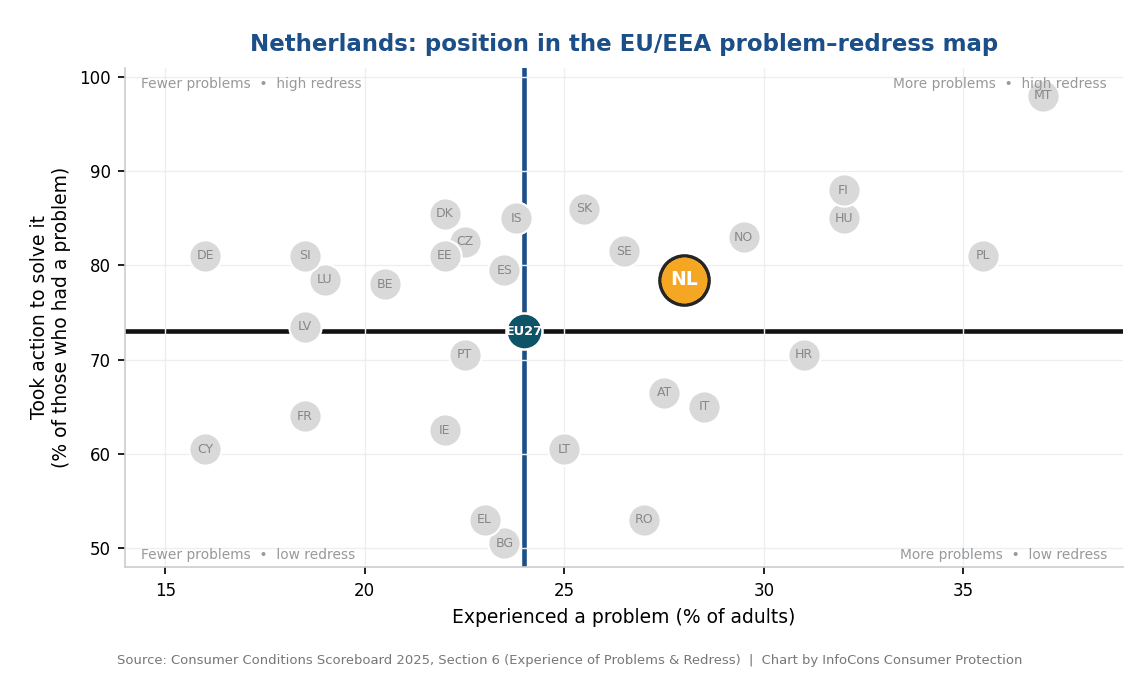
Consumers here report problems more often than the EU average, but they are also among the most likely to act — an active complaint culture that keeps pressure on traders. For an expat, exchange student or visiting academic, the practical takeaway is simple: keep proof of purchase, raise issues first with the retailer (the channel four in five Europeans use), and — for cross-border purchases inside the EU/EEA — remember that the European Consumer Centres Network can step in for free.
Norway — InfoCons Consumer Protection Country Profile
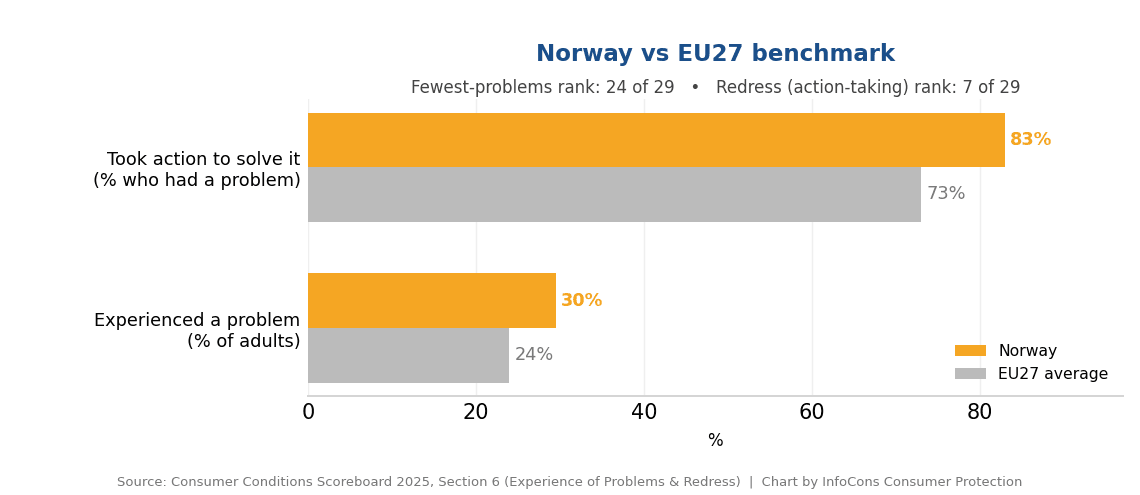
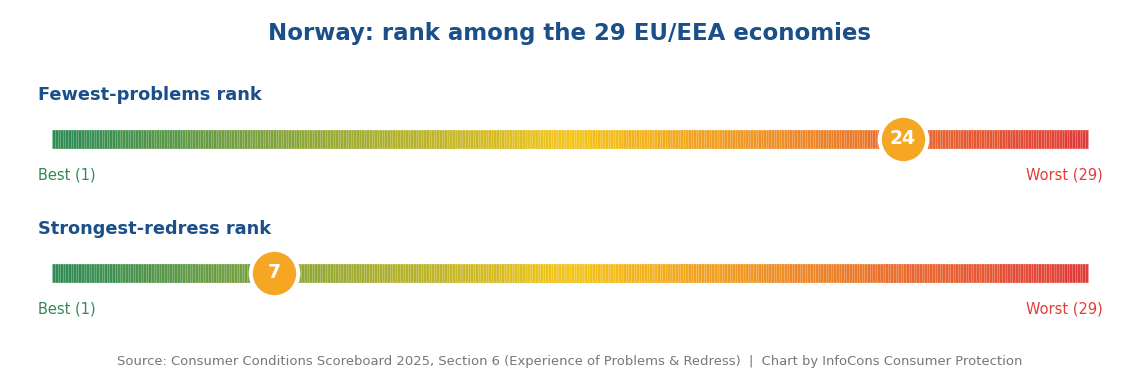
About 30% of adults in Norway report having hit a problem with a domestic trader in the past 12 months that they felt was worth complaining about — 6 percentage points above the EU27 average of 24%, and the 24th fewest-problem reading among the 29 EU/EEA economies in the scoreboard. When something does go wrong, roughly 83% of affected consumers take action to resolve it, 10 percentage points above the EU27 benchmark of 73% and the 7th strongest redress reflex in the panel. In short, Norway combines more problems but a decisive redress response.
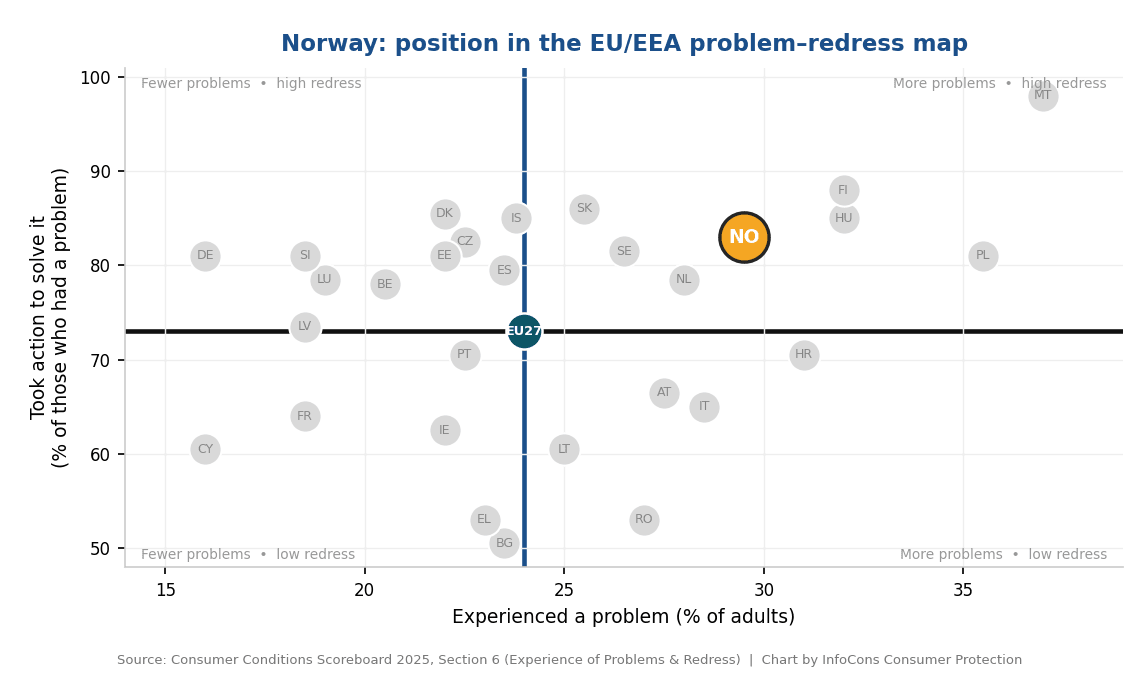
Consumers here report problems more often than the EU average, but they are also among the most likely to act — an active complaint culture that keeps pressure on traders. For an expat, exchange student or visiting academic, the practical takeaway is simple: keep proof of purchase, raise issues first with the retailer (the channel four in five Europeans use), and — for cross-border purchases inside the EU/EEA — remember that the European Consumer Centres Network can step in for free.
Poland — InfoCons Consumer Protection Country Profile
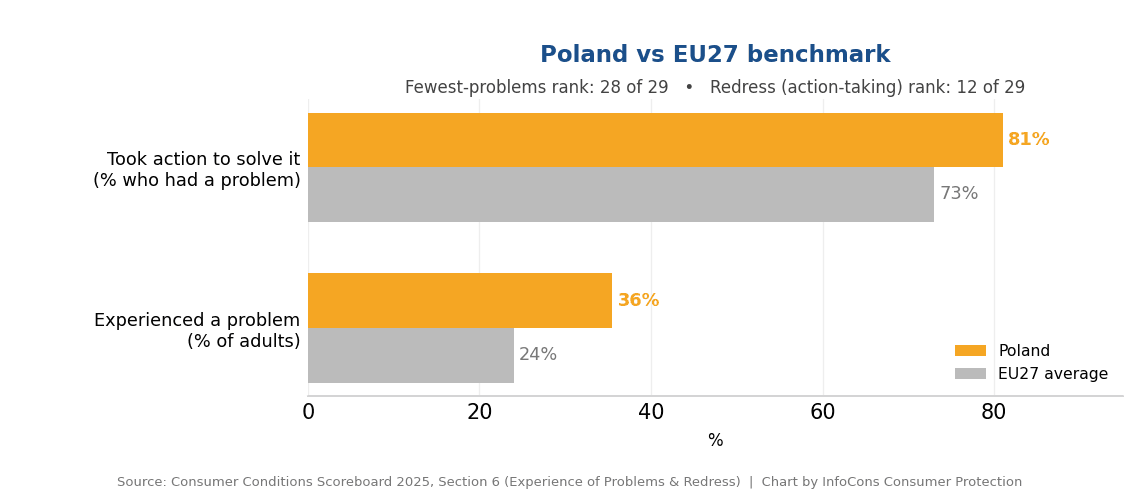
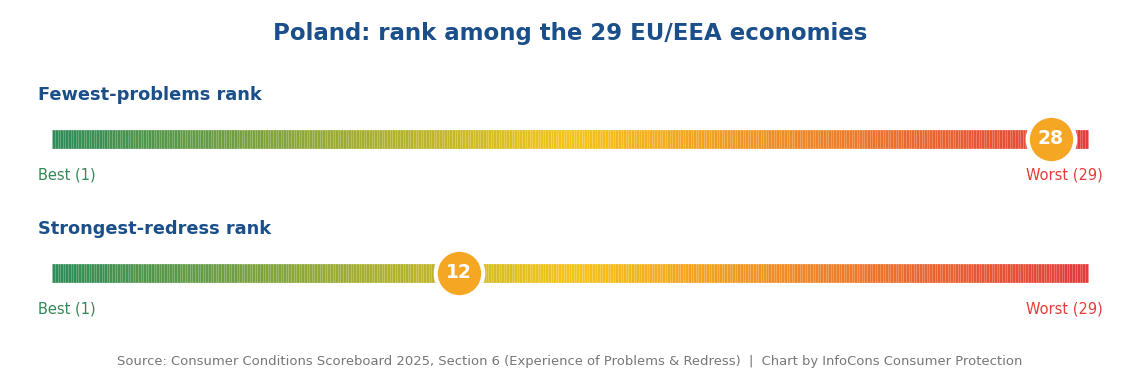
About 36% of adults in Poland report having hit a problem with a domestic trader in the past 12 months that they felt was worth complaining about — 12 percentage points above the EU27 average of 24%, and the 28th fewest-problem reading among the 29 EU/EEA economies in the scoreboard. When something does go wrong, roughly 81% of affected consumers take action to resolve it, 8 percentage points above the EU27 benchmark of 73% and the 12th strongest redress reflex in the panel. In short, Poland combines more problems but a decisive redress response.
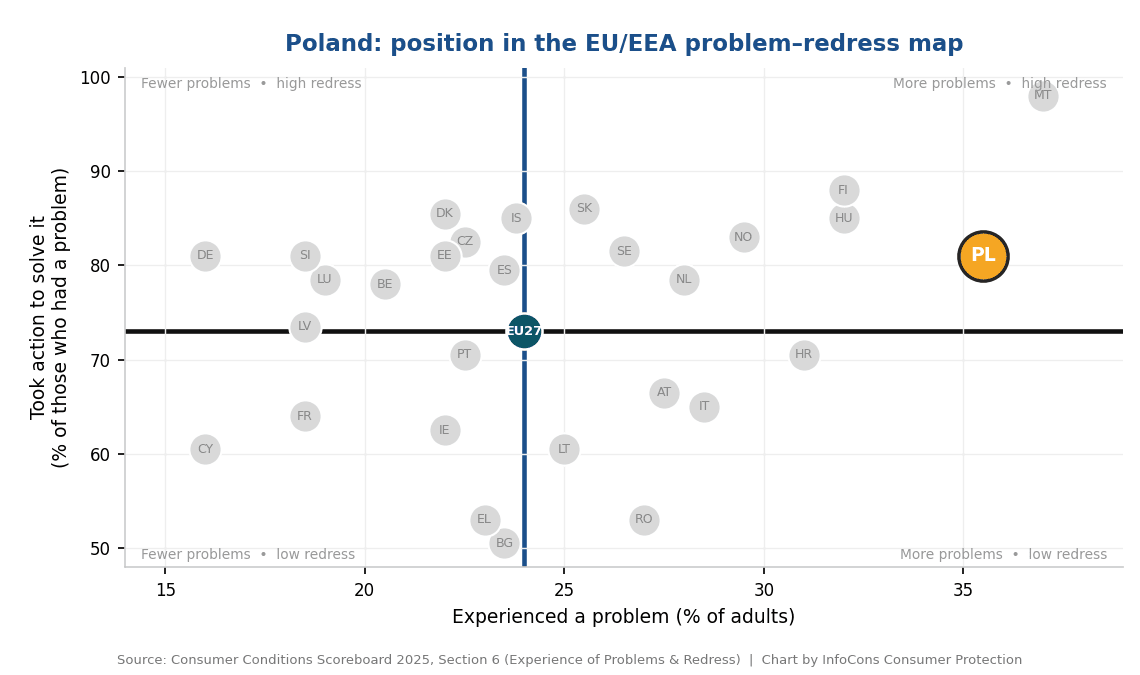
Consumers here report problems more often than the EU average, but they are also among the most likely to act — an active complaint culture that keeps pressure on traders. For an expat, exchange student or visiting academic, the practical takeaway is simple: keep proof of purchase, raise issues first with the retailer (the channel four in five Europeans use), and — for cross-border purchases inside the EU/EEA — remember that the European Consumer Centres Network can step in for free.
Portugal — InfoCons Consumer Protection Country Profile
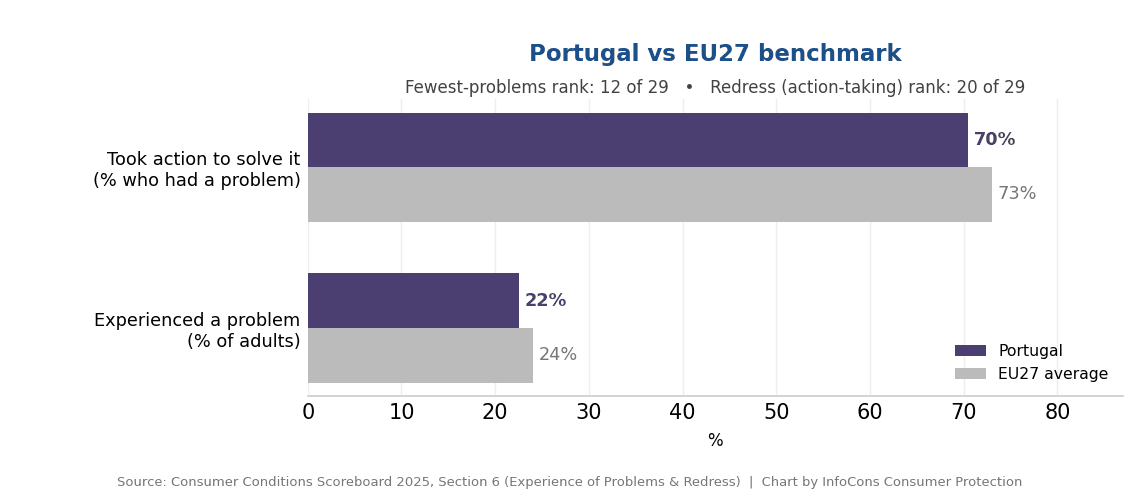
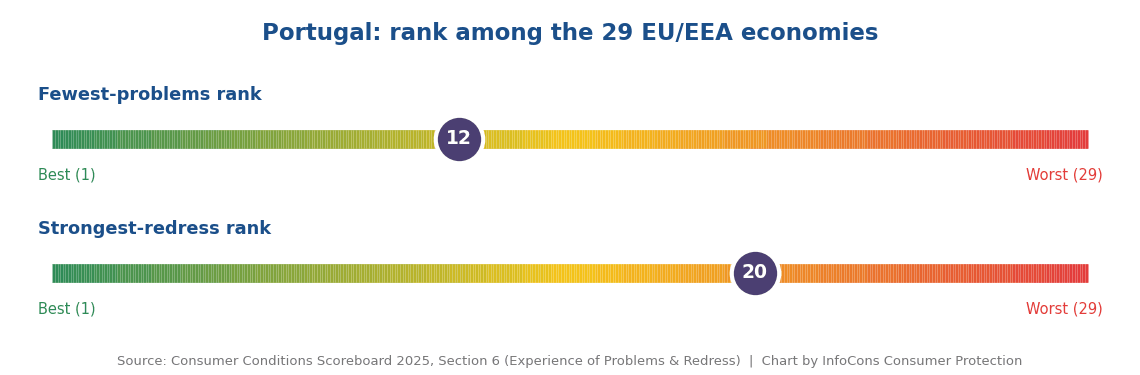
About 22% of adults in Portugal report having hit a problem with a domestic trader in the past 12 months that they felt was worth complaining about — 2 percentage points below the EU27 average of 24%, and the 12th fewest-problem reading among the 29 EU/EEA economies in the scoreboard. When something does go wrong, roughly 70% of affected consumers take action to resolve it, 2 percentage points below the EU27 benchmark of 73% and the 20th strongest redress reflex in the panel. In short, Portugal combines fewer problems but a weaker tendency to seek redress.
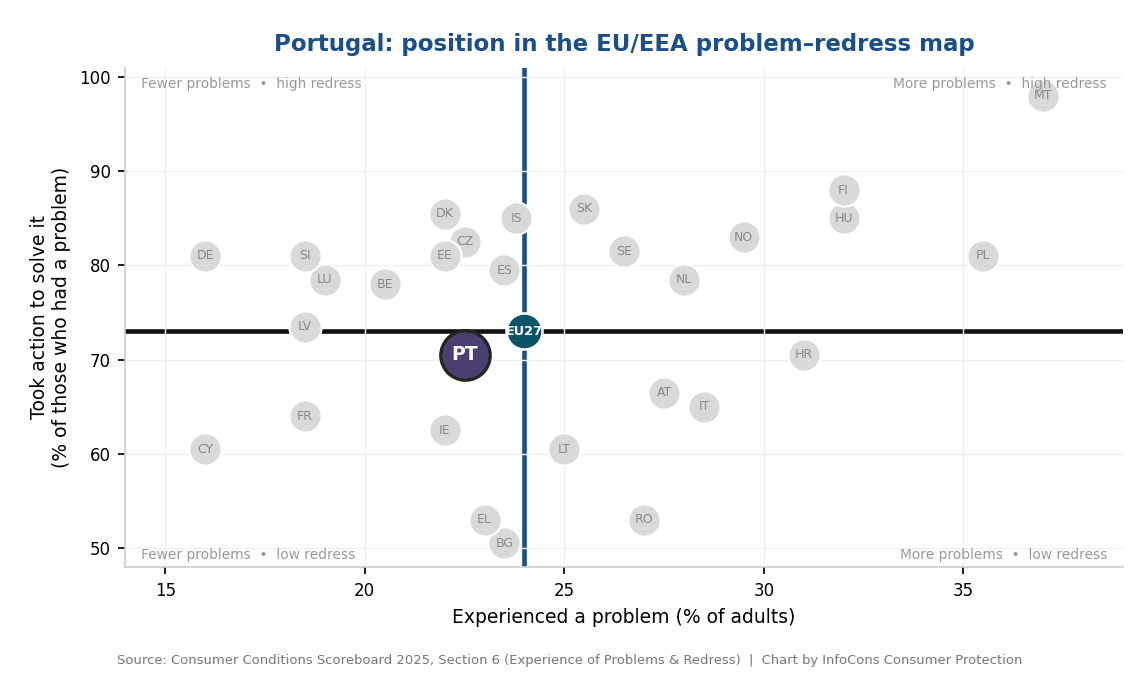
Trouble is comparatively rare here, yet affected consumers are noticeably less likely than the EU average to chase a remedy — a sign that practical or informational barriers may be holding people back. For an expat, exchange student or visiting academic, the practical takeaway is simple: keep proof of purchase, raise issues first with the retailer (the channel four in five Europeans use), and — for cross-border purchases inside the EU/EEA — remember that the European Consumer Centres Network can step in for free.
Romania — InfoCons Consumer Protection Country Profile
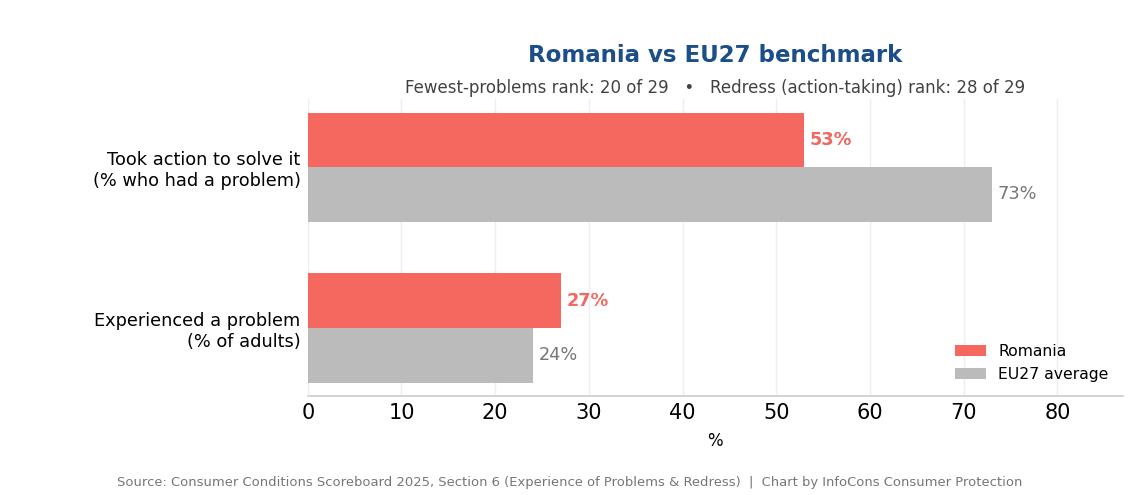
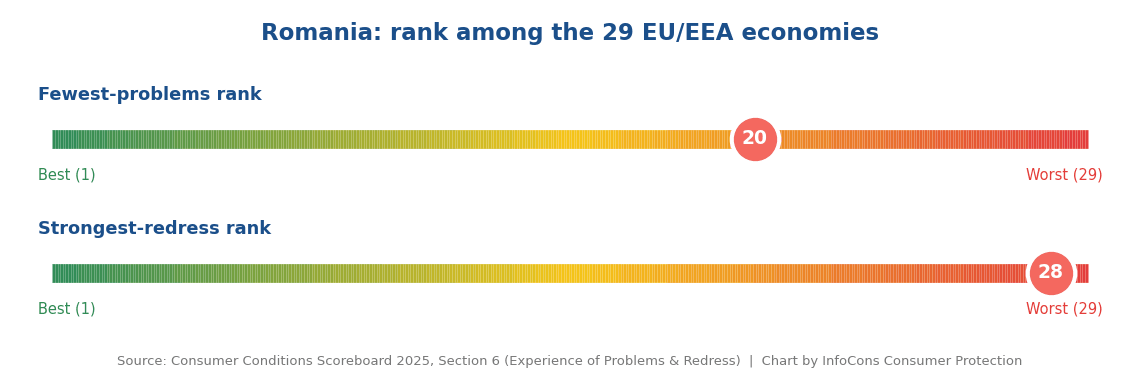
About 27% of adults in Romania report having hit a problem with a domestic trader in the past 12 months that they felt was worth complaining about — 3 percentage points above the EU27 average of 24%, and the 20th fewest-problem reading among the 29 EU/EEA economies in the scoreboard. When something does go wrong, roughly 53% of affected consumers take action to resolve it, 20 percentage points below the EU27 benchmark of 73% and the 28th strongest redress reflex in the panel. In short, Romania combines more problems and a weaker redress response.
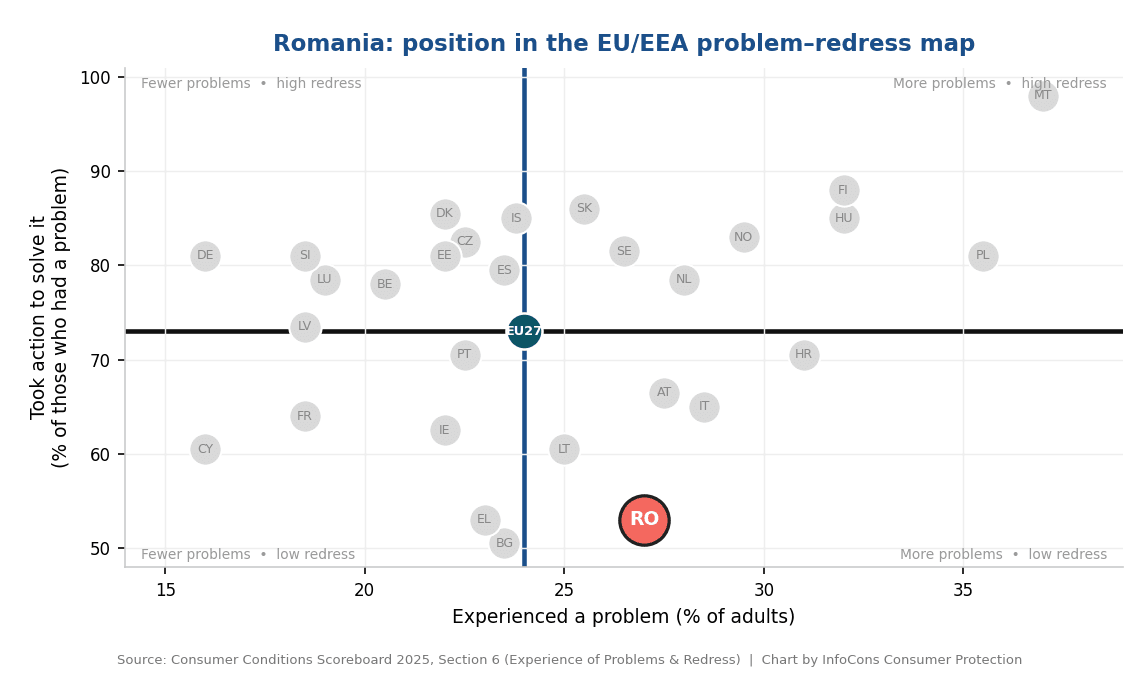
This is the most exposed position in the scoreboard: problems are more frequent than the EU average and the share of affected consumers who act to resolve them is below par — the combination that should most concern a newcomer. Romania is singled out in the scoreboard as one of the Member States where satisfaction with retailers’ handling of complaints dropped most steeply between 2022 and 2024. For an expat, exchange student or visiting academic, the practical takeaway is simple: keep proof of purchase, raise issues first with the retailer (the channel four in five Europeans use), and — for cross-border purchases inside the EU/EEA — remember that the European Consumer Centres Network can step in for free.
Slovakia — InfoCons Consumer Protection Country Profile
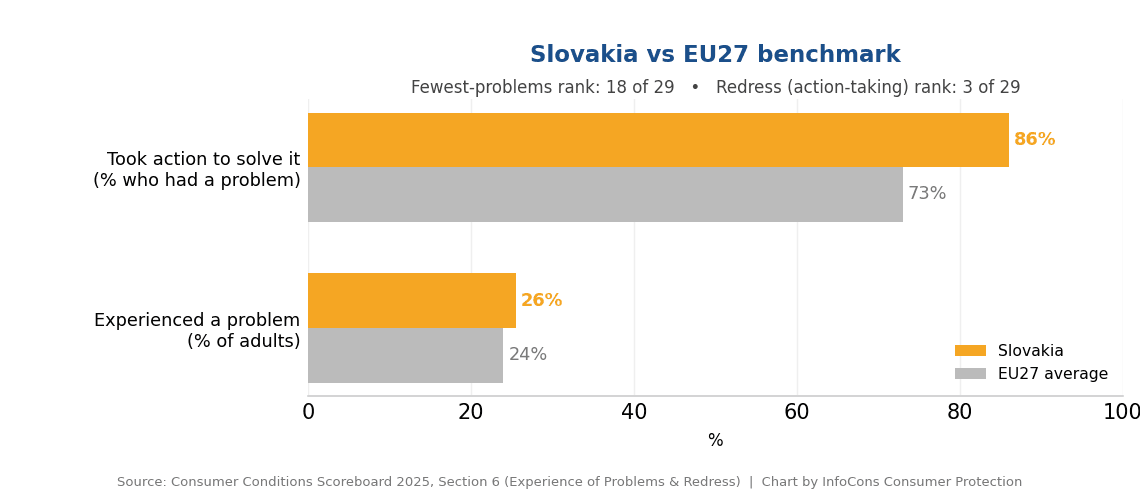
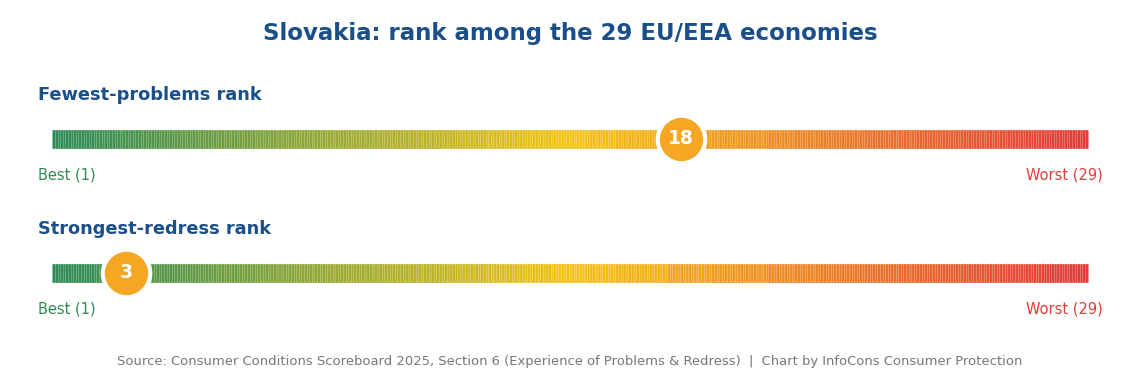
About 26% of adults in Slovakia report having hit a problem with a domestic trader in the past 12 months that they felt was worth complaining about — 2 percentage points above the EU27 average of 24%, and the 18th fewest-problem reading among the 29 EU/EEA economies in the scoreboard. When something does go wrong, roughly 86% of affected consumers take action to resolve it, 13 percentage points above the EU27 benchmark of 73% and the 3rd strongest redress reflex in the panel. In short, Slovakia combines more problems but a decisive redress response.
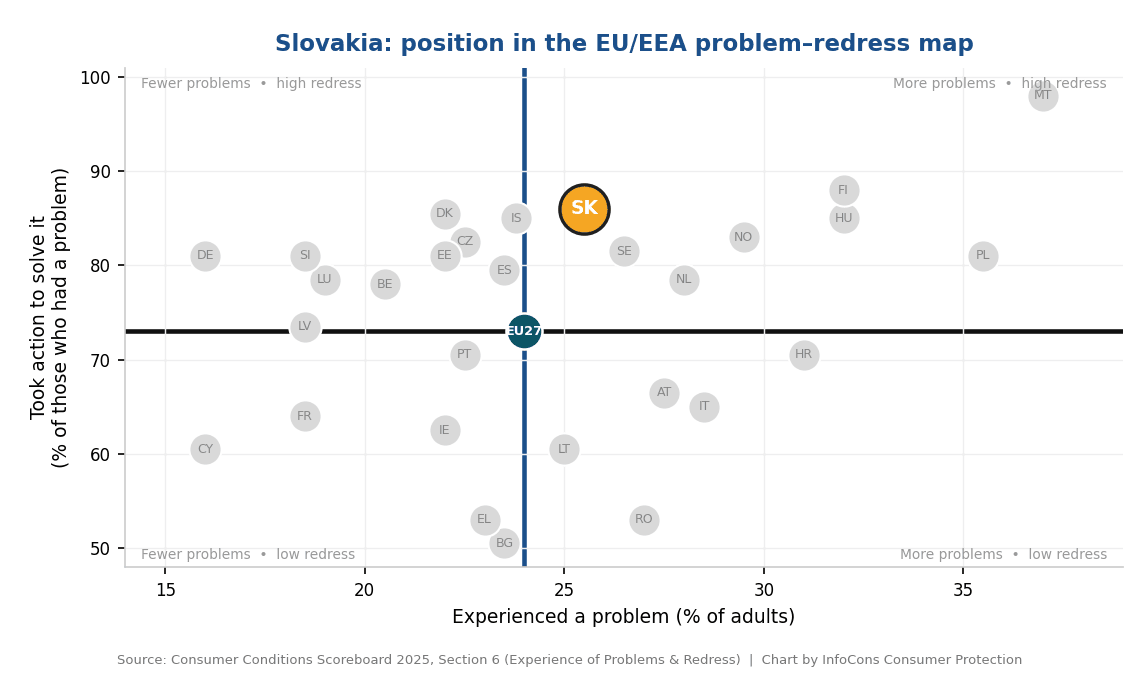
Consumers here report problems more often than the EU average, but they are also among the most likely to act — an active complaint culture that keeps pressure on traders. For an expat, exchange student or visiting academic, the practical takeaway is simple: keep proof of purchase, raise issues first with the retailer (the channel four in five Europeans use), and — for cross-border purchases inside the EU/EEA — remember that the European Consumer Centres Network can step in for free.
Slovenia — InfoCons Consumer Protection Country Profile
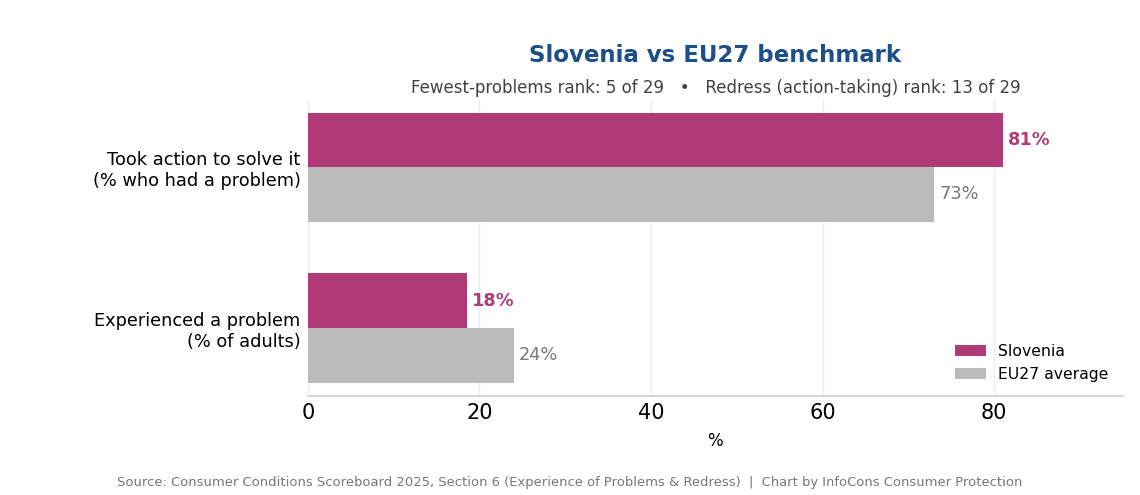
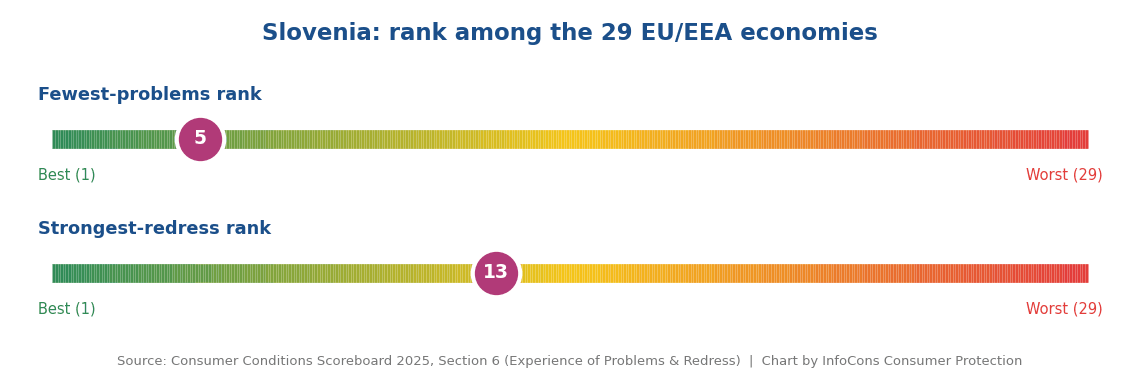
About 18% of adults in Slovenia report having hit a problem with a domestic trader in the past 12 months that they felt was worth complaining about — 6 percentage points below the EU27 average of 24%, and the 5th fewest-problem reading among the 29 EU/EEA economies in the scoreboard. When something does go wrong, roughly 81% of affected consumers take action to resolve it, 8 percentage points above the EU27 benchmark of 73% and the 13th strongest redress reflex in the panel. In short, Slovenia combines fewer problems and a strong redress reflex.
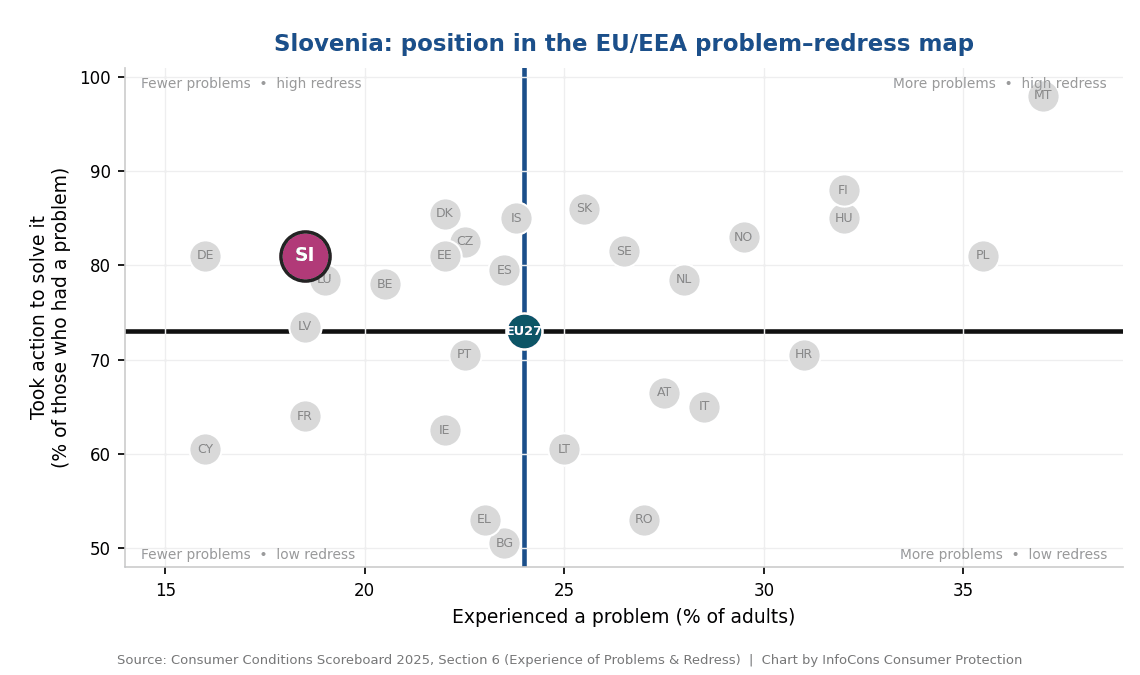
This is the most reassuring blend in the scoreboard: consumers here run into trouble less often than the EU average and, when they do, a large majority act to put it right. For an expat, exchange student or visiting academic, the practical takeaway is simple: keep proof of purchase, raise issues first with the retailer (the channel four in five Europeans use), and — for cross-border purchases inside the EU/EEA — remember that the European Consumer Centres Network can step in for free.
Spain — InfoCons Consumer Protection Country Profile
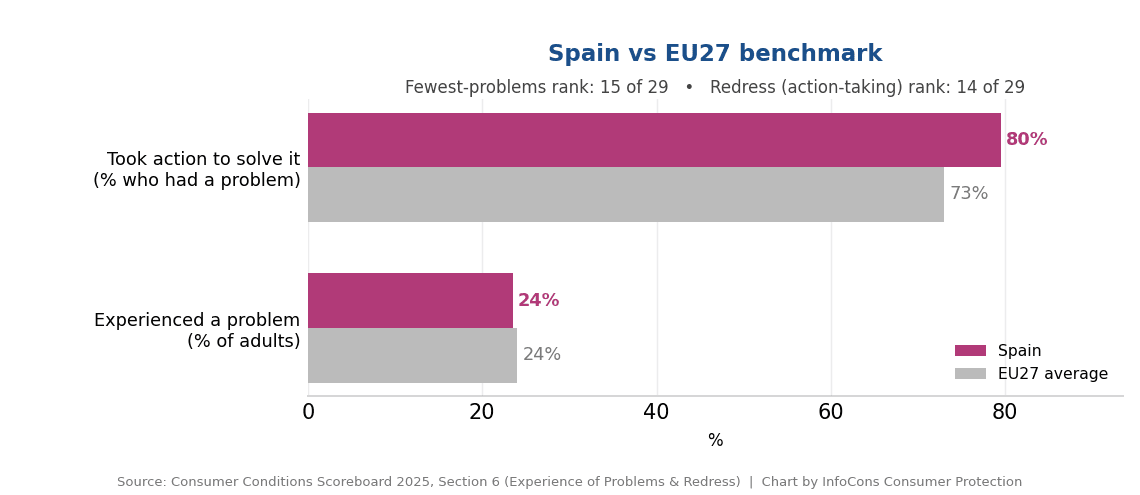
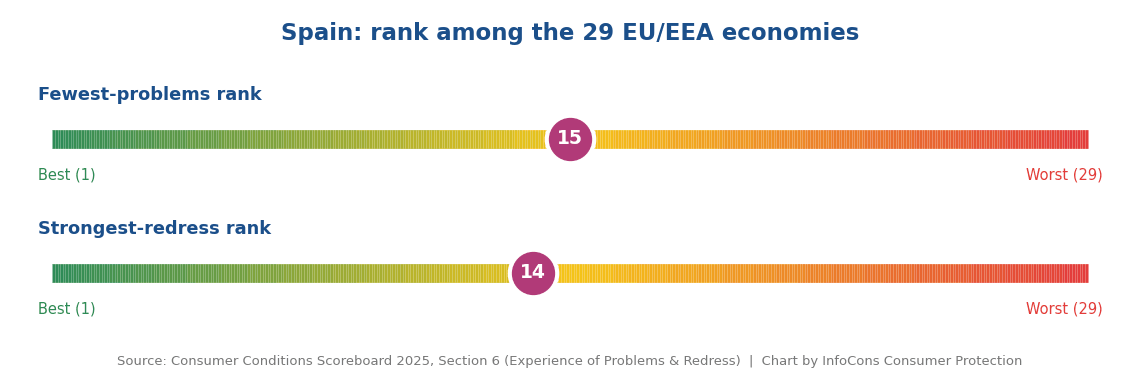
About 24% of adults in Spain report having hit a problem with a domestic trader in the past 12 months that they felt was worth complaining about — 0 percentage points below the EU27 average of 24%, and the 15th fewest-problem reading among the 29 EU/EEA economies in the scoreboard. When something does go wrong, roughly 80% of affected consumers take action to resolve it, 6 percentage points above the EU27 benchmark of 73% and the 14th strongest redress reflex in the panel. In short, Spain combines fewer problems and a strong redress reflex.
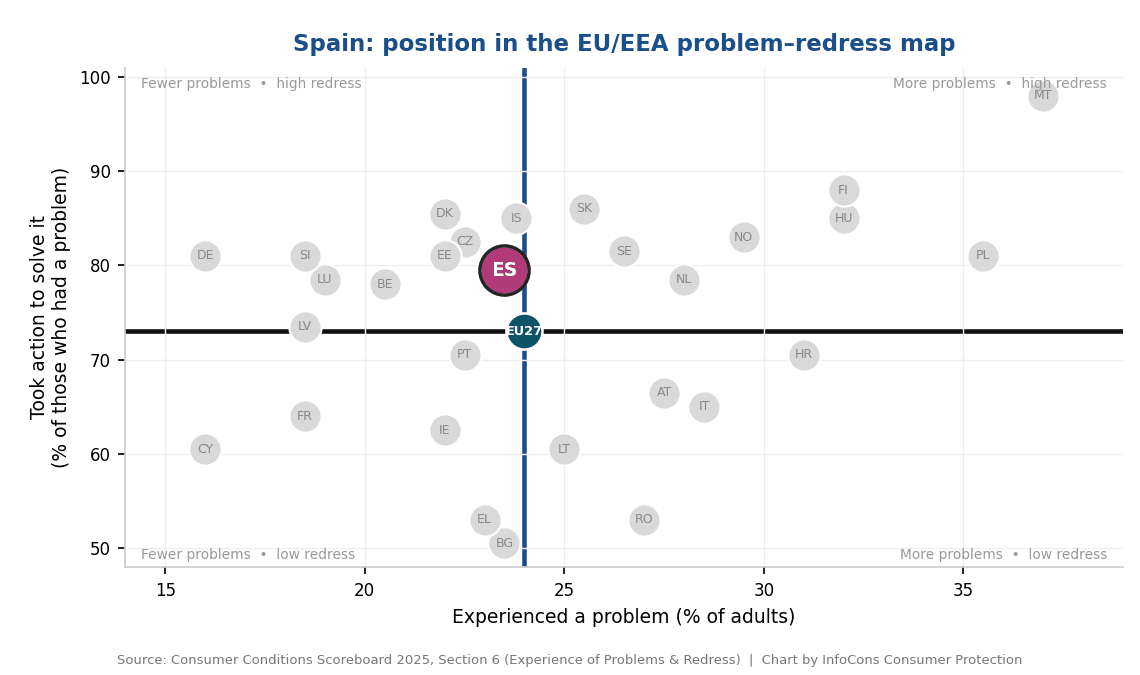
This is the most reassuring blend in the scoreboard: consumers here run into trouble less often than the EU average and, when they do, a large majority act to put it right. For an expat, exchange student or visiting academic, the practical takeaway is simple: keep proof of purchase, raise issues first with the retailer (the channel four in five Europeans use), and — for cross-border purchases inside the EU/EEA — remember that the European Consumer Centres Network can step in for free.
Sweden — InfoCons Consumer Protection Country Profile
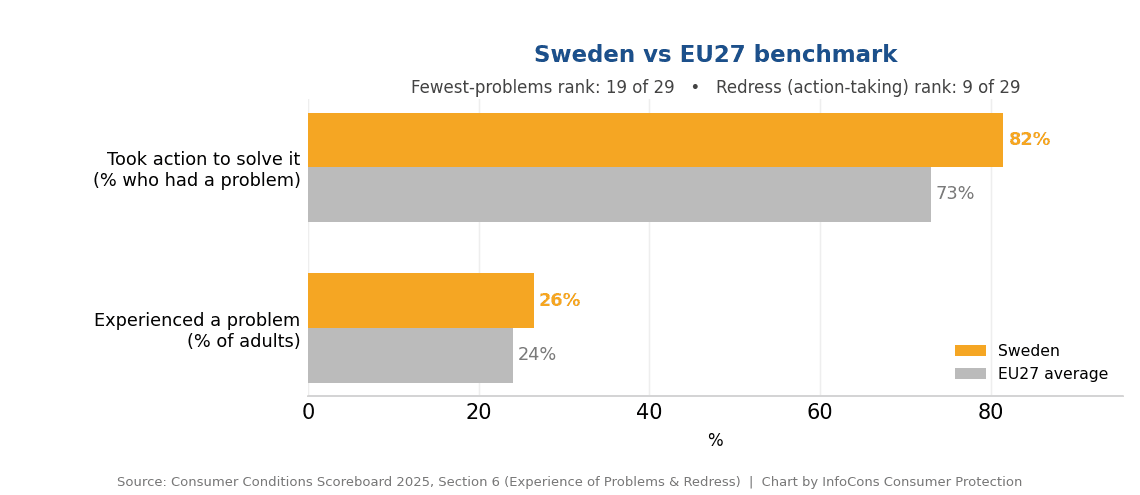
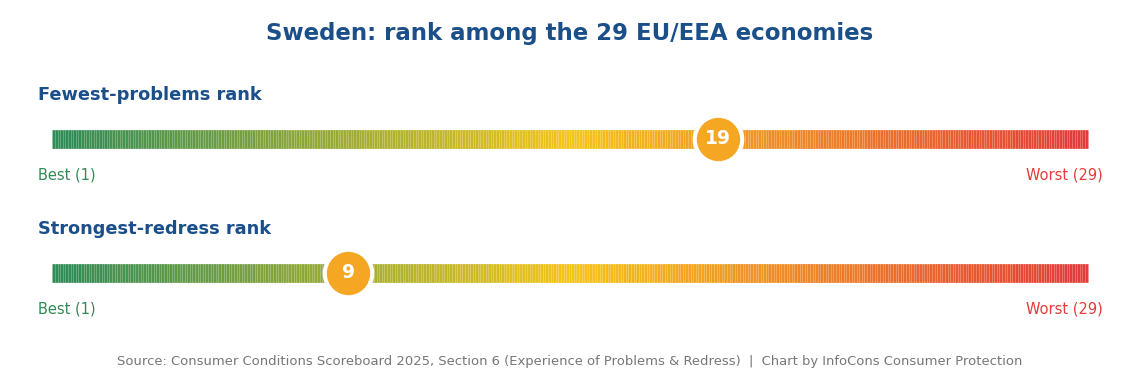
About 26% of adults in Sweden report having hit a problem with a domestic trader in the past 12 months that they felt was worth complaining about — 2 percentage points above the EU27 average of 24%, and the 19th fewest-problem reading among the 29 EU/EEA economies in the scoreboard. When something does go wrong, roughly 82% of affected consumers take action to resolve it, 8 percentage points above the EU27 benchmark of 73% and the 9th strongest redress reflex in the panel. In short, Sweden combines more problems but a decisive redress response.
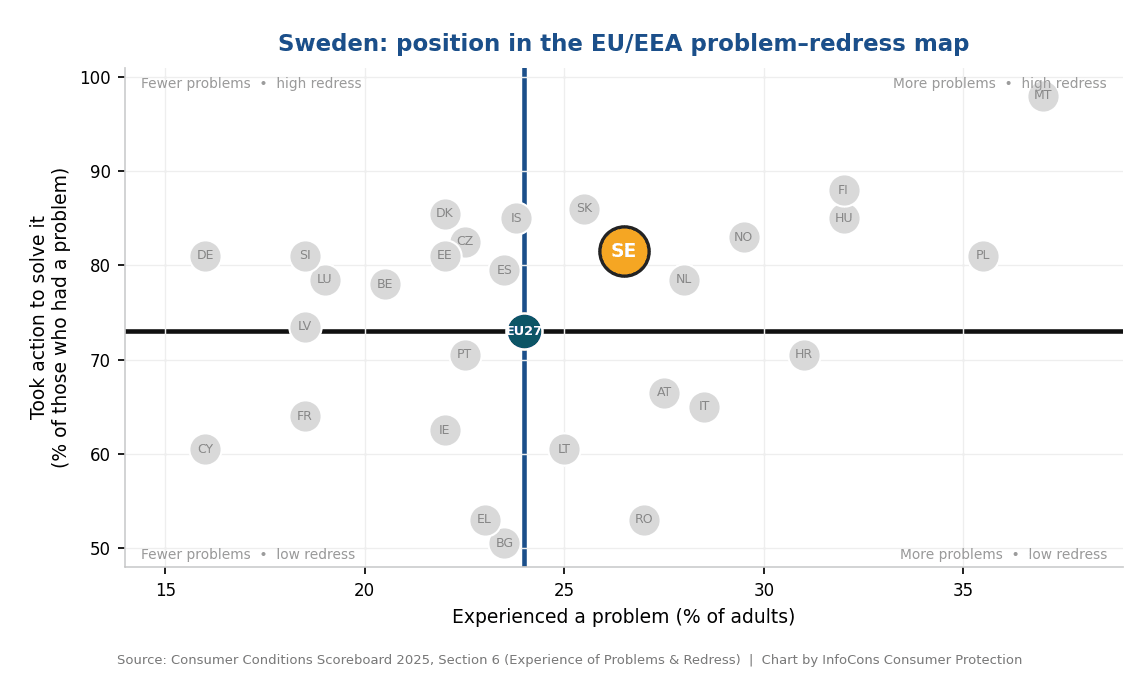
Consumers here report problems more often than the EU average, but they are also among the most likely to act — an active complaint culture that keeps pressure on traders. For an expat, exchange student or visiting academic, the practical takeaway is simple: keep proof of purchase, raise issues first with the retailer (the channel four in five Europeans use), and — for cross-border purchases inside the EU/EEA — remember that the European Consumer Centres Network can step in for free.
Closing Notes — InfoCons Consumer Protection
Three patterns run through the 2025 evidence. First, hitting a problem is not the same as being failed by the system — several high-problem countries also show the strongest habit of complaining and resolving. Second, the real fault line is redress behaviour: where consumers do not act, it is usually because the process feels too slow, too uncertain, or too unclear, not because they do not care. Third, the EU-wide slide in satisfaction with complaint handling is the trend worth watching, and the strongest argument for accessible, well-signposted consumer advice.
If you are living, studying or teaching away from home in the EU/EEA: keep receipts and order confirmations, raise problems first with the retailer, escalate to an ADR body or consumer association if needed, and — for cross-border purchases within the EU/EEA — use the European Consumer Centres Network, which assists free of charge.
Signature: InfoCons Consumer Protection Department