
Green Shopping Across Europe in 2025: About 4 in 10 People Now Think About the Planet When They Buy — See Where Your Country Stands
Every two years the European Union asks people in 29 countries (the 27 EU members plus Iceland and Norway) how they shop and how they treat the planet when they buy things. This guide takes one clear question from that survey and turns it into a simple, country-by-country picture. The question is: did the effect a product has on the planet change something you bought recently?
Across the EU, 43 out of every 100 people said yes — about 4 in 10. But the number is very different from country to country: from 62 out of 100 in Italy (about 6 in 10) down to 22 out of 100 in Bulgaria (about 1 in 5). Below we explain the big EU-wide findings first, then show where each country stands.
|
How to read this guide Every country has its own short entry with two pictures. Countries are listed from the most green-minded shoppers to the least. All the numbers come only from the green-shopping part of the EU’s Consumer Conditions Scoreboard 2025. When we say “43 out of 100” we mean the same thing as “43%”. |
1. Are Europeans Thinking About the Planet When They Shop? Less Than Before
The big news for 2025 is that fewer people are thinking about the planet when they shop. Across the EU, the number fell from 56 out of 100 in 2022 to 43 out of 100 in 2024 — a drop of 13 points in just two years. The fall happened in 23 of the 27 EU countries. People who are younger, better educated or better off are still the most likely to think about the planet when they buy.
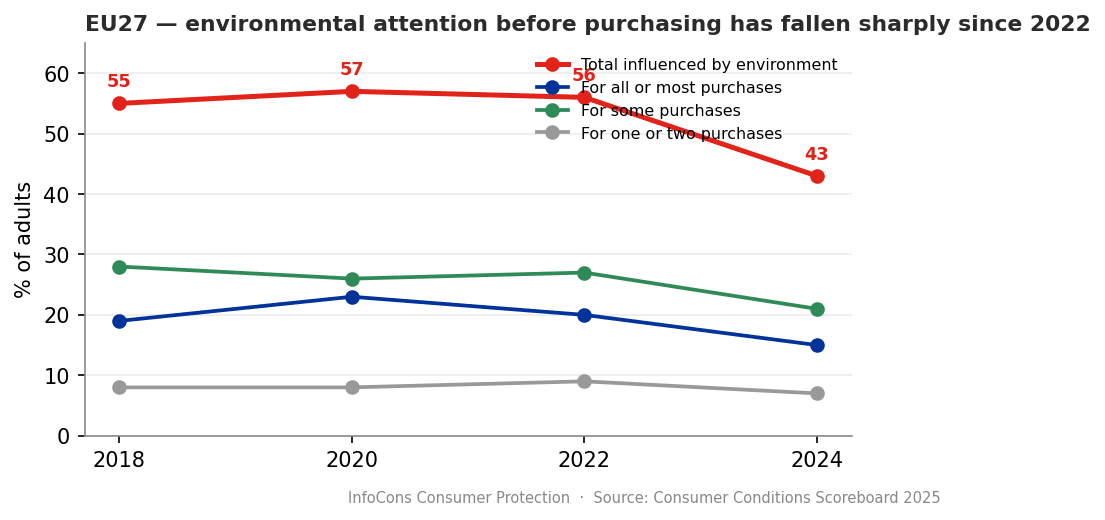
How the EU-wide number changed from 2018 to 2024.
|
What this picture shows — The red line at the top is the total share of people who think about the planet when they shop. It was steady near 55 out of 100 for years, then dropped sharply to 43 in 2024. The lower lines show how often they do it — for most purchases, some, or just one or two — and all of them went down. |
Behind the EU average there is a wide gap. The most green-minded shoppers are in Italy (62), Norway (61) and Austria (56). The least are in Bulgaria (22), Lithuania (23) and Estonia (30). That is a 40-point gap from top to bottom — so there is no single “European shopper”.
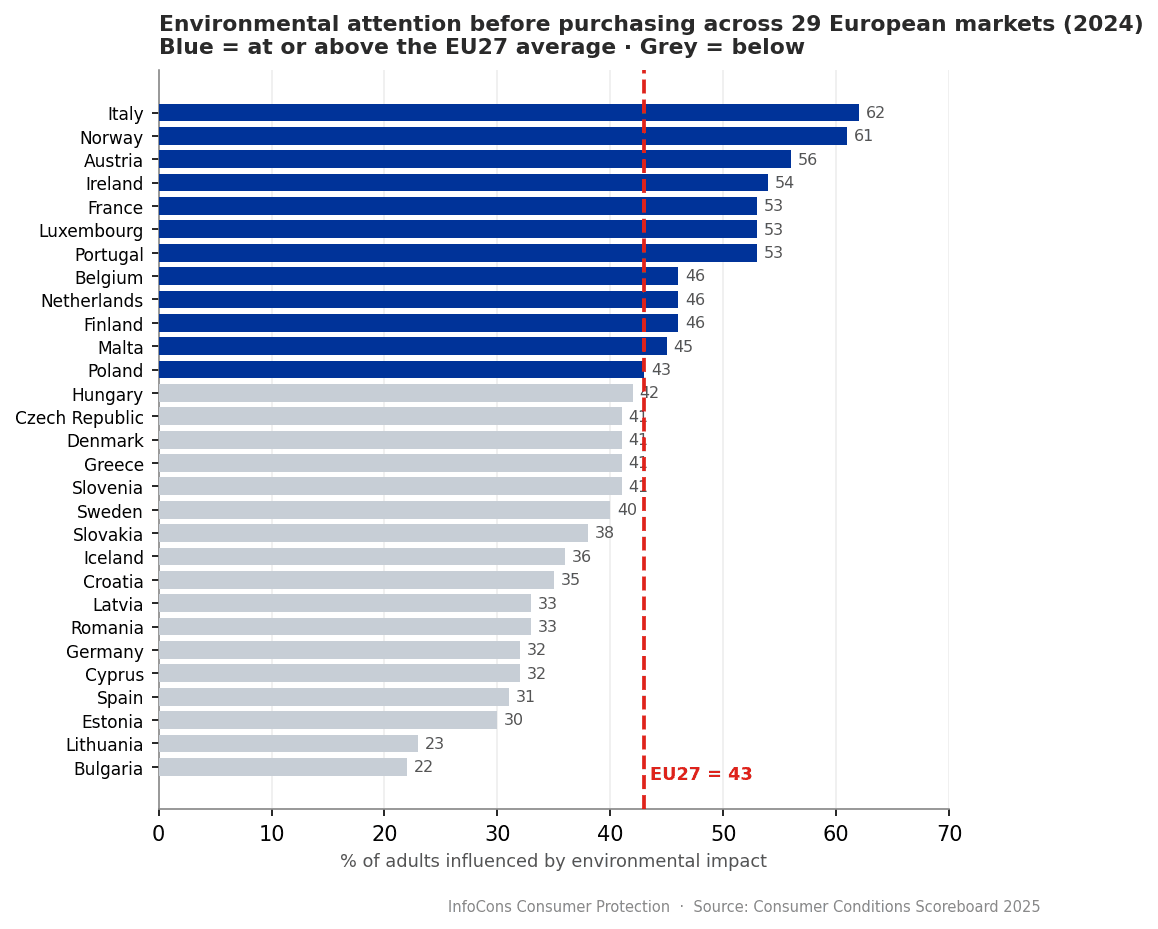
All 29 countries, highest to lowest. Blue bars beat the EU average of 43.
2. Why Don’t People Buy Green More Often? Mostly Price and Confusion
When people explain what stops them, the answers are practical, not lazy. The biggest reasons are simply about money and trust.
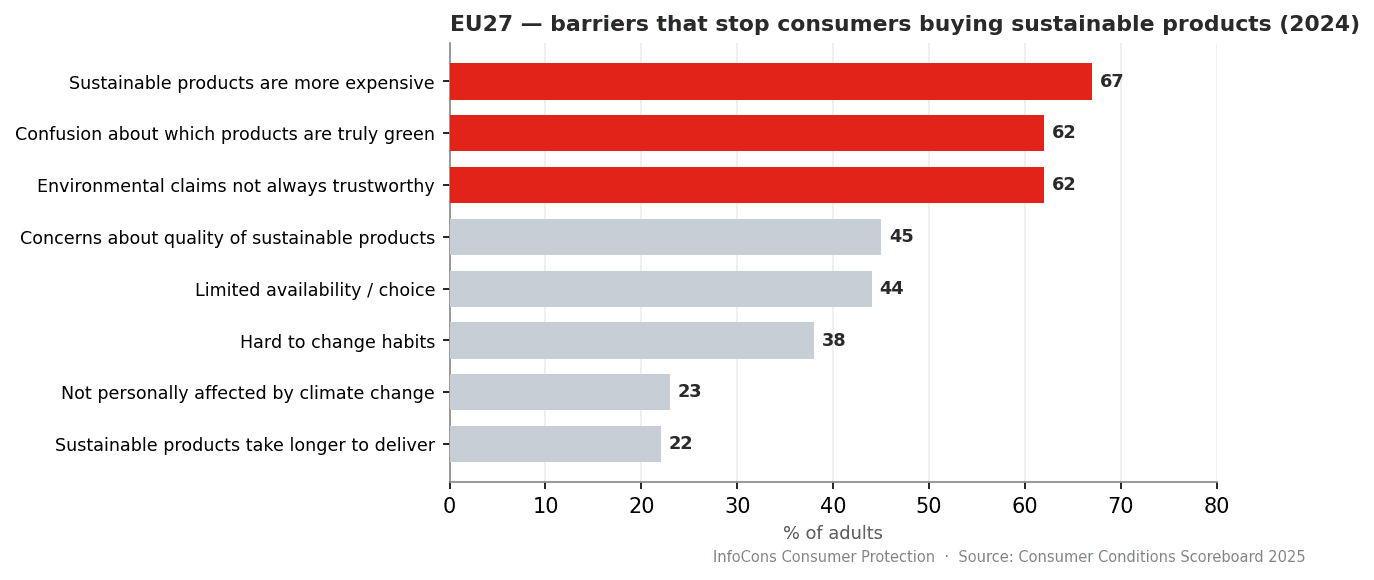
The main reasons people give for not buying green (EU-wide, 2024).
|
What this picture shows — 67 out of 100 people say green products cost too much. 62 say it is hard to know which products are really green, and 62 say they do not trust green claims. Worries about quality (45) and few choices in the shops (44) come next. Only 23 say they simply do not care. So the way to help is clearer, honest information and fairer prices. |
3. Do People Trust ‘Green’ Labels? Trust Has Dropped to Half
A green label only works if people believe it. Across the EU, fewer and fewer people do.
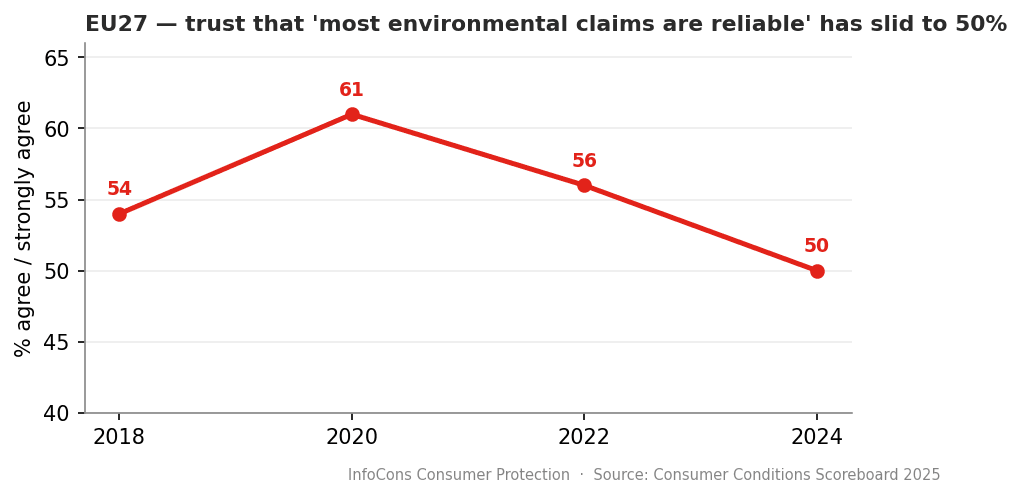
Share of people who believe most green claims (EU-wide).
|
What this picture shows — In 2020, 61 out of 100 people believed most green claims. By 2024 it was only 50 out of 100 — just half. The EU says France and Poland pushed this number down the most. The takeaway: even where many people care, weak trust in labels holds green shopping back. |
4. Repair It or Throw It Away? Cost Decides
Fixing things we already own is one of the easiest green choices. Here is what people across the EU do when something breaks after its guarantee ends.
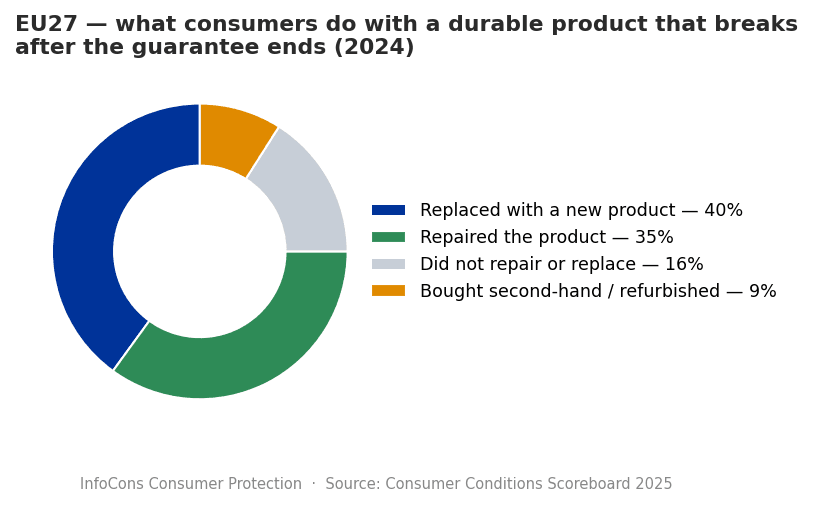
What people do with a broken phone, laptop or fridge (EU-wide, 2024).
|
What this picture shows — 40 out of 100 people buy a new one, 35 repair it, and only 9 buy a used or refurbished one. |
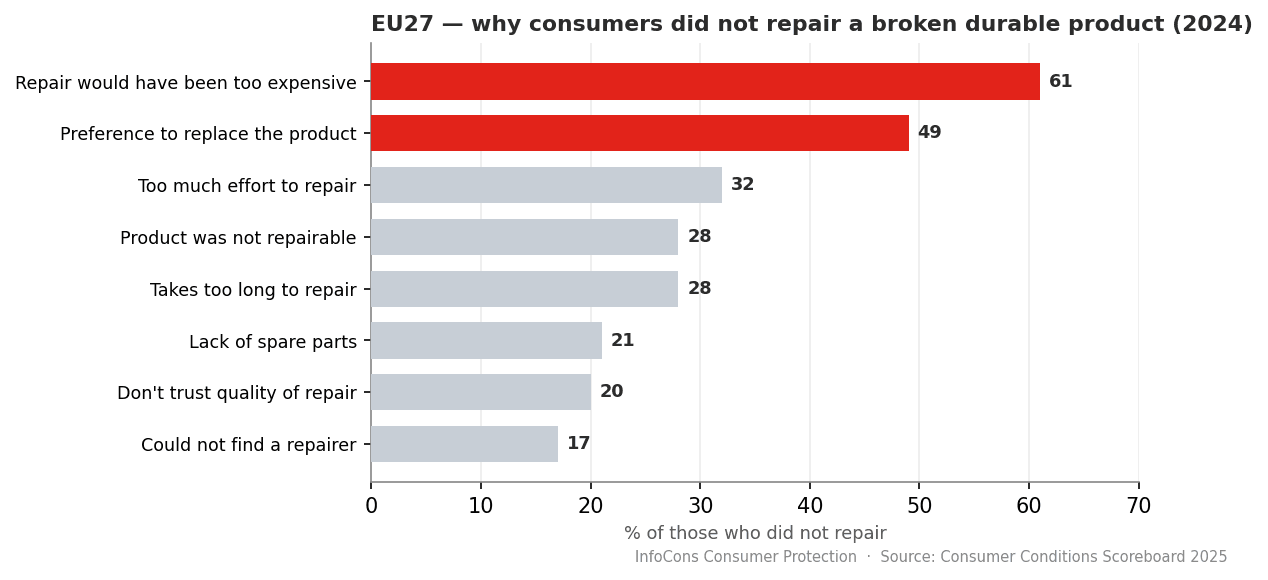
Why people did not repair their broken item (EU-wide, 2024).
|
What this picture shows — The main reason is cost: 61 out of 100 say repair was too expensive. 49 just preferred to buy new. Others say it took too long, the item could not be fixed, or there were no spare parts or repairers nearby. |
Where Each Country Stands, Best to Worst
Below are all 29 countries, from the most green-minded shoppers to the least. Each entry shows the score (out of 100), the place in Europe, and how it compares with the EU average of 43.
1. Italy — 62 out of 100 (about 6 in 10)
In Italy, 62 out of every 100 adults think about the planet when they shop — about 6 in 10. That is place 1 of 29 in Europe, and 19 points above the EU average of 43. 0 countries score higher and 28 score lower.
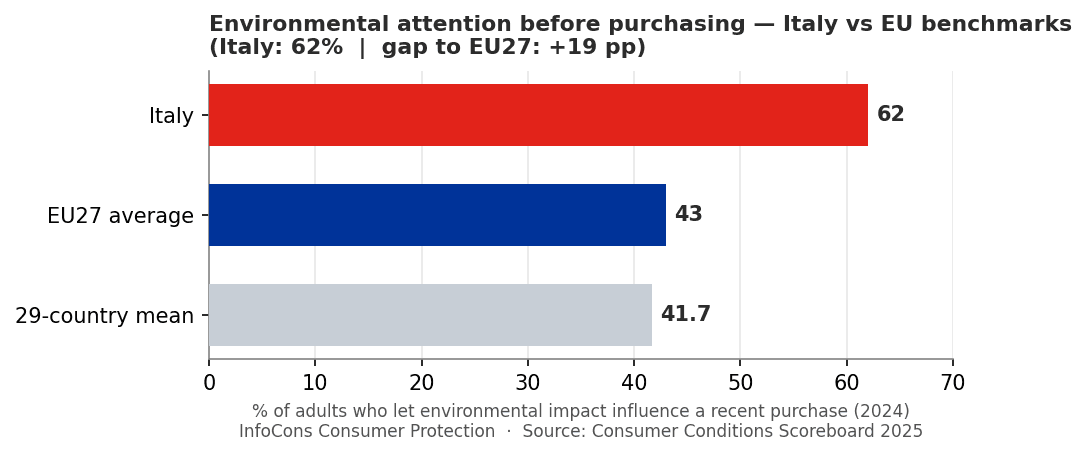
Italy (red) next to the EU average and the all-country average.
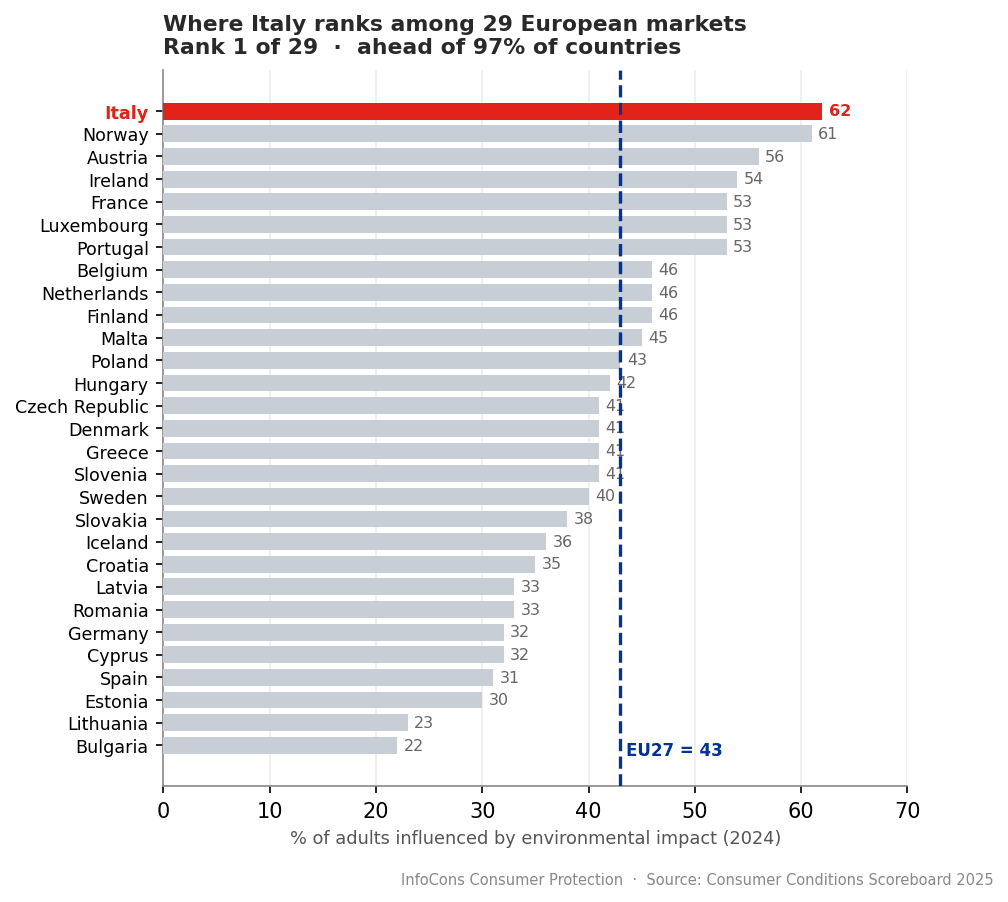
Where Italy sits among all 29 countries (dashed line = EU average).
2. Norway — 61 out of 100 (about 6 in 10)
In Norway, 61 out of every 100 adults think about the planet when they shop — about 6 in 10. That is place 2 of 29 in Europe, and 18 points above the EU average of 43. 1 countries score higher and 27 score lower.
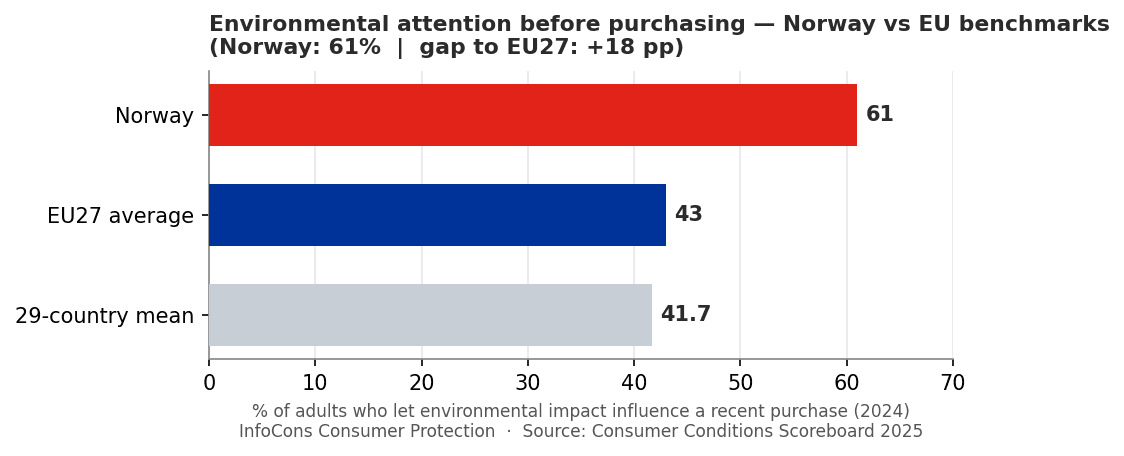
Norway (red) next to the EU average and the all-country average.
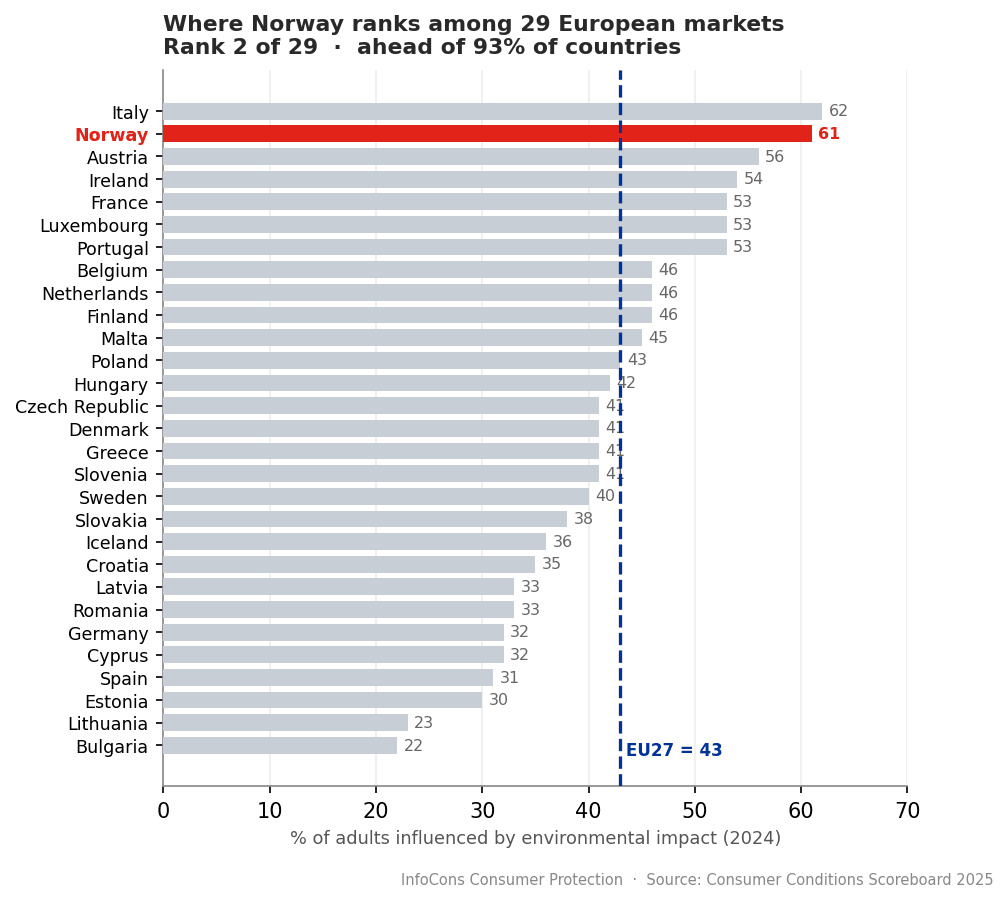
Where Norway sits among all 29 countries (dashed line = EU average).
3. Austria — 56 out of 100 (about 6 in 10)
In Austria, 56 out of every 100 adults think about the planet when they shop — about 6 in 10. That is place 3 of 29 in Europe, and 13 points above the EU average of 43. 2 countries score higher and 26 score lower.
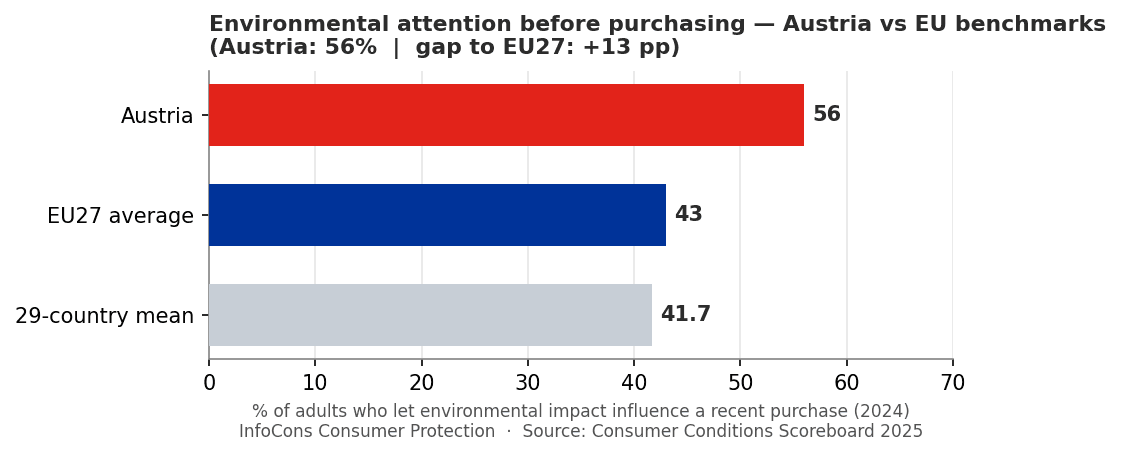
Austria (red) next to the EU average and the all-country average.
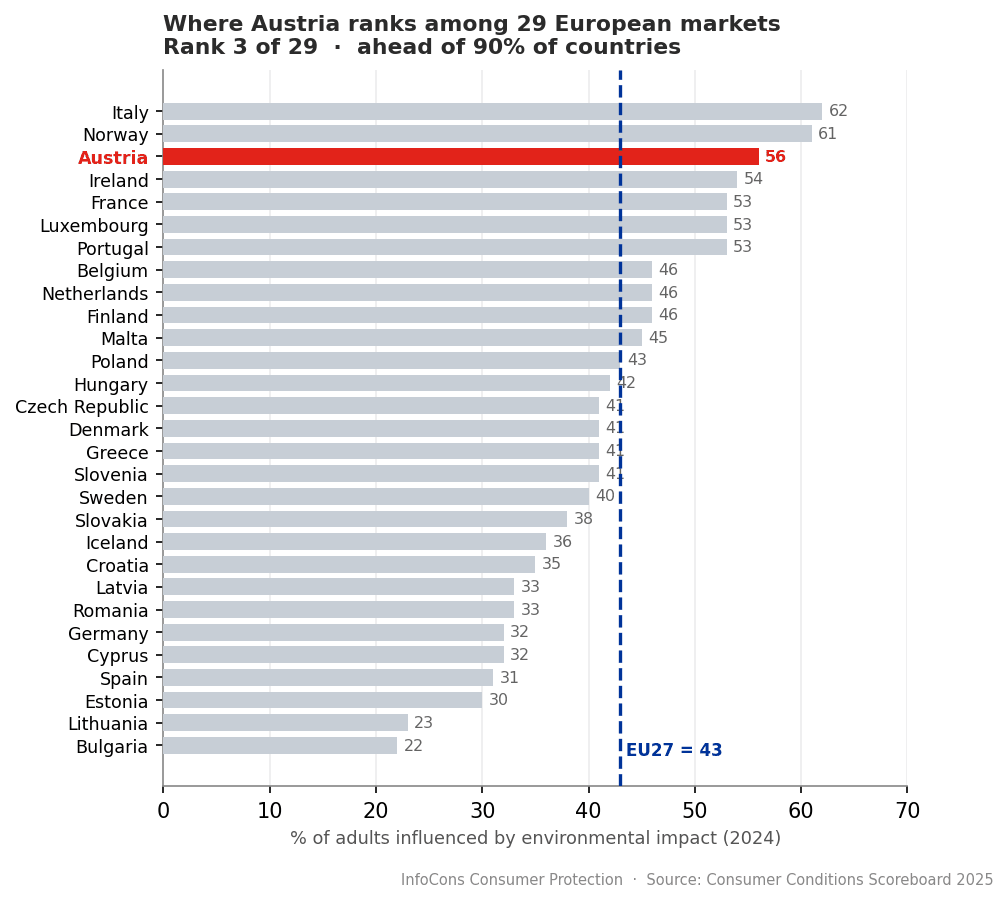
Where Austria sits among all 29 countries (dashed line = EU average).
4. Ireland — 54 out of 100 (about half)
In Ireland, 54 out of every 100 adults think about the planet when they shop — about half. That is place 4 of 29 in Europe, and 11 points above the EU average of 43. 3 countries score higher and 25 score lower.
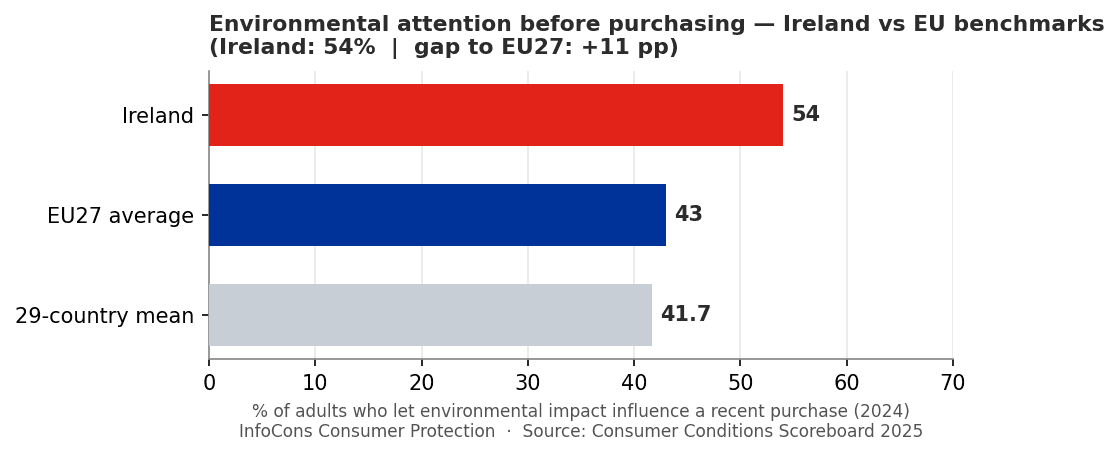
Ireland (red) next to the EU average and the all-country average.
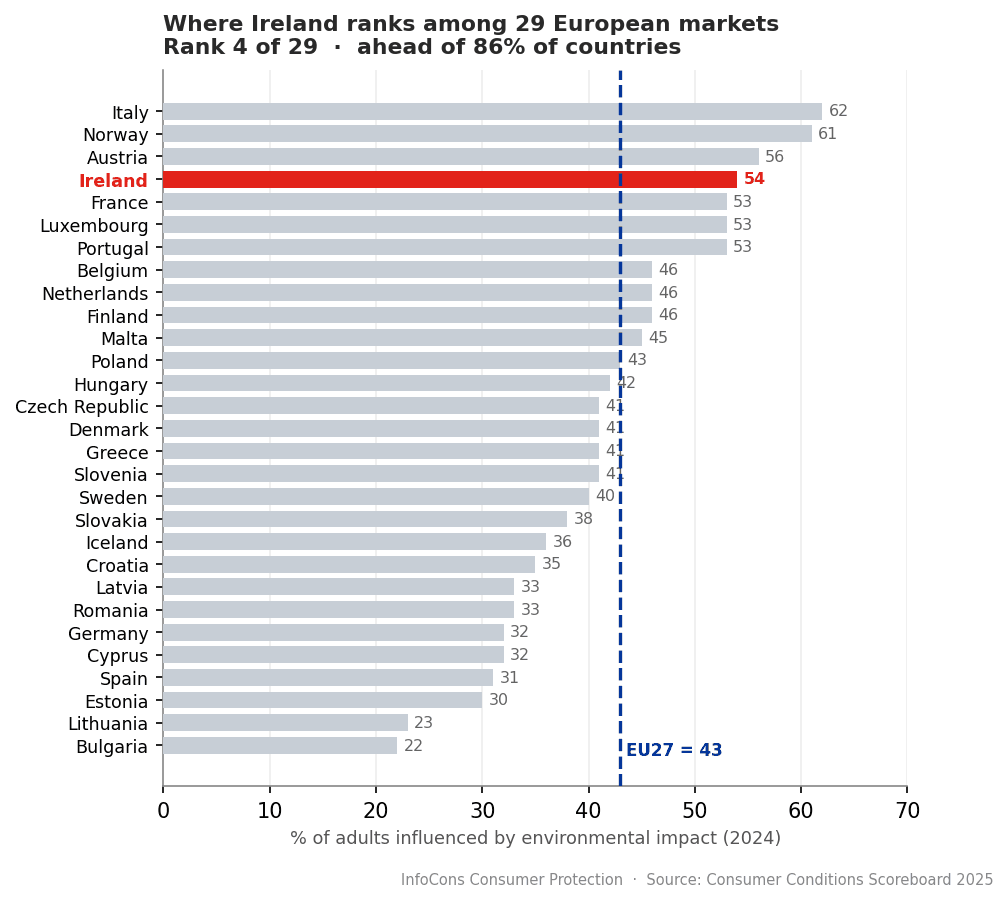
Where Ireland sits among all 29 countries (dashed line = EU average).
5. France — 53 out of 100 (about half)
In France, 53 out of every 100 adults think about the planet when they shop — about half. That is place 5 of 29 in Europe, and 10 points above the EU average of 43. 4 countries score higher and 22 score lower.
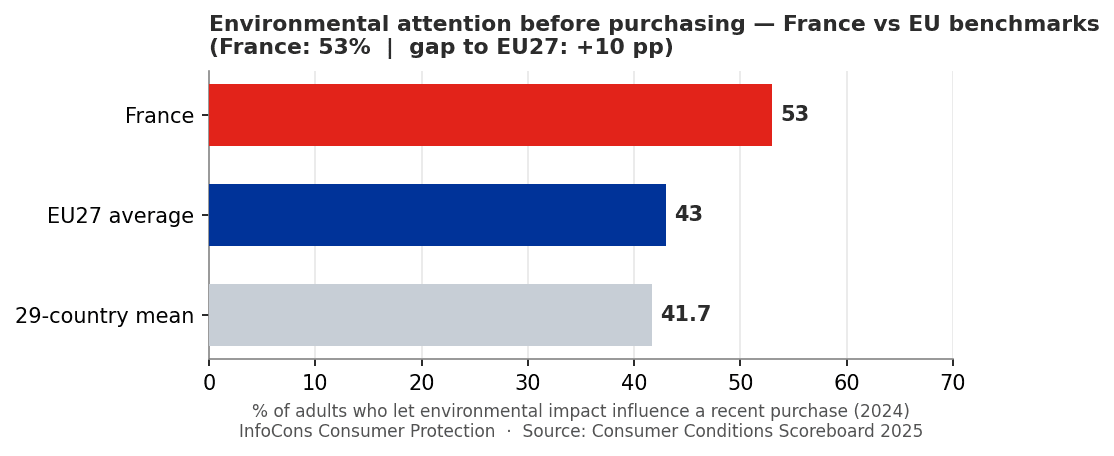
France (red) next to the EU average and the all-country average.
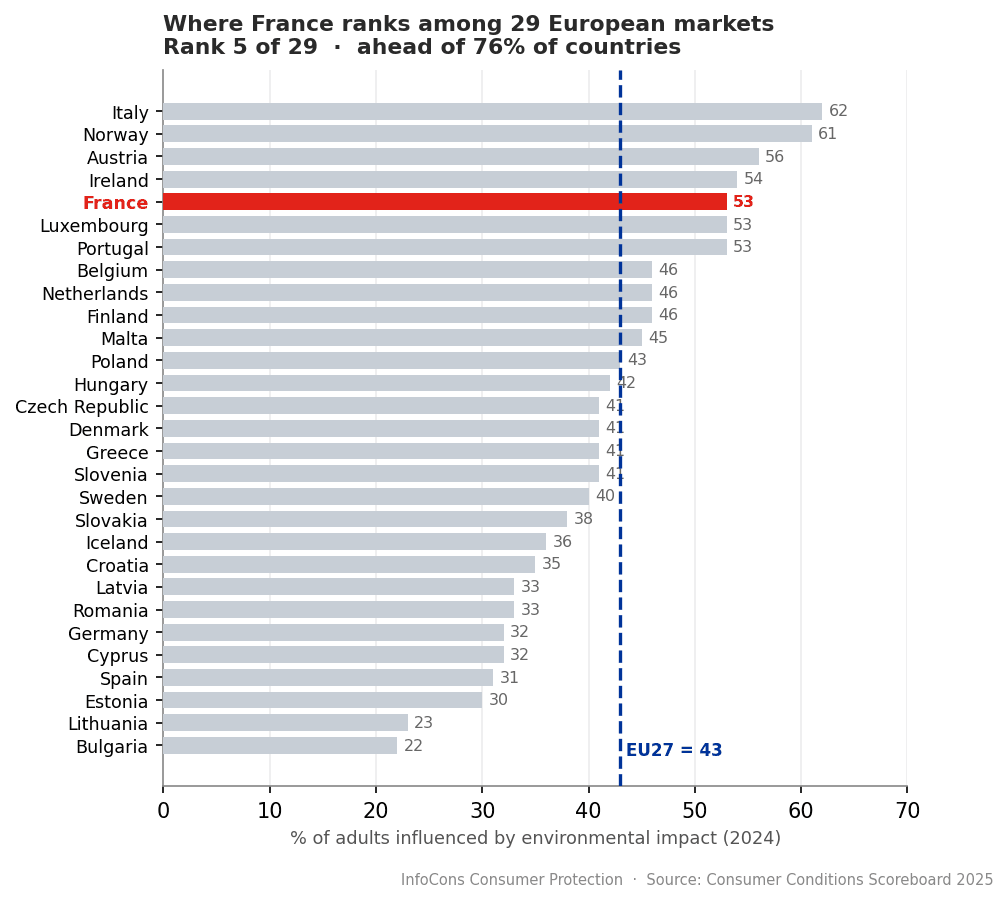
Where France sits among all 29 countries (dashed line = EU average).
5. Luxembourg — 53 out of 100 (about half)
In Luxembourg, 53 out of every 100 adults think about the planet when they shop — about half. That is place 5 of 29 in Europe, and 10 points above the EU average of 43. 4 countries score higher and 22 score lower.
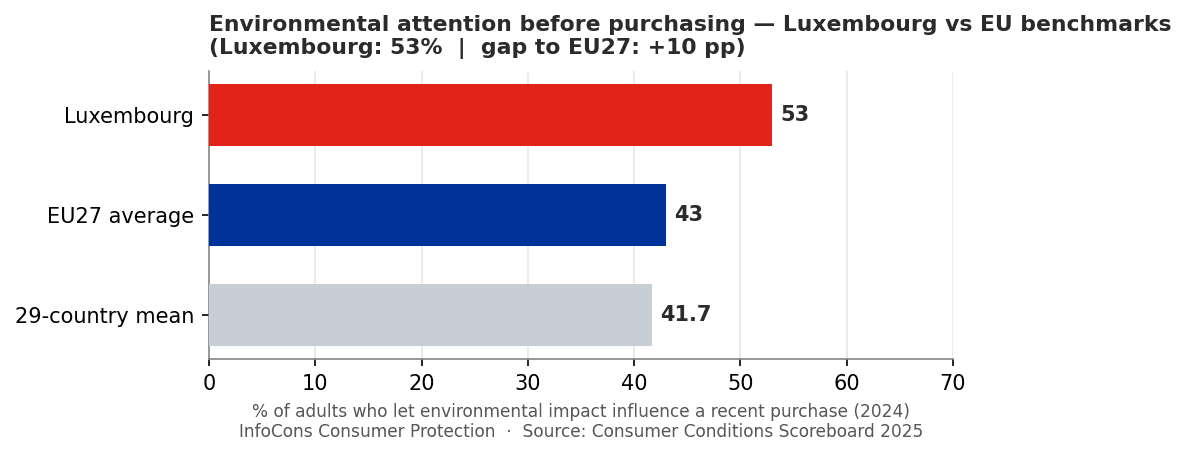
Luxembourg (red) next to the EU average and the all-country average.
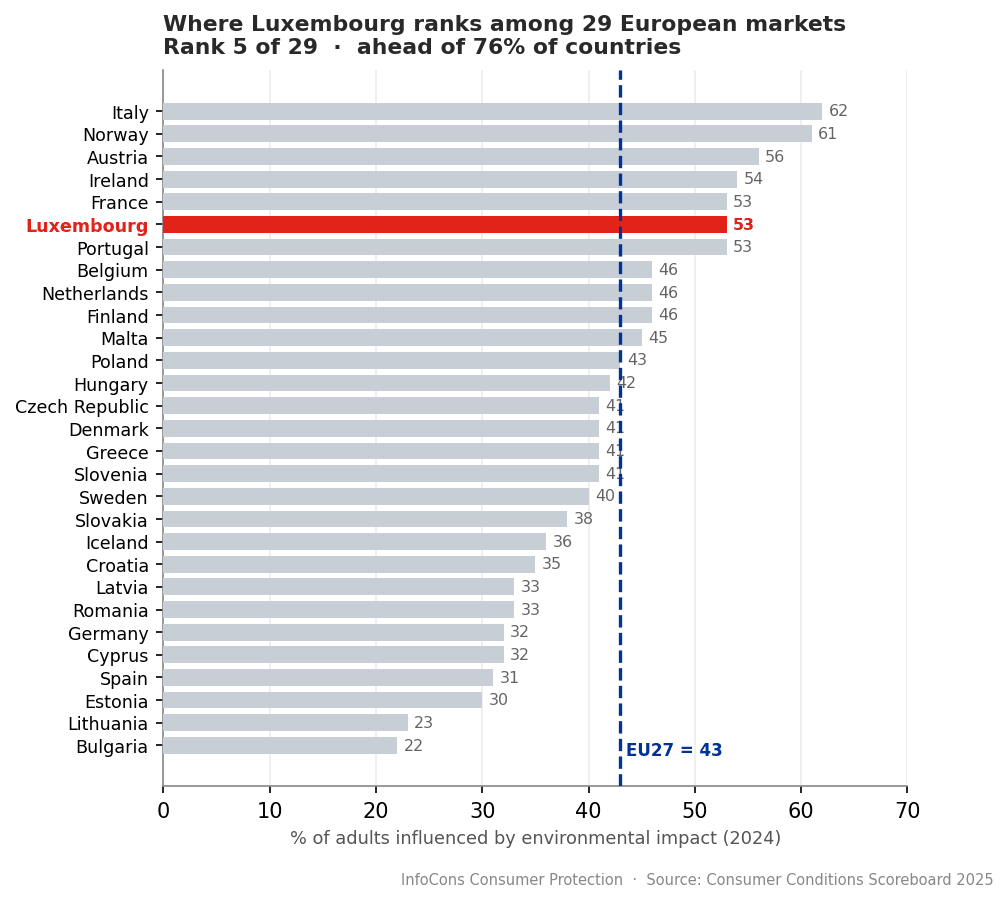
Where Luxembourg sits among all 29 countries (dashed line = EU average).
5. Portugal — 53 out of 100 (about half)
In Portugal, 53 out of every 100 adults think about the planet when they shop — about half. That is place 5 of 29 in Europe, and 10 points above the EU average of 43. 4 countries score higher and 22 score lower.
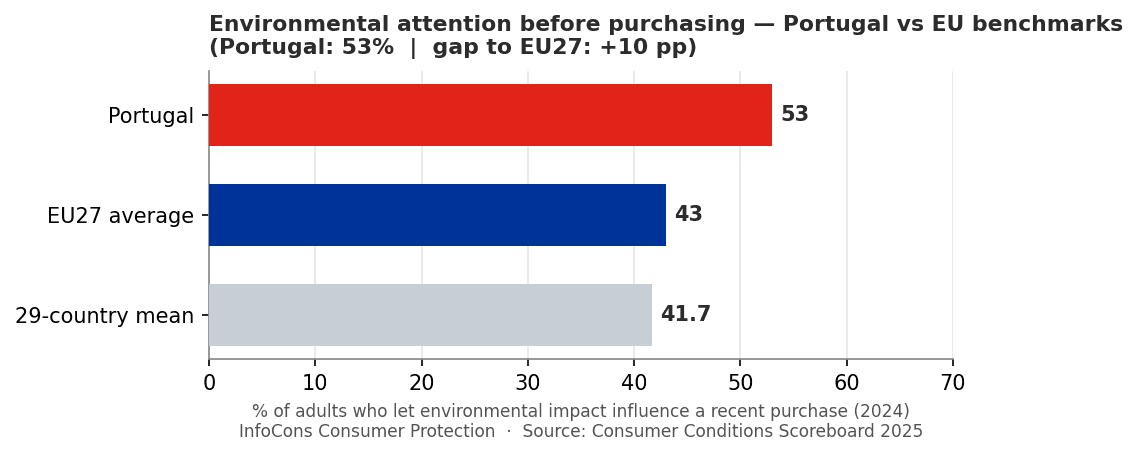
Portugal (red) next to the EU average and the all-country average.
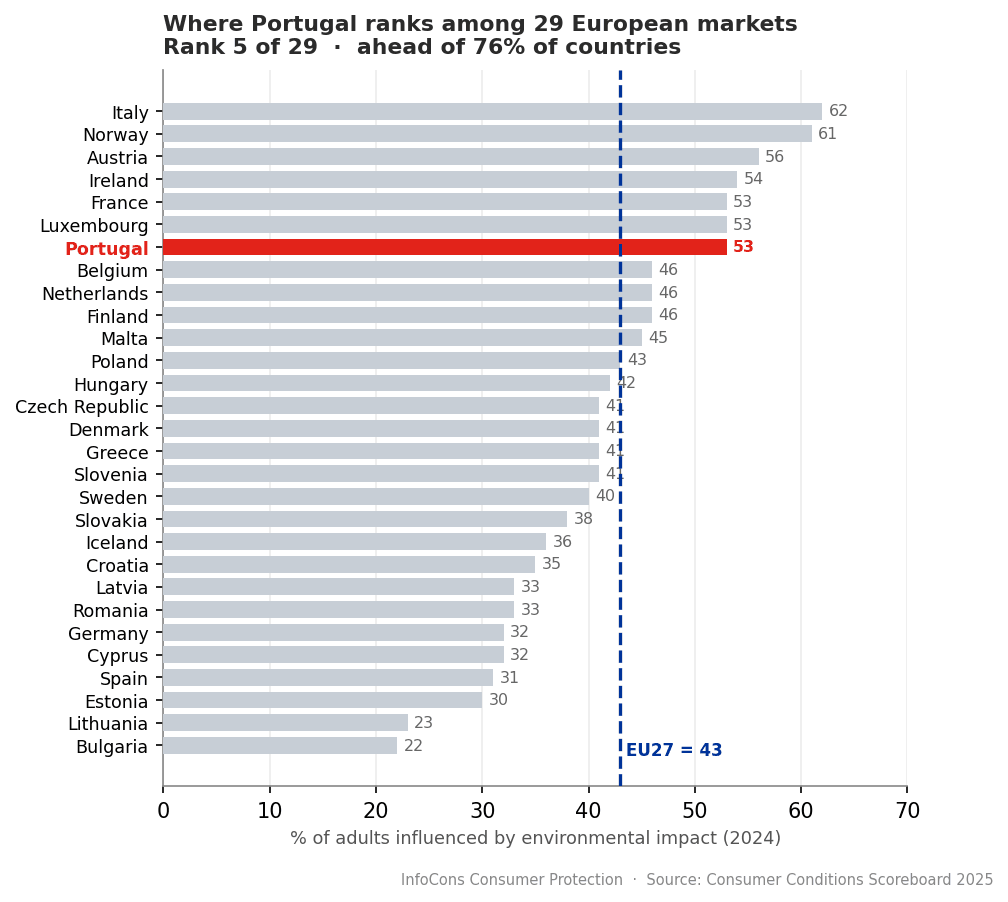
Where Portugal sits among all 29 countries (dashed line = EU average).
8. Belgium — 46 out of 100 (about half)
In Belgium, 46 out of every 100 adults think about the planet when they shop — about half. That is place 8 of 29 in Europe, and 3 points above the EU average of 43. 7 countries score higher and 19 score lower.
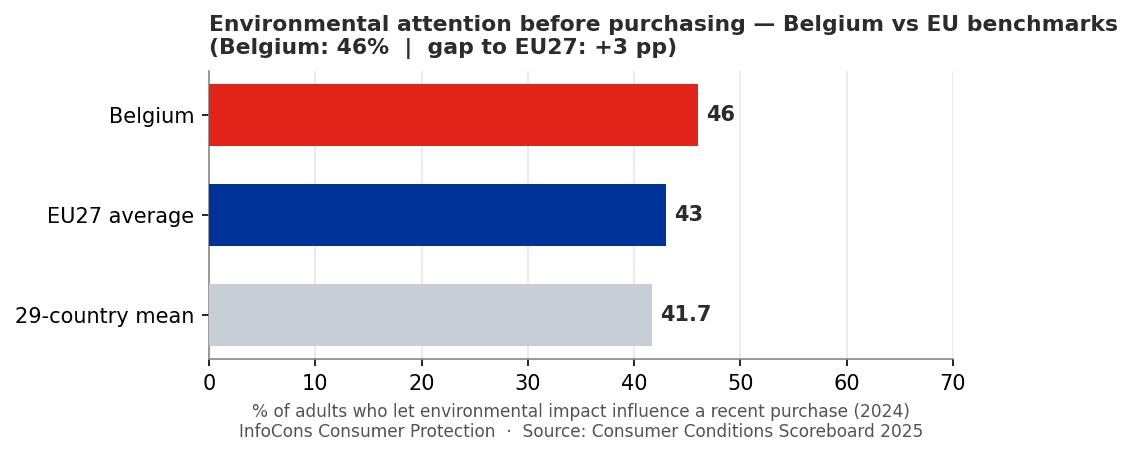
Belgium (red) next to the EU average and the all-country average.
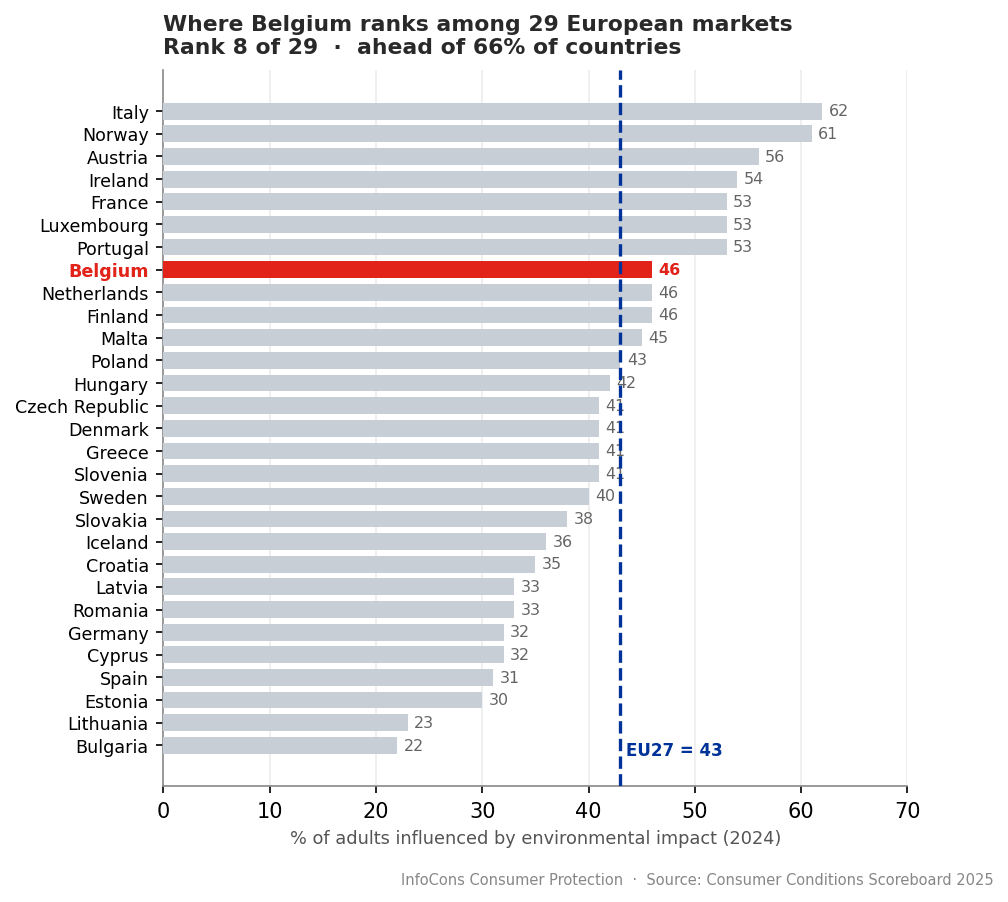
Where Belgium sits among all 29 countries (dashed line = EU average).
8. Netherlands — 46 out of 100 (about half)
In Netherlands, 46 out of every 100 adults think about the planet when they shop — about half. That is place 8 of 29 in Europe, and 3 points above the EU average of 43. 7 countries score higher and 19 score lower.
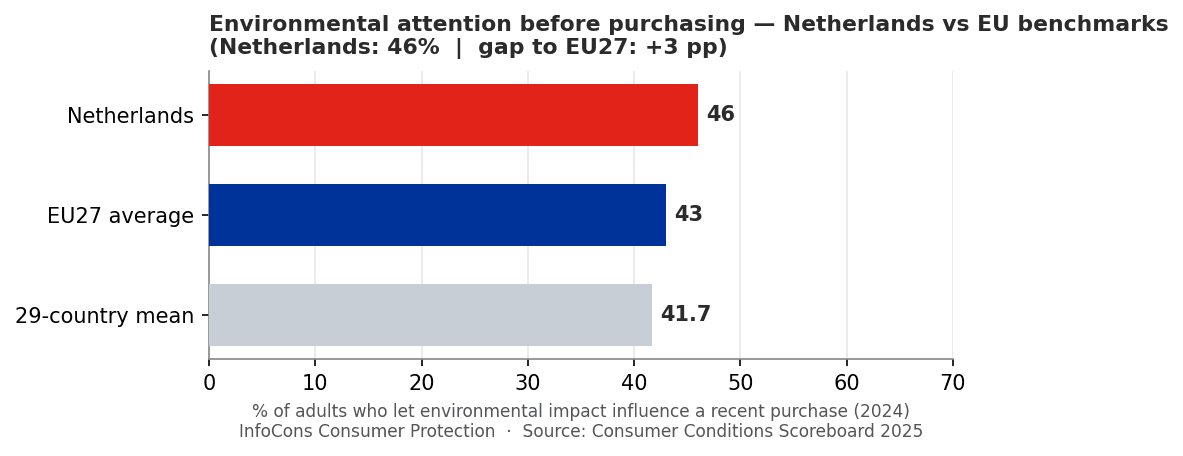
Netherlands (red) next to the EU average and the all-country average.
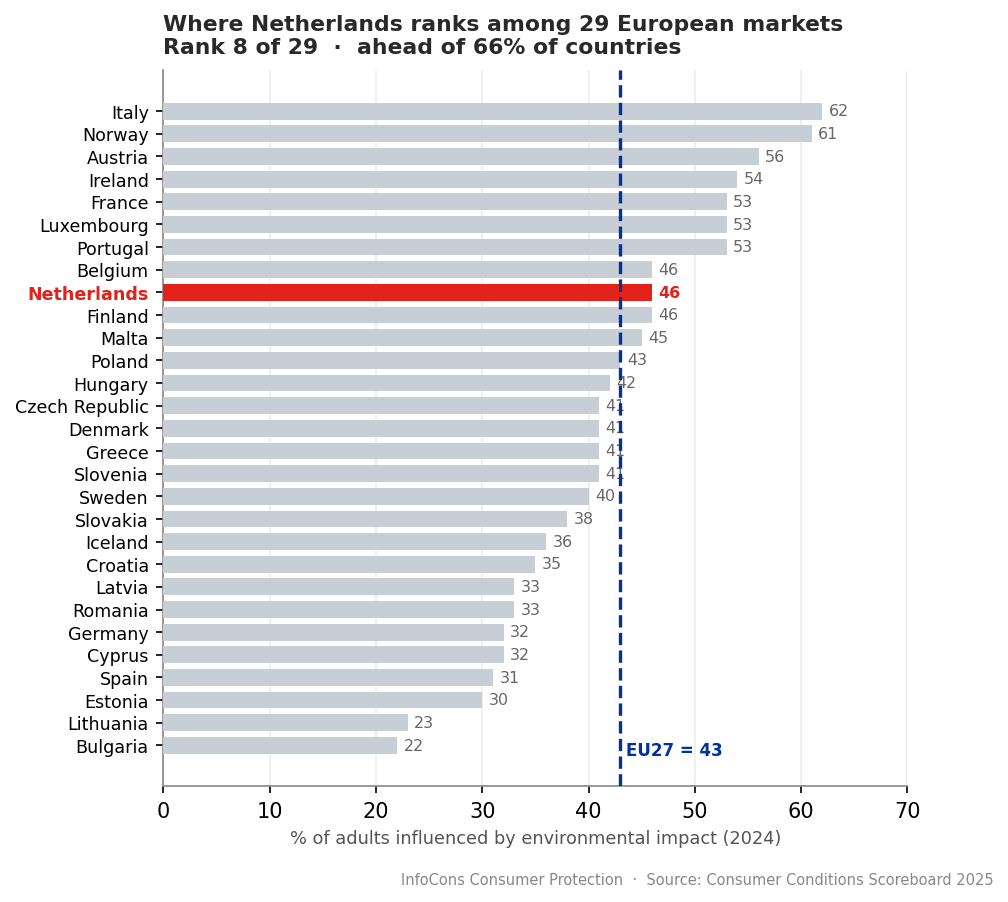
Where Netherlands sits among all 29 countries (dashed line = EU average).
8. Finland — 46 out of 100 (about half)
In Finland, 46 out of every 100 adults think about the planet when they shop — about half. That is place 8 of 29 in Europe, and 3 points above the EU average of 43. 7 countries score higher and 19 score lower.
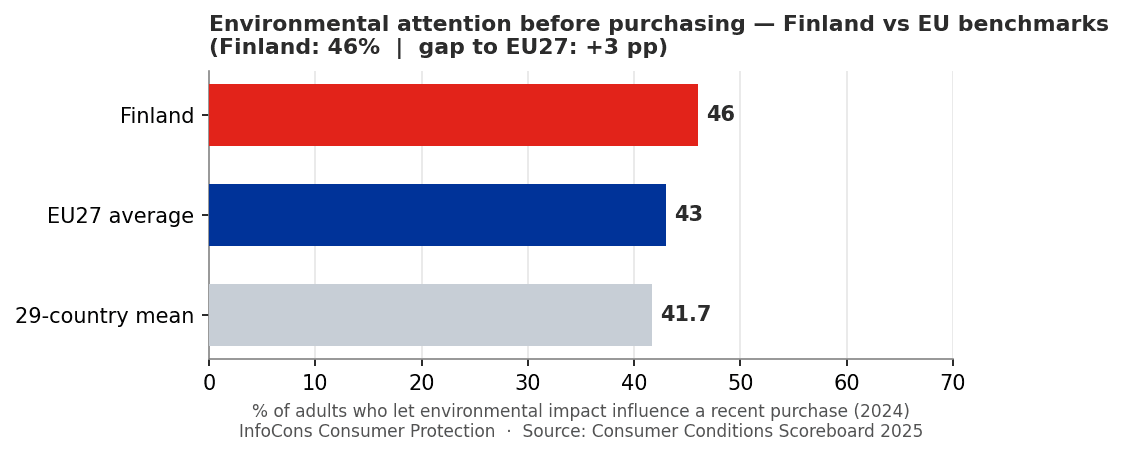
Finland (red) next to the EU average and the all-country average.
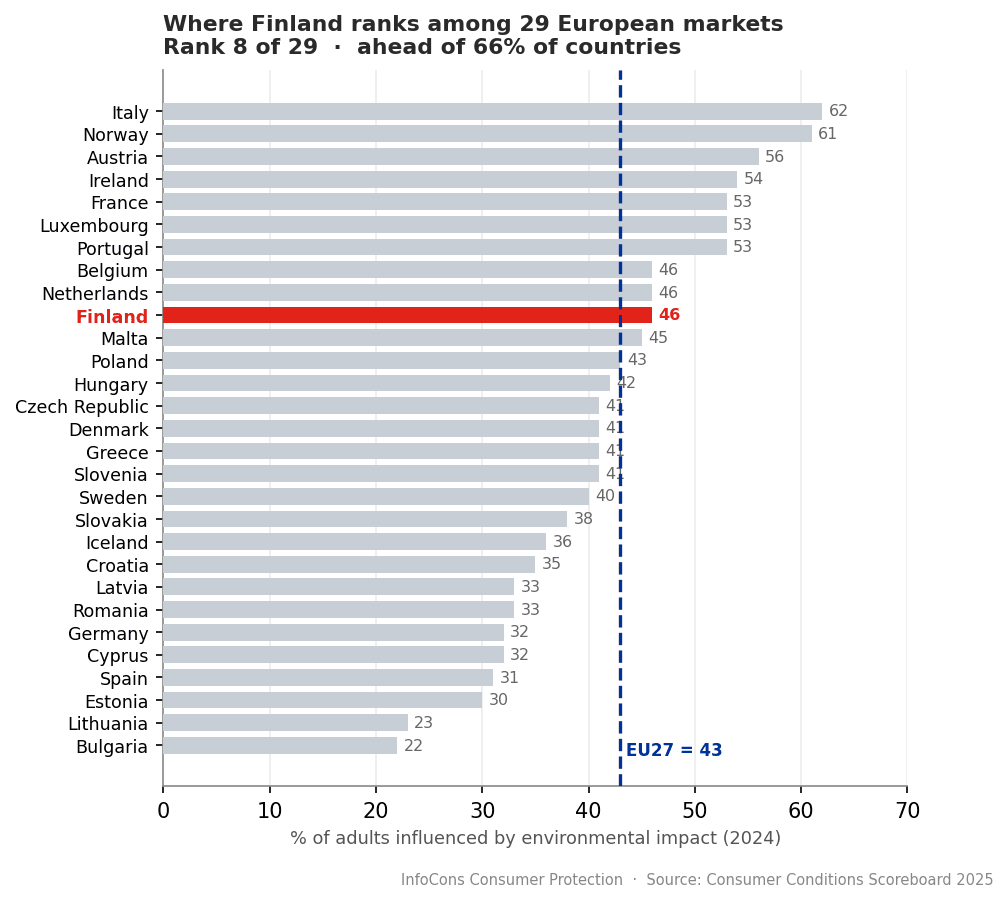
Where Finland sits among all 29 countries (dashed line = EU average).
11. Malta — 45 out of 100 (about 4 in 10)
In Malta, 45 out of every 100 adults think about the planet when they shop — about 4 in 10. That is place 11 of 29 in Europe, and 2 points above the EU average of 43. 10 countries score higher and 18 score lower.
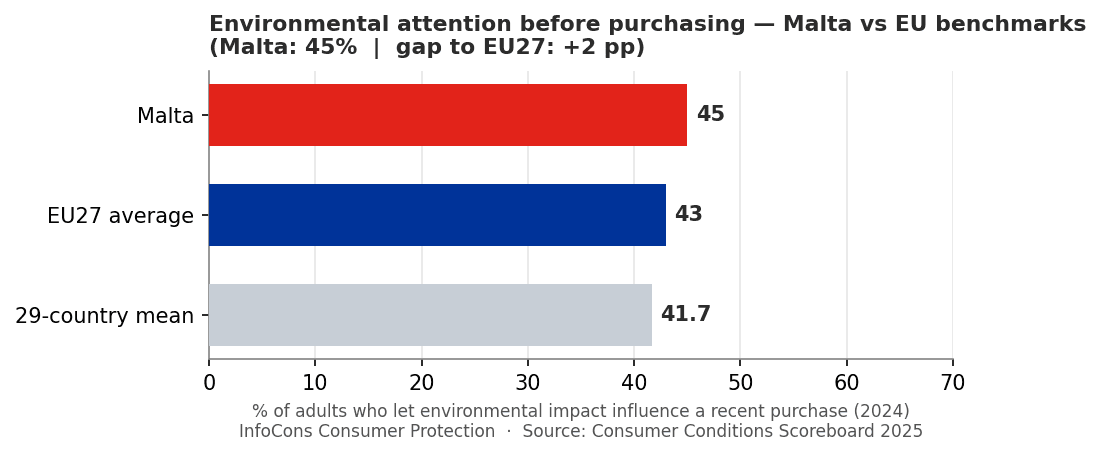
Malta (red) next to the EU average and the all-country average.
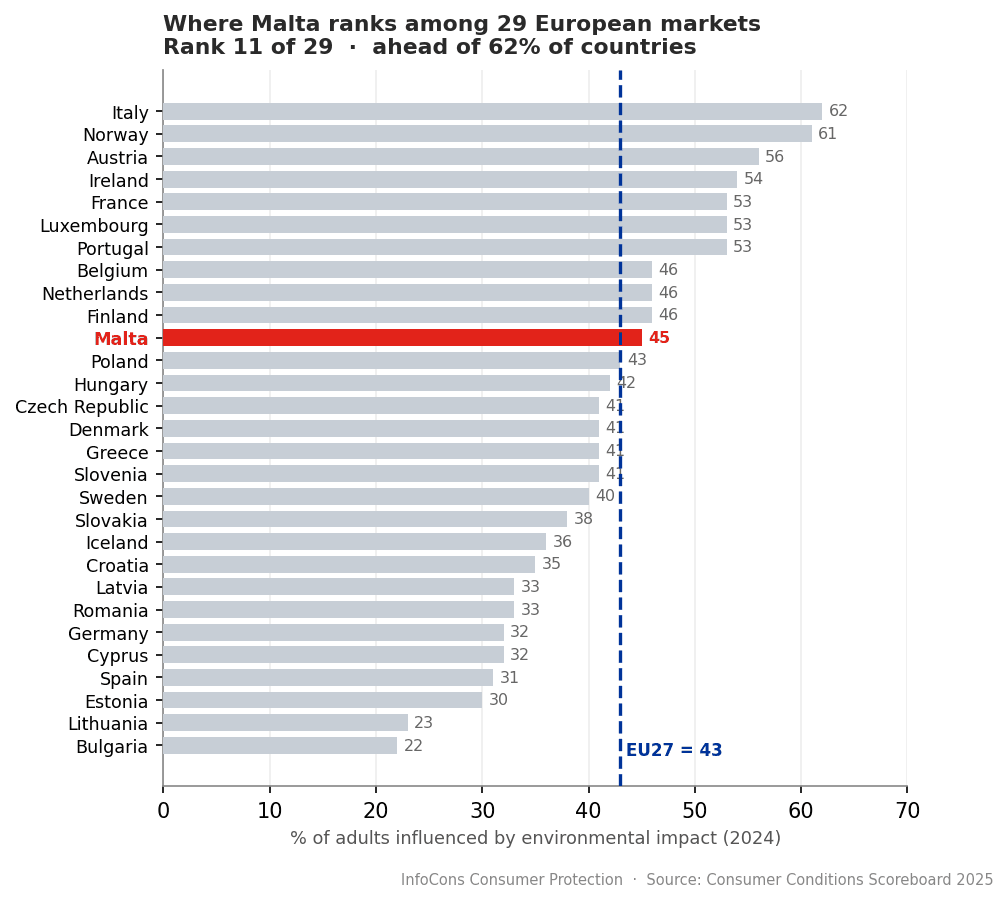
Where Malta sits among all 29 countries (dashed line = EU average).
12. Poland — 43 out of 100 (about 4 in 10)
In Poland, 43 out of every 100 adults think about the planet when they shop — about 4 in 10. That is place 12 of 29 in Europe, and 0 points the same as the EU average of 43. 11 countries score higher and 17 score lower.
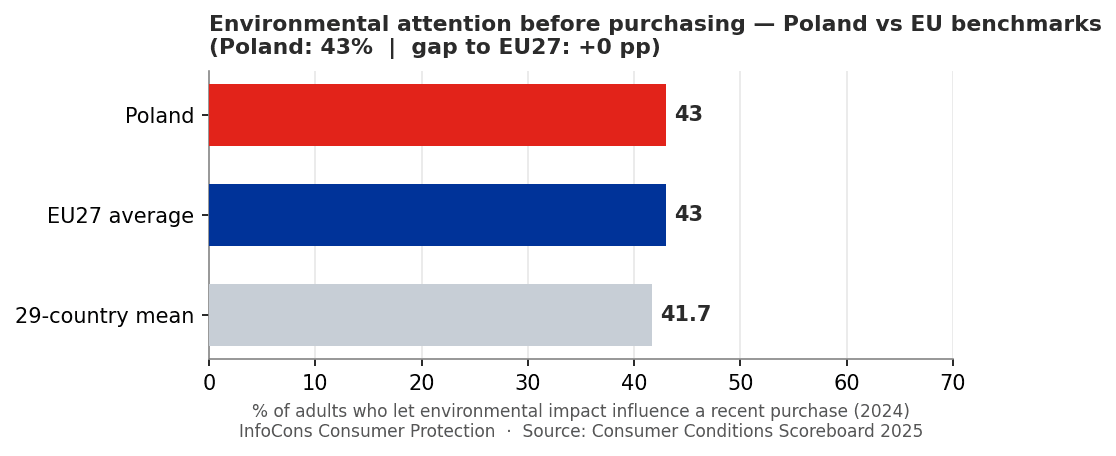
Poland (red) next to the EU average and the all-country average.
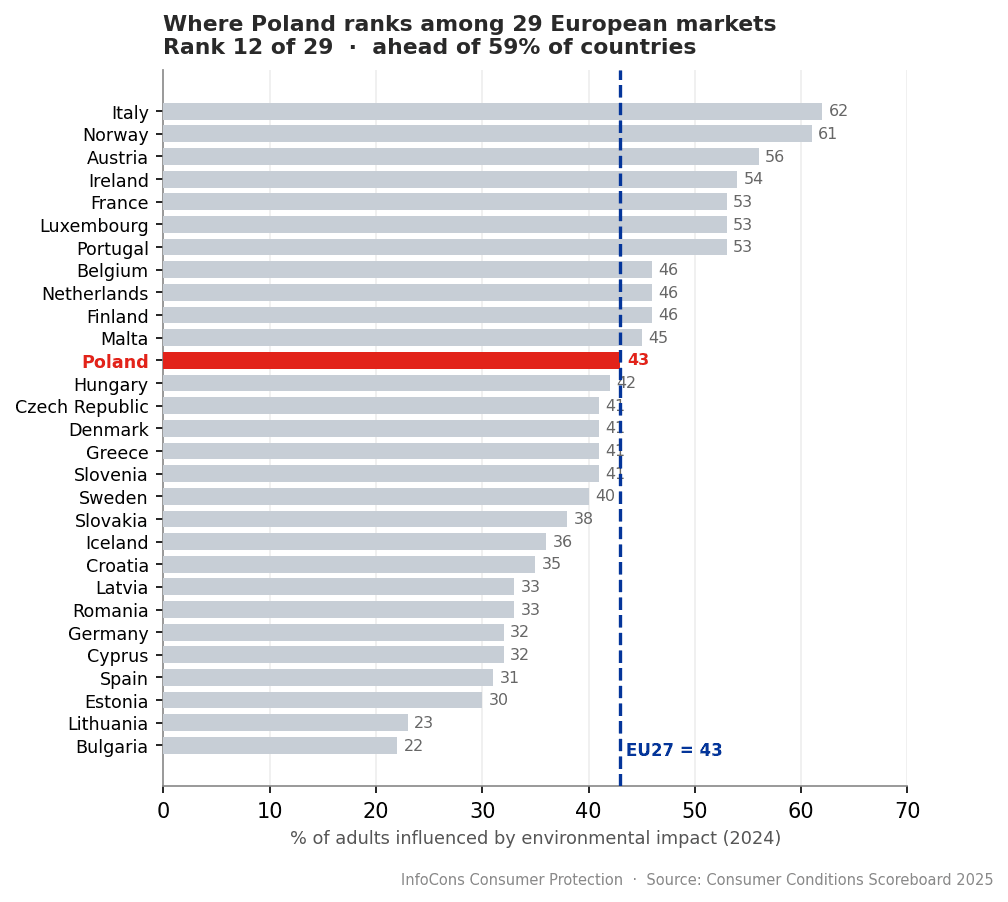
Where Poland sits among all 29 countries (dashed line = EU average).
13. Hungary — 42 out of 100 (about 4 in 10)
In Hungary, 42 out of every 100 adults think about the planet when they shop — about 4 in 10. That is place 13 of 29 in Europe, and 1 points below the EU average of 43. 12 countries score higher and 16 score lower.
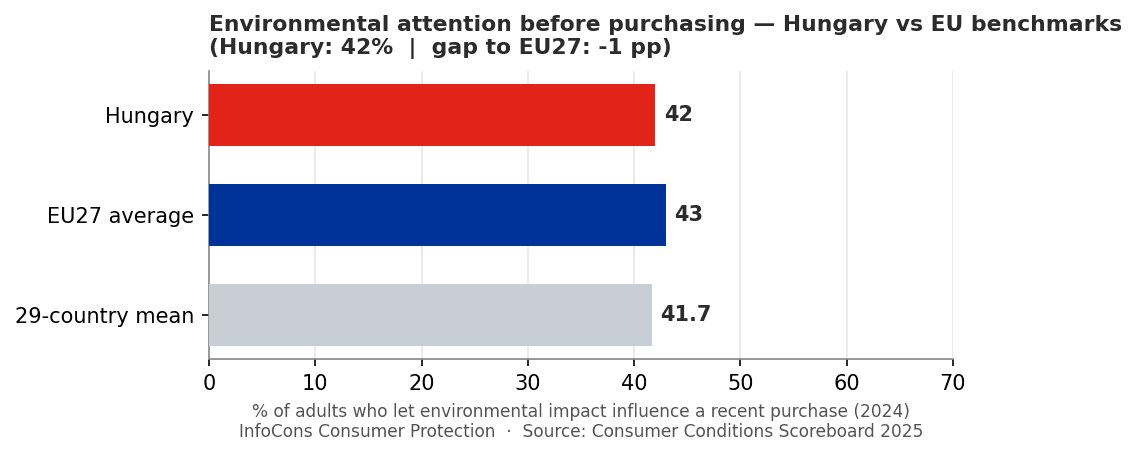
Hungary (red) next to the EU average and the all-country average.
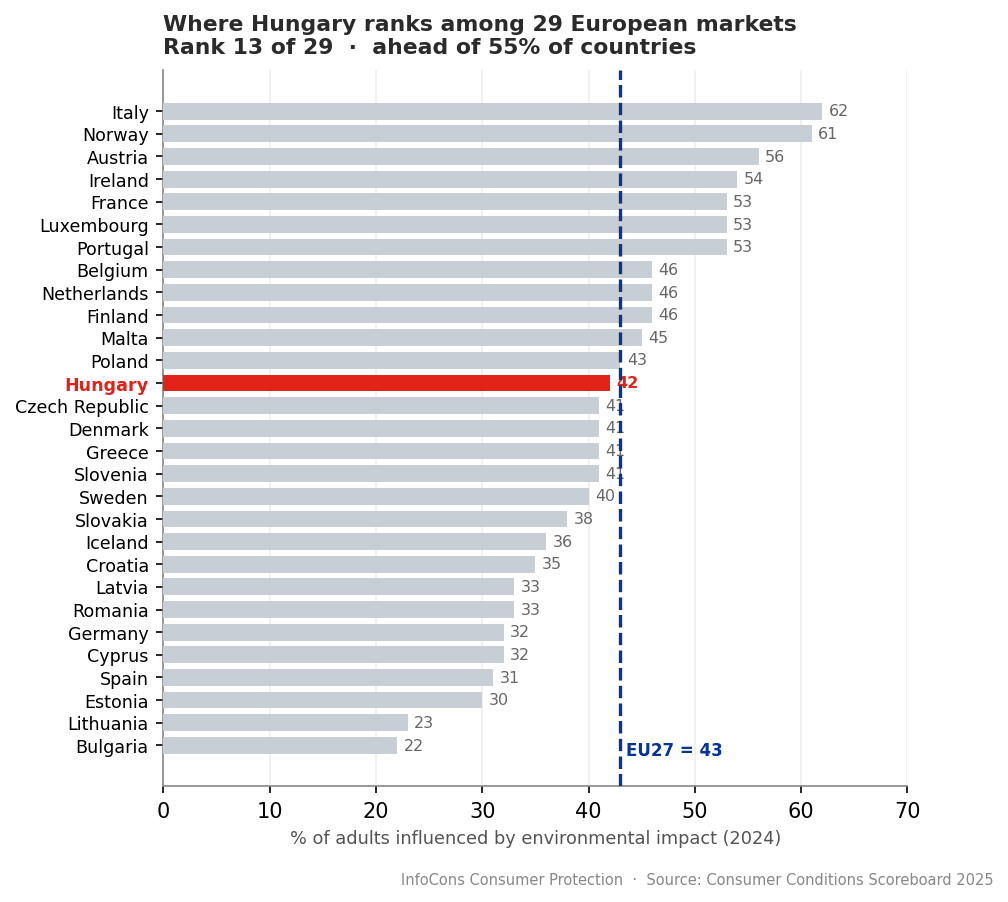
Where Hungary sits among all 29 countries (dashed line = EU average).
14. Czech Republic — 41 out of 100 (about 4 in 10)
In Czech Republic, 41 out of every 100 adults think about the planet when they shop — about 4 in 10. That is place 14 of 29 in Europe, and 2 points below the EU average of 43. 13 countries score higher and 12 score lower.
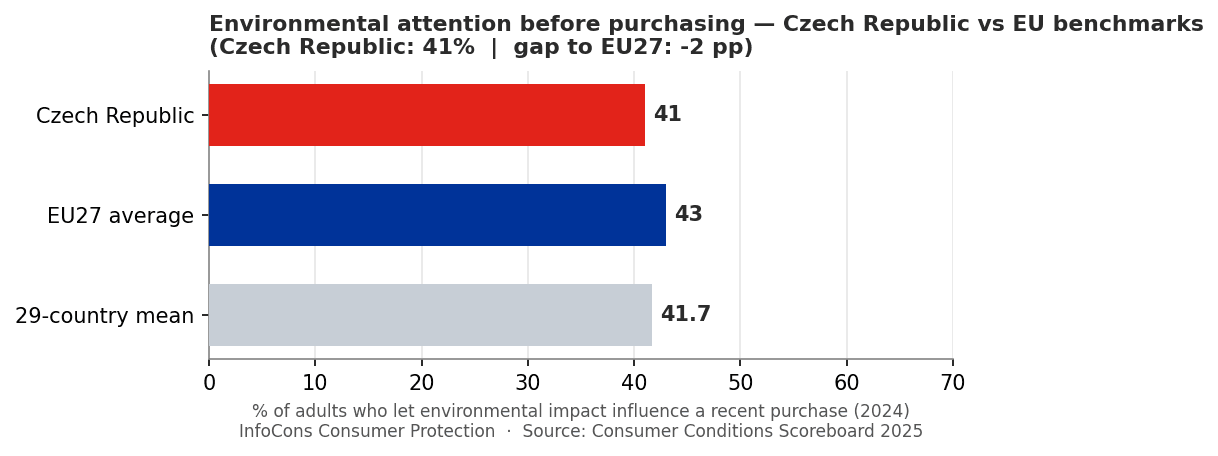
Czech Republic (red) next to the EU average and the all-country average.
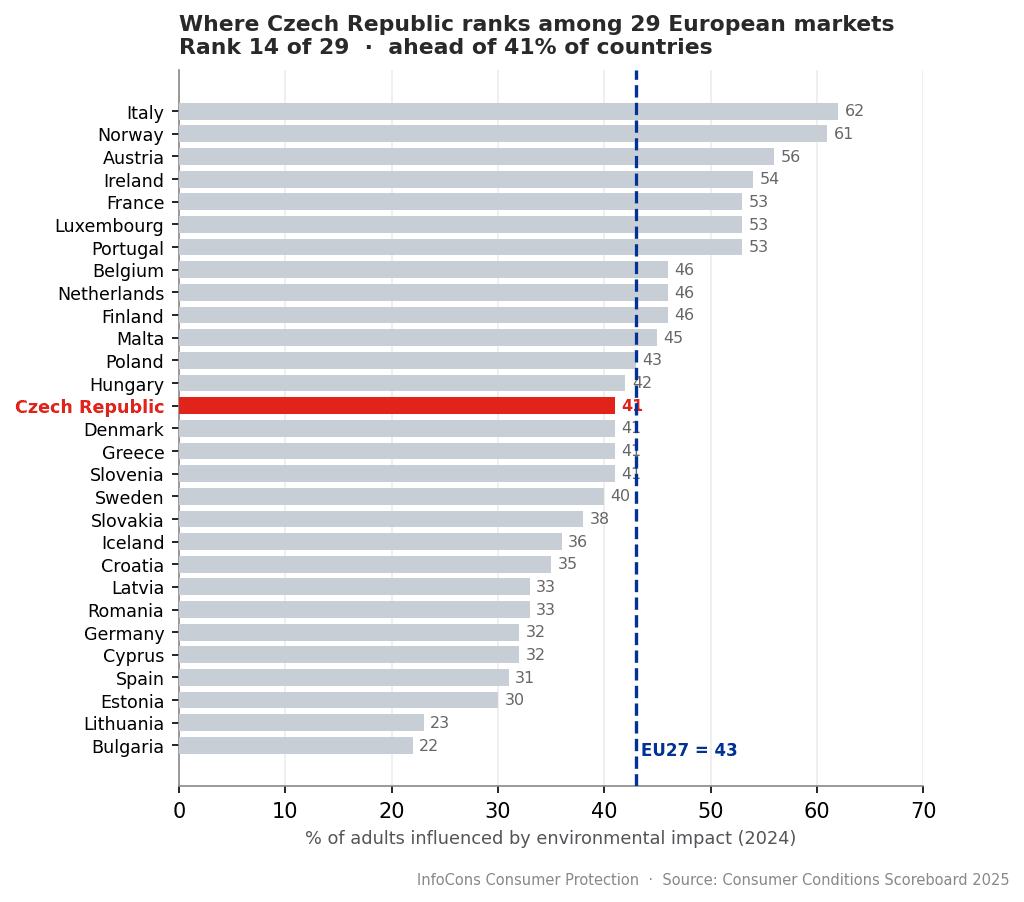
Where Czech Republic sits among all 29 countries (dashed line = EU average).
14. Denmark — 41 out of 100 (about 4 in 10)
In Denmark, 41 out of every 100 adults think about the planet when they shop — about 4 in 10. That is place 14 of 29 in Europe, and 2 points below the EU average of 43. 13 countries score higher and 12 score lower.
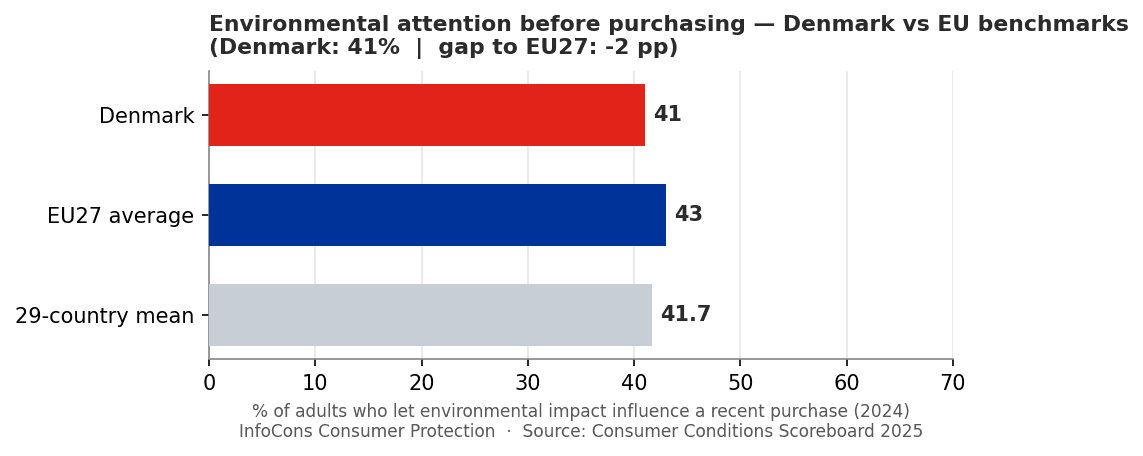
Denmark (red) next to the EU average and the all-country average.
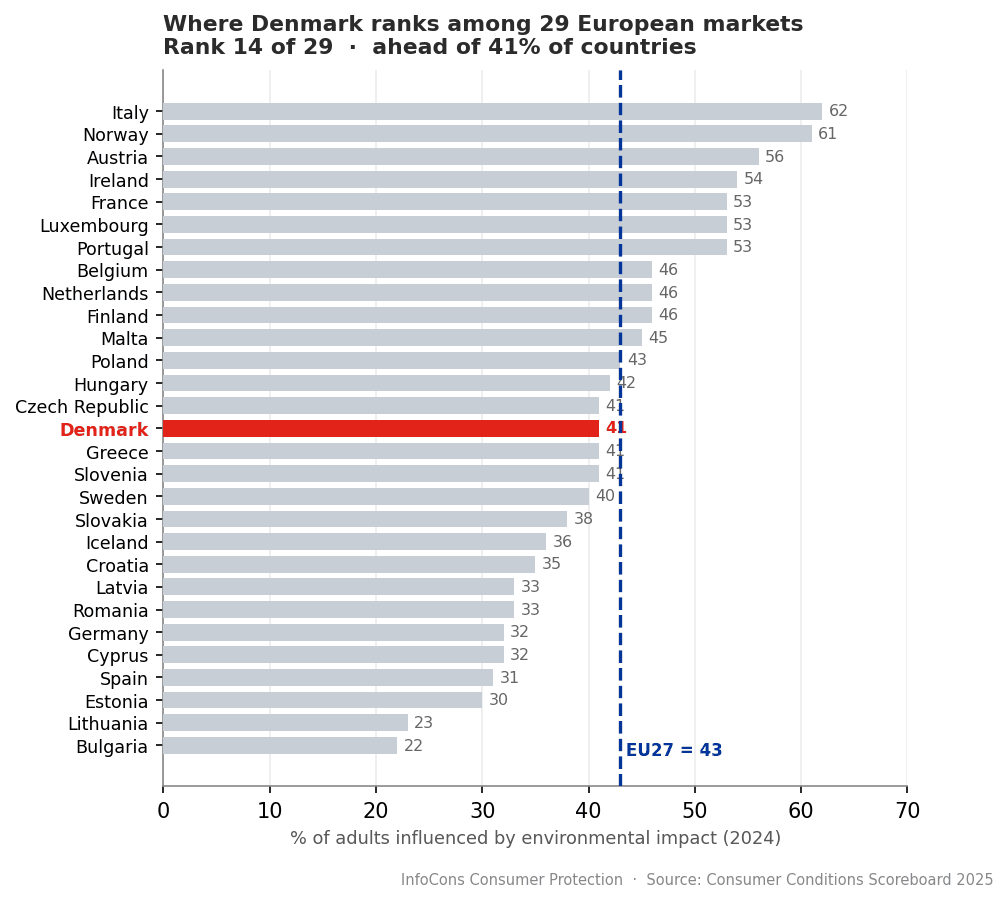
Where Denmark sits among all 29 countries (dashed line = EU average).
14. Greece — 41 out of 100 (about 4 in 10)
In Greece, 41 out of every 100 adults think about the planet when they shop — about 4 in 10. That is place 14 of 29 in Europe, and 2 points below the EU average of 43. 13 countries score higher and 12 score lower.
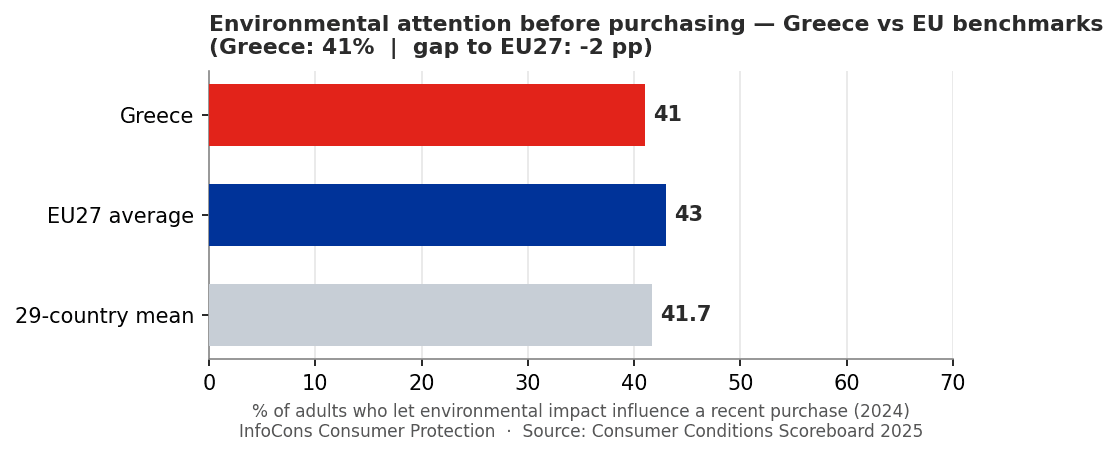
Greece (red) next to the EU average and the all-country average.
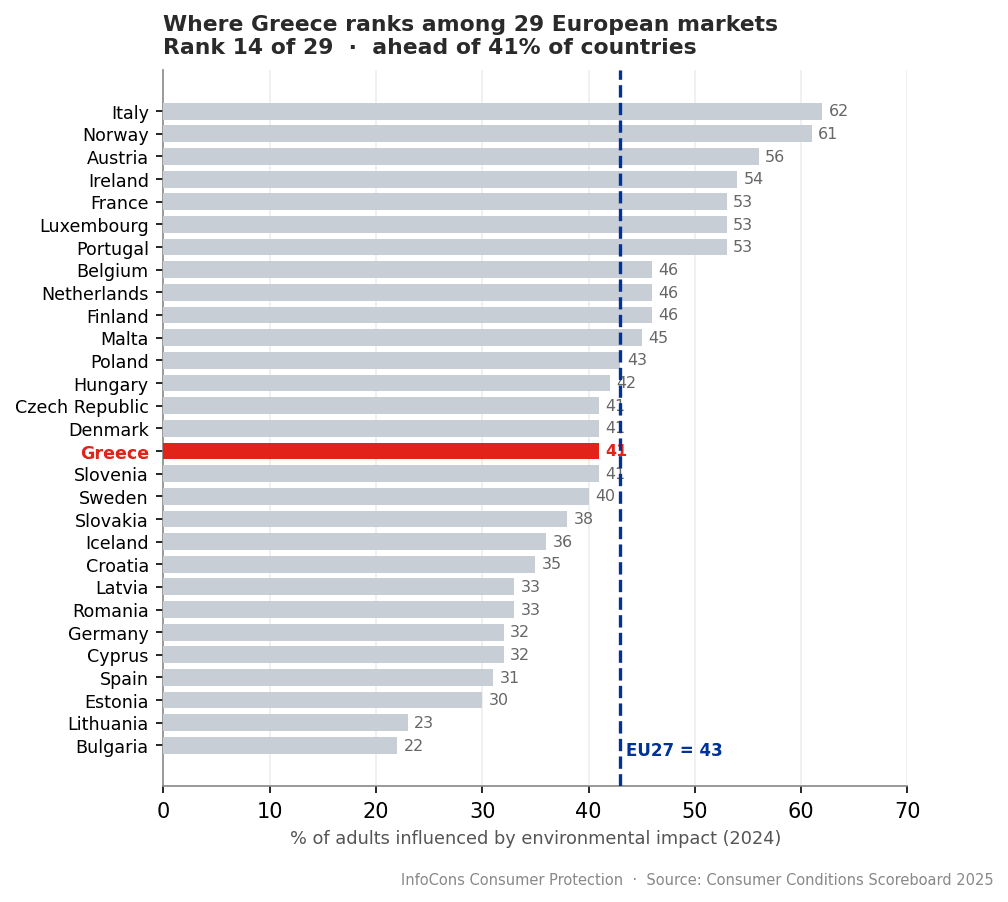
Where Greece sits among all 29 countries (dashed line = EU average).
14. Slovenia — 41 out of 100 (about 4 in 10)
In Slovenia, 41 out of every 100 adults think about the planet when they shop — about 4 in 10. That is place 14 of 29 in Europe, and 2 points below the EU average of 43. 13 countries score higher and 12 score lower.
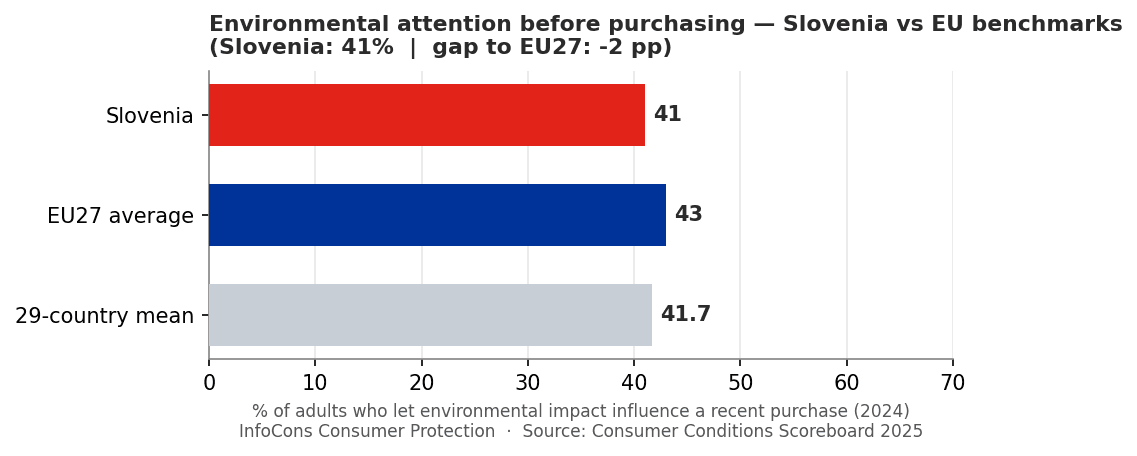
Slovenia (red) next to the EU average and the all-country average.
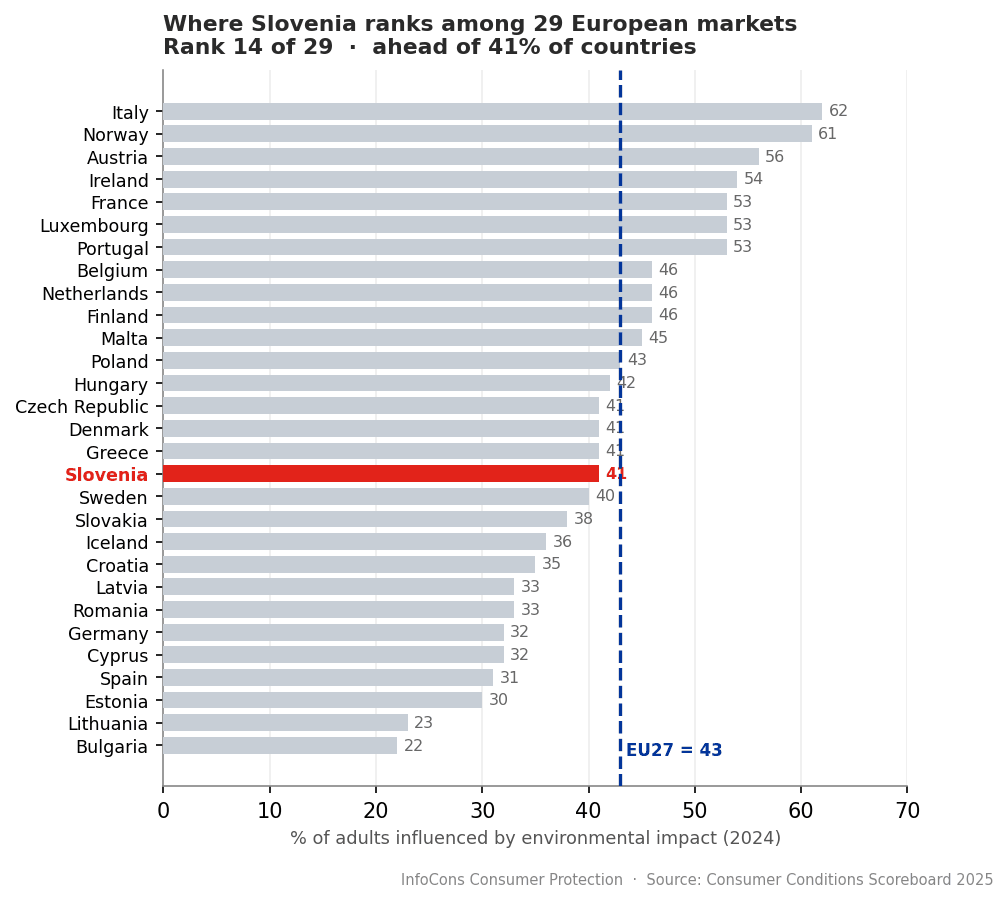
Where Slovenia sits among all 29 countries (dashed line = EU average).
18. Sweden — 40 out of 100 (about 4 in 10)
In Sweden, 40 out of every 100 adults think about the planet when they shop — about 4 in 10. That is place 18 of 29 in Europe, and 3 points below the EU average of 43. 17 countries score higher and 11 score lower.
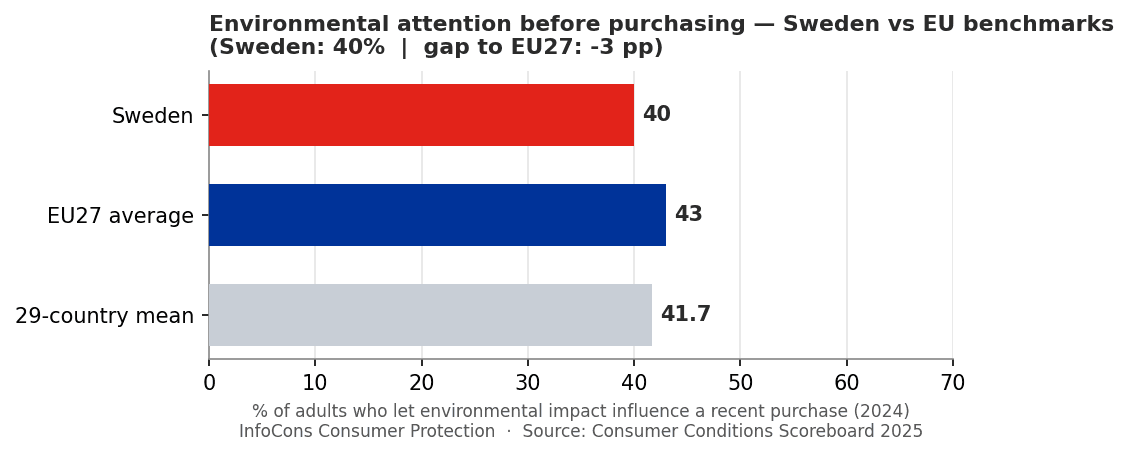
Sweden (red) next to the EU average and the all-country average.
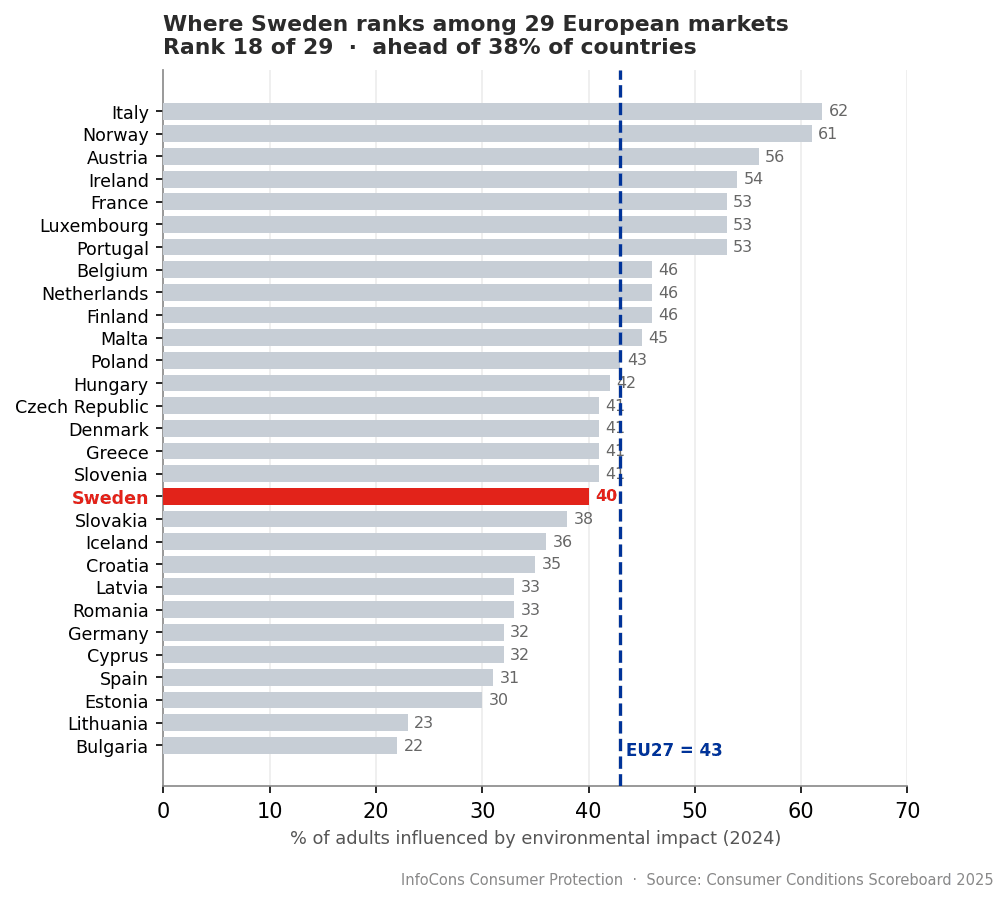
Where Sweden sits among all 29 countries (dashed line = EU average).
19. Slovakia — 38 out of 100 (about 4 in 10)
In Slovakia, 38 out of every 100 adults think about the planet when they shop — about 4 in 10. That is place 19 of 29 in Europe, and 5 points below the EU average of 43. 18 countries score higher and 10 score lower.
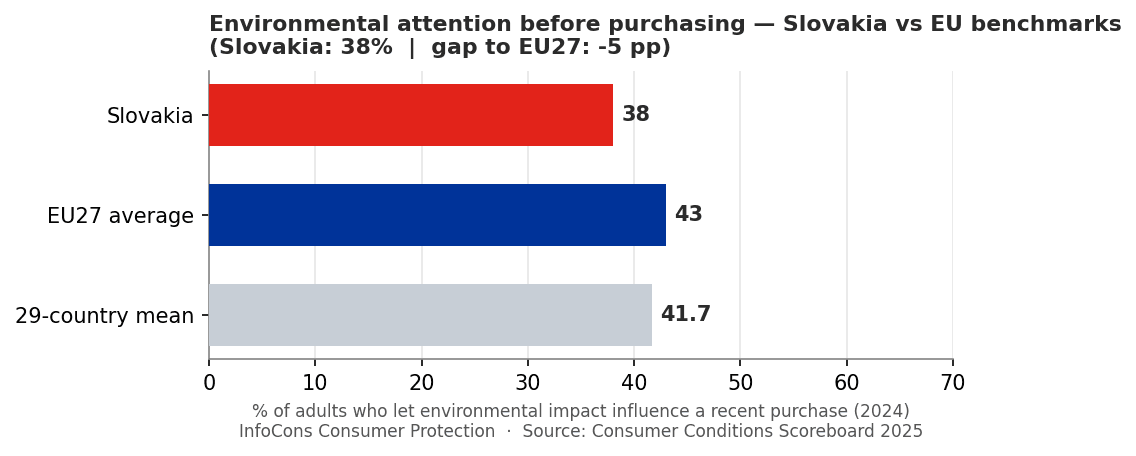
Slovakia (red) next to the EU average and the all-country average.
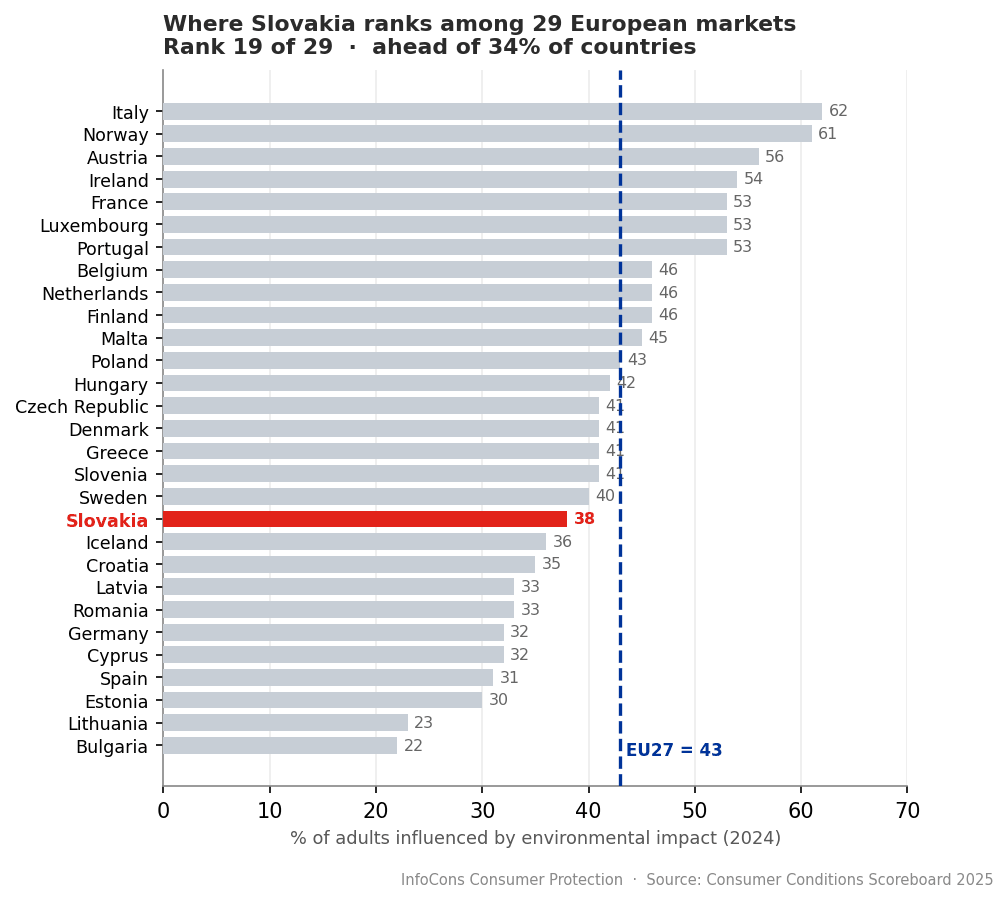
Where Slovakia sits among all 29 countries (dashed line = EU average).
20. Iceland — 36 out of 100 (about 4 in 10)
In Iceland, 36 out of every 100 adults think about the planet when they shop — about 4 in 10. That is place 20 of 29 in Europe, and 7 points below the EU average of 43. 19 countries score higher and 9 score lower.
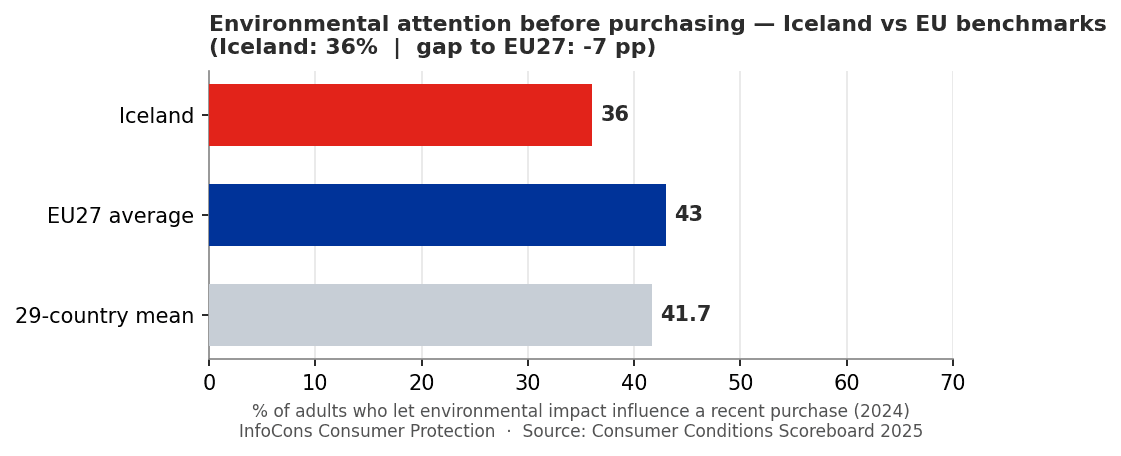
Iceland (red) next to the EU average and the all-country average.
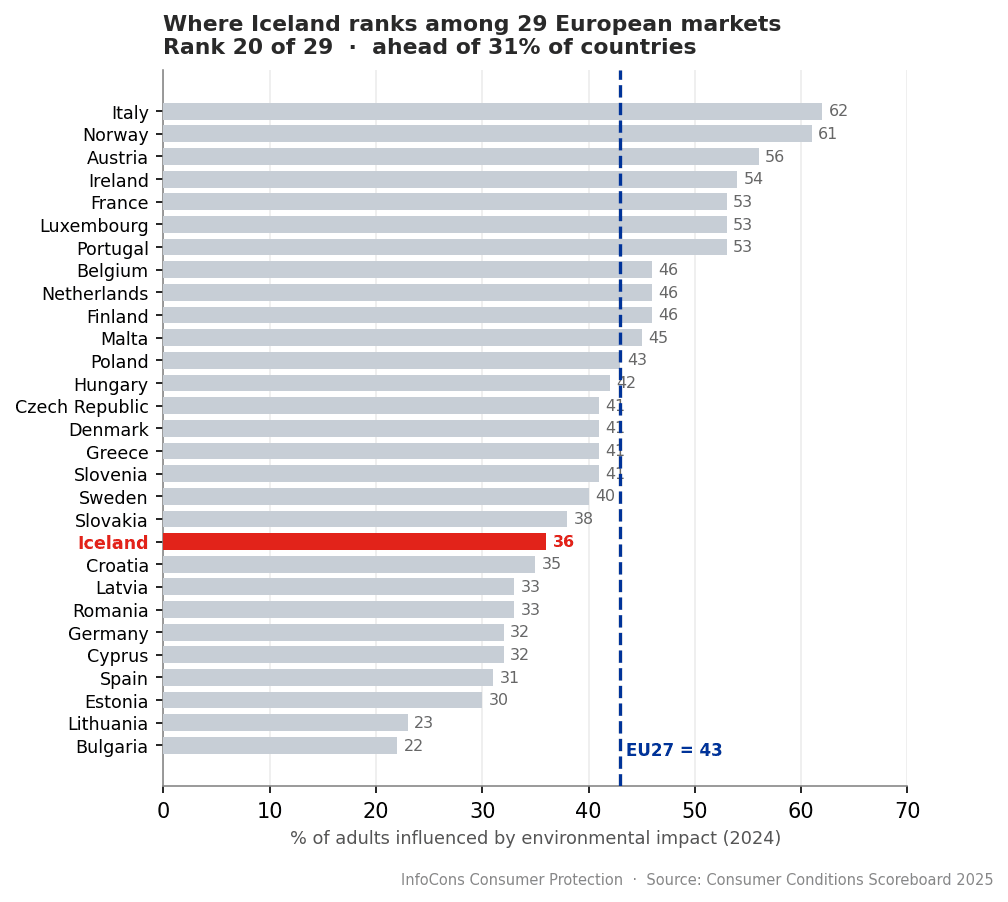
Where Iceland sits among all 29 countries (dashed line = EU average).
21. Croatia — 35 out of 100 (about 4 in 10)
In Croatia, 35 out of every 100 adults think about the planet when they shop — about 4 in 10. That is place 21 of 29 in Europe, and 8 points below the EU average of 43. 20 countries score higher and 8 score lower.
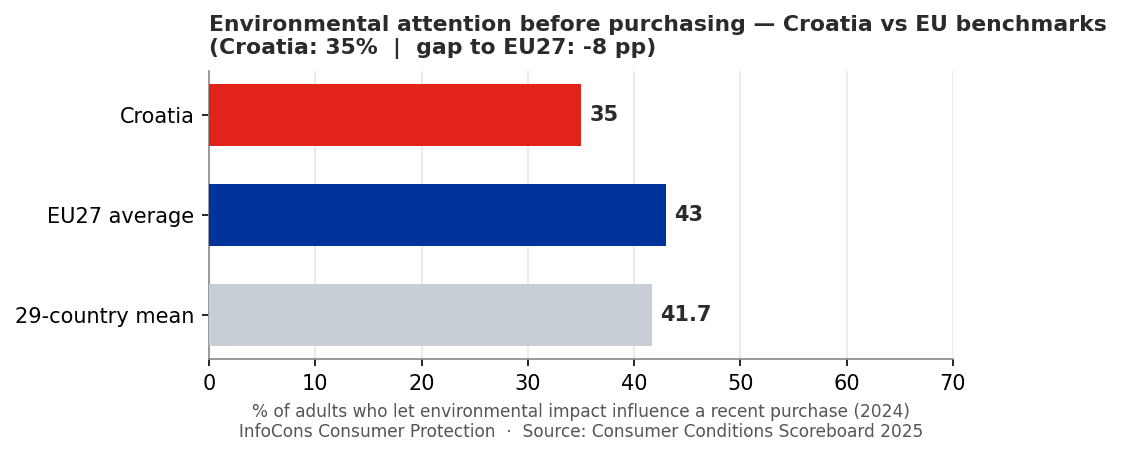
Croatia (red) next to the EU average and the all-country average.
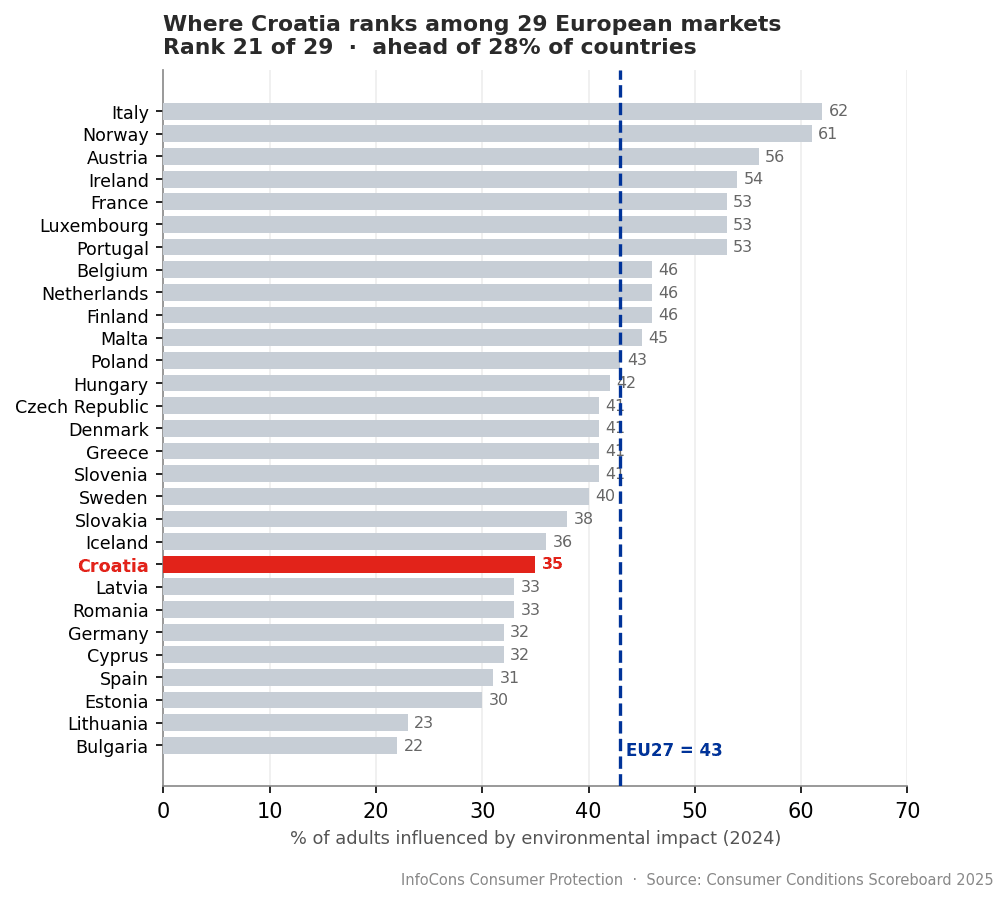
Where Croatia sits among all 29 countries (dashed line = EU average).
22. Latvia — 33 out of 100 (about 3 in 10)
In Latvia, 33 out of every 100 adults think about the planet when they shop — about 3 in 10. That is place 22 of 29 in Europe, and 10 points below the EU average of 43. 21 countries score higher and 6 score lower.
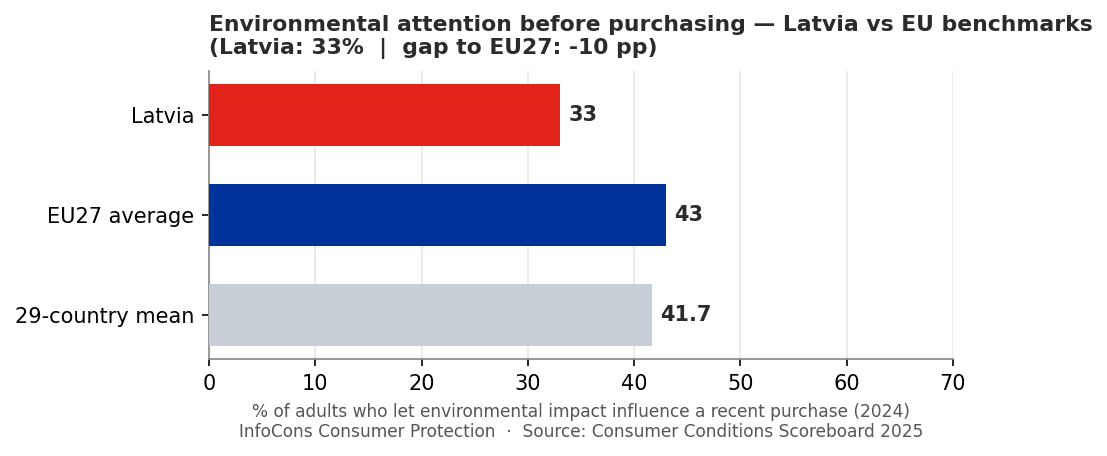
Latvia (red) next to the EU average and the all-country average.
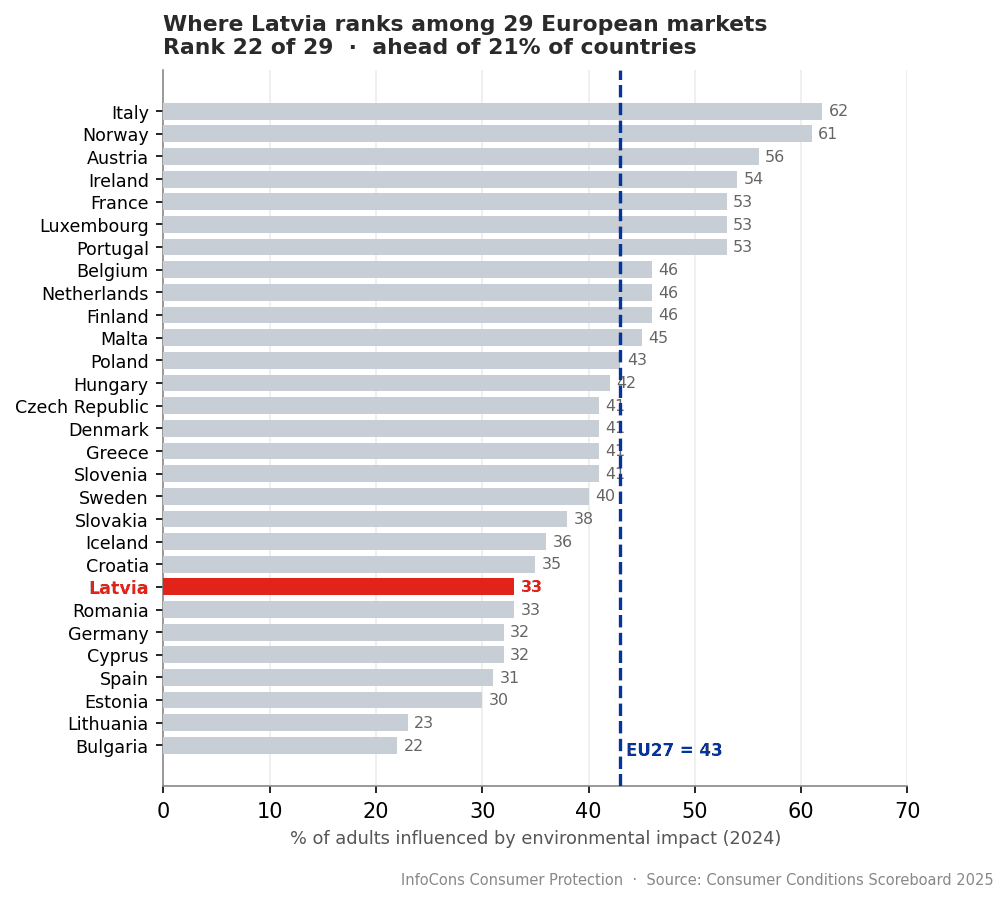
Where Latvia sits among all 29 countries (dashed line = EU average).
22. Romania — 33 out of 100 (about 3 in 10)
In Romania, 33 out of every 100 adults think about the planet when they shop — about 3 in 10. That is place 22 of 29 in Europe, and 10 points below the EU average of 43. 21 countries score higher and 6 score lower.
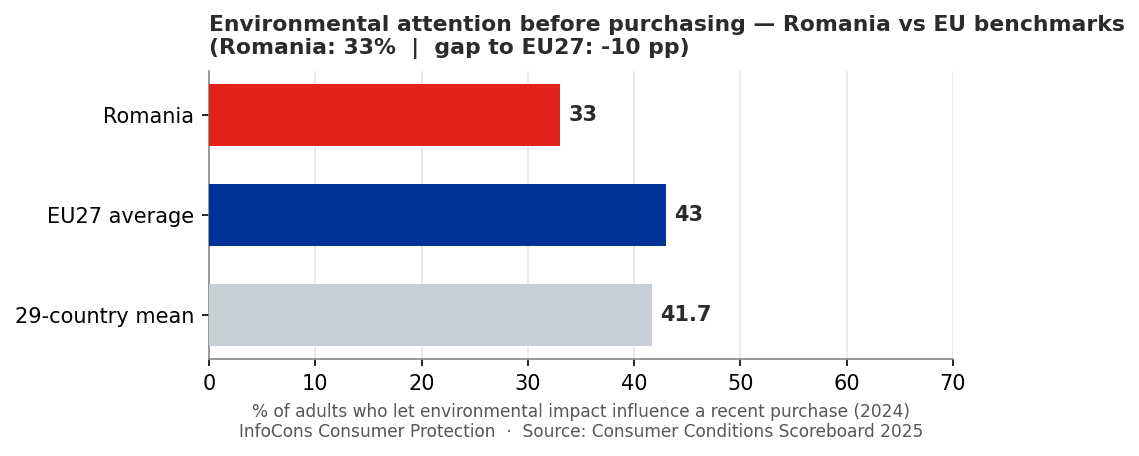
Romania (red) next to the EU average and the all-country average.
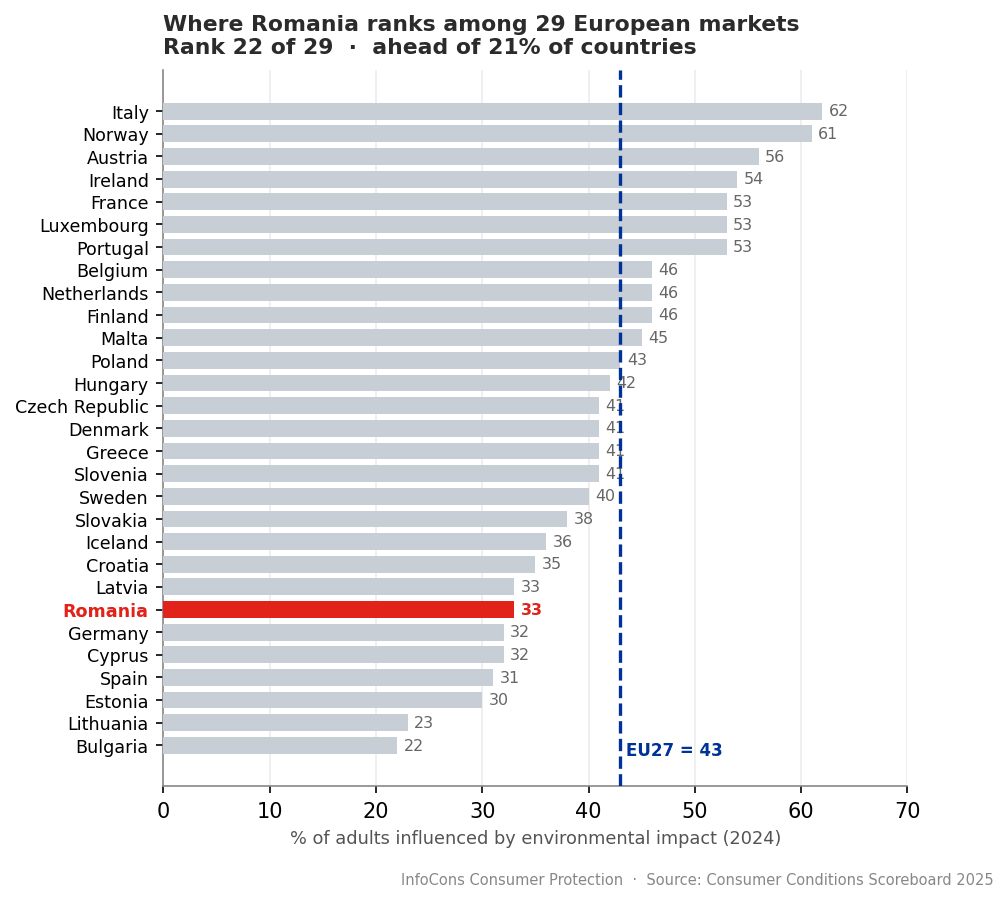
Where Romania sits among all 29 countries (dashed line = EU average).
24. Germany — 32 out of 100 (about 3 in 10)
In Germany, 32 out of every 100 adults think about the planet when they shop — about 3 in 10. That is place 24 of 29 in Europe, and 11 points below the EU average of 43. 23 countries score higher and 4 score lower.
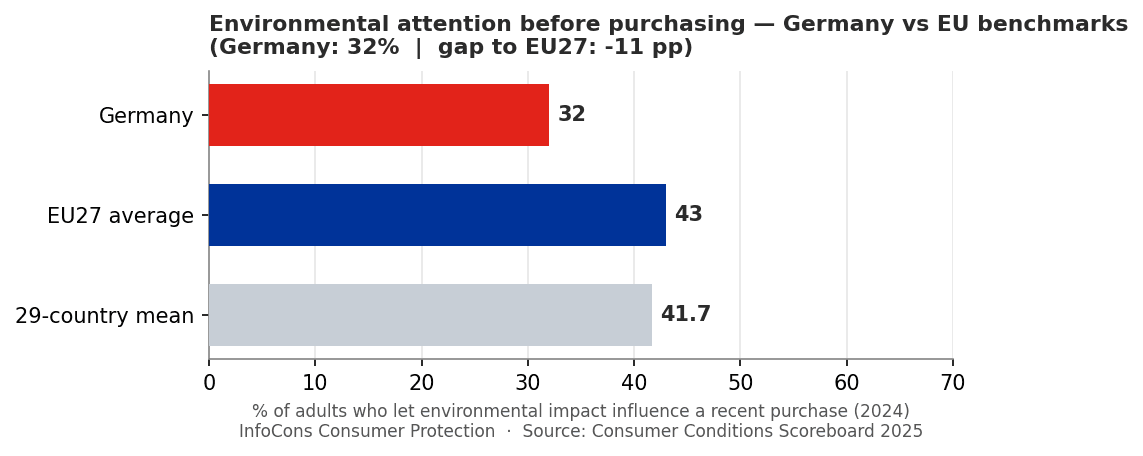
Germany (red) next to the EU average and the all-country average.
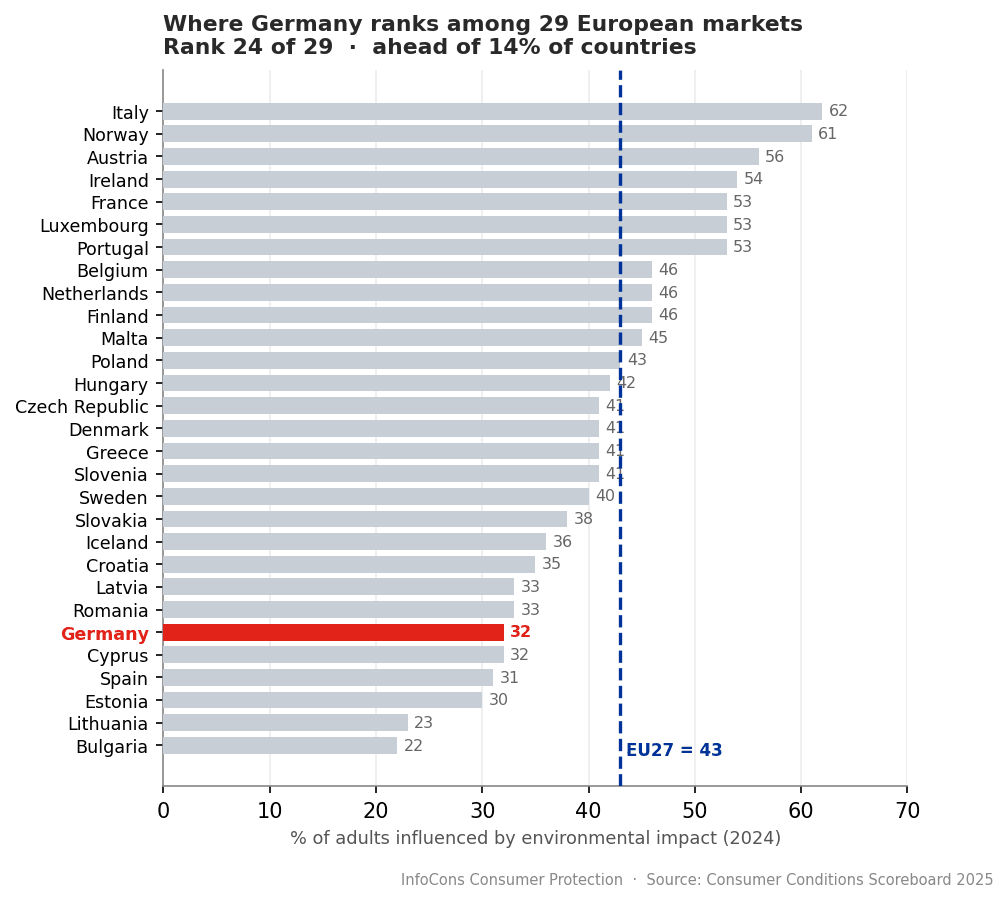
Where Germany sits among all 29 countries (dashed line = EU average).
24. Cyprus — 32 out of 100 (about 3 in 10)
In Cyprus, 32 out of every 100 adults think about the planet when they shop — about 3 in 10. That is place 24 of 29 in Europe, and 11 points below the EU average of 43. 23 countries score higher and 4 score lower.
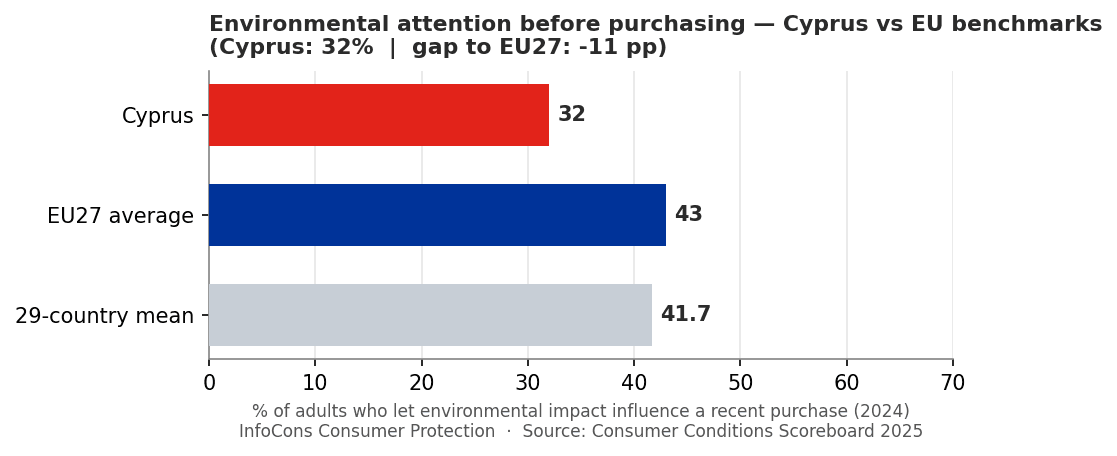
Cyprus (red) next to the EU average and the all-country average.
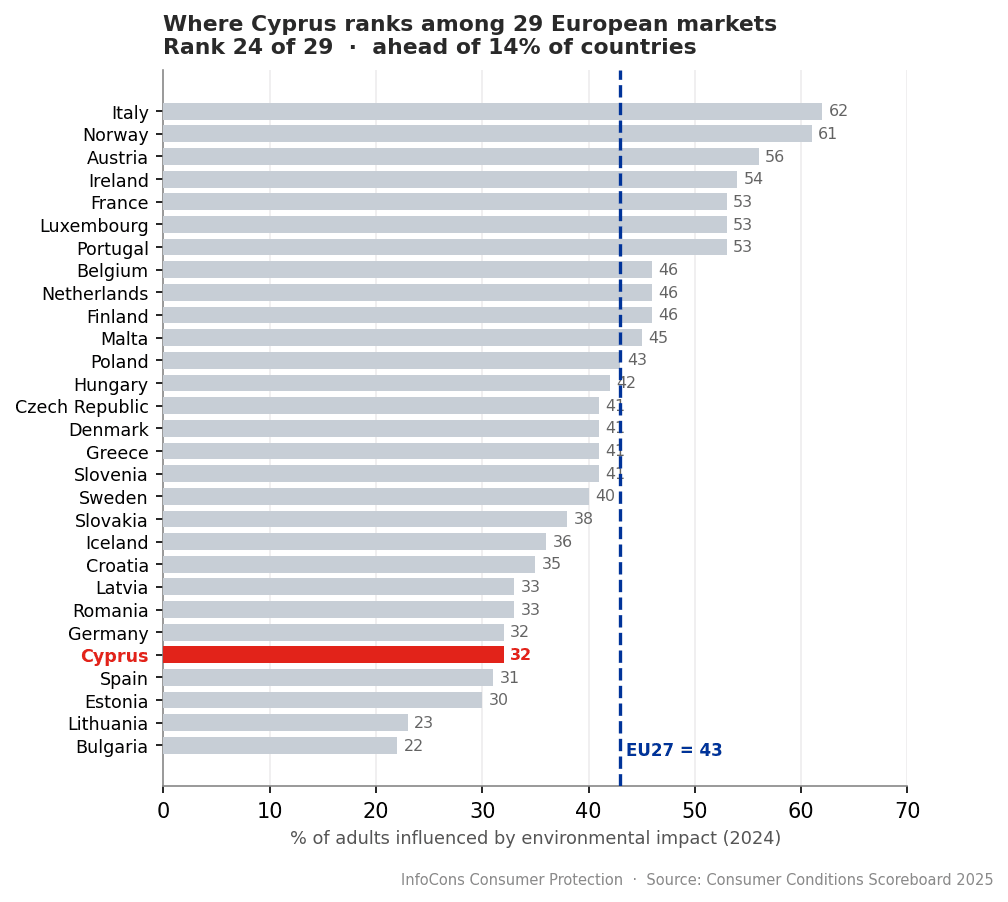
Where Cyprus sits among all 29 countries (dashed line = EU average).
26. Spain — 31 out of 100 (about 3 in 10)
In Spain, 31 out of every 100 adults think about the planet when they shop — about 3 in 10. That is place 26 of 29 in Europe, and 12 points below the EU average of 43. 25 countries score higher and 3 score lower.
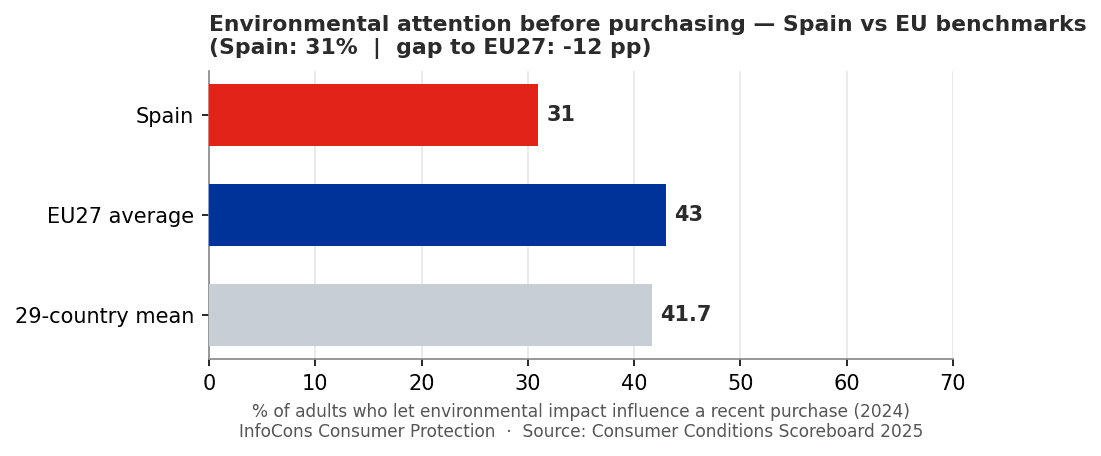
Spain (red) next to the EU average and the all-country average.
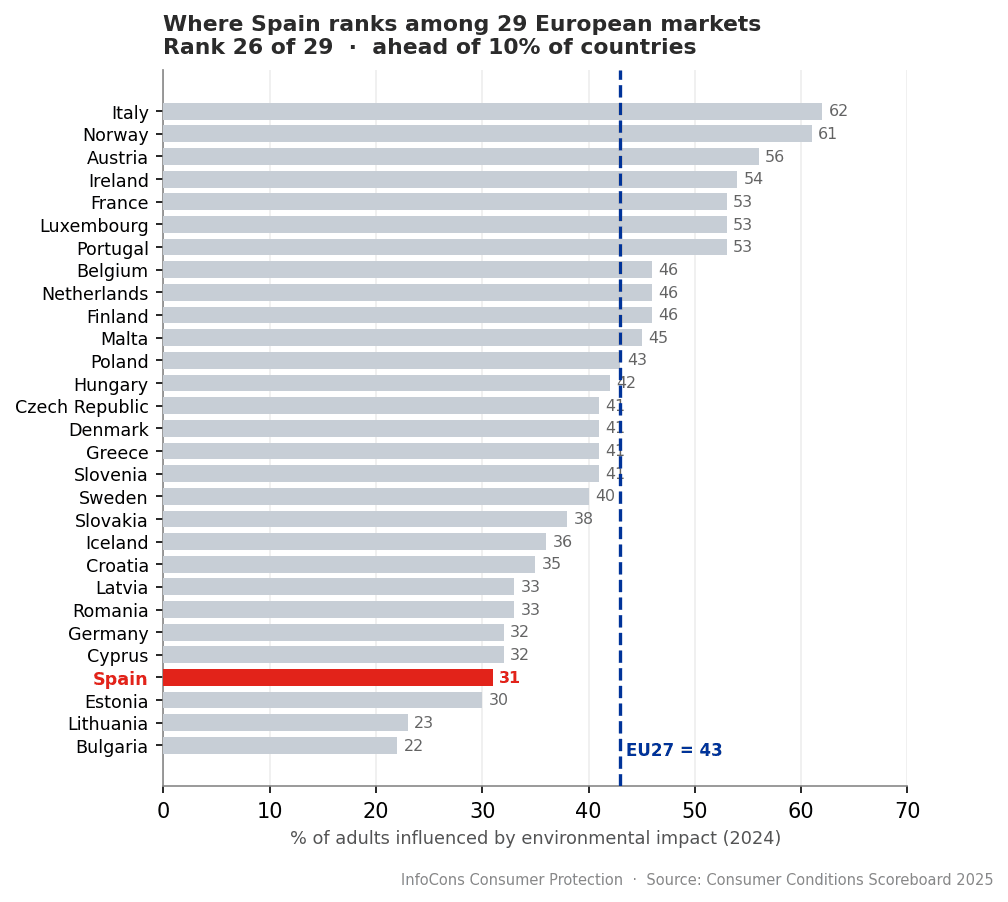
Where Spain sits among all 29 countries (dashed line = EU average).
27. Estonia — 30 out of 100 (about 3 in 10)
In Estonia, 30 out of every 100 adults think about the planet when they shop — about 3 in 10. That is place 27 of 29 in Europe, and 13 points below the EU average of 43. 26 countries score higher and 2 score lower.
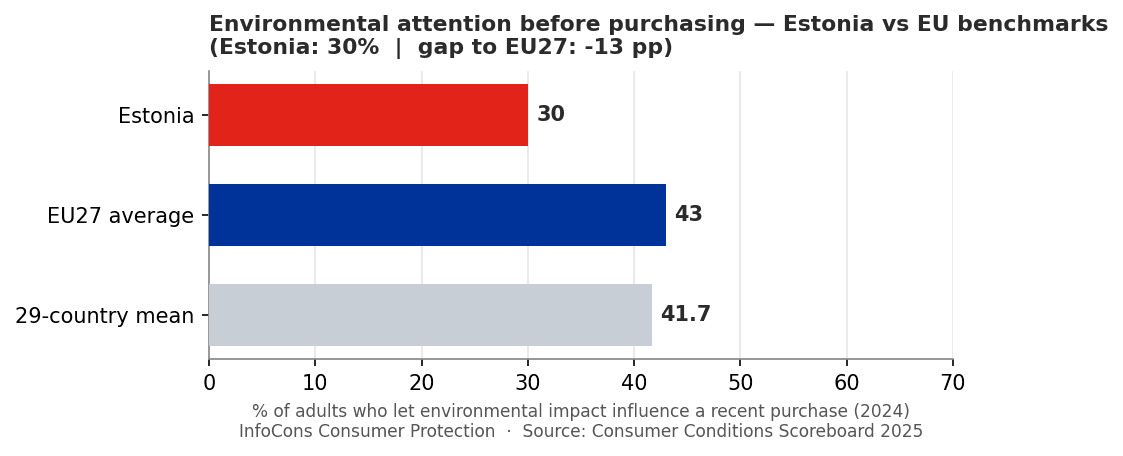
Estonia (red) next to the EU average and the all-country average.
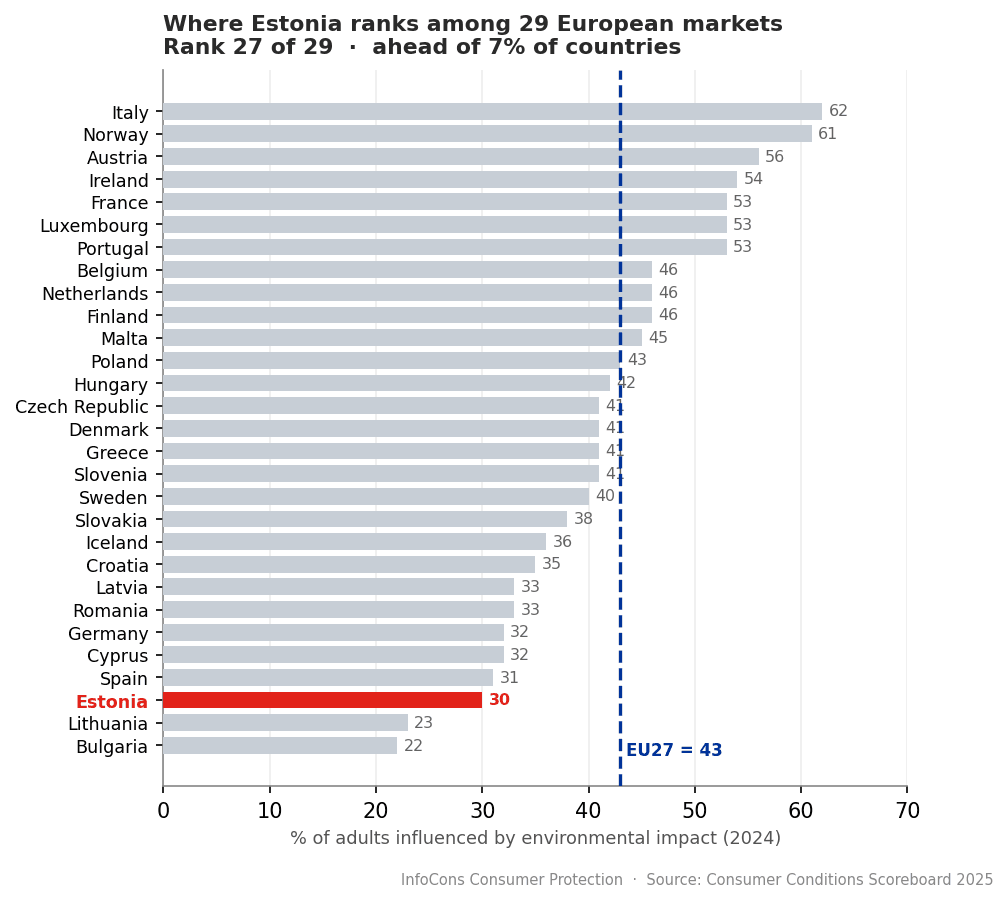
Where Estonia sits among all 29 countries (dashed line = EU average).
28. Lithuania — 23 out of 100 (about 1 in 5)
In Lithuania, 23 out of every 100 adults think about the planet when they shop — about 1 in 5. That is place 28 of 29 in Europe, and 20 points below the EU average of 43. 27 countries score higher and 1 score lower.
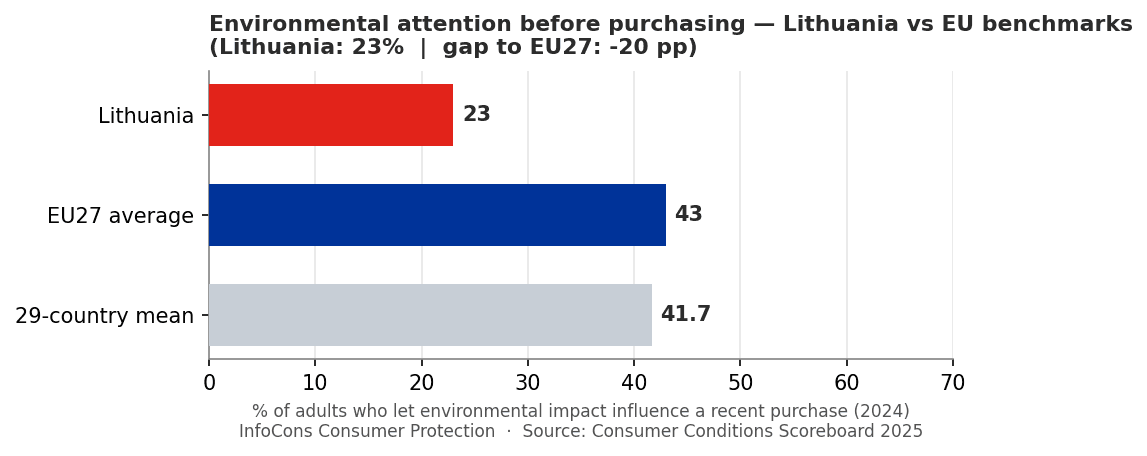
Lithuania (red) next to the EU average and the all-country average.
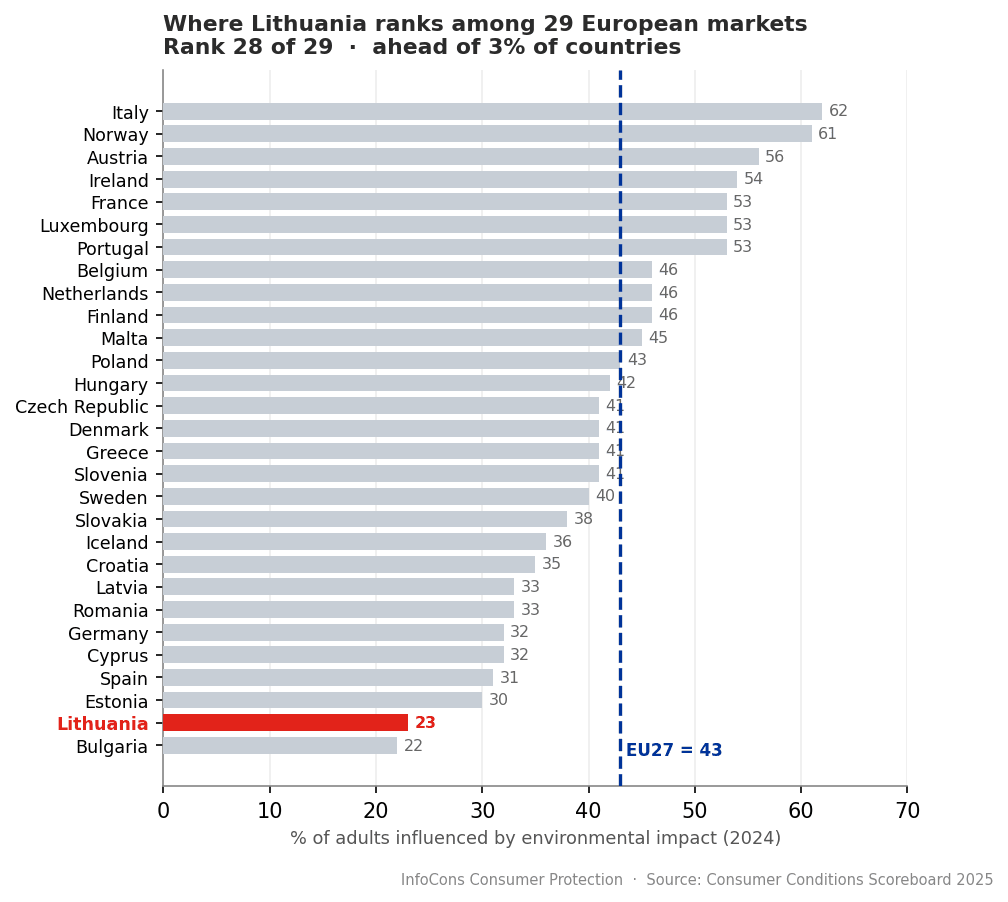
Where Lithuania sits among all 29 countries (dashed line = EU average).
29. Bulgaria — 22 out of 100 (about 1 in 5)
In Bulgaria, 22 out of every 100 adults think about the planet when they shop — about 1 in 5. That is place 29 of 29 in Europe, and 21 points below the EU average of 43. 28 countries score higher and 0 score lower.
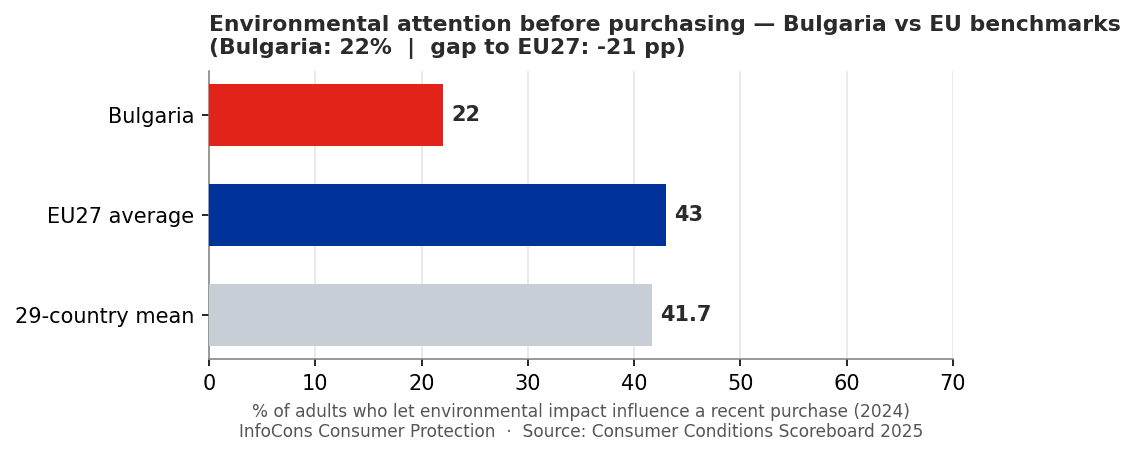
Bulgaria (red) next to the EU average and the all-country average.
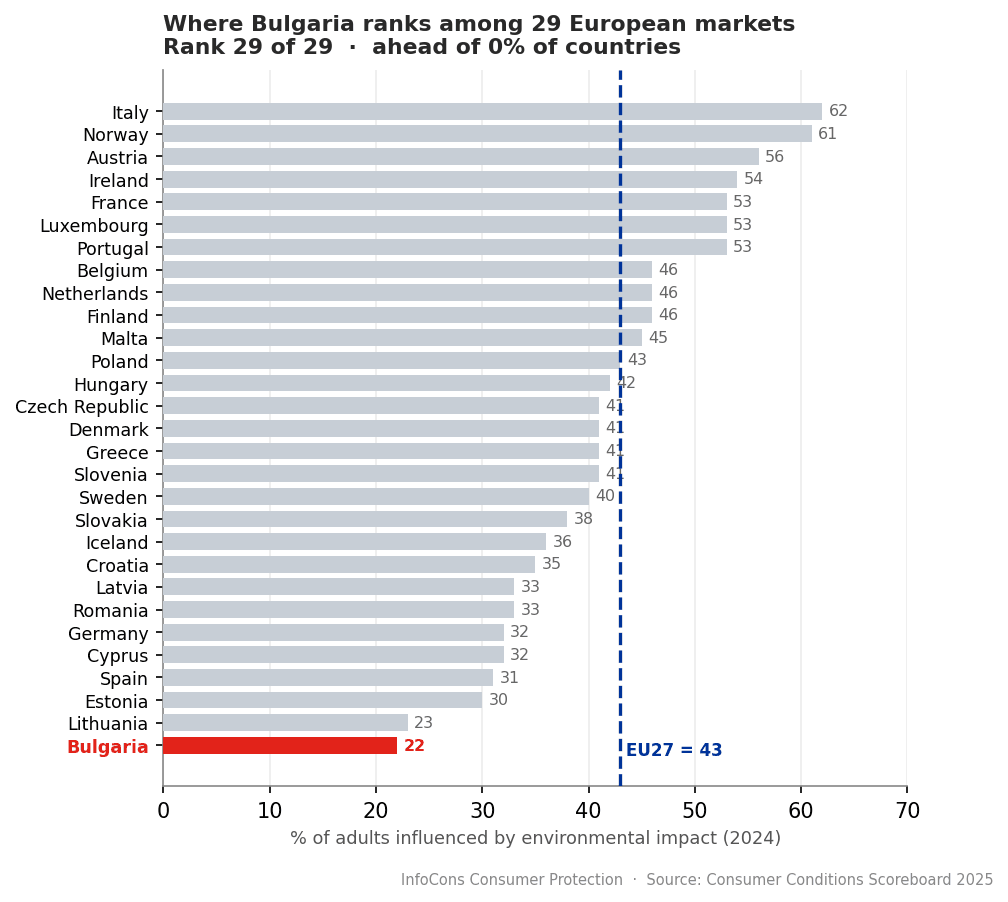
Where Bulgaria sits among all 29 countries (dashed line = EU average).
What It All Means
Three simple points. First, being a rich or northern country does not mean people there shop greener — Germany and Sweden, for example, are below the EU average, while Italy and Portugal are near the top. Second, the gap between countries is huge: from about 6 in 10 people in Italy to about 1 in 5 in Bulgaria. Third, the EU-wide drop since 2022 is mostly about price and trust, not because people stopped caring.
If you are moving to another EU country, expect green shopping to be easier in some places than others — clear labels, fair prices and repair shops are not the same everywhere. And for everyone, the same things help: honest labels you can trust, fair prices, and an easy, affordable way to repair the things you already own.
All numbers in this guide come only from the green-shopping part of the EU’s Consumer Conditions Scoreboard 2025 (survey done in November 2024 in the 27 EU countries plus Iceland and Norway).
Signature: InfoCons Consumer Protection Department for Green Transition