
Safe, Smart & Savvy in Europe: The 2025 Country-by-Country Ranking of Consumer Trust, Rights Knowledge & Product Safety
Which EU Country Best Protects You as a Consumer? An Expat, Student & Educator Field Guide Built on the European Commission’s Consumer Conditions Scoreboard 2025
Who this is for. This briefing is written in English for people living, studying and teaching across the European Union and the EEA – in particular expatriates settling into a new market, international students, and academic staff at English-language faculties who need a clear, comparable reference. It draws exclusively from the Knowledge, Trust & Product Safety chapter of the European Commission’s Consumer Conditions Scoreboard 2025, and turns its country data into a profile for every market covered.
What you will find. An EU27 snapshot, then a dedicated profile for each of the 29 markets (the 27 EU Member States plus Iceland and Norway). Every country profile shows, percentage by percentage and rank by rank, how the market compares with the rest of Europe on three pillars: trust that retailers respect consumer rights, the share of consumers with high knowledge of their rights, and confidence that products on the market are safe.
InfoCons Consumer Protection — Why Knowledge, Trust & Product Safety Decide Your Everyday Life in Europe
The Single Market promises that a consumer is protected to the same high standard whether shopping in Lisbon or Tallinn. In practice, how protected people feel – and how much they know about the rights that protect them – varies sharply from country to country. For someone who has just relocated, that gap is not academic: it shapes whether you push back on a faulty laptop, whether you trust a local retailer, and whether you recognise an unsafe product when you see one.
The Consumer Conditions Scoreboard 2025 measures consumer sentiment across the EU27 plus Iceland and Norway, drawing chiefly on a representative Consumer Conditions Survey of adults aged 18 and over carried out for the European Commission in November 2024. This report isolates the Scoreboard’s Knowledge, Trust & Product Safety chapter and rebuilds it around the country comparison that matters to mobile, internationally minded readers.
The three pillars, defined. Trust measures the share of adults who agree that retailers and service providers respect their rights as consumers. Knowledge captures the share with HIGH knowledge of their rights, meaning at least three correct answers out of four core questions. Product safety records the share confident that non-food products on the market are safe (essentially all safe, or mostly safe).
InfoCons Consumer Protection — How to Read the Numbers (Methodology & EU27 Benchmarks)
All percentages are shares of adults (18+) and are taken from the Scoreboard’s figures and the country summaries in its Annex I. The EU27 benchmarks used throughout this report are: trust in retailers 70%, high knowledge of rights 29%, and product-safety confidence 68%. Ranks are calculated across all 29 markets, with rank 1 being the highest value. Country-level values are read from the Scoreboard’s country-summary charts; where a country sits very close to a neighbour, small ordering differences should be treated as indicative rather than exact.
Important context the survey adds at EU level. Beyond the country comparison, the chapter reports that across the EU27, 56% of consumers had seen a product recall in the past two years and 13% had owned a recalled product; 14% experienced a product-safety issue (more than half of whom did not complain); and 2% reported an injury from a dangerous product. Trust in public organisations to protect consumer rights stood at 61%, the same as for consumer NGOs. On specific rights, 59% knew the 14-day distance cooling-off right, 56% the rule against one-sided price rises, 44% the two-year guarantee, and just 31% knew they need not pay for unsolicited goods – which is why 35% of EU consumers fall into the LOW knowledge band and only 29% into the HIGH band.
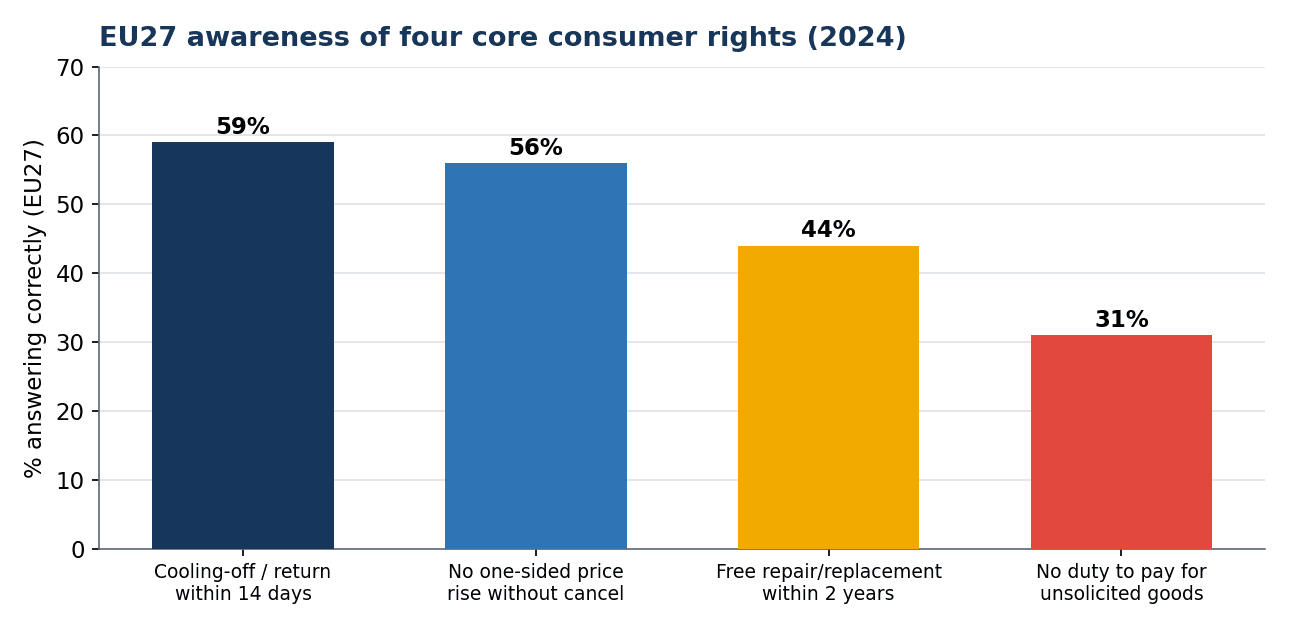
Figure: EU27 awareness of four core consumer rights (% answering correctly, 2024).
InfoCons Consumer Protection — The EU27 Snapshot: Where Every Country Stands in 2025
The three charts below rank all 29 markets on each pillar. Bars in navy sit at or above the EU27 average; red bars fall below it; grey bars are the two non-EU EEA markets, Iceland and Norway. The gold dashed line is the EU27 benchmark.
InfoCons Consumer Protection — Trust League Table
Trust that retailers respect consumer rights averages 70% across the EU27. Austria (88%), Estonia (84%) and Hungary (82%) lead, while France (58%), Cyprus (47%) and Greece (44%) trail. The spread – more than 40 percentage points top to bottom – is the single widest of the three pillars.
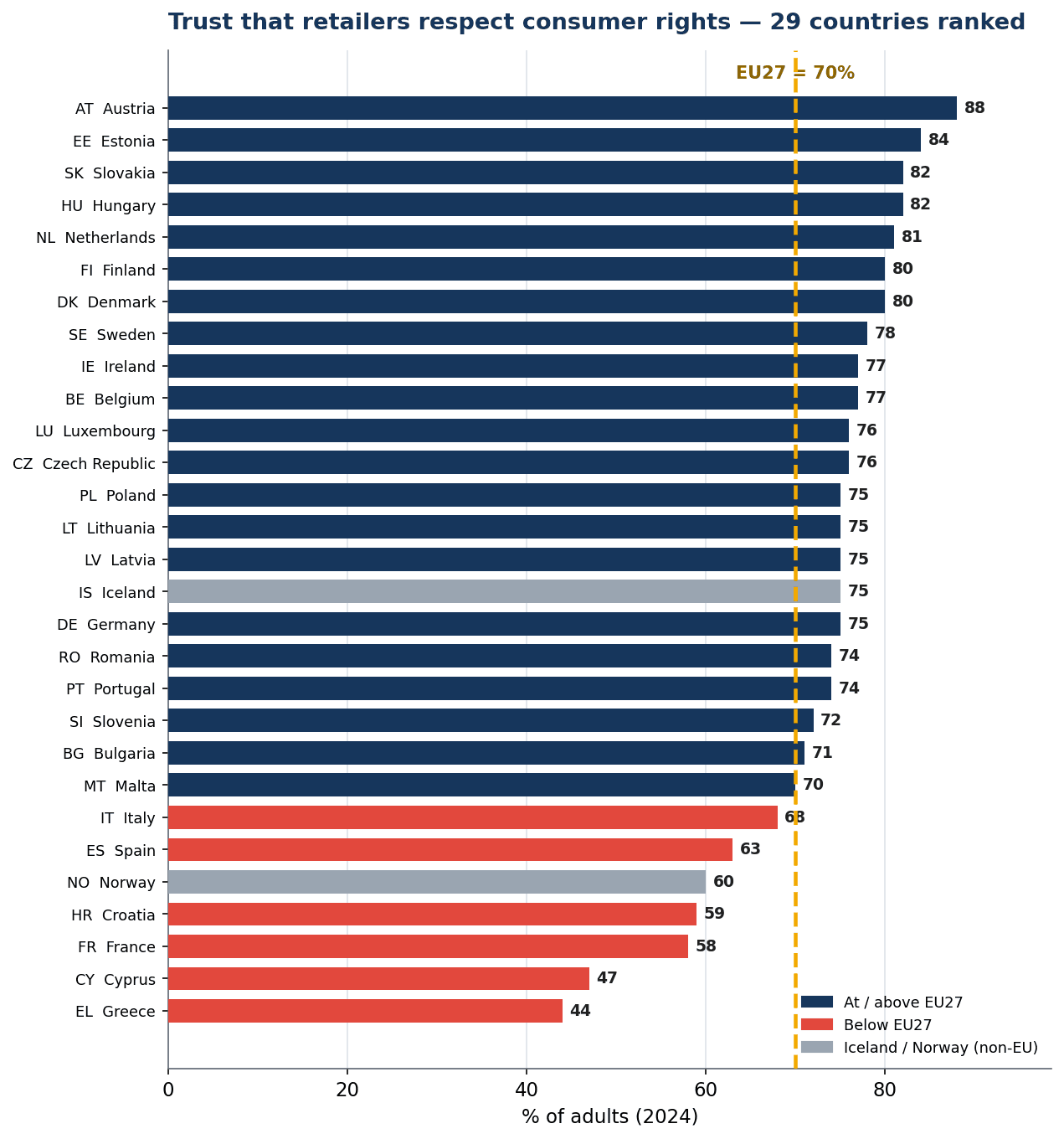
Figure: Trust in retailers, 29 markets ranked (% of adults, 2024). Gold line = EU27 average.
InfoCons Consumer Protection — Rights-Knowledge League Table
Only 29% of EU27 consumers reach the HIGH knowledge band. Denmark (43%), the Czech Republic (37%) and Norway (37%) come top; Croatia (17%), Cyprus (16%) and Greece (10%) anchor the bottom. Knowledge is the weakest pillar Europe-wide – in most markets fewer than a third of consumers know their core rights.
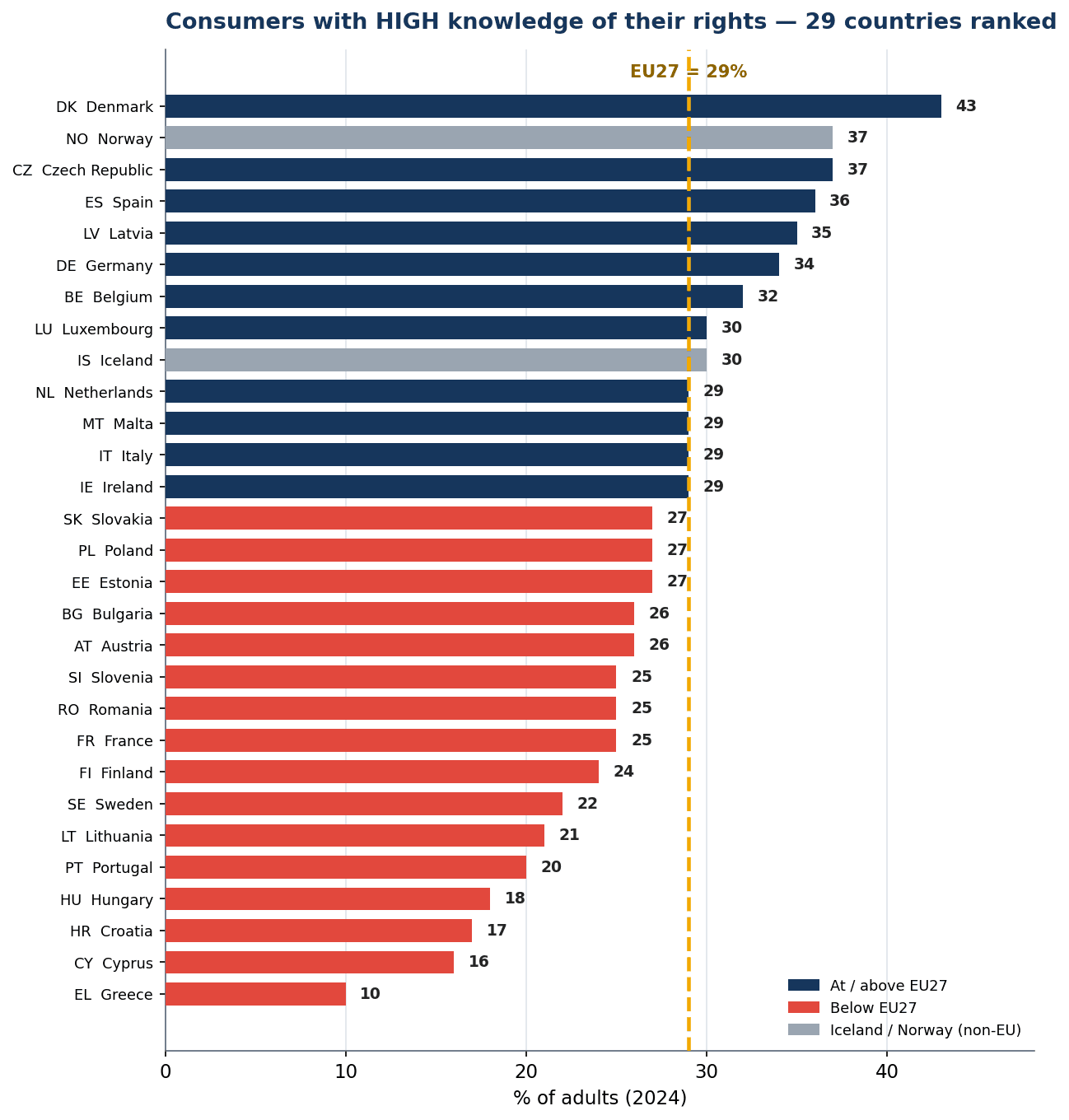
Figure: High knowledge of consumer rights, 29 markets ranked (% of adults, 2024).
InfoCons Consumer Protection — Product-Safety Confidence League Table
Confidence that products are safe is the most reassuring pillar, averaging 68% across the EU27. Finland (92%), Estonia (82%) and Norway (81%) score highest; Cyprus and Luxembourg (both 60%) and Greece (59%) lowest.
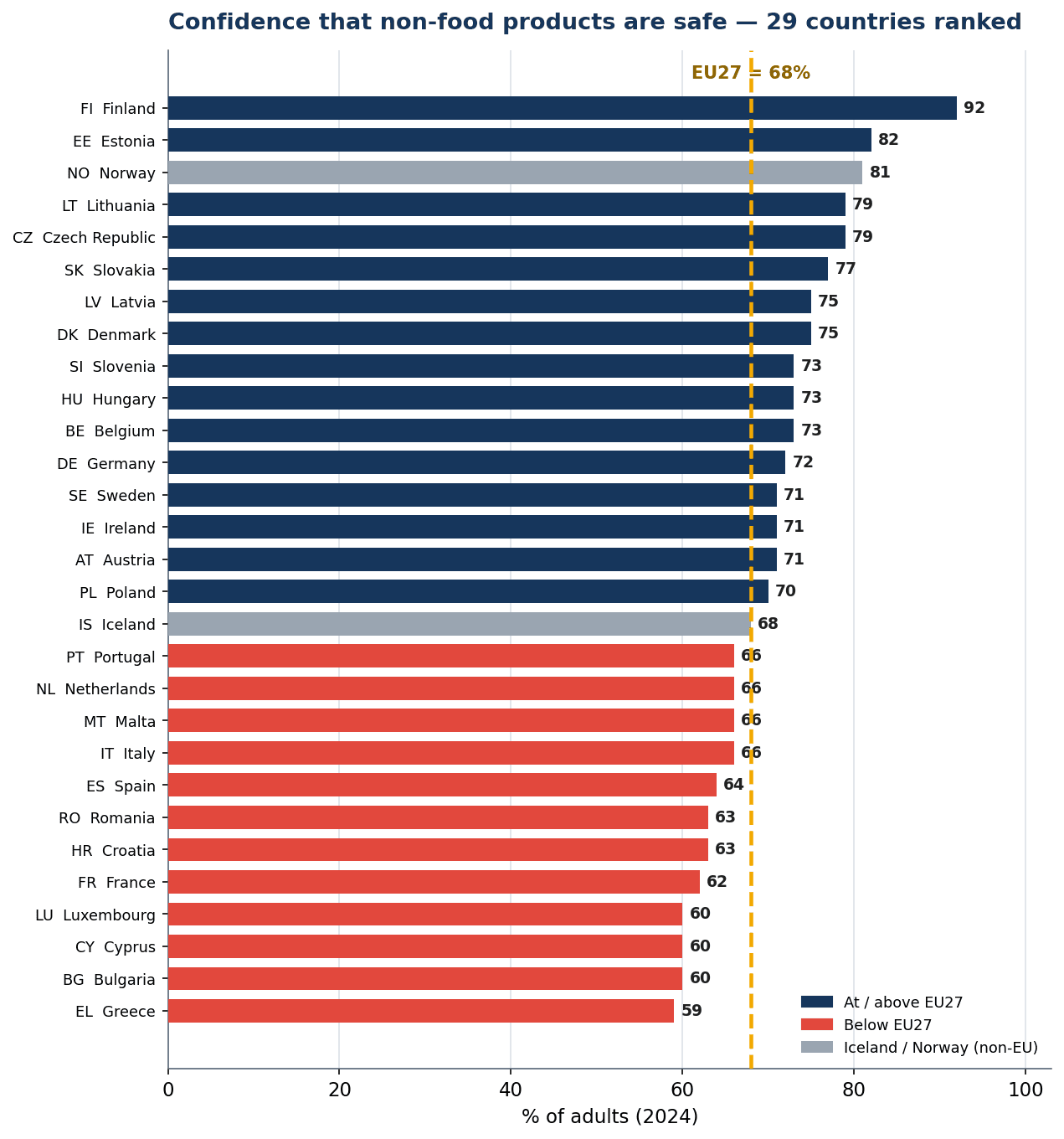
Figure: Confidence in product safety, 29 markets ranked (% of adults, 2024).
InfoCons Consumer Protection — Trust, Knowledge & Safety at a Glance
Plotting trust against rights knowledge – with bubble size showing product-safety confidence – reveals that high trust does not guarantee high knowledge. Several high-trust markets still have below-average rights awareness, a reminder that feeling protected and being informed are not the same thing.
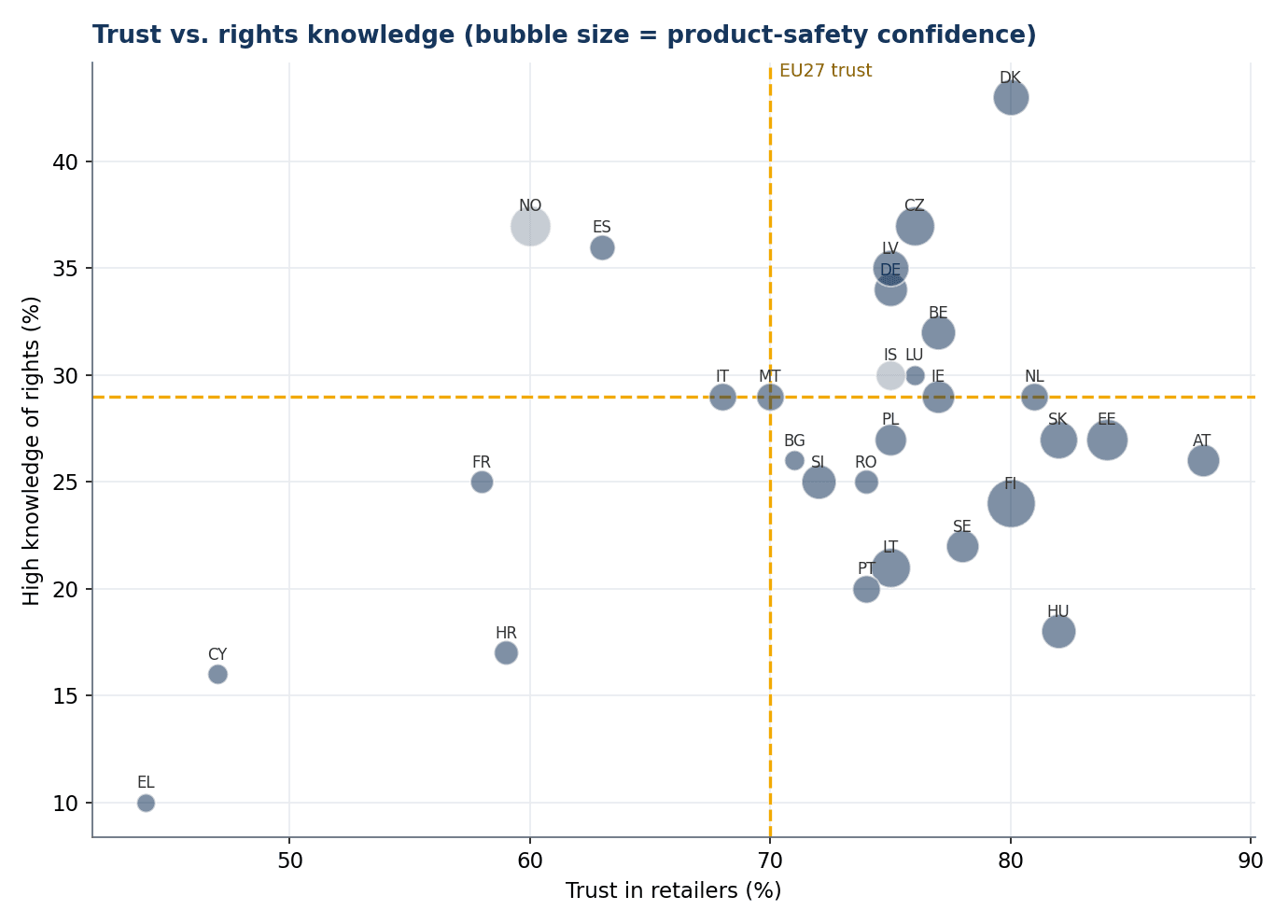
Figure: Trust vs. rights knowledge across 29 markets; bubble size = product-safety confidence.
InfoCons Consumer Protection — The Safety Gate Backdrop
Product-safety confidence should be read alongside the EU’s enforcement machinery. In 2024 the Safety Gate rapid-alert system exchanged 4,137 alerts on dangerous non-food products – up 22% on 2023 and 95% on 2022 – reflecting both stronger market surveillance and the new General Product Safety Regulation. Products originating in China accounted for 40% of alerts and Italy for 16%; chemical risks were the most common hazard at 49%.
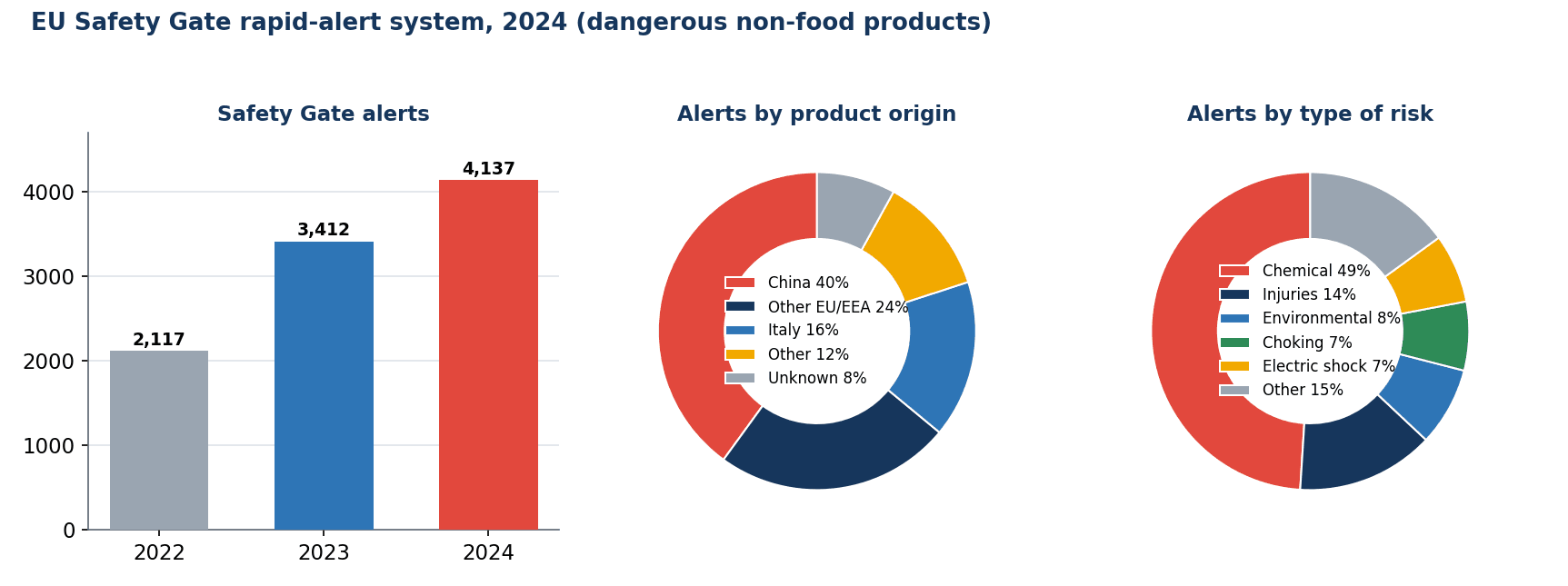
Figure: EU Safety Gate alerts in 2024 – trend, product origin and type of risk.
InfoCons Consumer Protection — The 29 Country Profiles
Each profile below compares the market with the EU27 average and with the full European field on all three pillars. Two infographics accompany every country: a side-by-side comparison with the EU27 average, and a diverging chart showing the percentage-point gap from the EU average together with the market’s European rank.
Belgium — InfoCons Consumer Protection Country Profile: Trust, Rights Knowledge & Product Safety
Belgium (BE) is benchmarked here against all 28 other markets covered by the European Commission’s Consumer Conditions Scoreboard 2025. On the three pillars of the Knowledge, Trust & Product Safety chapter, Belgium ranks 9th of 29 for trust in retailers, 7th of 29 for rights knowledge and 9th of 29 for product-safety confidence. Averaged across the three, it sits well inside the European top tier.
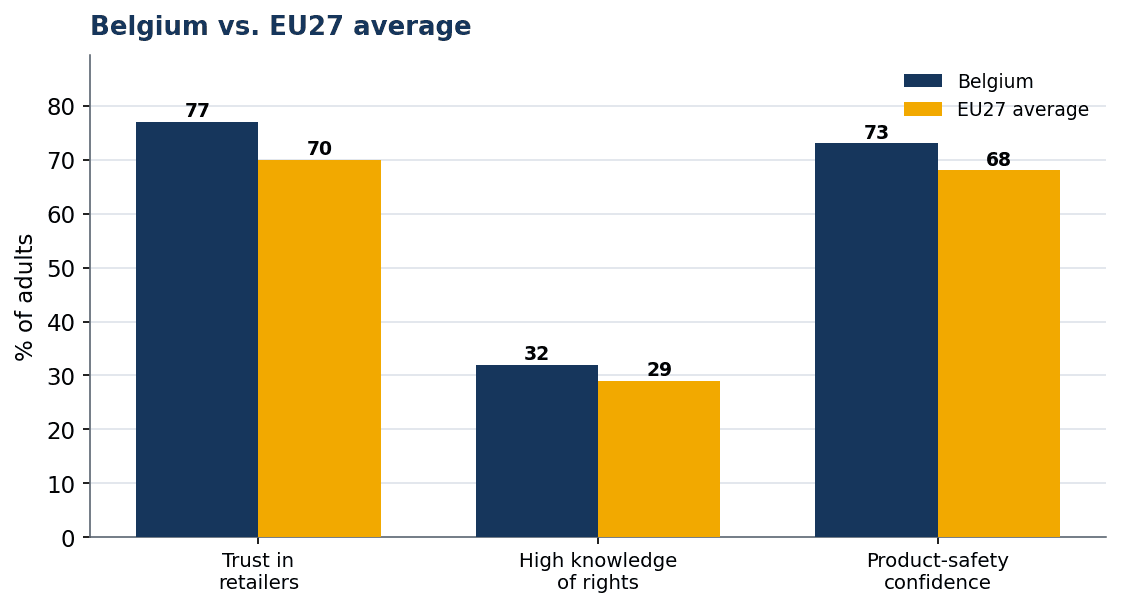
Figure: Belgium versus the EU27 average on the three Knowledge, Trust & Product Safety indicators (% of adults, 2024).
Trust in retailers and service providers. 77% of consumers in Belgium agree that retailers and service providers respect their rights, which is 7 percentage points above the EU27 average (EU27: 70%). That places Belgium 9th out of 29 countries. For reference, Austria leads the continent on this measure (88%), while Greece trails the field (44%).
Knowledge of consumer rights. 32% of Belgium’s consumers qualify as having HIGH knowledge of their rights – correctly answering at least three of the four test questions on cooling-off periods, one-sided contract changes, the two-year legal guarantee and unsolicited goods. That is 3 percentage points above the EU27 average (EU27: 29%), ranking Belgium 7th of 29. Denmark tops Europe here (43%); Greece records the lowest score (10%).
Confidence in product safety. 73% of consumers in Belgium are confident that the non-food products on the market are safe (all safe or mostly safe), 5 percentage points above the EU27 average (EU27: 68%) and 9th of 29. Finland is Europe’s safety-confidence champion (92%), with Greece again at the foot of the table (59%).
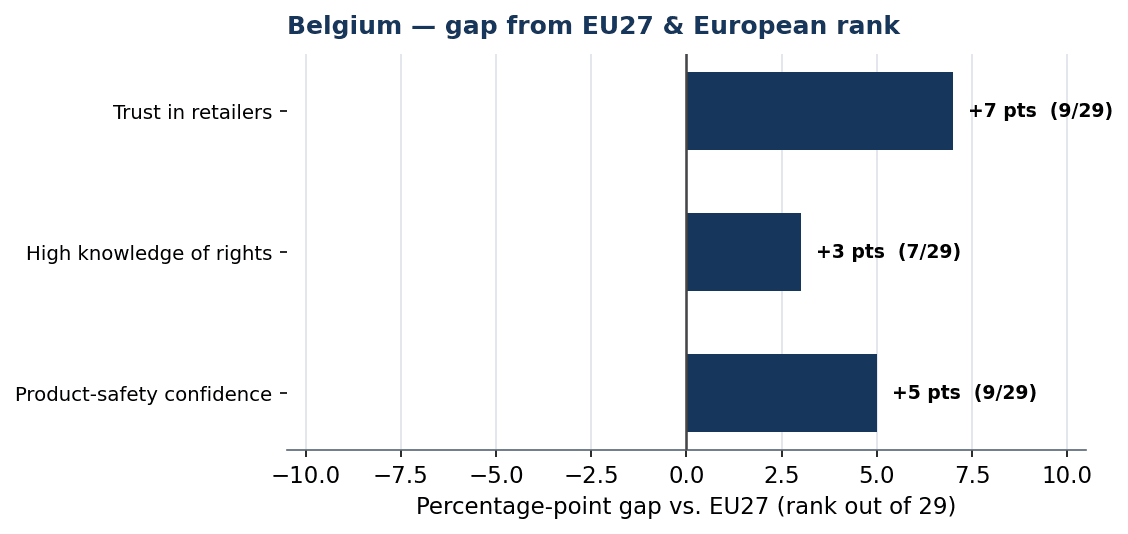
Figure: How far Belgium sits from the EU27 average on each indicator, with its rank out of 29 European markets.
InfoCons takeaway for readers in Belgium. Belgium’s relative strength is rights knowledge (7th in Europe), while its weakest pillar is trust in retailers (9th of 29). Newcomers, exchange students and faculty should calibrate expectations accordingly: where the country ranks low, knowing your rights and the EU-wide redress channels (the European Consumer Centres Network, online dispute resolution, and the Safety Gate alert system) matters most.
Bulgaria — InfoCons Consumer Protection Country Profile: Trust, Rights Knowledge & Product Safety
Bulgaria (BG) is benchmarked here against all 28 other markets covered by the European Commission’s Consumer Conditions Scoreboard 2025. On the three pillars of the Knowledge, Trust & Product Safety chapter, Bulgaria ranks 21st of 29 for trust in retailers, 17th of 29 for rights knowledge and 26th of 29 for product-safety confidence. Averaged across the three, it sits in the lower-middle of the European field.
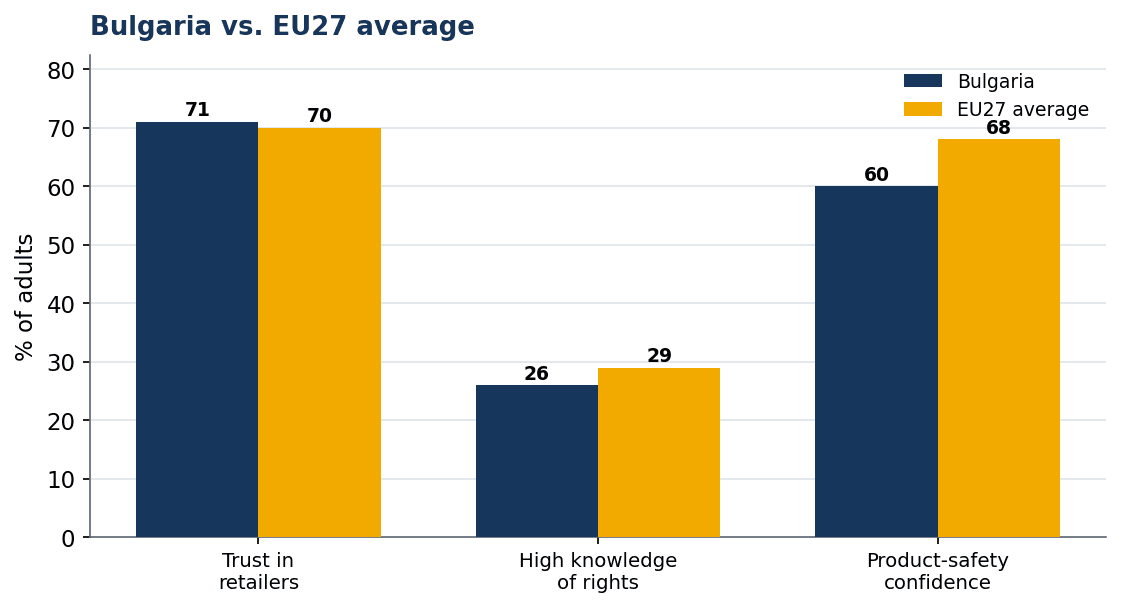
Figure: Bulgaria versus the EU27 average on the three Knowledge, Trust & Product Safety indicators (% of adults, 2024).
Trust in retailers and service providers. 71% of consumers in Bulgaria agree that retailers and service providers respect their rights, which is 1 percentage point above the EU27 average (EU27: 70%). That places Bulgaria 21st out of 29 countries. For reference, Austria leads the continent on this measure (88%), while Greece trails the field (44%).
Knowledge of consumer rights. 26% of Bulgaria’s consumers qualify as having HIGH knowledge of their rights – correctly answering at least three of the four test questions on cooling-off periods, one-sided contract changes, the two-year legal guarantee and unsolicited goods. That is 3 percentage points below the EU27 average (EU27: 29%), ranking Bulgaria 17th of 29. Denmark tops Europe here (43%); Greece records the lowest score (10%).
Confidence in product safety. 60% of consumers in Bulgaria are confident that the non-food products on the market are safe (all safe or mostly safe), 8 percentage points below the EU27 average (EU27: 68%) and 26th of 29. Finland is Europe’s safety-confidence champion (92%), with Greece again at the foot of the table (59%).
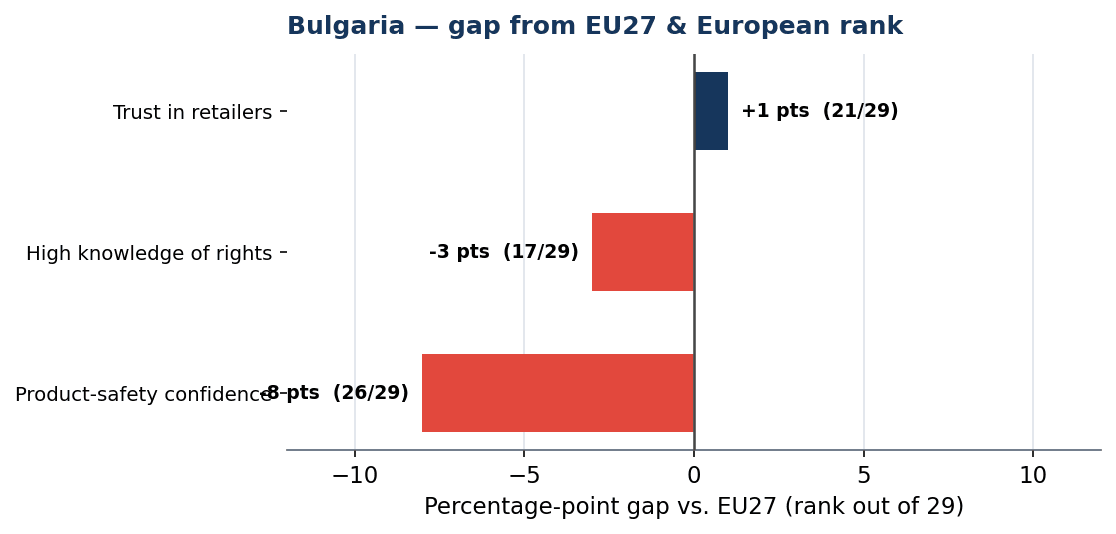
Figure: How far Bulgaria sits from the EU27 average on each indicator, with its rank out of 29 European markets.
InfoCons takeaway for readers in Bulgaria. Bulgaria’s relative strength is rights knowledge (17th in Europe), while its weakest pillar is product-safety confidence (26th of 29). Newcomers, exchange students and faculty should calibrate expectations accordingly: where the country ranks low, knowing your rights and the EU-wide redress channels (the European Consumer Centres Network, online dispute resolution, and the Safety Gate alert system) matters most.
Czech Republic — InfoCons Consumer Protection Country Profile: Trust, Rights Knowledge & Product Safety
Czech Republic (CZ) is benchmarked here against all 28 other markets covered by the European Commission’s Consumer Conditions Scoreboard 2025. On the three pillars of the Knowledge, Trust & Product Safety chapter, Czech Republic ranks 11th of 29 for trust in retailers, 2nd of 29 for rights knowledge and 4th of 29 for product-safety confidence. Averaged across the three, it sits well inside the European top tier.
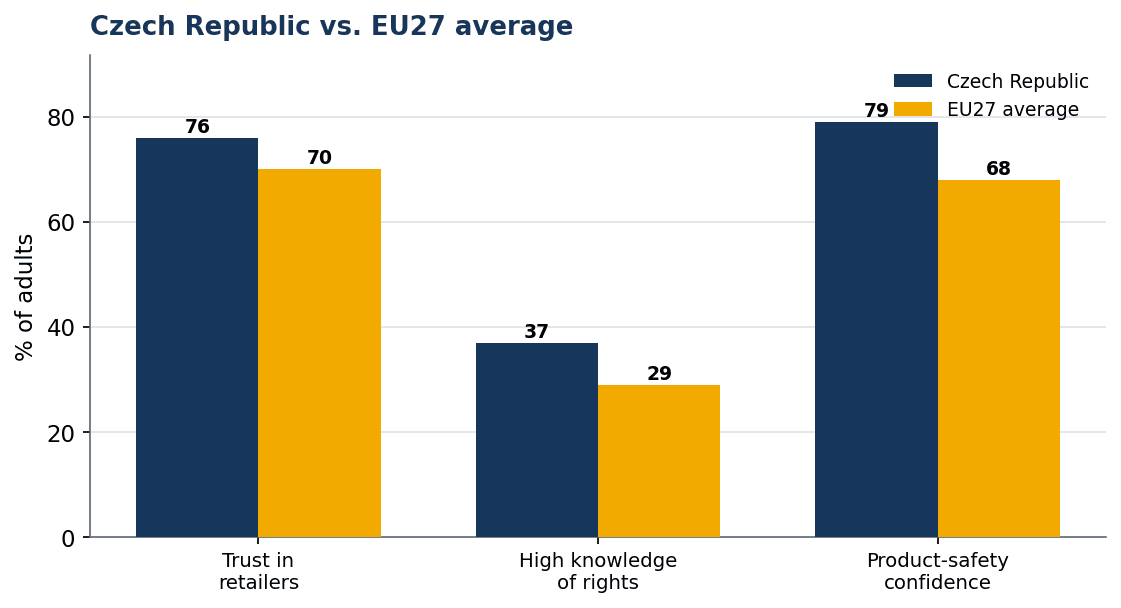
Figure: Czech Republic versus the EU27 average on the three Knowledge, Trust & Product Safety indicators (% of adults, 2024).
Trust in retailers and service providers. 76% of consumers in Czech Republic agree that retailers and service providers respect their rights, which is 6 percentage points above the EU27 average (EU27: 70%). That places Czech Republic 11th out of 29 countries. For reference, Austria leads the continent on this measure (88%), while Greece trails the field (44%).
Knowledge of consumer rights. 37% of Czech Republic’s consumers qualify as having HIGH knowledge of their rights – correctly answering at least three of the four test questions on cooling-off periods, one-sided contract changes, the two-year legal guarantee and unsolicited goods. That is 8 percentage points above the EU27 average (EU27: 29%), ranking Czech Republic 2nd of 29. Denmark tops Europe here (43%); Greece records the lowest score (10%).
Confidence in product safety. 79% of consumers in Czech Republic are confident that the non-food products on the market are safe (all safe or mostly safe), 11 percentage points above the EU27 average (EU27: 68%) and 4th of 29. Finland is Europe’s safety-confidence champion (92%), with Greece again at the foot of the table (59%).
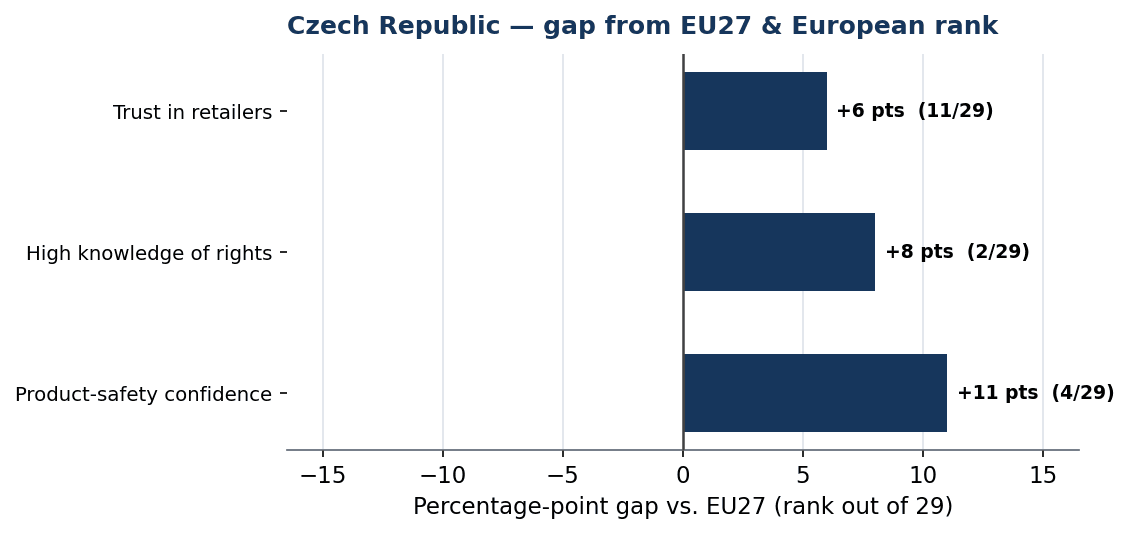
Figure: How far Czech Republic sits from the EU27 average on each indicator, with its rank out of 29 European markets.
InfoCons takeaway for readers in Czech Republic. Czech Republic’s relative strength is rights knowledge (2nd in Europe), while its weakest pillar is trust in retailers (11th of 29). Newcomers, exchange students and faculty should calibrate expectations accordingly: where the country ranks low, knowing your rights and the EU-wide redress channels (the European Consumer Centres Network, online dispute resolution, and the Safety Gate alert system) matters most.
Denmark — InfoCons Consumer Protection Country Profile: Trust, Rights Knowledge & Product Safety
Denmark (DK) is benchmarked here against all 28 other markets covered by the European Commission’s Consumer Conditions Scoreboard 2025. On the three pillars of the Knowledge, Trust & Product Safety chapter, Denmark ranks 6th of 29 for trust in retailers, 1st of 29 for rights knowledge and 7th of 29 for product-safety confidence. Averaged across the three, it sits well inside the European top tier.
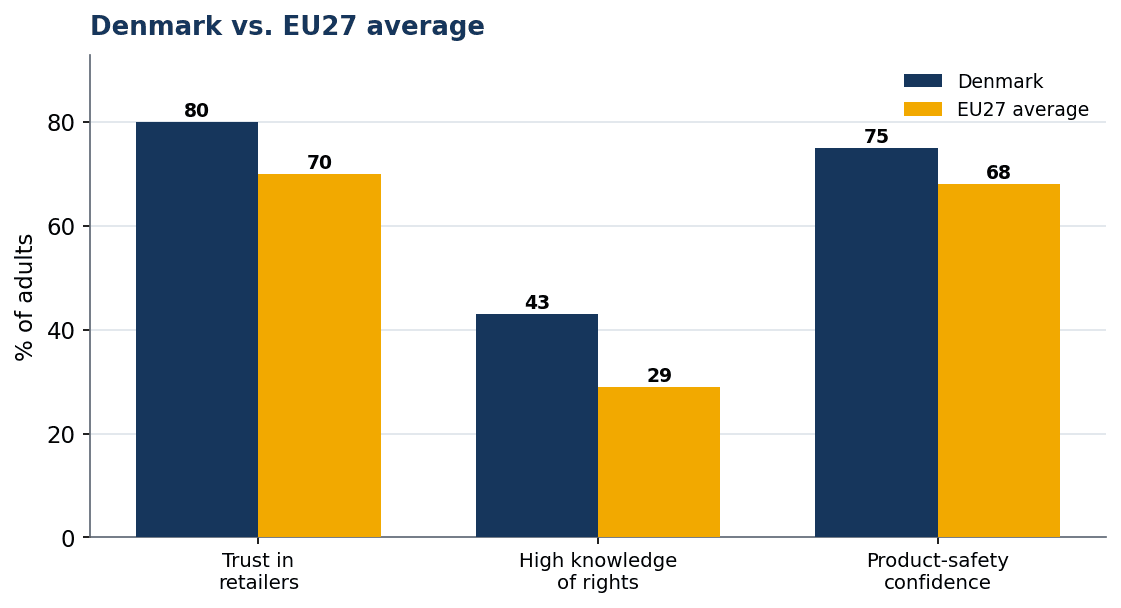
Figure: Denmark versus the EU27 average on the three Knowledge, Trust & Product Safety indicators (% of adults, 2024).
Trust in retailers and service providers. 80% of consumers in Denmark agree that retailers and service providers respect their rights, which is 10 percentage points above the EU27 average (EU27: 70%). That places Denmark 6th out of 29 countries. For reference, Austria leads the continent on this measure (88%), while Greece trails the field (44%).
Knowledge of consumer rights. 43% of Denmark’s consumers qualify as having HIGH knowledge of their rights – correctly answering at least three of the four test questions on cooling-off periods, one-sided contract changes, the two-year legal guarantee and unsolicited goods. That is 14 percentage points above the EU27 average (EU27: 29%), ranking Denmark 1st of 29. Denmark tops Europe here (43%); Greece records the lowest score (10%).
Confidence in product safety. 75% of consumers in Denmark are confident that the non-food products on the market are safe (all safe or mostly safe), 7 percentage points above the EU27 average (EU27: 68%) and 7th of 29. Finland is Europe’s safety-confidence champion (92%), with Greece again at the foot of the table (59%).
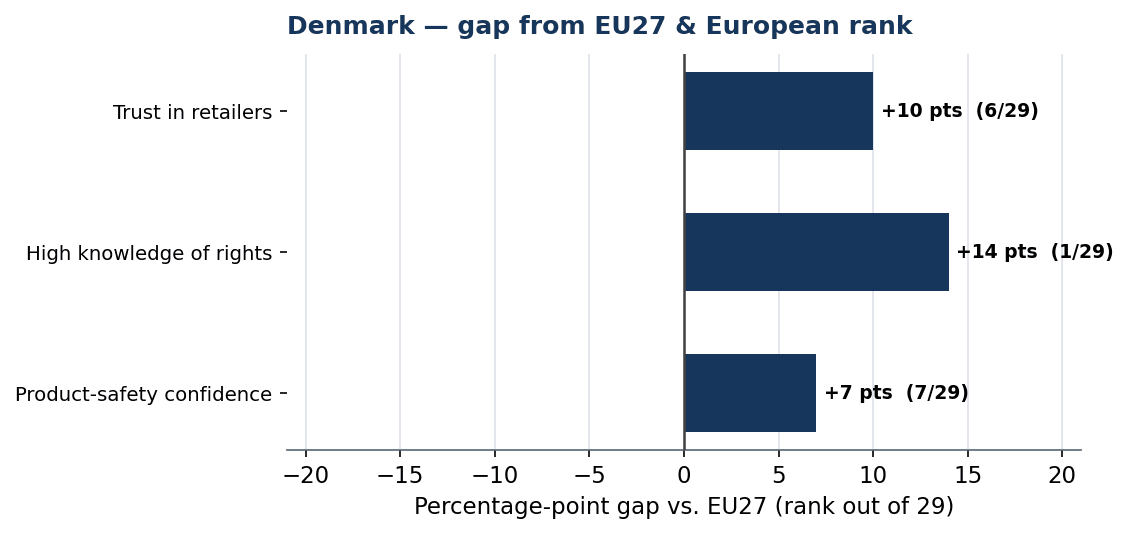
Figure: How far Denmark sits from the EU27 average on each indicator, with its rank out of 29 European markets.
InfoCons takeaway for readers in Denmark. Denmark’s relative strength is rights knowledge (1st in Europe), while its weakest pillar is product-safety confidence (7th of 29). Newcomers, exchange students and faculty should calibrate expectations accordingly: where the country ranks low, knowing your rights and the EU-wide redress channels (the European Consumer Centres Network, online dispute resolution, and the Safety Gate alert system) matters most.
Germany — InfoCons Consumer Protection Country Profile: Trust, Rights Knowledge & Product Safety
Germany (DE) is benchmarked here against all 28 other markets covered by the European Commission’s Consumer Conditions Scoreboard 2025. On the three pillars of the Knowledge, Trust & Product Safety chapter, Germany ranks 13th of 29 for trust in retailers, 6th of 29 for rights knowledge and 12th of 29 for product-safety confidence. Averaged across the three, it sits in the upper-middle of the European field.
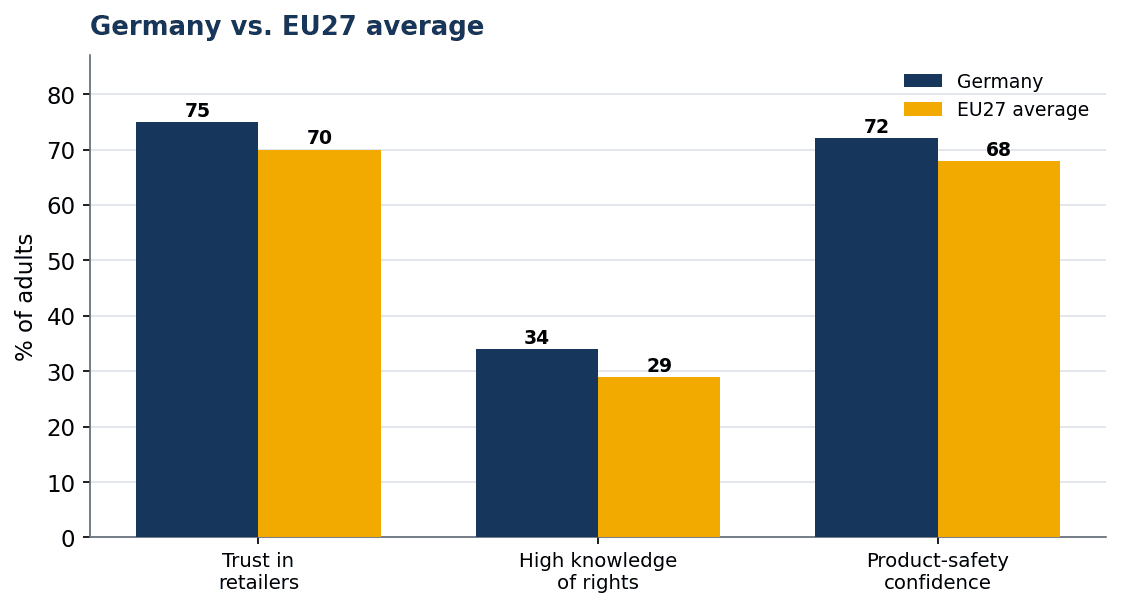
Figure: Germany versus the EU27 average on the three Knowledge, Trust & Product Safety indicators (% of adults, 2024).
Trust in retailers and service providers. 75% of consumers in Germany agree that retailers and service providers respect their rights, which is 5 percentage points above the EU27 average (EU27: 70%). That places Germany 13th out of 29 countries. For reference, Austria leads the continent on this measure (88%), while Greece trails the field (44%).
Knowledge of consumer rights. 34% of Germany’s consumers qualify as having HIGH knowledge of their rights – correctly answering at least three of the four test questions on cooling-off periods, one-sided contract changes, the two-year legal guarantee and unsolicited goods. That is 5 percentage points above the EU27 average (EU27: 29%), ranking Germany 6th of 29. Denmark tops Europe here (43%); Greece records the lowest score (10%).
Confidence in product safety. 72% of consumers in Germany are confident that the non-food products on the market are safe (all safe or mostly safe), 4 percentage points above the EU27 average (EU27: 68%) and 12th of 29. Finland is Europe’s safety-confidence champion (92%), with Greece again at the foot of the table (59%).
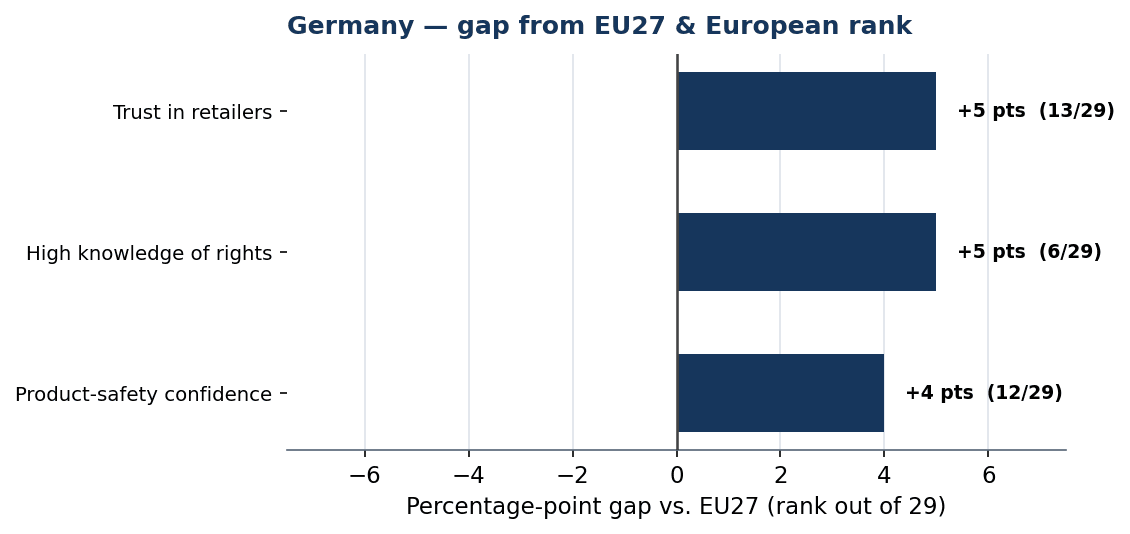
Figure: How far Germany sits from the EU27 average on each indicator, with its rank out of 29 European markets.
InfoCons takeaway for readers in Germany. Germany’s relative strength is rights knowledge (6th in Europe), while its weakest pillar is trust in retailers (13th of 29). Newcomers, exchange students and faculty should calibrate expectations accordingly: where the country ranks low, knowing your rights and the EU-wide redress channels (the European Consumer Centres Network, online dispute resolution, and the Safety Gate alert system) matters most.
Estonia — InfoCons Consumer Protection Country Profile: Trust, Rights Knowledge & Product Safety
Estonia (EE) is benchmarked here against all 28 other markets covered by the European Commission’s Consumer Conditions Scoreboard 2025. On the three pillars of the Knowledge, Trust & Product Safety chapter, Estonia ranks 2nd of 29 for trust in retailers, 14th of 29 for rights knowledge and 2nd of 29 for product-safety confidence. Averaged across the three, it sits well inside the European top tier.
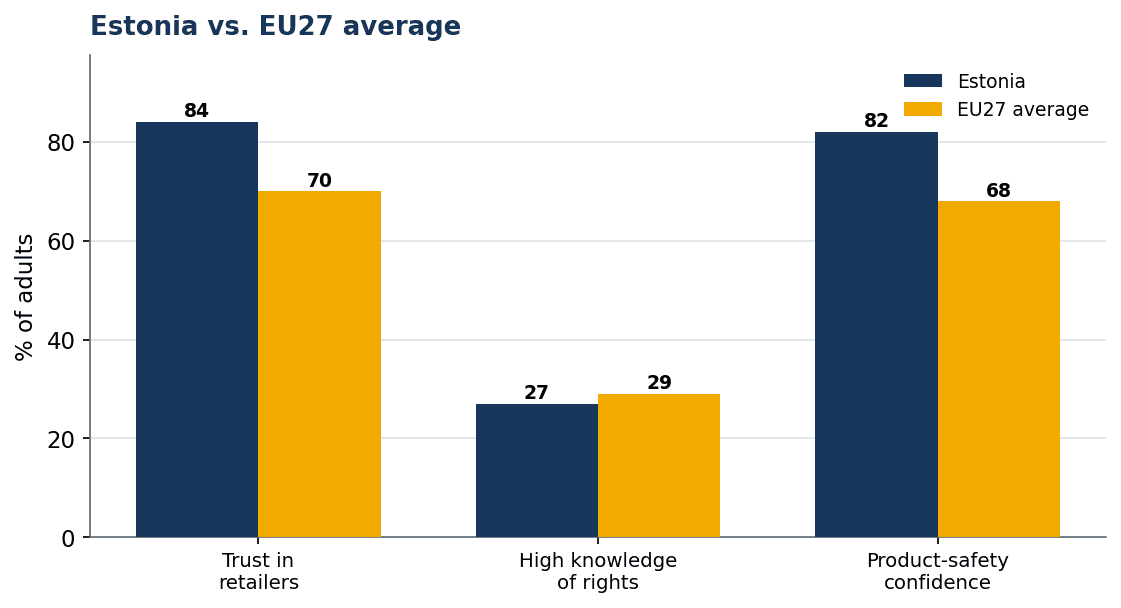
Figure: Estonia versus the EU27 average on the three Knowledge, Trust & Product Safety indicators (% of adults, 2024).
Trust in retailers and service providers. 84% of consumers in Estonia agree that retailers and service providers respect their rights, which is 14 percentage points above the EU27 average (EU27: 70%). That places Estonia 2nd out of 29 countries. For reference, Austria leads the continent on this measure (88%), while Greece trails the field (44%).
Knowledge of consumer rights. 27% of Estonia’s consumers qualify as having HIGH knowledge of their rights – correctly answering at least three of the four test questions on cooling-off periods, one-sided contract changes, the two-year legal guarantee and unsolicited goods. That is 2 percentage points below the EU27 average (EU27: 29%), ranking Estonia 14th of 29. Denmark tops Europe here (43%); Greece records the lowest score (10%).
Confidence in product safety. 82% of consumers in Estonia are confident that the non-food products on the market are safe (all safe or mostly safe), 14 percentage points above the EU27 average (EU27: 68%) and 2nd of 29. Finland is Europe’s safety-confidence champion (92%), with Greece again at the foot of the table (59%).
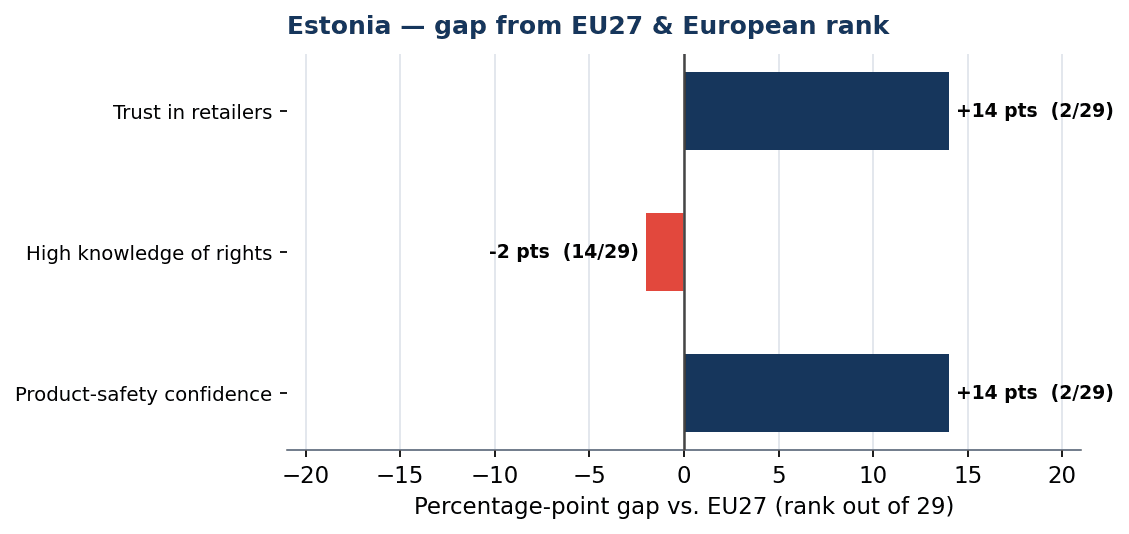
Figure: How far Estonia sits from the EU27 average on each indicator, with its rank out of 29 European markets.
InfoCons takeaway for readers in Estonia. Estonia’s relative strength is trust in retailers (2nd in Europe), while its weakest pillar is rights knowledge (14th of 29). Newcomers, exchange students and faculty should calibrate expectations accordingly: where the country ranks low, knowing your rights and the EU-wide redress channels (the European Consumer Centres Network, online dispute resolution, and the Safety Gate alert system) matters most.
Ireland — InfoCons Consumer Protection Country Profile: Trust, Rights Knowledge & Product Safety
Ireland (IE) is benchmarked here against all 28 other markets covered by the European Commission’s Consumer Conditions Scoreboard 2025. On the three pillars of the Knowledge, Trust & Product Safety chapter, Ireland ranks 9th of 29 for trust in retailers, 10th of 29 for rights knowledge and 13th of 29 for product-safety confidence. Averaged across the three, it sits in the upper-middle of the European field.
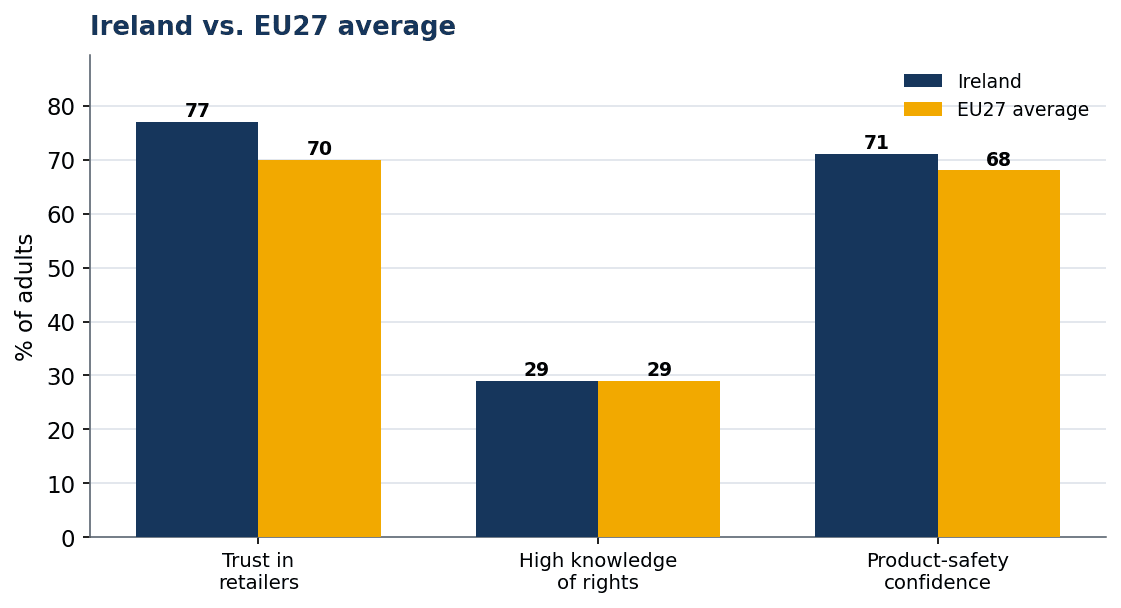
Figure: Ireland versus the EU27 average on the three Knowledge, Trust & Product Safety indicators (% of adults, 2024).
Trust in retailers and service providers. 77% of consumers in Ireland agree that retailers and service providers respect their rights, which is 7 percentage points above the EU27 average (EU27: 70%). That places Ireland 9th out of 29 countries. For reference, Austria leads the continent on this measure (88%), while Greece trails the field (44%).
Knowledge of consumer rights. 29% of Ireland’s consumers qualify as having HIGH knowledge of their rights – correctly answering at least three of the four test questions on cooling-off periods, one-sided contract changes, the two-year legal guarantee and unsolicited goods. That is exactly level with the EU27 average (EU27: 29%), ranking Ireland 10th of 29. Denmark tops Europe here (43%); Greece records the lowest score (10%).
Confidence in product safety. 71% of consumers in Ireland are confident that the non-food products on the market are safe (all safe or mostly safe), 3 percentage points above the EU27 average (EU27: 68%) and 13th of 29. Finland is Europe’s safety-confidence champion (92%), with Greece again at the foot of the table (59%).
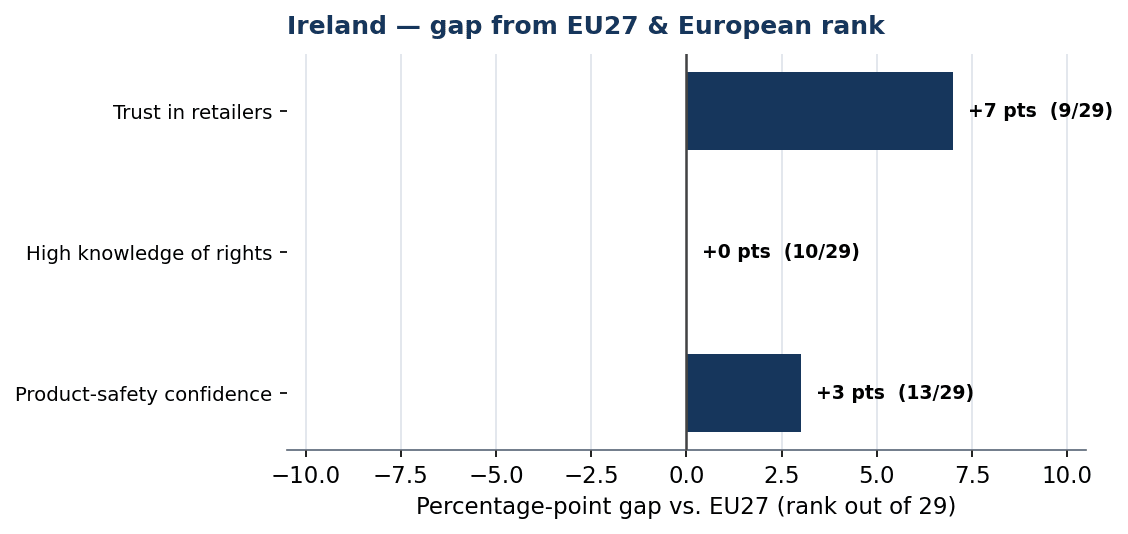
Figure: How far Ireland sits from the EU27 average on each indicator, with its rank out of 29 European markets.
InfoCons takeaway for readers in Ireland. Ireland’s relative strength is trust in retailers (9th in Europe), while its weakest pillar is product-safety confidence (13th of 29). Newcomers, exchange students and faculty should calibrate expectations accordingly: where the country ranks low, knowing your rights and the EU-wide redress channels (the European Consumer Centres Network, online dispute resolution, and the Safety Gate alert system) matters most.
Greece — InfoCons Consumer Protection Country Profile: Trust, Rights Knowledge & Product Safety
Greece (EL) is benchmarked here against all 28 other markets covered by the European Commission’s Consumer Conditions Scoreboard 2025. On the three pillars of the Knowledge, Trust & Product Safety chapter, Greece ranks 29th of 29 for trust in retailers, 29th of 29 for rights knowledge and 29th of 29 for product-safety confidence. Averaged across the three, it sits among the weakest in Europe.
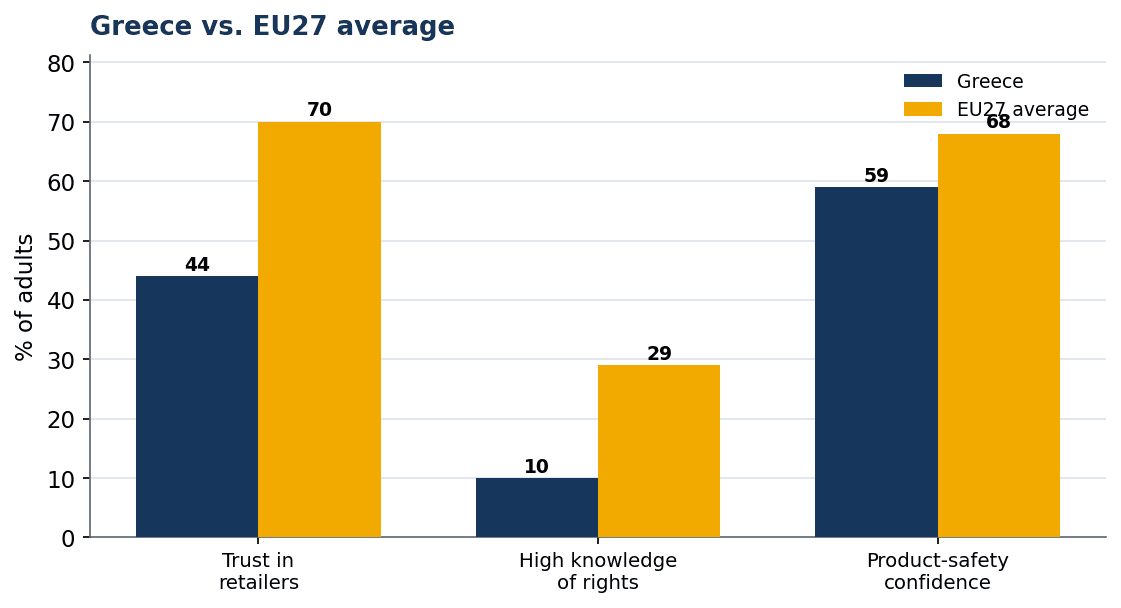
Figure: Greece versus the EU27 average on the three Knowledge, Trust & Product Safety indicators (% of adults, 2024).
Trust in retailers and service providers. 44% of consumers in Greece agree that retailers and service providers respect their rights, which is 26 percentage points below the EU27 average (EU27: 70%). That places Greece 29th out of 29 countries. For reference, Austria leads the continent on this measure (88%), while Greece trails the field (44%).
Knowledge of consumer rights. 10% of Greece’s consumers qualify as having HIGH knowledge of their rights – correctly answering at least three of the four test questions on cooling-off periods, one-sided contract changes, the two-year legal guarantee and unsolicited goods. That is 19 percentage points below the EU27 average (EU27: 29%), ranking Greece 29th of 29. Denmark tops Europe here (43%); Greece records the lowest score (10%).
Confidence in product safety. 59% of consumers in Greece are confident that the non-food products on the market are safe (all safe or mostly safe), 9 percentage points below the EU27 average (EU27: 68%) and 29th of 29. Finland is Europe’s safety-confidence champion (92%), with Greece again at the foot of the table (59%).
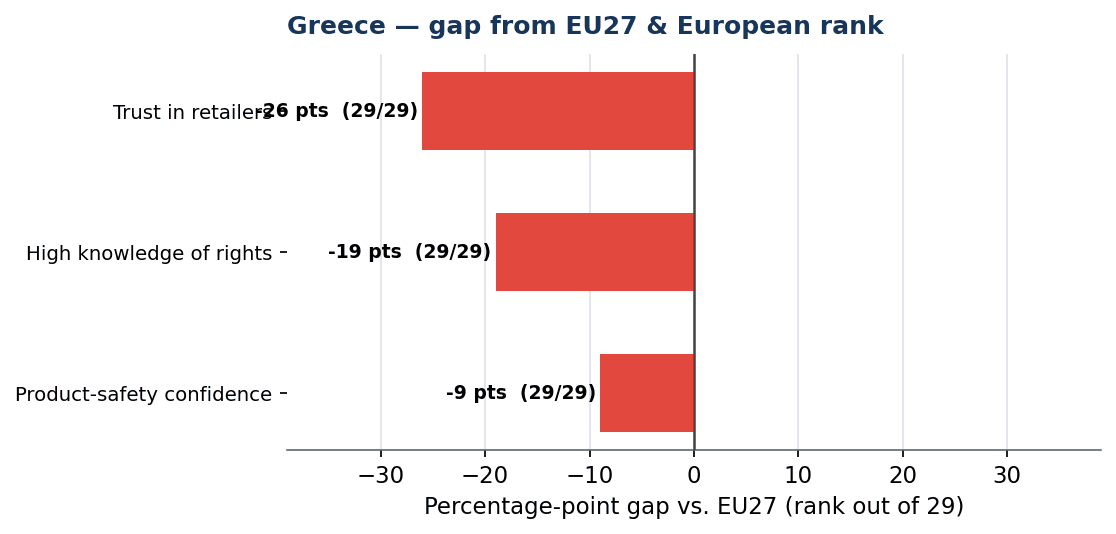
Figure: How far Greece sits from the EU27 average on each indicator, with its rank out of 29 European markets.
InfoCons takeaway for readers in Greece. Greece’s relative strength is trust in retailers (29th in Europe), while its weakest pillar is trust in retailers (29th of 29). Newcomers, exchange students and faculty should calibrate expectations accordingly: where the country ranks low, knowing your rights and the EU-wide redress channels (the European Consumer Centres Network, online dispute resolution, and the Safety Gate alert system) matters most.
Spain — InfoCons Consumer Protection Country Profile: Trust, Rights Knowledge & Product Safety
Spain (ES) is benchmarked here against all 28 other markets covered by the European Commission’s Consumer Conditions Scoreboard 2025. On the three pillars of the Knowledge, Trust & Product Safety chapter, Spain ranks 24th of 29 for trust in retailers, 4th of 29 for rights knowledge and 22nd of 29 for product-safety confidence. Averaged across the three, it sits in the lower-middle of the European field.
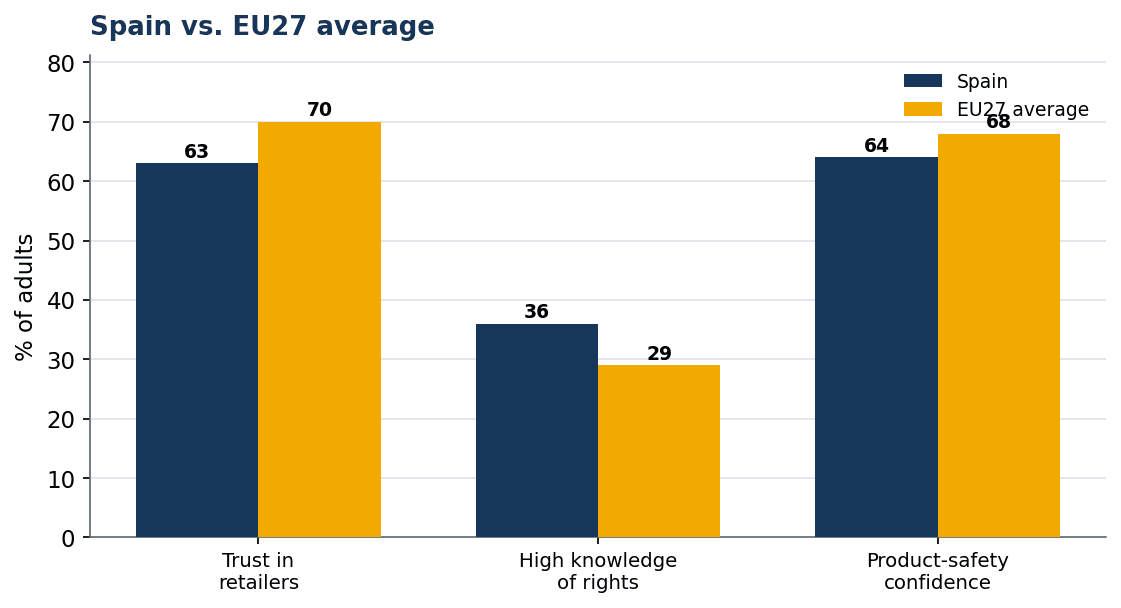
Figure: Spain versus the EU27 average on the three Knowledge, Trust & Product Safety indicators (% of adults, 2024).
Trust in retailers and service providers. 63% of consumers in Spain agree that retailers and service providers respect their rights, which is 7 percentage points below the EU27 average (EU27: 70%). That places Spain 24th out of 29 countries. For reference, Austria leads the continent on this measure (88%), while Greece trails the field (44%).
Knowledge of consumer rights. 36% of Spain’s consumers qualify as having HIGH knowledge of their rights – correctly answering at least three of the four test questions on cooling-off periods, one-sided contract changes, the two-year legal guarantee and unsolicited goods. That is 7 percentage points above the EU27 average (EU27: 29%), ranking Spain 4th of 29. Denmark tops Europe here (43%); Greece records the lowest score (10%).
Confidence in product safety. 64% of consumers in Spain are confident that the non-food products on the market are safe (all safe or mostly safe), 4 percentage points below the EU27 average (EU27: 68%) and 22nd of 29. Finland is Europe’s safety-confidence champion (92%), with Greece again at the foot of the table (59%).
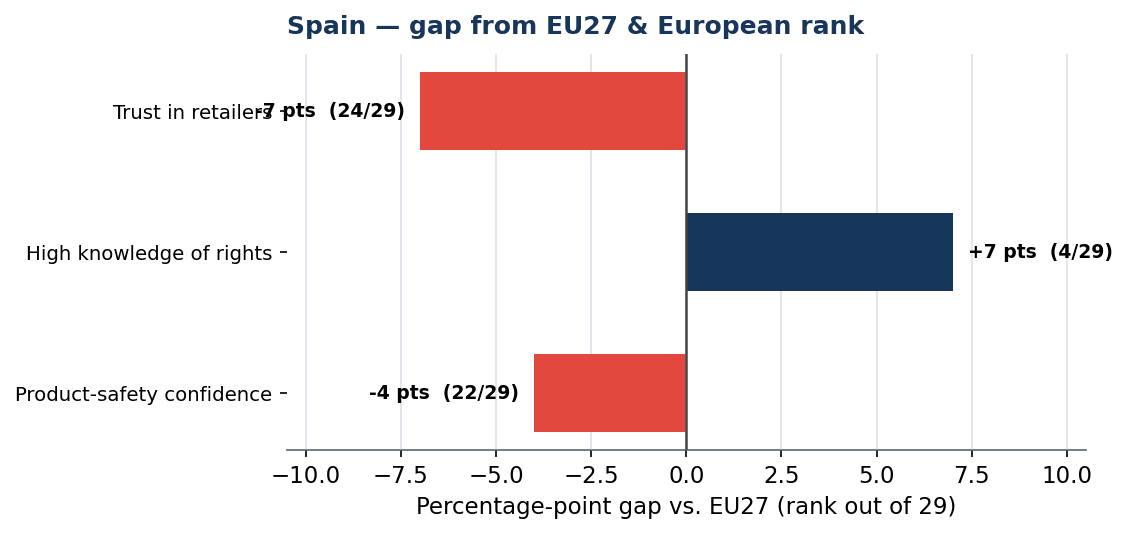
Figure: How far Spain sits from the EU27 average on each indicator, with its rank out of 29 European markets.
InfoCons takeaway for readers in Spain. Spain’s relative strength is rights knowledge (4th in Europe), while its weakest pillar is trust in retailers (24th of 29). Newcomers, exchange students and faculty should calibrate expectations accordingly: where the country ranks low, knowing your rights and the EU-wide redress channels (the European Consumer Centres Network, online dispute resolution, and the Safety Gate alert system) matters most.
France — InfoCons Consumer Protection Country Profile: Trust, Rights Knowledge & Product Safety
France (FR) is benchmarked here against all 28 other markets covered by the European Commission’s Consumer Conditions Scoreboard 2025. On the three pillars of the Knowledge, Trust & Product Safety chapter, France ranks 27th of 29 for trust in retailers, 19th of 29 for rights knowledge and 25th of 29 for product-safety confidence. Averaged across the three, it sits toward the bottom of the European field.
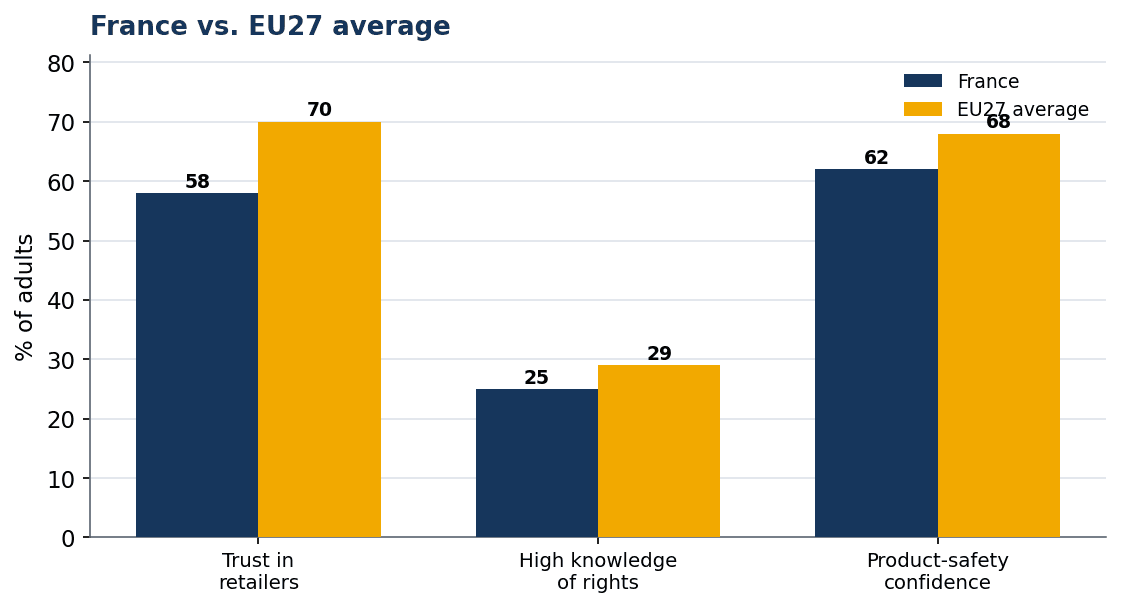
Figure: France versus the EU27 average on the three Knowledge, Trust & Product Safety indicators (% of adults, 2024).
Trust in retailers and service providers. 58% of consumers in France agree that retailers and service providers respect their rights, which is 12 percentage points below the EU27 average (EU27: 70%). That places France 27th out of 29 countries. For reference, Austria leads the continent on this measure (88%), while Greece trails the field (44%).
Knowledge of consumer rights. 25% of France’s consumers qualify as having HIGH knowledge of their rights – correctly answering at least three of the four test questions on cooling-off periods, one-sided contract changes, the two-year legal guarantee and unsolicited goods. That is 4 percentage points below the EU27 average (EU27: 29%), ranking France 19th of 29. Denmark tops Europe here (43%); Greece records the lowest score (10%).
Confidence in product safety. 62% of consumers in France are confident that the non-food products on the market are safe (all safe or mostly safe), 6 percentage points below the EU27 average (EU27: 68%) and 25th of 29. Finland is Europe’s safety-confidence champion (92%), with Greece again at the foot of the table (59%).
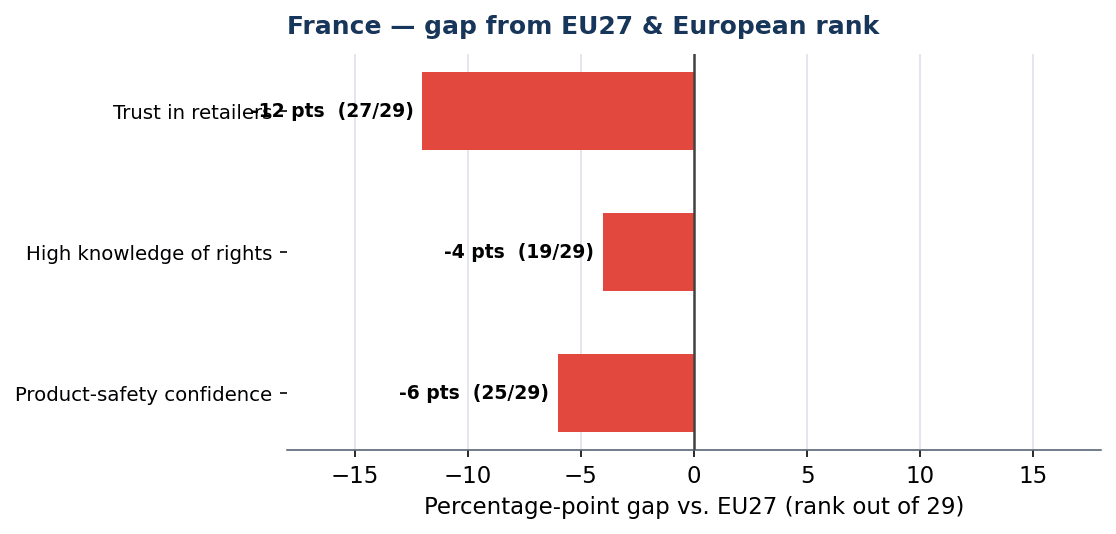
Figure: How far France sits from the EU27 average on each indicator, with its rank out of 29 European markets.
InfoCons takeaway for readers in France. France’s relative strength is rights knowledge (19th in Europe), while its weakest pillar is trust in retailers (27th of 29). Newcomers, exchange students and faculty should calibrate expectations accordingly: where the country ranks low, knowing your rights and the EU-wide redress channels (the European Consumer Centres Network, online dispute resolution, and the Safety Gate alert system) matters most.
Croatia — InfoCons Consumer Protection Country Profile: Trust, Rights Knowledge & Product Safety
Croatia (HR) is benchmarked here against all 28 other markets covered by the European Commission’s Consumer Conditions Scoreboard 2025. On the three pillars of the Knowledge, Trust & Product Safety chapter, Croatia ranks 26th of 29 for trust in retailers, 27th of 29 for rights knowledge and 23rd of 29 for product-safety confidence. Averaged across the three, it sits toward the bottom of the European field.
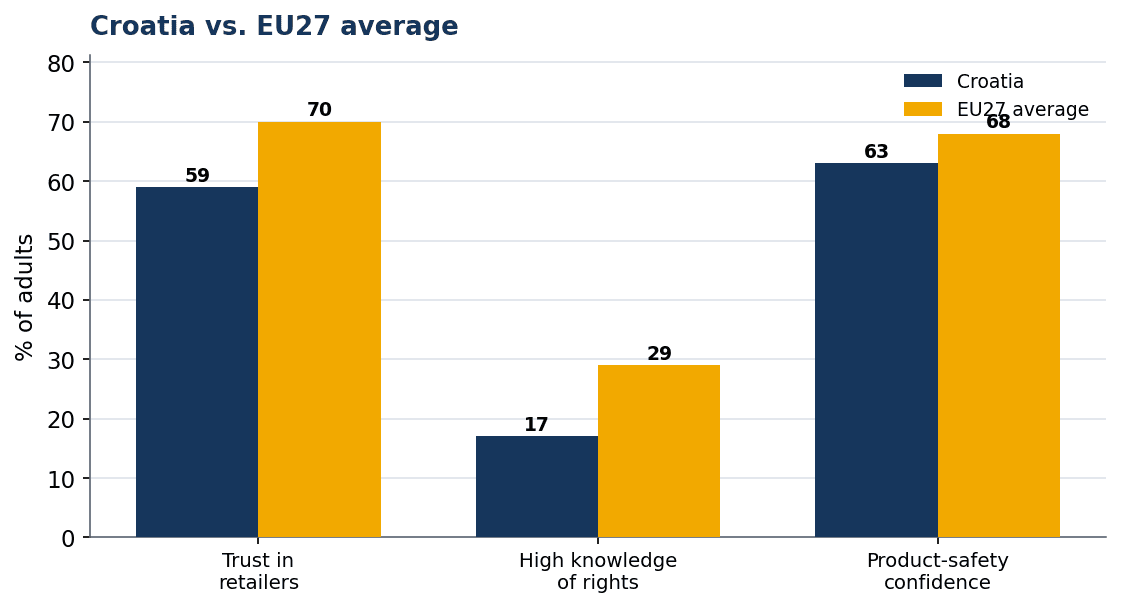
Figure: Croatia versus the EU27 average on the three Knowledge, Trust & Product Safety indicators (% of adults, 2024).
Trust in retailers and service providers. 59% of consumers in Croatia agree that retailers and service providers respect their rights, which is 11 percentage points below the EU27 average (EU27: 70%). That places Croatia 26th out of 29 countries. For reference, Austria leads the continent on this measure (88%), while Greece trails the field (44%).
Knowledge of consumer rights. 17% of Croatia’s consumers qualify as having HIGH knowledge of their rights – correctly answering at least three of the four test questions on cooling-off periods, one-sided contract changes, the two-year legal guarantee and unsolicited goods. That is 12 percentage points below the EU27 average (EU27: 29%), ranking Croatia 27th of 29. Denmark tops Europe here (43%); Greece records the lowest score (10%).
Confidence in product safety. 63% of consumers in Croatia are confident that the non-food products on the market are safe (all safe or mostly safe), 5 percentage points below the EU27 average (EU27: 68%) and 23rd of 29. Finland is Europe’s safety-confidence champion (92%), with Greece again at the foot of the table (59%).
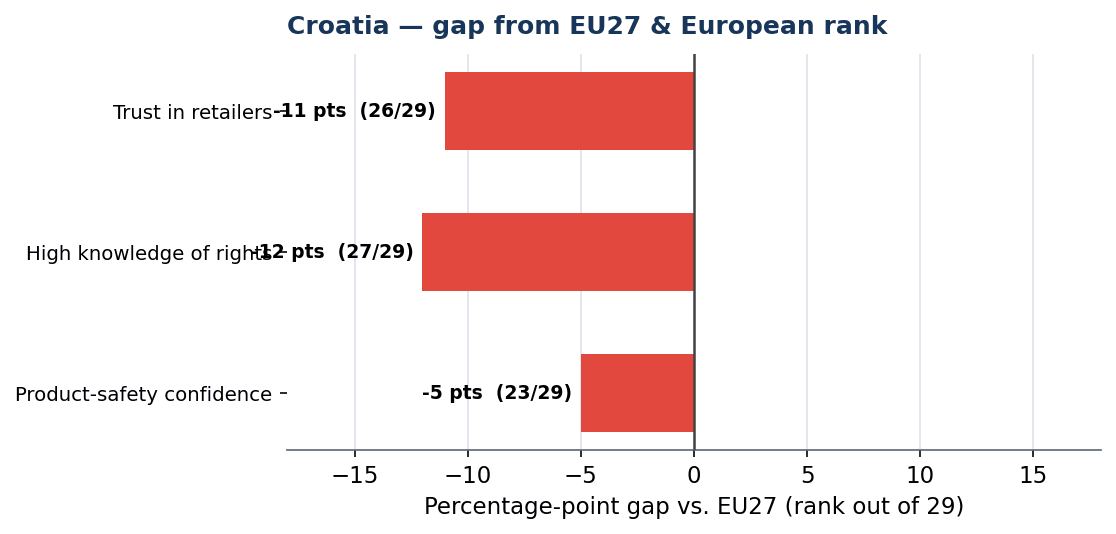
Figure: How far Croatia sits from the EU27 average on each indicator, with its rank out of 29 European markets.
InfoCons takeaway for readers in Croatia. Croatia’s relative strength is product-safety confidence (23rd in Europe), while its weakest pillar is rights knowledge (27th of 29). Newcomers, exchange students and faculty should calibrate expectations accordingly: where the country ranks low, knowing your rights and the EU-wide redress channels (the European Consumer Centres Network, online dispute resolution, and the Safety Gate alert system) matters most.
Italy — InfoCons Consumer Protection Country Profile: Trust, Rights Knowledge & Product Safety
Italy (IT) is benchmarked here against all 28 other markets covered by the European Commission’s Consumer Conditions Scoreboard 2025. On the three pillars of the Knowledge, Trust & Product Safety chapter, Italy ranks 23rd of 29 for trust in retailers, 10th of 29 for rights knowledge and 18th of 29 for product-safety confidence. Averaged across the three, it sits in the lower-middle of the European field.
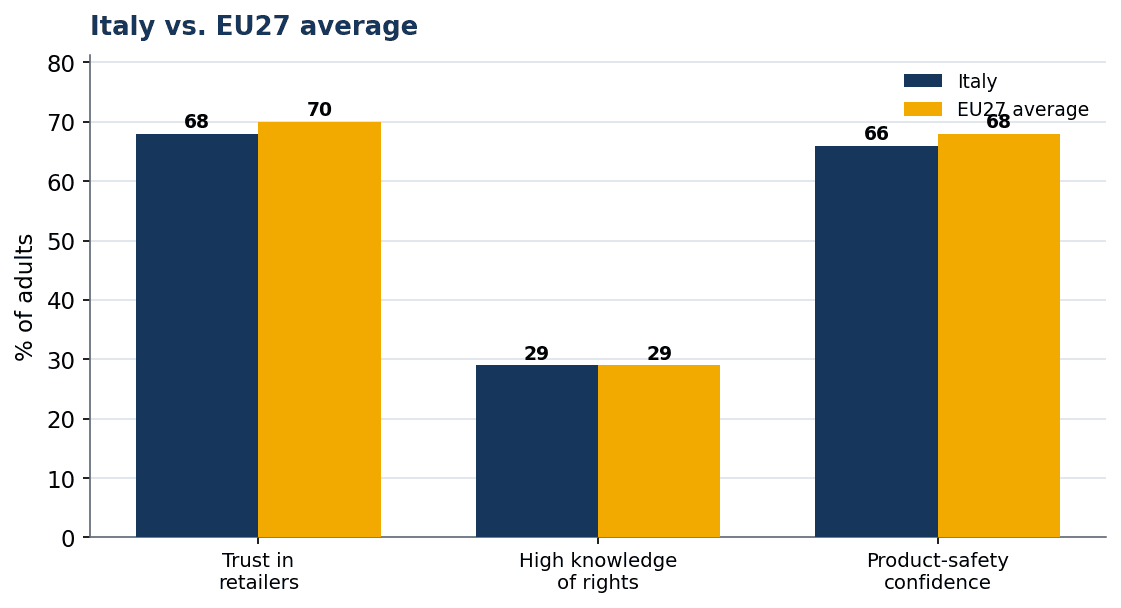
Figure: Italy versus the EU27 average on the three Knowledge, Trust & Product Safety indicators (% of adults, 2024).
Trust in retailers and service providers. 68% of consumers in Italy agree that retailers and service providers respect their rights, which is 2 percentage points below the EU27 average (EU27: 70%). That places Italy 23rd out of 29 countries. For reference, Austria leads the continent on this measure (88%), while Greece trails the field (44%).
Knowledge of consumer rights. 29% of Italy’s consumers qualify as having HIGH knowledge of their rights – correctly answering at least three of the four test questions on cooling-off periods, one-sided contract changes, the two-year legal guarantee and unsolicited goods. That is exactly level with the EU27 average (EU27: 29%), ranking Italy 10th of 29. Denmark tops Europe here (43%); Greece records the lowest score (10%).
Confidence in product safety. 66% of consumers in Italy are confident that the non-food products on the market are safe (all safe or mostly safe), 2 percentage points below the EU27 average (EU27: 68%) and 18th of 29. Finland is Europe’s safety-confidence champion (92%), with Greece again at the foot of the table (59%).
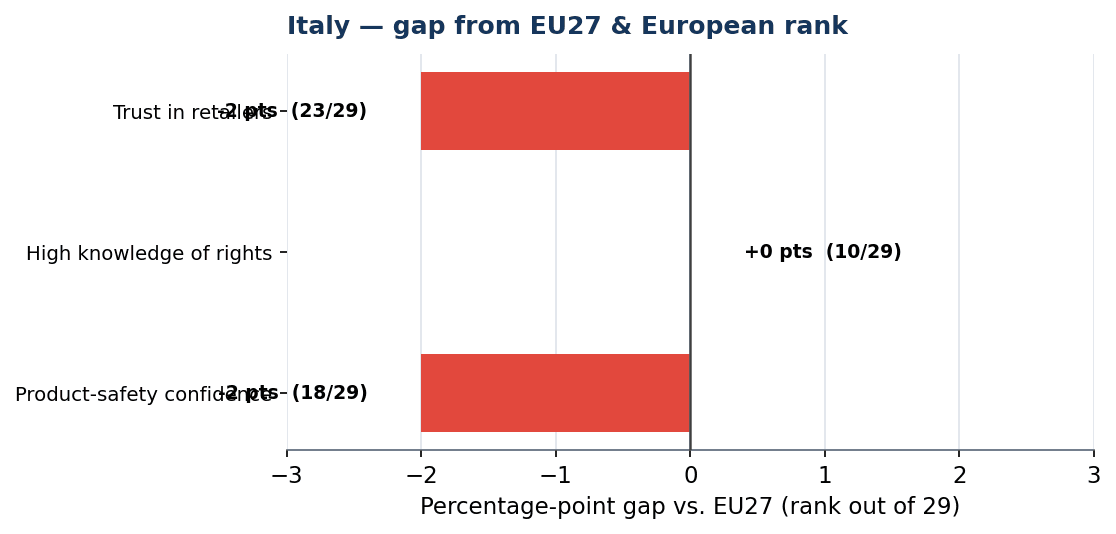
Figure: How far Italy sits from the EU27 average on each indicator, with its rank out of 29 European markets.
InfoCons takeaway for readers in Italy. Italy’s relative strength is rights knowledge (10th in Europe), while its weakest pillar is trust in retailers (23rd of 29). Newcomers, exchange students and faculty should calibrate expectations accordingly: where the country ranks low, knowing your rights and the EU-wide redress channels (the European Consumer Centres Network, online dispute resolution, and the Safety Gate alert system) matters most.
Cyprus — InfoCons Consumer Protection Country Profile: Trust, Rights Knowledge & Product Safety
Cyprus (CY) is benchmarked here against all 28 other markets covered by the European Commission’s Consumer Conditions Scoreboard 2025. On the three pillars of the Knowledge, Trust & Product Safety chapter, Cyprus ranks 28th of 29 for trust in retailers, 28th of 29 for rights knowledge and 26th of 29 for product-safety confidence. Averaged across the three, it sits among the weakest in Europe.
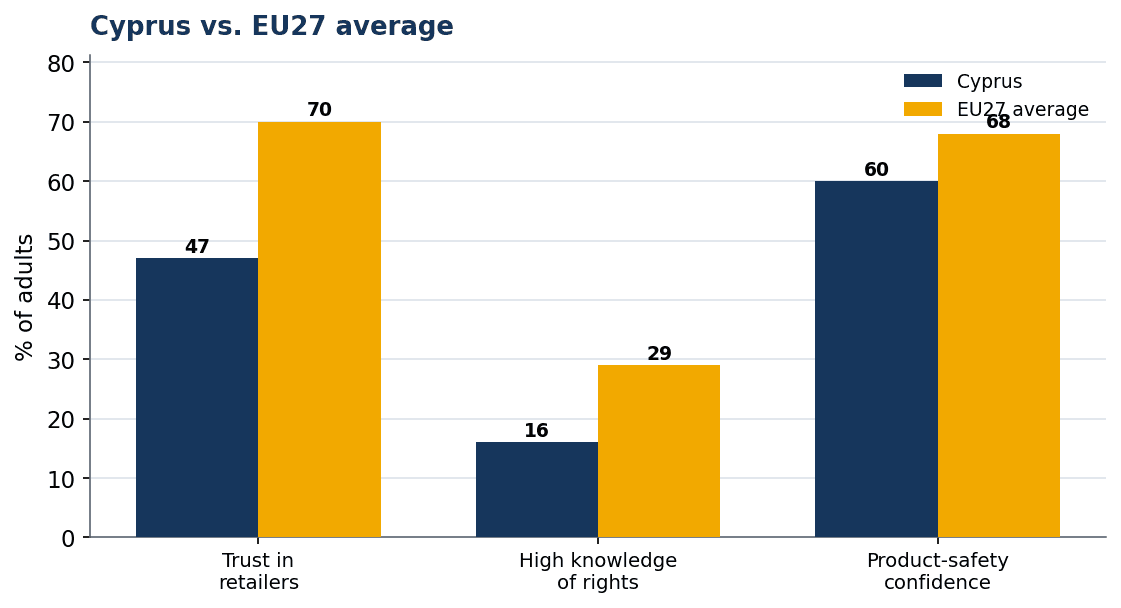
Figure: Cyprus versus the EU27 average on the three Knowledge, Trust & Product Safety indicators (% of adults, 2024).
Trust in retailers and service providers. 47% of consumers in Cyprus agree that retailers and service providers respect their rights, which is 23 percentage points below the EU27 average (EU27: 70%). That places Cyprus 28th out of 29 countries. For reference, Austria leads the continent on this measure (88%), while Greece trails the field (44%).
Knowledge of consumer rights. 16% of Cyprus’s consumers qualify as having HIGH knowledge of their rights – correctly answering at least three of the four test questions on cooling-off periods, one-sided contract changes, the two-year legal guarantee and unsolicited goods. That is 13 percentage points below the EU27 average (EU27: 29%), ranking Cyprus 28th of 29. Denmark tops Europe here (43%); Greece records the lowest score (10%).
Confidence in product safety. 60% of consumers in Cyprus are confident that the non-food products on the market are safe (all safe or mostly safe), 8 percentage points below the EU27 average (EU27: 68%) and 26th of 29. Finland is Europe’s safety-confidence champion (92%), with Greece again at the foot of the table (59%).
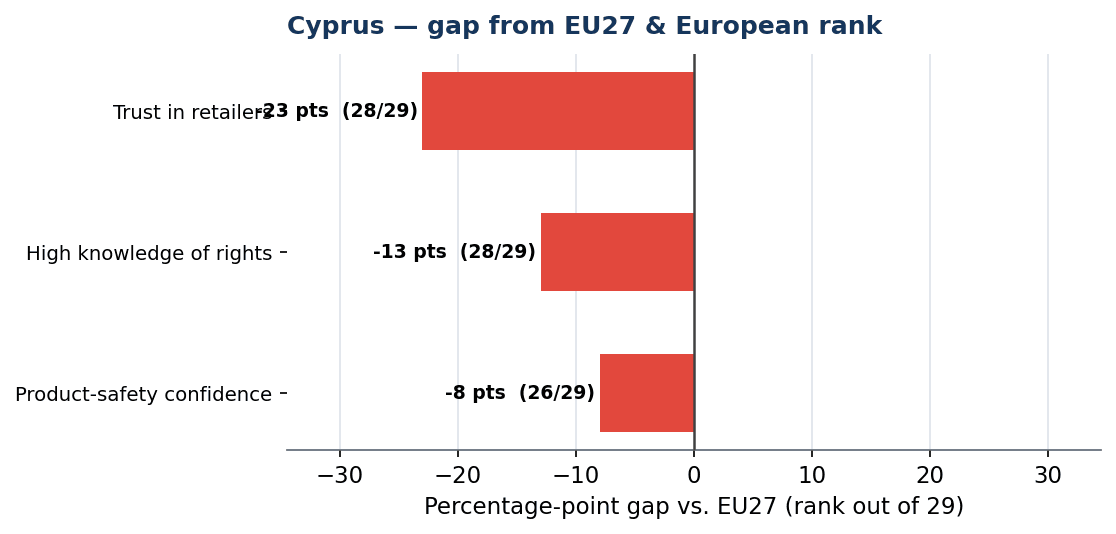
Figure: How far Cyprus sits from the EU27 average on each indicator, with its rank out of 29 European markets.
InfoCons takeaway for readers in Cyprus. Cyprus’s relative strength is product-safety confidence (26th in Europe), while its weakest pillar is trust in retailers (28th of 29). Newcomers, exchange students and faculty should calibrate expectations accordingly: where the country ranks low, knowing your rights and the EU-wide redress channels (the European Consumer Centres Network, online dispute resolution, and the Safety Gate alert system) matters most.
Latvia — InfoCons Consumer Protection Country Profile: Trust, Rights Knowledge & Product Safety
Latvia (LV) is benchmarked here against all 28 other markets covered by the European Commission’s Consumer Conditions Scoreboard 2025. On the three pillars of the Knowledge, Trust & Product Safety chapter, Latvia ranks 13th of 29 for trust in retailers, 5th of 29 for rights knowledge and 7th of 29 for product-safety confidence. Averaged across the three, it sits well inside the European top tier.
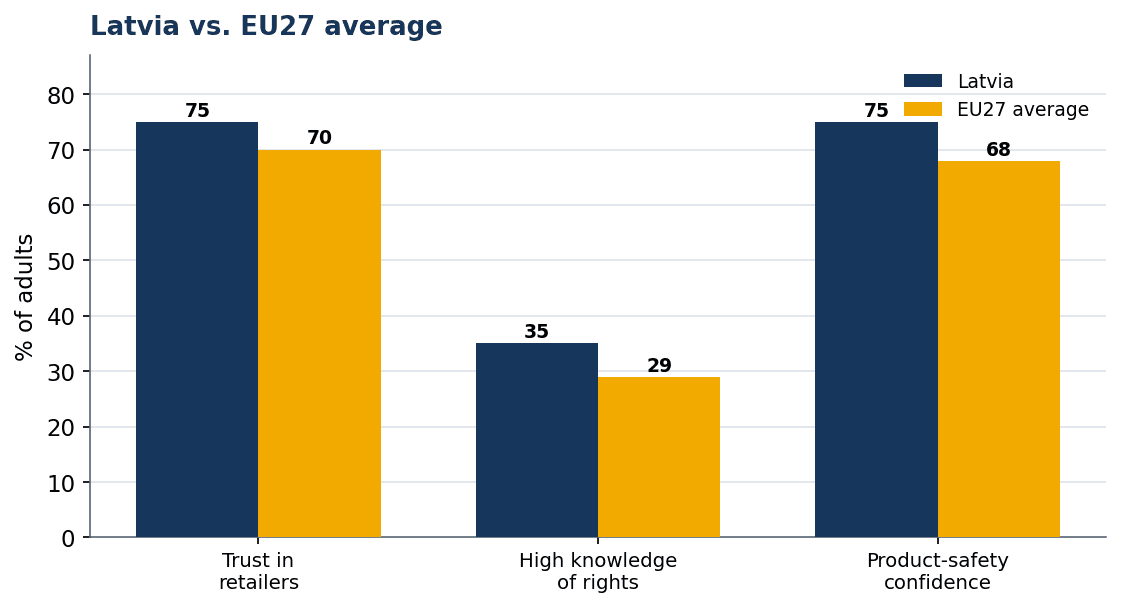
Figure: Latvia versus the EU27 average on the three Knowledge, Trust & Product Safety indicators (% of adults, 2024).
Trust in retailers and service providers. 75% of consumers in Latvia agree that retailers and service providers respect their rights, which is 5 percentage points above the EU27 average (EU27: 70%). That places Latvia 13th out of 29 countries. For reference, Austria leads the continent on this measure (88%), while Greece trails the field (44%).
Knowledge of consumer rights. 35% of Latvia’s consumers qualify as having HIGH knowledge of their rights – correctly answering at least three of the four test questions on cooling-off periods, one-sided contract changes, the two-year legal guarantee and unsolicited goods. That is 6 percentage points above the EU27 average (EU27: 29%), ranking Latvia 5th of 29. Denmark tops Europe here (43%); Greece records the lowest score (10%).
Confidence in product safety. 75% of consumers in Latvia are confident that the non-food products on the market are safe (all safe or mostly safe), 7 percentage points above the EU27 average (EU27: 68%) and 7th of 29. Finland is Europe’s safety-confidence champion (92%), with Greece again at the foot of the table (59%).
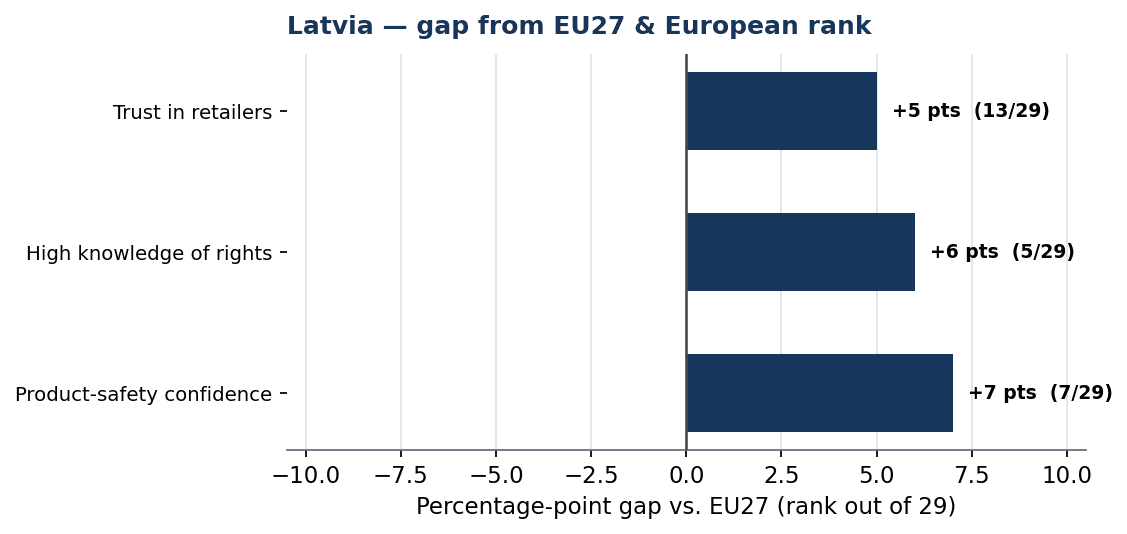
Figure: How far Latvia sits from the EU27 average on each indicator, with its rank out of 29 European markets.
InfoCons takeaway for readers in Latvia. Latvia’s relative strength is rights knowledge (5th in Europe), while its weakest pillar is trust in retailers (13th of 29). Newcomers, exchange students and faculty should calibrate expectations accordingly: where the country ranks low, knowing your rights and the EU-wide redress channels (the European Consumer Centres Network, online dispute resolution, and the Safety Gate alert system) matters most.
Lithuania — InfoCons Consumer Protection Country Profile: Trust, Rights Knowledge & Product Safety
Lithuania (LT) is benchmarked here against all 28 other markets covered by the European Commission’s Consumer Conditions Scoreboard 2025. On the three pillars of the Knowledge, Trust & Product Safety chapter, Lithuania ranks 13th of 29 for trust in retailers, 24th of 29 for rights knowledge and 4th of 29 for product-safety confidence. Averaged across the three, it sits in the upper-middle of the European field.
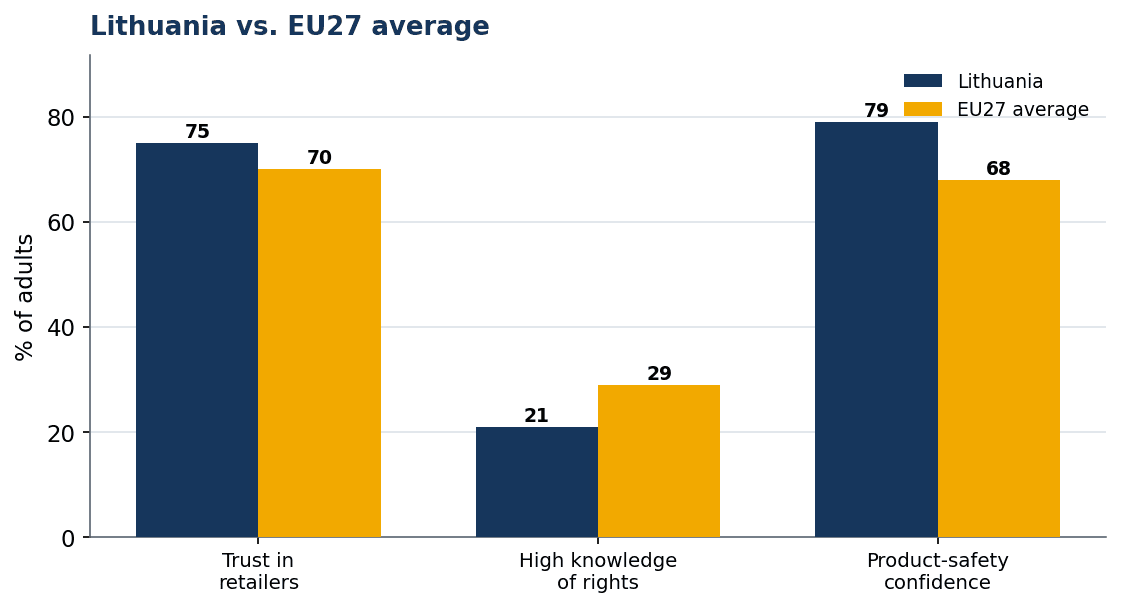
Figure: Lithuania versus the EU27 average on the three Knowledge, Trust & Product Safety indicators (% of adults, 2024).
Trust in retailers and service providers. 75% of consumers in Lithuania agree that retailers and service providers respect their rights, which is 5 percentage points above the EU27 average (EU27: 70%). That places Lithuania 13th out of 29 countries. For reference, Austria leads the continent on this measure (88%), while Greece trails the field (44%).
Knowledge of consumer rights. 21% of Lithuania’s consumers qualify as having HIGH knowledge of their rights – correctly answering at least three of the four test questions on cooling-off periods, one-sided contract changes, the two-year legal guarantee and unsolicited goods. That is 8 percentage points below the EU27 average (EU27: 29%), ranking Lithuania 24th of 29. Denmark tops Europe here (43%); Greece records the lowest score (10%).
Confidence in product safety. 79% of consumers in Lithuania are confident that the non-food products on the market are safe (all safe or mostly safe), 11 percentage points above the EU27 average (EU27: 68%) and 4th of 29. Finland is Europe’s safety-confidence champion (92%), with Greece again at the foot of the table (59%).
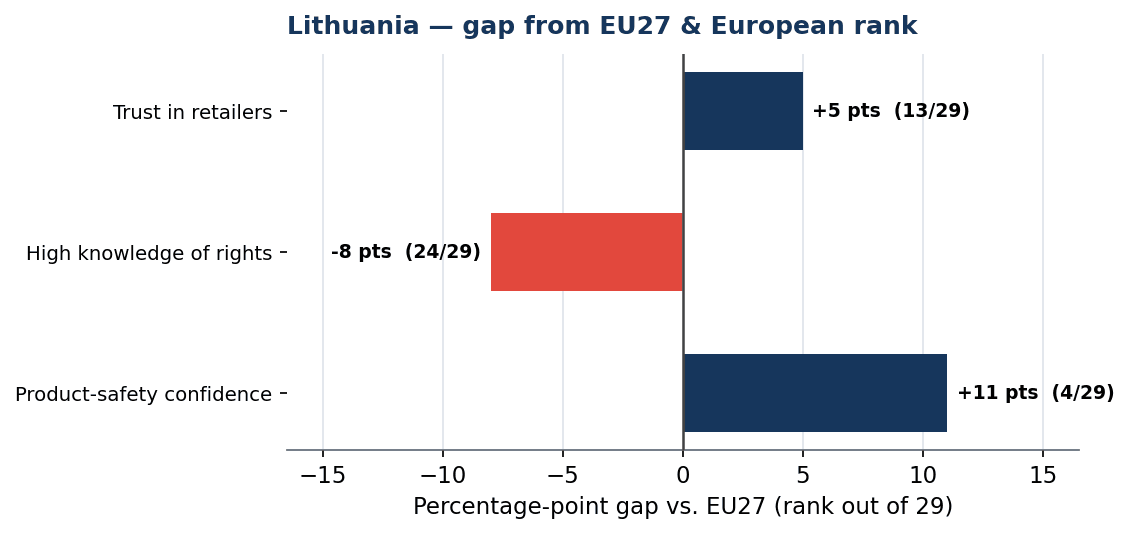
Figure: How far Lithuania sits from the EU27 average on each indicator, with its rank out of 29 European markets.
InfoCons takeaway for readers in Lithuania. Lithuania’s relative strength is product-safety confidence (4th in Europe), while its weakest pillar is rights knowledge (24th of 29). Newcomers, exchange students and faculty should calibrate expectations accordingly: where the country ranks low, knowing your rights and the EU-wide redress channels (the European Consumer Centres Network, online dispute resolution, and the Safety Gate alert system) matters most.
Luxembourg — InfoCons Consumer Protection Country Profile: Trust, Rights Knowledge & Product Safety
Luxembourg (LU) is benchmarked here against all 28 other markets covered by the European Commission’s Consumer Conditions Scoreboard 2025. On the three pillars of the Knowledge, Trust & Product Safety chapter, Luxembourg ranks 11th of 29 for trust in retailers, 8th of 29 for rights knowledge and 26th of 29 for product-safety confidence. Averaged across the three, it sits in the upper-middle of the European field.
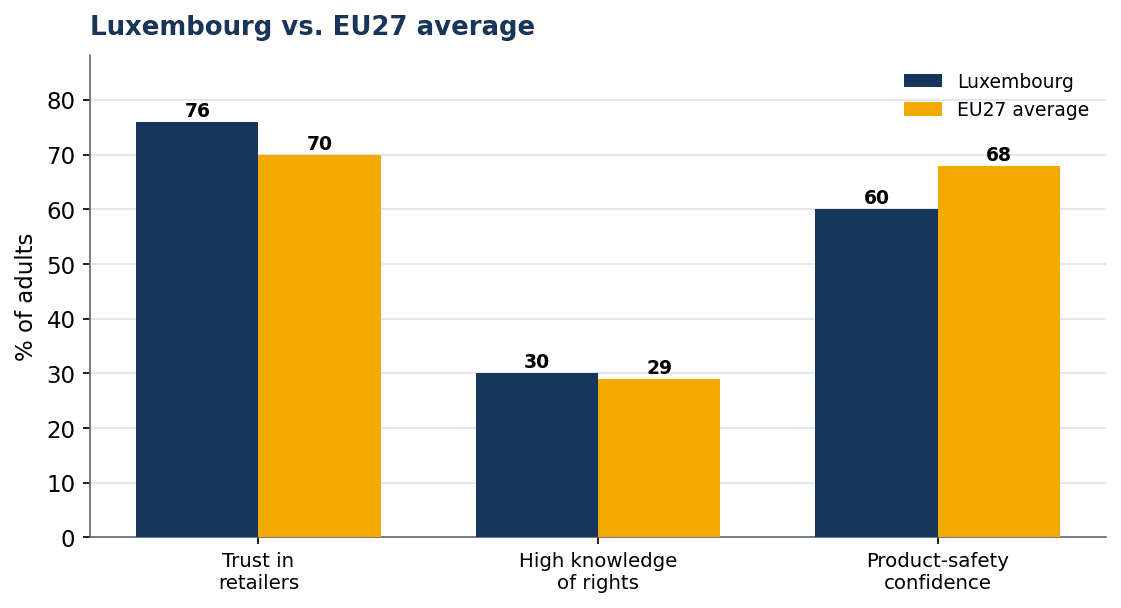
Figure: Luxembourg versus the EU27 average on the three Knowledge, Trust & Product Safety indicators (% of adults, 2024).
Trust in retailers and service providers. 76% of consumers in Luxembourg agree that retailers and service providers respect their rights, which is 6 percentage points above the EU27 average (EU27: 70%). That places Luxembourg 11th out of 29 countries. For reference, Austria leads the continent on this measure (88%), while Greece trails the field (44%).
Knowledge of consumer rights. 30% of Luxembourg’s consumers qualify as having HIGH knowledge of their rights – correctly answering at least three of the four test questions on cooling-off periods, one-sided contract changes, the two-year legal guarantee and unsolicited goods. That is 1 percentage point above the EU27 average (EU27: 29%), ranking Luxembourg 8th of 29. Denmark tops Europe here (43%); Greece records the lowest score (10%).
Confidence in product safety. 60% of consumers in Luxembourg are confident that the non-food products on the market are safe (all safe or mostly safe), 8 percentage points below the EU27 average (EU27: 68%) and 26th of 29. Finland is Europe’s safety-confidence champion (92%), with Greece again at the foot of the table (59%).
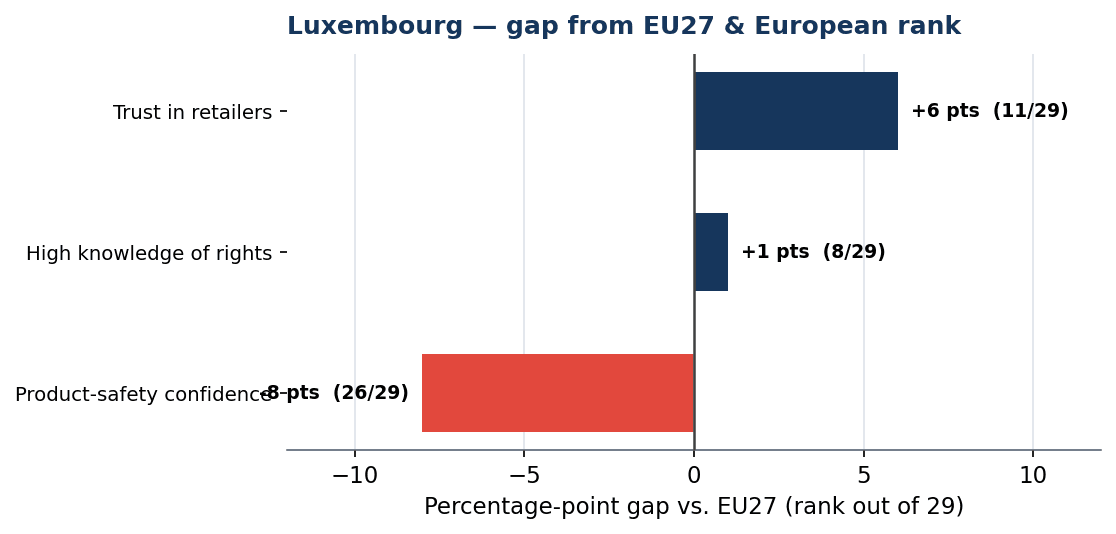
Figure: How far Luxembourg sits from the EU27 average on each indicator, with its rank out of 29 European markets.
InfoCons takeaway for readers in Luxembourg. Luxembourg’s relative strength is rights knowledge (8th in Europe), while its weakest pillar is product-safety confidence (26th of 29). Newcomers, exchange students and faculty should calibrate expectations accordingly: where the country ranks low, knowing your rights and the EU-wide redress channels (the European Consumer Centres Network, online dispute resolution, and the Safety Gate alert system) matters most.
Hungary — InfoCons Consumer Protection Country Profile: Trust, Rights Knowledge & Product Safety
Hungary (HU) is benchmarked here against all 28 other markets covered by the European Commission’s Consumer Conditions Scoreboard 2025. On the three pillars of the Knowledge, Trust & Product Safety chapter, Hungary ranks 3rd of 29 for trust in retailers, 26th of 29 for rights knowledge and 9th of 29 for product-safety confidence. Averaged across the three, it sits in the upper-middle of the European field.
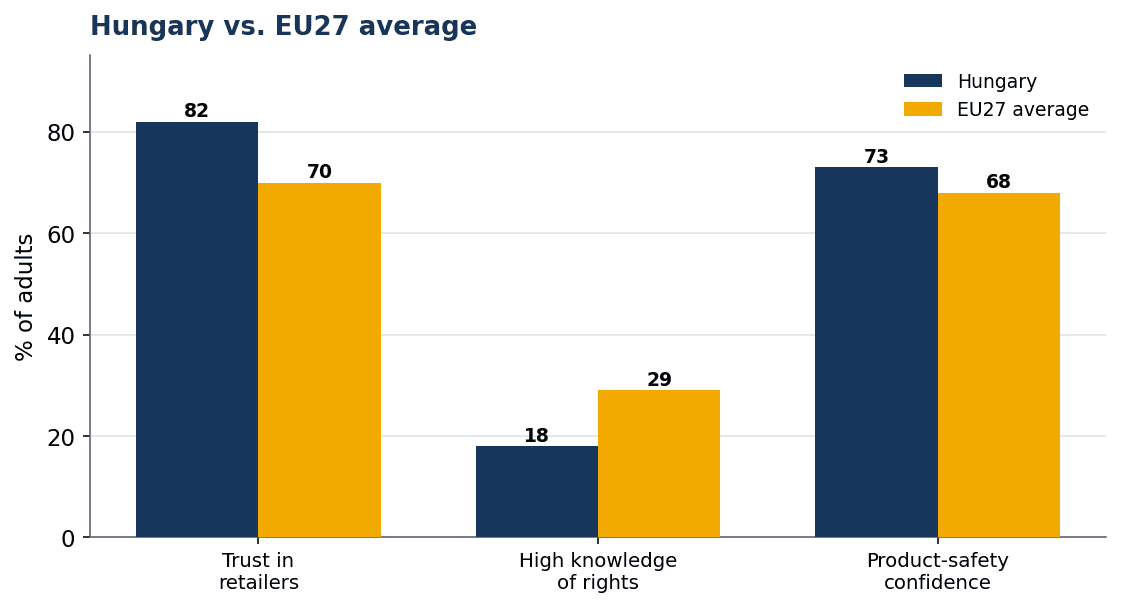
Figure: Hungary versus the EU27 average on the three Knowledge, Trust & Product Safety indicators (% of adults, 2024).
Trust in retailers and service providers. 82% of consumers in Hungary agree that retailers and service providers respect their rights, which is 12 percentage points above the EU27 average (EU27: 70%). That places Hungary 3rd out of 29 countries. For reference, Austria leads the continent on this measure (88%), while Greece trails the field (44%).
Knowledge of consumer rights. 18% of Hungary’s consumers qualify as having HIGH knowledge of their rights – correctly answering at least three of the four test questions on cooling-off periods, one-sided contract changes, the two-year legal guarantee and unsolicited goods. That is 11 percentage points below the EU27 average (EU27: 29%), ranking Hungary 26th of 29. Denmark tops Europe here (43%); Greece records the lowest score (10%).
Confidence in product safety. 73% of consumers in Hungary are confident that the non-food products on the market are safe (all safe or mostly safe), 5 percentage points above the EU27 average (EU27: 68%) and 9th of 29. Finland is Europe’s safety-confidence champion (92%), with Greece again at the foot of the table (59%).
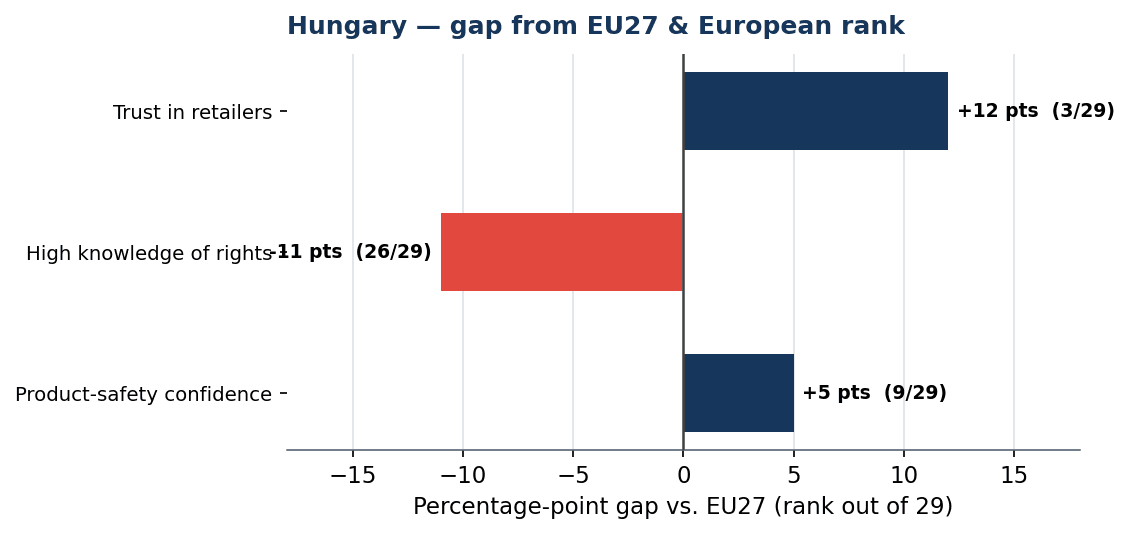
Figure: How far Hungary sits from the EU27 average on each indicator, with its rank out of 29 European markets.
InfoCons takeaway for readers in Hungary. Hungary’s relative strength is trust in retailers (3rd in Europe), while its weakest pillar is rights knowledge (26th of 29). Newcomers, exchange students and faculty should calibrate expectations accordingly: where the country ranks low, knowing your rights and the EU-wide redress channels (the European Consumer Centres Network, online dispute resolution, and the Safety Gate alert system) matters most.
Malta — InfoCons Consumer Protection Country Profile: Trust, Rights Knowledge & Product Safety
Malta (MT) is benchmarked here against all 28 other markets covered by the European Commission’s Consumer Conditions Scoreboard 2025. On the three pillars of the Knowledge, Trust & Product Safety chapter, Malta ranks 22nd of 29 for trust in retailers, 10th of 29 for rights knowledge and 18th of 29 for product-safety confidence. Averaged across the three, it sits in the lower-middle of the European field.
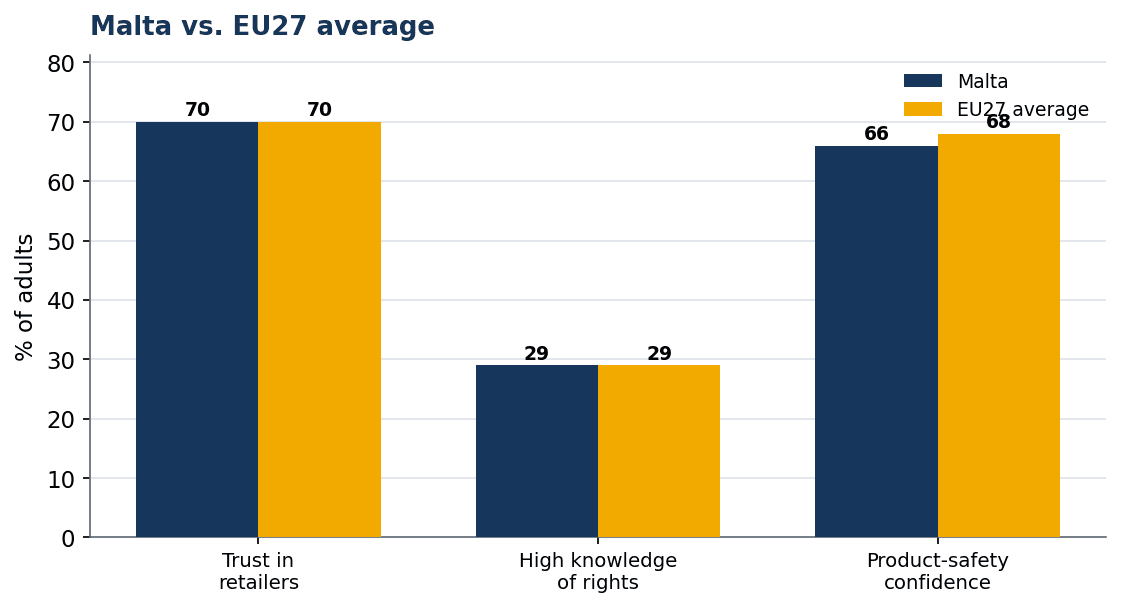
Figure: Malta versus the EU27 average on the three Knowledge, Trust & Product Safety indicators (% of adults, 2024).
Trust in retailers and service providers. 70% of consumers in Malta agree that retailers and service providers respect their rights, which is exactly level with the EU27 average (EU27: 70%). That places Malta 22nd out of 29 countries. For reference, Austria leads the continent on this measure (88%), while Greece trails the field (44%).
Knowledge of consumer rights. 29% of Malta’s consumers qualify as having HIGH knowledge of their rights – correctly answering at least three of the four test questions on cooling-off periods, one-sided contract changes, the two-year legal guarantee and unsolicited goods. That is exactly level with the EU27 average (EU27: 29%), ranking Malta 10th of 29. Denmark tops Europe here (43%); Greece records the lowest score (10%).
Confidence in product safety. 66% of consumers in Malta are confident that the non-food products on the market are safe (all safe or mostly safe), 2 percentage points below the EU27 average (EU27: 68%) and 18th of 29. Finland is Europe’s safety-confidence champion (92%), with Greece again at the foot of the table (59%).
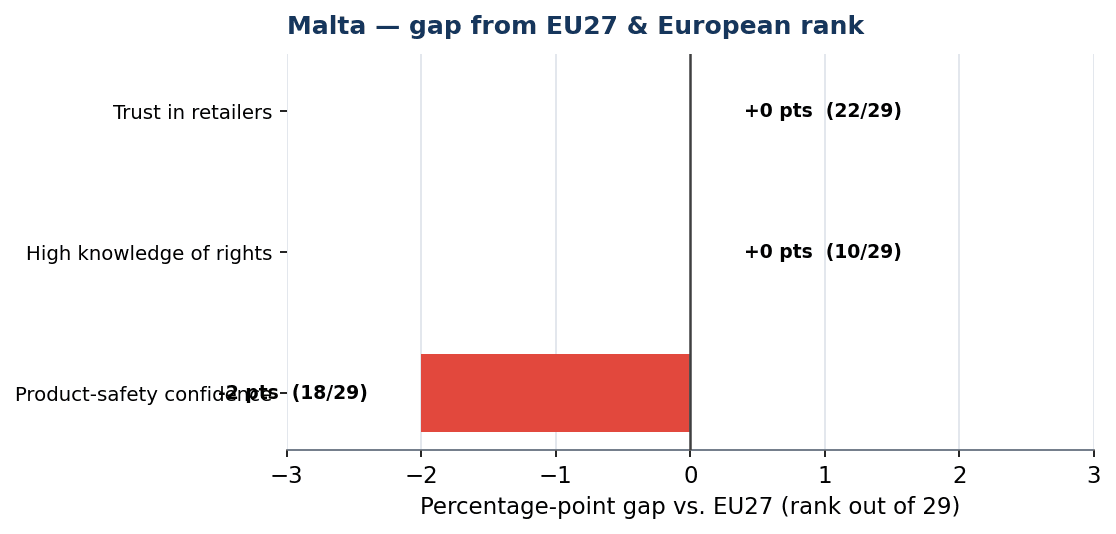
Figure: How far Malta sits from the EU27 average on each indicator, with its rank out of 29 European markets.
InfoCons takeaway for readers in Malta. Malta’s relative strength is rights knowledge (10th in Europe), while its weakest pillar is trust in retailers (22nd of 29). Newcomers, exchange students and faculty should calibrate expectations accordingly: where the country ranks low, knowing your rights and the EU-wide redress channels (the European Consumer Centres Network, online dispute resolution, and the Safety Gate alert system) matters most.
Netherlands — InfoCons Consumer Protection Country Profile: Trust, Rights Knowledge & Product Safety
Netherlands (NL) is benchmarked here against all 28 other markets covered by the European Commission’s Consumer Conditions Scoreboard 2025. On the three pillars of the Knowledge, Trust & Product Safety chapter, Netherlands ranks 5th of 29 for trust in retailers, 10th of 29 for rights knowledge and 18th of 29 for product-safety confidence. Averaged across the three, it sits in the upper-middle of the European field.
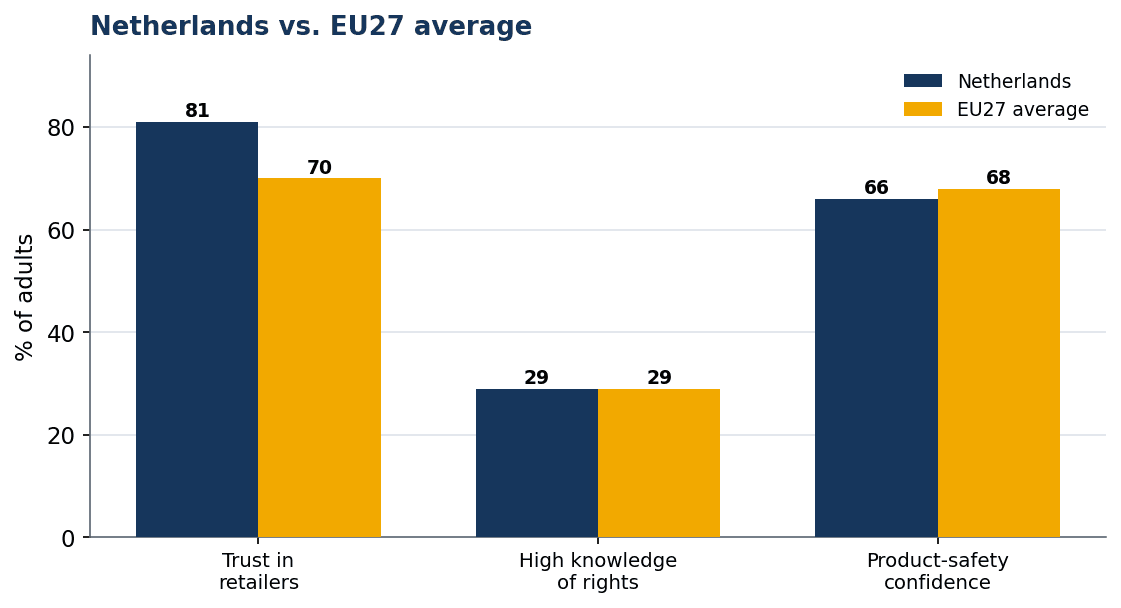
Figure: Netherlands versus the EU27 average on the three Knowledge, Trust & Product Safety indicators (% of adults, 2024).
Trust in retailers and service providers. 81% of consumers in Netherlands agree that retailers and service providers respect their rights, which is 11 percentage points above the EU27 average (EU27: 70%). That places Netherlands 5th out of 29 countries. For reference, Austria leads the continent on this measure (88%), while Greece trails the field (44%).
Knowledge of consumer rights. 29% of Netherlands’s consumers qualify as having HIGH knowledge of their rights – correctly answering at least three of the four test questions on cooling-off periods, one-sided contract changes, the two-year legal guarantee and unsolicited goods. That is exactly level with the EU27 average (EU27: 29%), ranking Netherlands 10th of 29. Denmark tops Europe here (43%); Greece records the lowest score (10%).
Confidence in product safety. 66% of consumers in Netherlands are confident that the non-food products on the market are safe (all safe or mostly safe), 2 percentage points below the EU27 average (EU27: 68%) and 18th of 29. Finland is Europe’s safety-confidence champion (92%), with Greece again at the foot of the table (59%).
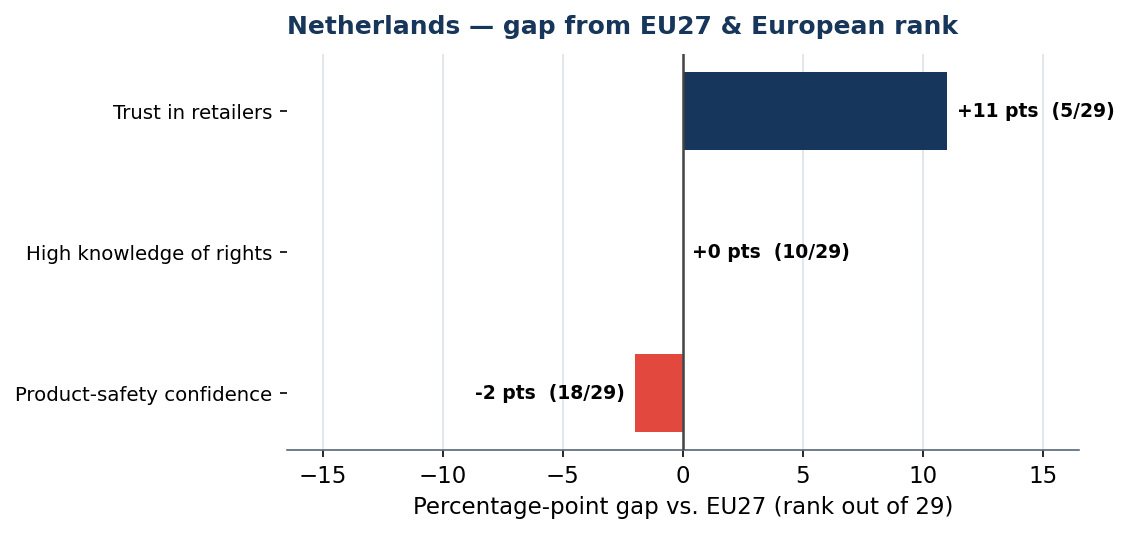
Figure: How far Netherlands sits from the EU27 average on each indicator, with its rank out of 29 European markets.
InfoCons takeaway for readers in Netherlands. Netherlands’s relative strength is trust in retailers (5th in Europe), while its weakest pillar is product-safety confidence (18th of 29). Newcomers, exchange students and faculty should calibrate expectations accordingly: where the country ranks low, knowing your rights and the EU-wide redress channels (the European Consumer Centres Network, online dispute resolution, and the Safety Gate alert system) matters most.
Austria — InfoCons Consumer Protection Country Profile: Trust, Rights Knowledge & Product Safety
Austria (AT) is benchmarked here against all 28 other markets covered by the European Commission’s Consumer Conditions Scoreboard 2025. On the three pillars of the Knowledge, Trust & Product Safety chapter, Austria ranks 1st of 29 for trust in retailers, 17th of 29 for rights knowledge and 13th of 29 for product-safety confidence. Averaged across the three, it sits in the upper-middle of the European field.
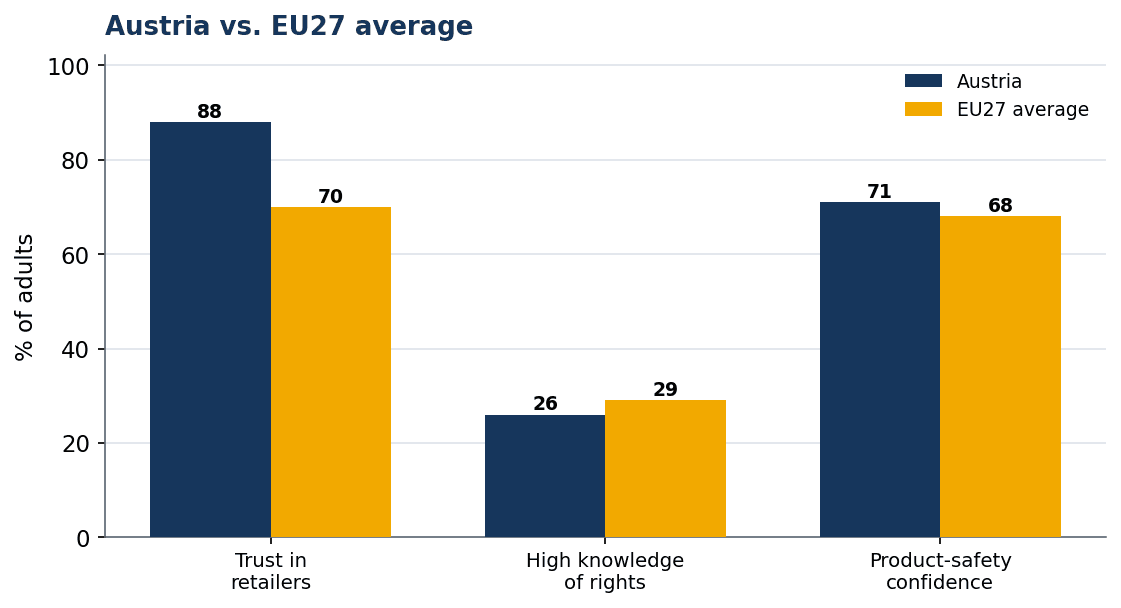
Figure: Austria versus the EU27 average on the three Knowledge, Trust & Product Safety indicators (% of adults, 2024).
Trust in retailers and service providers. 88% of consumers in Austria agree that retailers and service providers respect their rights, which is 18 percentage points above the EU27 average (EU27: 70%). That places Austria 1st out of 29 countries. For reference, Austria leads the continent on this measure (88%), while Greece trails the field (44%).
Knowledge of consumer rights. 26% of Austria’s consumers qualify as having HIGH knowledge of their rights – correctly answering at least three of the four test questions on cooling-off periods, one-sided contract changes, the two-year legal guarantee and unsolicited goods. That is 3 percentage points below the EU27 average (EU27: 29%), ranking Austria 17th of 29. Denmark tops Europe here (43%); Greece records the lowest score (10%).
Confidence in product safety. 71% of consumers in Austria are confident that the non-food products on the market are safe (all safe or mostly safe), 3 percentage points above the EU27 average (EU27: 68%) and 13th of 29. Finland is Europe’s safety-confidence champion (92%), with Greece again at the foot of the table (59%).
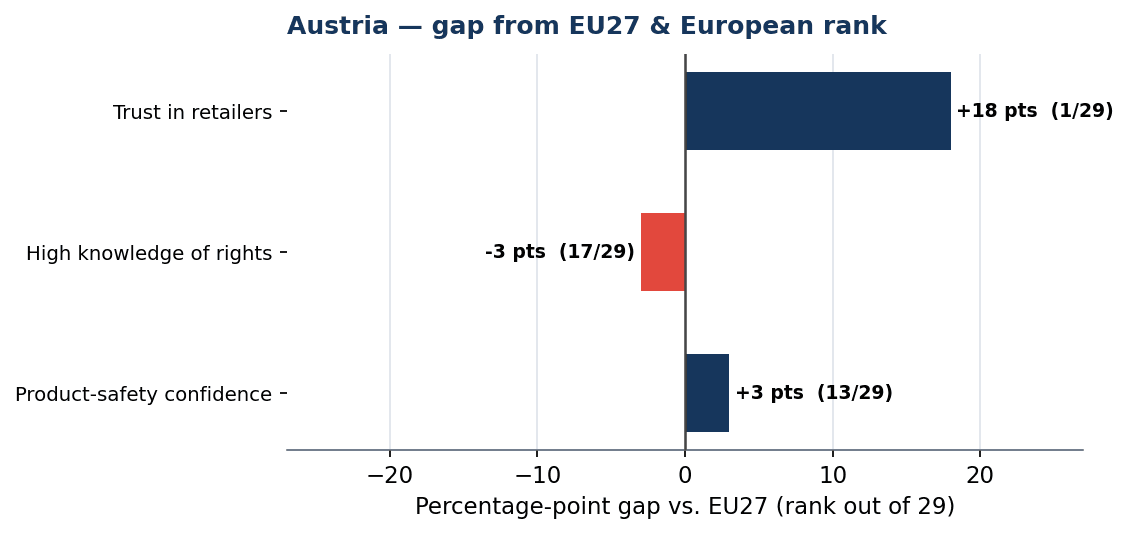
Figure: How far Austria sits from the EU27 average on each indicator, with its rank out of 29 European markets.
InfoCons takeaway for readers in Austria. Austria’s relative strength is trust in retailers (1st in Europe), while its weakest pillar is rights knowledge (17th of 29). Newcomers, exchange students and faculty should calibrate expectations accordingly: where the country ranks low, knowing your rights and the EU-wide redress channels (the European Consumer Centres Network, online dispute resolution, and the Safety Gate alert system) matters most.
Poland — InfoCons Consumer Protection Country Profile: Trust, Rights Knowledge & Product Safety
Poland (PL) is benchmarked here against all 28 other markets covered by the European Commission’s Consumer Conditions Scoreboard 2025. On the three pillars of the Knowledge, Trust & Product Safety chapter, Poland ranks 13th of 29 for trust in retailers, 14th of 29 for rights knowledge and 16th of 29 for product-safety confidence. Averaged across the three, it sits in the upper-middle of the European field.
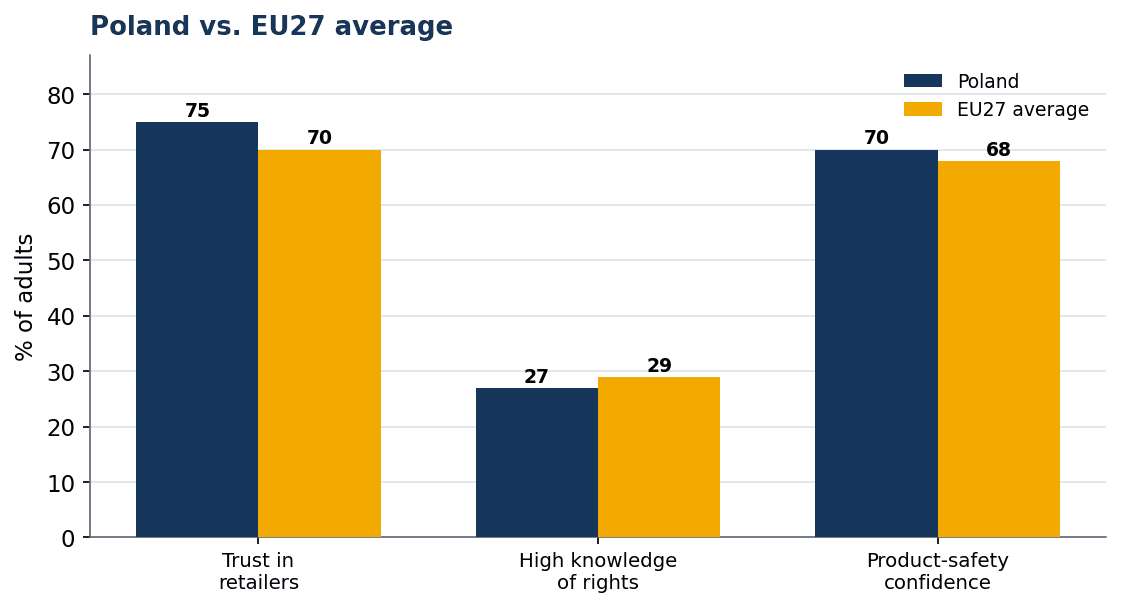
Figure: Poland versus the EU27 average on the three Knowledge, Trust & Product Safety indicators (% of adults, 2024).
Trust in retailers and service providers. 75% of consumers in Poland agree that retailers and service providers respect their rights, which is 5 percentage points above the EU27 average (EU27: 70%). That places Poland 13th out of 29 countries. For reference, Austria leads the continent on this measure (88%), while Greece trails the field (44%).
Knowledge of consumer rights. 27% of Poland’s consumers qualify as having HIGH knowledge of their rights – correctly answering at least three of the four test questions on cooling-off periods, one-sided contract changes, the two-year legal guarantee and unsolicited goods. That is 2 percentage points below the EU27 average (EU27: 29%), ranking Poland 14th of 29. Denmark tops Europe here (43%); Greece records the lowest score (10%).
Confidence in product safety. 70% of consumers in Poland are confident that the non-food products on the market are safe (all safe or mostly safe), 2 percentage points above the EU27 average (EU27: 68%) and 16th of 29. Finland is Europe’s safety-confidence champion (92%), with Greece again at the foot of the table (59%).
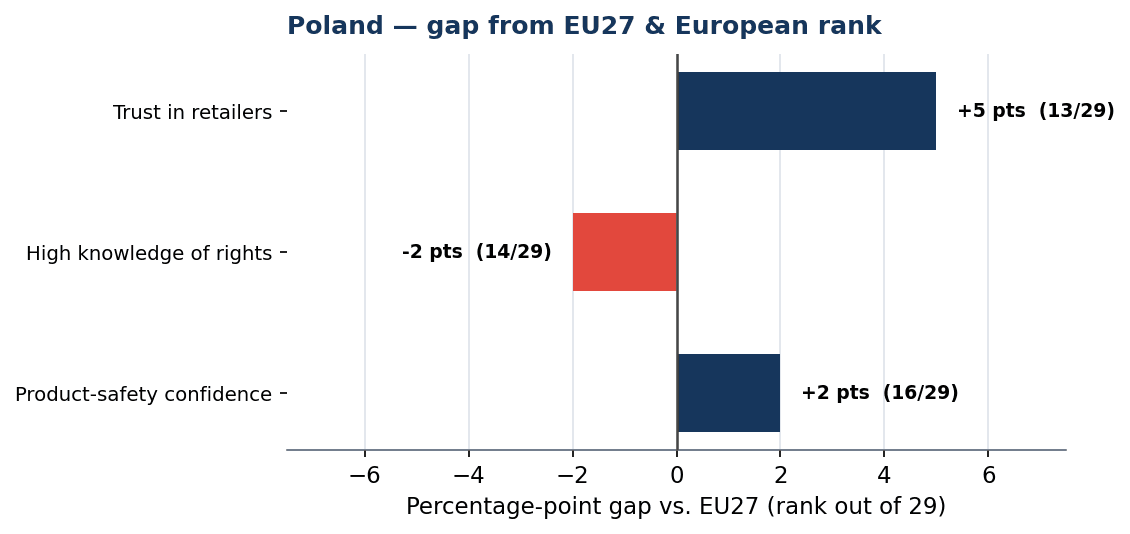
Figure: How far Poland sits from the EU27 average on each indicator, with its rank out of 29 European markets.
InfoCons takeaway for readers in Poland. Poland’s relative strength is trust in retailers (13th in Europe), while its weakest pillar is product-safety confidence (16th of 29). Newcomers, exchange students and faculty should calibrate expectations accordingly: where the country ranks low, knowing your rights and the EU-wide redress channels (the European Consumer Centres Network, online dispute resolution, and the Safety Gate alert system) matters most.
Portugal — InfoCons Consumer Protection Country Profile: Trust, Rights Knowledge & Product Safety
Portugal (PT) is benchmarked here against all 28 other markets covered by the European Commission’s Consumer Conditions Scoreboard 2025. On the three pillars of the Knowledge, Trust & Product Safety chapter, Portugal ranks 18th of 29 for trust in retailers, 25th of 29 for rights knowledge and 18th of 29 for product-safety confidence. Averaged across the three, it sits in the lower-middle of the European field.
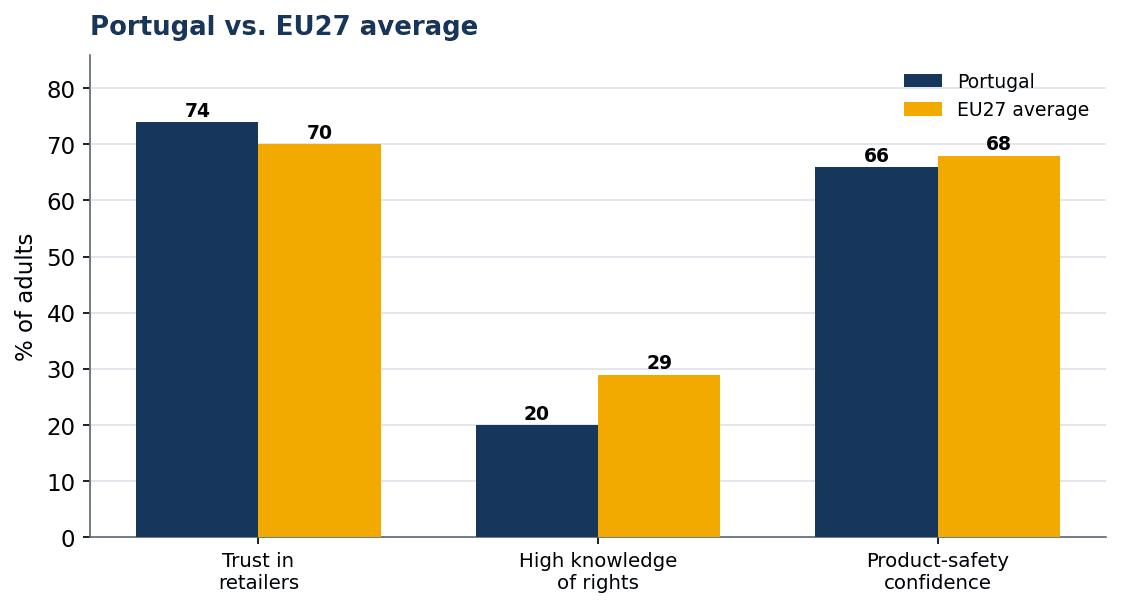
Figure: Portugal versus the EU27 average on the three Knowledge, Trust & Product Safety indicators (% of adults, 2024).
Trust in retailers and service providers. 74% of consumers in Portugal agree that retailers and service providers respect their rights, which is 4 percentage points above the EU27 average (EU27: 70%). That places Portugal 18th out of 29 countries. For reference, Austria leads the continent on this measure (88%), while Greece trails the field (44%).
Knowledge of consumer rights. 20% of Portugal’s consumers qualify as having HIGH knowledge of their rights – correctly answering at least three of the four test questions on cooling-off periods, one-sided contract changes, the two-year legal guarantee and unsolicited goods. That is 9 percentage points below the EU27 average (EU27: 29%), ranking Portugal 25th of 29. Denmark tops Europe here (43%); Greece records the lowest score (10%).
Confidence in product safety. 66% of consumers in Portugal are confident that the non-food products on the market are safe (all safe or mostly safe), 2 percentage points below the EU27 average (EU27: 68%) and 18th of 29. Finland is Europe’s safety-confidence champion (92%), with Greece again at the foot of the table (59%).
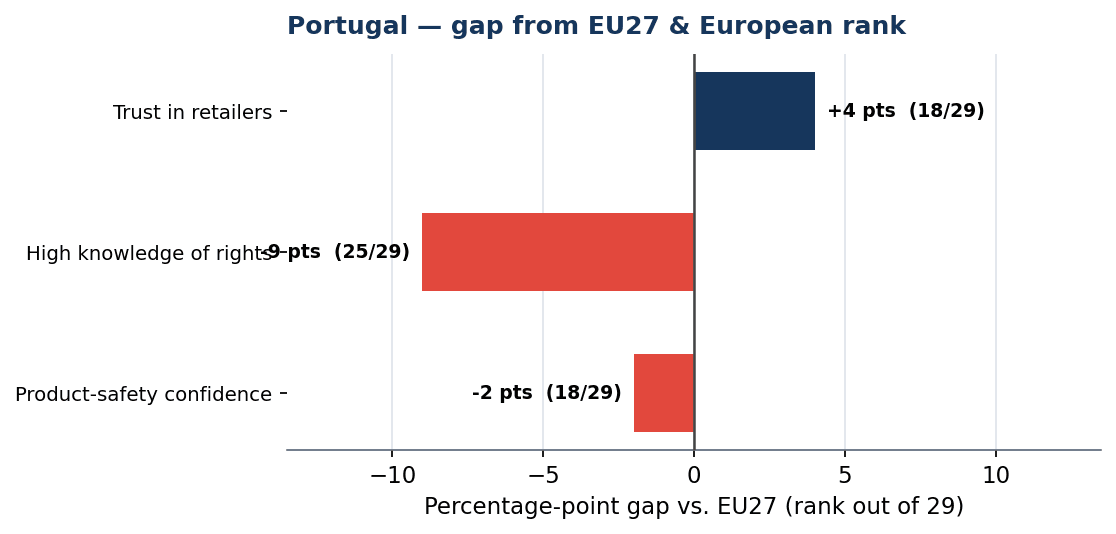
Figure: How far Portugal sits from the EU27 average on each indicator, with its rank out of 29 European markets.
InfoCons takeaway for readers in Portugal. Portugal’s relative strength is trust in retailers (18th in Europe), while its weakest pillar is rights knowledge (25th of 29). Newcomers, exchange students and faculty should calibrate expectations accordingly: where the country ranks low, knowing your rights and the EU-wide redress channels (the European Consumer Centres Network, online dispute resolution, and the Safety Gate alert system) matters most.
Romania — InfoCons Consumer Protection Country Profile: Trust, Rights Knowledge & Product Safety
Romania (RO) is benchmarked here against all 28 other markets covered by the European Commission’s Consumer Conditions Scoreboard 2025. On the three pillars of the Knowledge, Trust & Product Safety chapter, Romania ranks 18th of 29 for trust in retailers, 19th of 29 for rights knowledge and 23rd of 29 for product-safety confidence. Averaged across the three, it sits in the lower-middle of the European field.
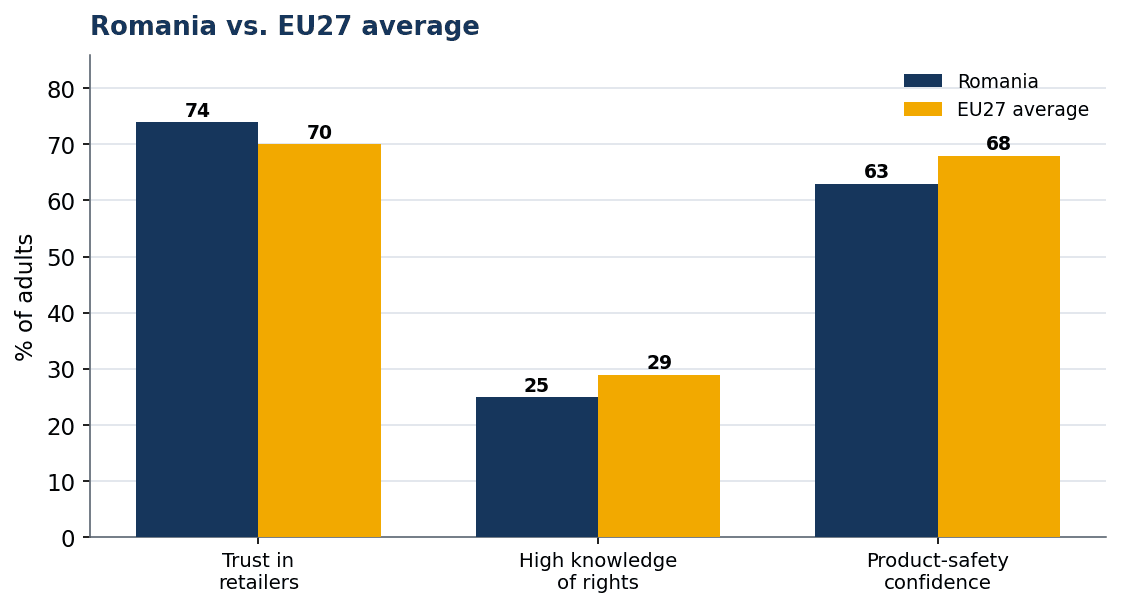
Figure: Romania versus the EU27 average on the three Knowledge, Trust & Product Safety indicators (% of adults, 2024).
Trust in retailers and service providers. 74% of consumers in Romania agree that retailers and service providers respect their rights, which is 4 percentage points above the EU27 average (EU27: 70%). That places Romania 18th out of 29 countries. For reference, Austria leads the continent on this measure (88%), while Greece trails the field (44%).
Knowledge of consumer rights. 25% of Romania’s consumers qualify as having HIGH knowledge of their rights – correctly answering at least three of the four test questions on cooling-off periods, one-sided contract changes, the two-year legal guarantee and unsolicited goods. That is 4 percentage points below the EU27 average (EU27: 29%), ranking Romania 19th of 29. Denmark tops Europe here (43%); Greece records the lowest score (10%).
Confidence in product safety. 63% of consumers in Romania are confident that the non-food products on the market are safe (all safe or mostly safe), 5 percentage points below the EU27 average (EU27: 68%) and 23rd of 29. Finland is Europe’s safety-confidence champion (92%), with Greece again at the foot of the table (59%).
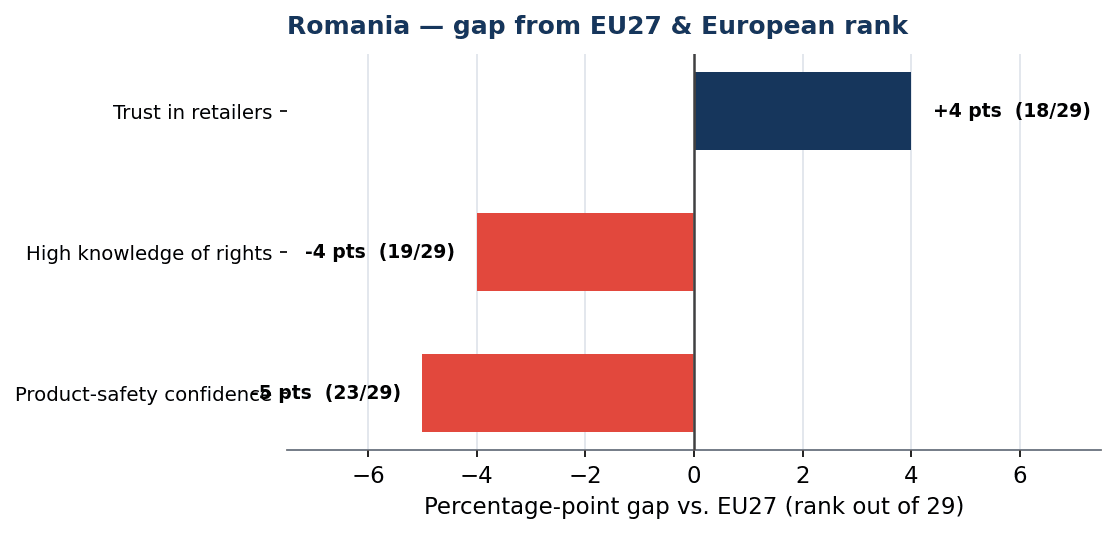
Figure: How far Romania sits from the EU27 average on each indicator, with its rank out of 29 European markets.
InfoCons takeaway for readers in Romania. Romania’s relative strength is trust in retailers (18th in Europe), while its weakest pillar is product-safety confidence (23rd of 29). Newcomers, exchange students and faculty should calibrate expectations accordingly: where the country ranks low, knowing your rights and the EU-wide redress channels (the European Consumer Centres Network, online dispute resolution, and the Safety Gate alert system) matters most.
Slovenia — InfoCons Consumer Protection Country Profile: Trust, Rights Knowledge & Product Safety
Slovenia (SI) is benchmarked here against all 28 other markets covered by the European Commission’s Consumer Conditions Scoreboard 2025. On the three pillars of the Knowledge, Trust & Product Safety chapter, Slovenia ranks 20th of 29 for trust in retailers, 19th of 29 for rights knowledge and 9th of 29 for product-safety confidence. Averaged across the three, it sits in the lower-middle of the European field.
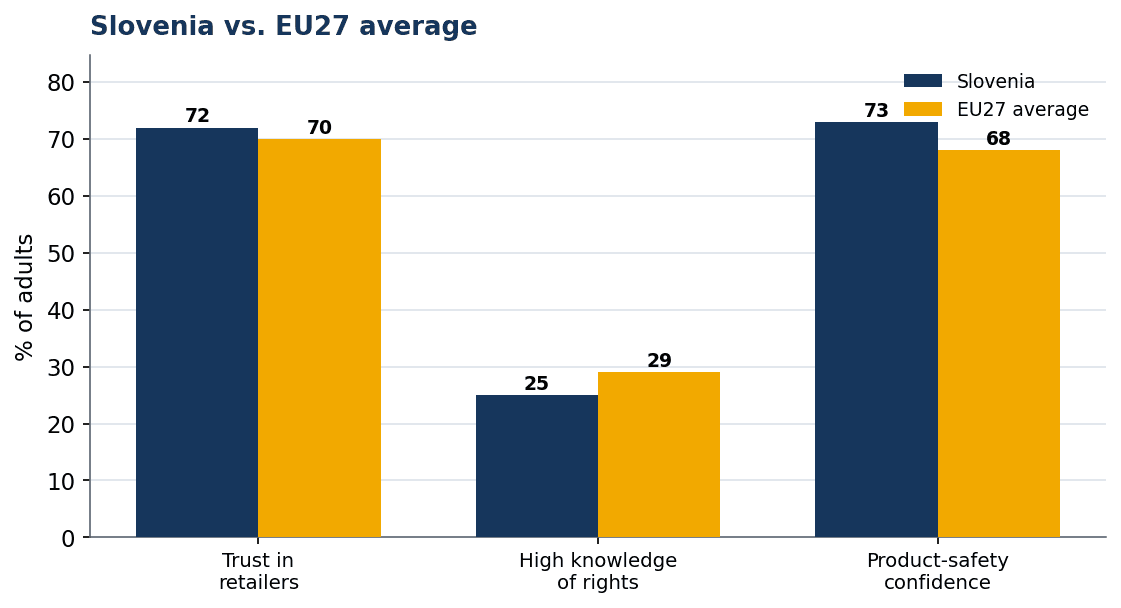
Figure: Slovenia versus the EU27 average on the three Knowledge, Trust & Product Safety indicators (% of adults, 2024).
Trust in retailers and service providers. 72% of consumers in Slovenia agree that retailers and service providers respect their rights, which is 2 percentage points above the EU27 average (EU27: 70%). That places Slovenia 20th out of 29 countries. For reference, Austria leads the continent on this measure (88%), while Greece trails the field (44%).
Knowledge of consumer rights. 25% of Slovenia’s consumers qualify as having HIGH knowledge of their rights – correctly answering at least three of the four test questions on cooling-off periods, one-sided contract changes, the two-year legal guarantee and unsolicited goods. That is 4 percentage points below the EU27 average (EU27: 29%), ranking Slovenia 19th of 29. Denmark tops Europe here (43%); Greece records the lowest score (10%).
Confidence in product safety. 73% of consumers in Slovenia are confident that the non-food products on the market are safe (all safe or mostly safe), 5 percentage points above the EU27 average (EU27: 68%) and 9th of 29. Finland is Europe’s safety-confidence champion (92%), with Greece again at the foot of the table (59%).
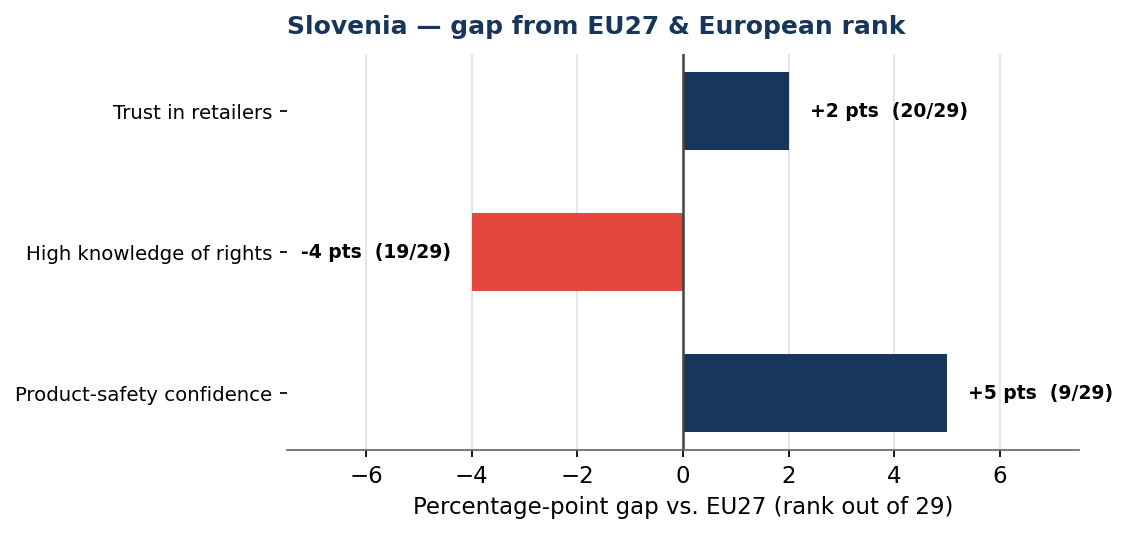
Figure: How far Slovenia sits from the EU27 average on each indicator, with its rank out of 29 European markets.
InfoCons takeaway for readers in Slovenia. Slovenia’s relative strength is product-safety confidence (9th in Europe), while its weakest pillar is trust in retailers (20th of 29). Newcomers, exchange students and faculty should calibrate expectations accordingly: where the country ranks low, knowing your rights and the EU-wide redress channels (the European Consumer Centres Network, online dispute resolution, and the Safety Gate alert system) matters most.
Slovakia — InfoCons Consumer Protection Country Profile: Trust, Rights Knowledge & Product Safety
Slovakia (SK) is benchmarked here against all 28 other markets covered by the European Commission’s Consumer Conditions Scoreboard 2025. On the three pillars of the Knowledge, Trust & Product Safety chapter, Slovakia ranks 3rd of 29 for trust in retailers, 14th of 29 for rights knowledge and 6th of 29 for product-safety confidence. Averaged across the three, it sits well inside the European top tier.
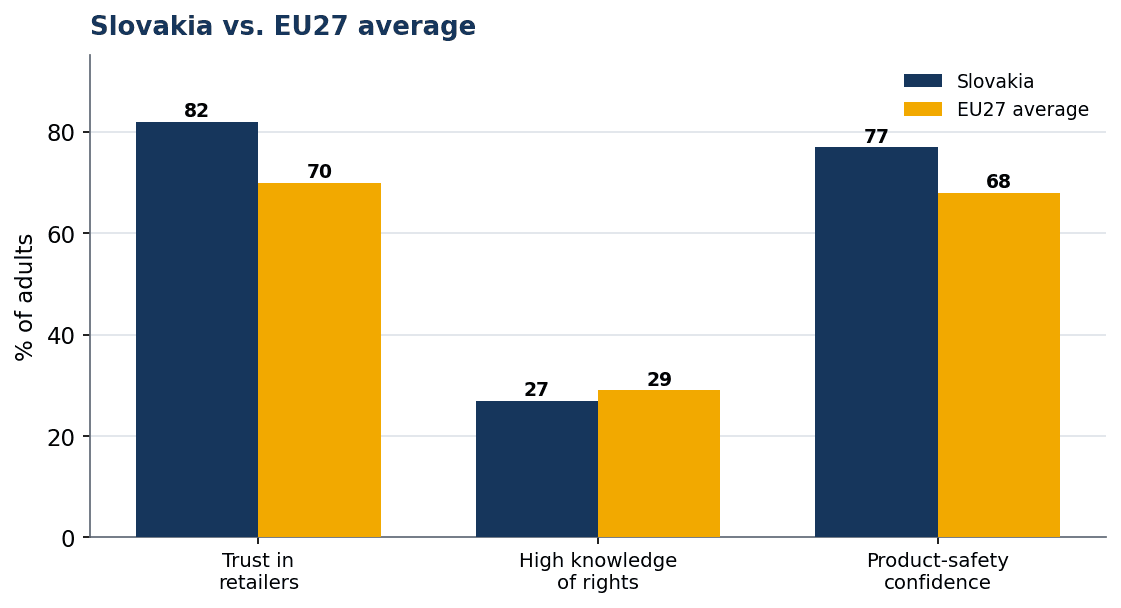
Figure: Slovakia versus the EU27 average on the three Knowledge, Trust & Product Safety indicators (% of adults, 2024).
Trust in retailers and service providers. 82% of consumers in Slovakia agree that retailers and service providers respect their rights, which is 12 percentage points above the EU27 average (EU27: 70%). That places Slovakia 3rd out of 29 countries. For reference, Austria leads the continent on this measure (88%), while Greece trails the field (44%).
Knowledge of consumer rights. 27% of Slovakia’s consumers qualify as having HIGH knowledge of their rights – correctly answering at least three of the four test questions on cooling-off periods, one-sided contract changes, the two-year legal guarantee and unsolicited goods. That is 2 percentage points below the EU27 average (EU27: 29%), ranking Slovakia 14th of 29. Denmark tops Europe here (43%); Greece records the lowest score (10%).
Confidence in product safety. 77% of consumers in Slovakia are confident that the non-food products on the market are safe (all safe or mostly safe), 9 percentage points above the EU27 average (EU27: 68%) and 6th of 29. Finland is Europe’s safety-confidence champion (92%), with Greece again at the foot of the table (59%).
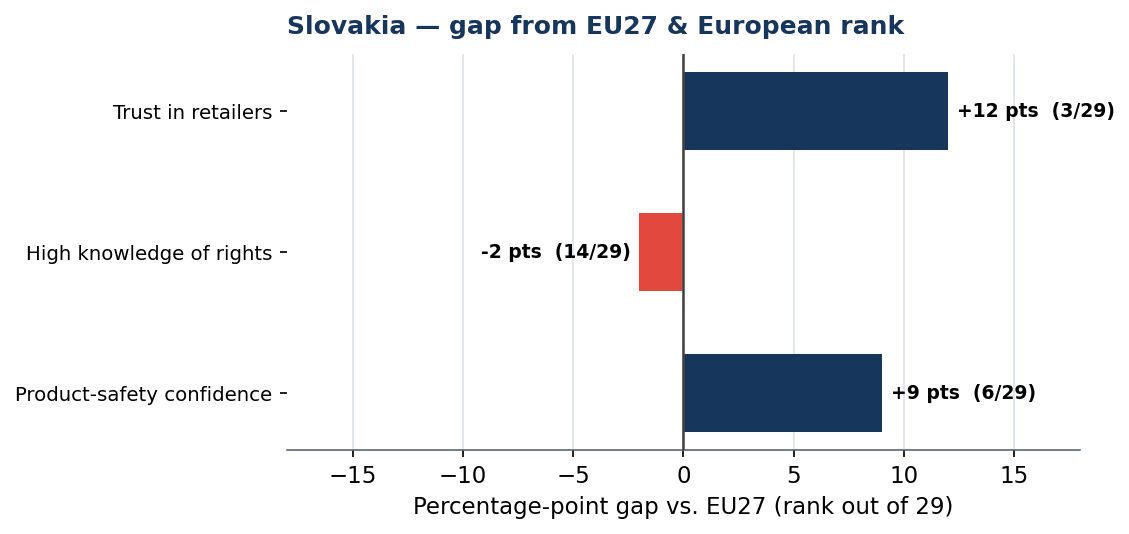
Figure: How far Slovakia sits from the EU27 average on each indicator, with its rank out of 29 European markets.
InfoCons takeaway for readers in Slovakia. Slovakia’s relative strength is trust in retailers (3rd in Europe), while its weakest pillar is rights knowledge (14th of 29). Newcomers, exchange students and faculty should calibrate expectations accordingly: where the country ranks low, knowing your rights and the EU-wide redress channels (the European Consumer Centres Network, online dispute resolution, and the Safety Gate alert system) matters most.
Finland — InfoCons Consumer Protection Country Profile: Trust, Rights Knowledge & Product Safety
Finland (FI) is benchmarked here against all 28 other markets covered by the European Commission’s Consumer Conditions Scoreboard 2025. On the three pillars of the Knowledge, Trust & Product Safety chapter, Finland ranks 6th of 29 for trust in retailers, 22nd of 29 for rights knowledge and 1st of 29 for product-safety confidence. Averaged across the three, it sits in the upper-middle of the European field.
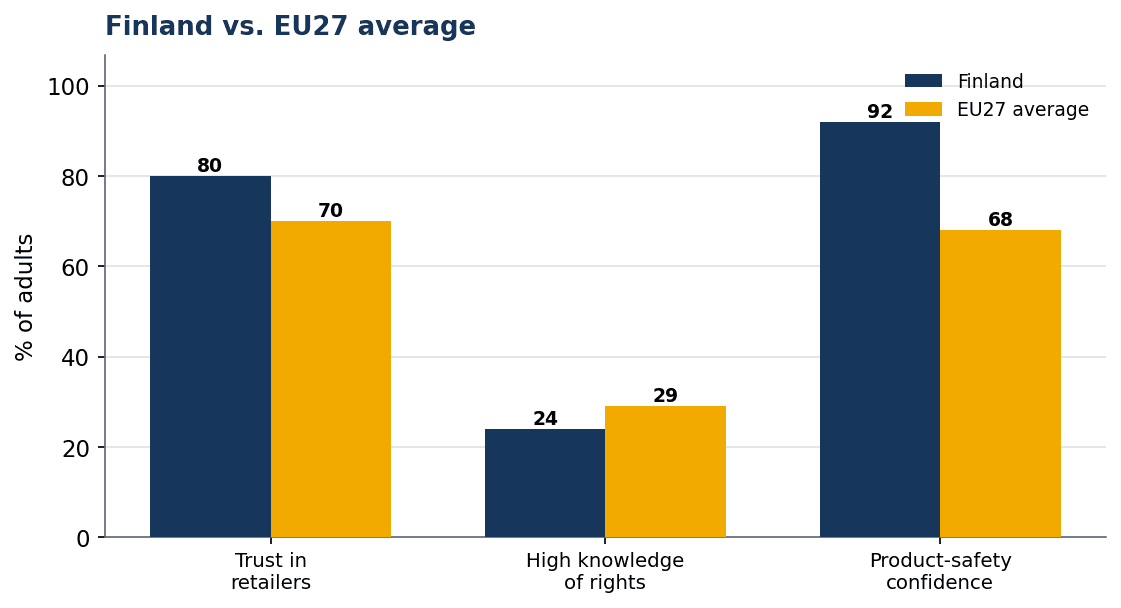
Figure: Finland versus the EU27 average on the three Knowledge, Trust & Product Safety indicators (% of adults, 2024).
Trust in retailers and service providers. 80% of consumers in Finland agree that retailers and service providers respect their rights, which is 10 percentage points above the EU27 average (EU27: 70%). That places Finland 6th out of 29 countries. For reference, Austria leads the continent on this measure (88%), while Greece trails the field (44%).
Knowledge of consumer rights. 24% of Finland’s consumers qualify as having HIGH knowledge of their rights – correctly answering at least three of the four test questions on cooling-off periods, one-sided contract changes, the two-year legal guarantee and unsolicited goods. That is 5 percentage points below the EU27 average (EU27: 29%), ranking Finland 22nd of 29. Denmark tops Europe here (43%); Greece records the lowest score (10%).
Confidence in product safety. 92% of consumers in Finland are confident that the non-food products on the market are safe (all safe or mostly safe), 24 percentage points above the EU27 average (EU27: 68%) and 1st of 29. Finland is Europe’s safety-confidence champion (92%), with Greece again at the foot of the table (59%).
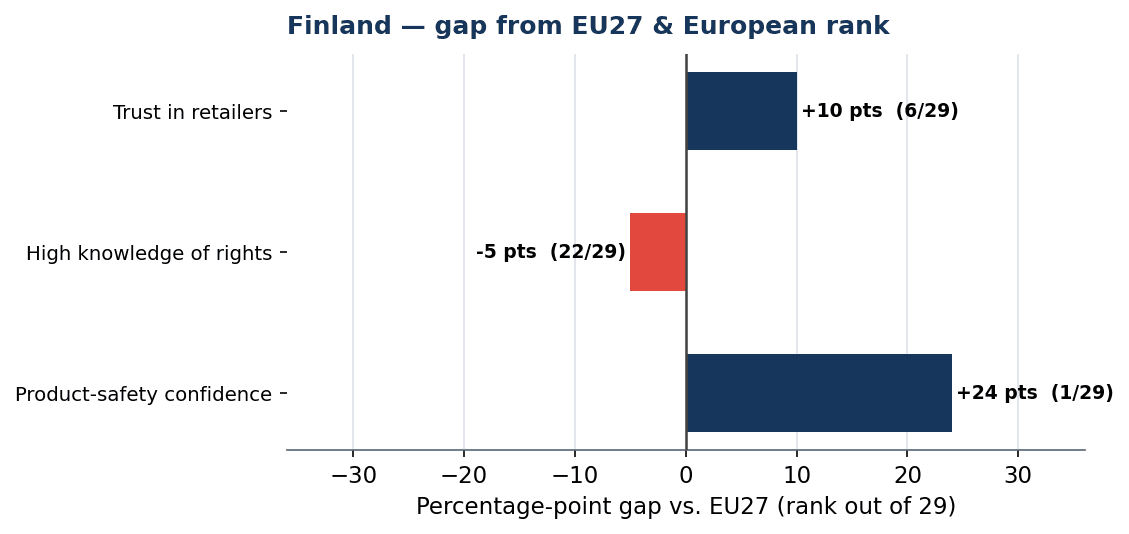
Figure: How far Finland sits from the EU27 average on each indicator, with its rank out of 29 European markets.
InfoCons takeaway for readers in Finland. Finland’s relative strength is product-safety confidence (1st in Europe), while its weakest pillar is rights knowledge (22nd of 29). Newcomers, exchange students and faculty should calibrate expectations accordingly: where the country ranks low, knowing your rights and the EU-wide redress channels (the European Consumer Centres Network, online dispute resolution, and the Safety Gate alert system) matters most.
Sweden — InfoCons Consumer Protection Country Profile: Trust, Rights Knowledge & Product Safety
Sweden (SE) is benchmarked here against all 28 other markets covered by the European Commission’s Consumer Conditions Scoreboard 2025. On the three pillars of the Knowledge, Trust & Product Safety chapter, Sweden ranks 8th of 29 for trust in retailers, 23rd of 29 for rights knowledge and 13th of 29 for product-safety confidence. Averaged across the three, it sits in the upper-middle of the European field.
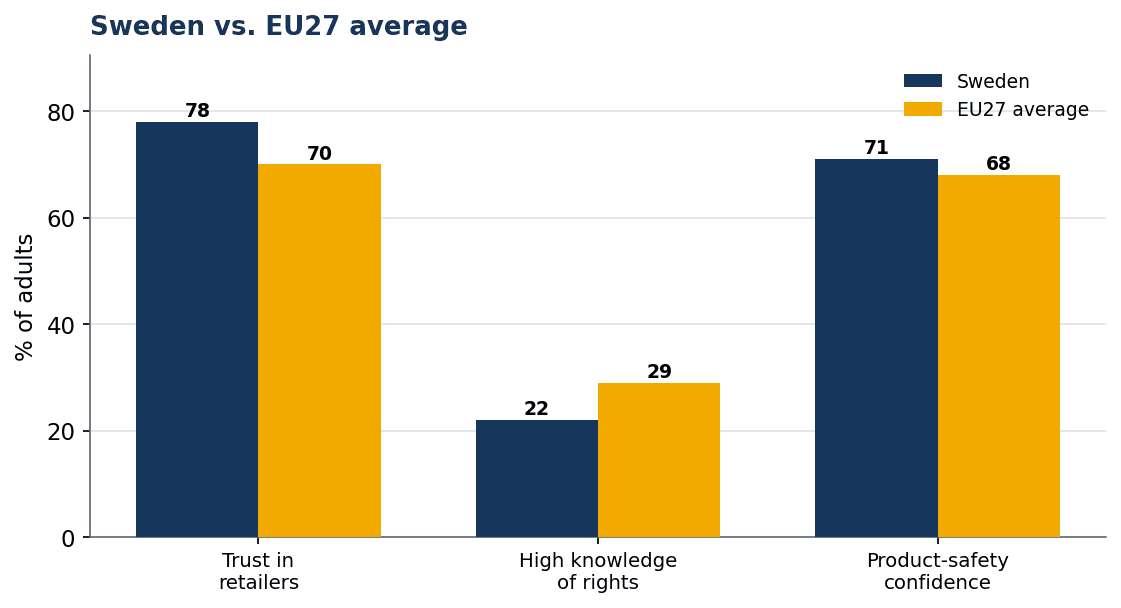
Figure: Sweden versus the EU27 average on the three Knowledge, Trust & Product Safety indicators (% of adults, 2024).
Trust in retailers and service providers. 78% of consumers in Sweden agree that retailers and service providers respect their rights, which is 8 percentage points above the EU27 average (EU27: 70%). That places Sweden 8th out of 29 countries. For reference, Austria leads the continent on this measure (88%), while Greece trails the field (44%).
Knowledge of consumer rights. 22% of Sweden’s consumers qualify as having HIGH knowledge of their rights – correctly answering at least three of the four test questions on cooling-off periods, one-sided contract changes, the two-year legal guarantee and unsolicited goods. That is 7 percentage points below the EU27 average (EU27: 29%), ranking Sweden 23rd of 29. Denmark tops Europe here (43%); Greece records the lowest score (10%).
Confidence in product safety. 71% of consumers in Sweden are confident that the non-food products on the market are safe (all safe or mostly safe), 3 percentage points above the EU27 average (EU27: 68%) and 13th of 29. Finland is Europe’s safety-confidence champion (92%), with Greece again at the foot of the table (59%).
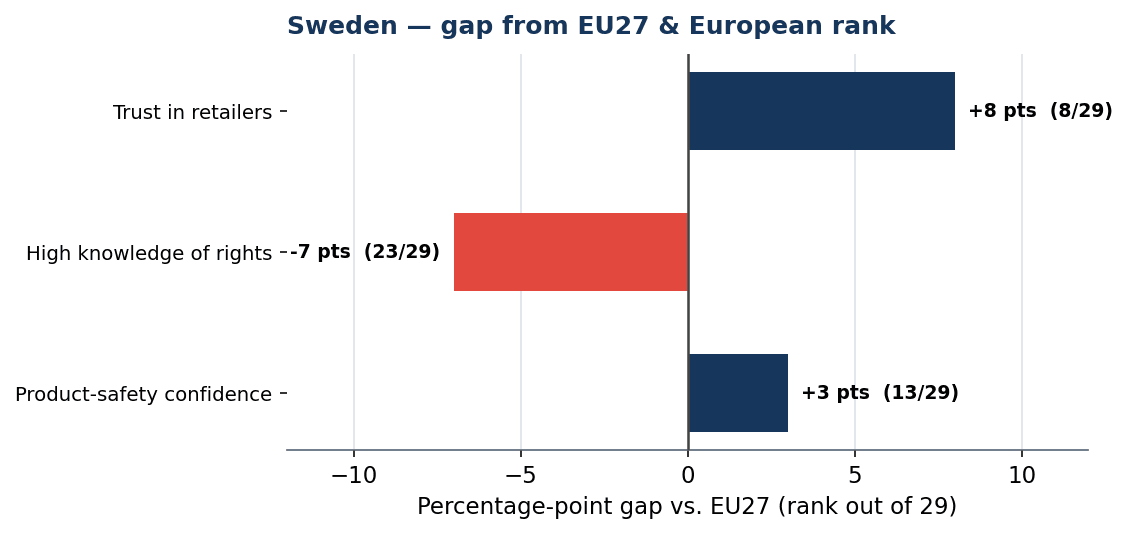
Figure: How far Sweden sits from the EU27 average on each indicator, with its rank out of 29 European markets.
InfoCons takeaway for readers in Sweden. Sweden’s relative strength is trust in retailers (8th in Europe), while its weakest pillar is rights knowledge (23rd of 29). Newcomers, exchange students and faculty should calibrate expectations accordingly: where the country ranks low, knowing your rights and the EU-wide redress channels (the European Consumer Centres Network, online dispute resolution, and the Safety Gate alert system) matters most.
Iceland — InfoCons Consumer Protection Country Profile: Trust, Rights Knowledge & Product Safety
Iceland (IS) is benchmarked here against all 28 other markets covered by the European Commission’s Consumer Conditions Scoreboard 2025. On the three pillars of the Knowledge, Trust & Product Safety chapter, Iceland ranks 13th of 29 for trust in retailers, 8th of 29 for rights knowledge and 17th of 29 for product-safety confidence. Averaged across the three, it sits in the upper-middle of the European field.
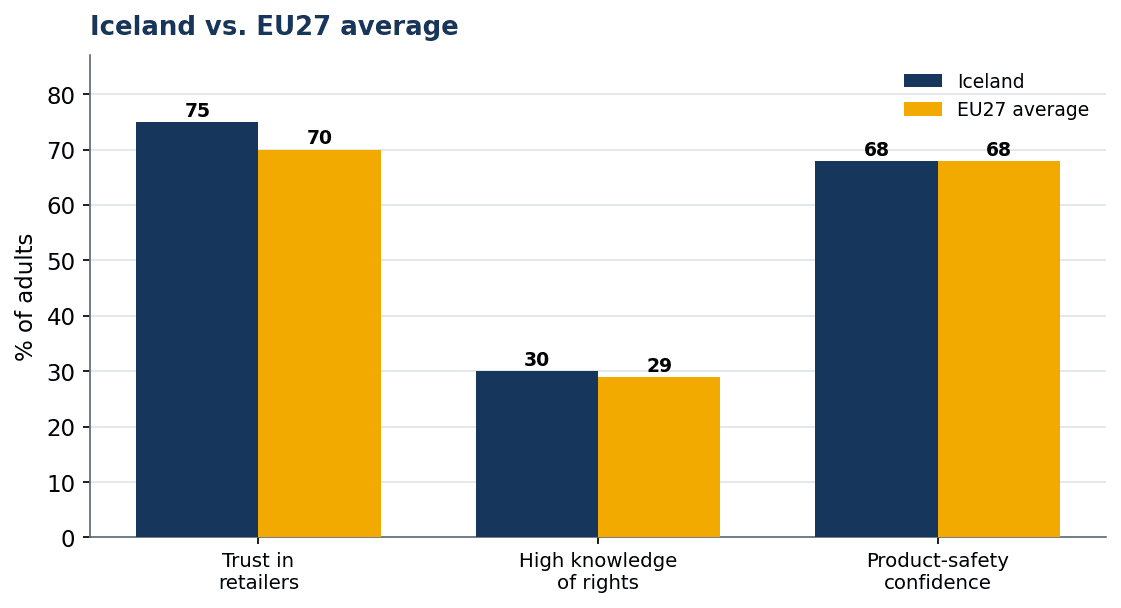
Figure: Iceland versus the EU27 average on the three Knowledge, Trust & Product Safety indicators (% of adults, 2024).
Trust in retailers and service providers. 75% of consumers in Iceland agree that retailers and service providers respect their rights, which is 5 percentage points above the EU27 average (EU27: 70%). That places Iceland 13th out of 29 countries. For reference, Austria leads the continent on this measure (88%), while Greece trails the field (44%).
Knowledge of consumer rights. 30% of Iceland’s consumers qualify as having HIGH knowledge of their rights – correctly answering at least three of the four test questions on cooling-off periods, one-sided contract changes, the two-year legal guarantee and unsolicited goods. That is 1 percentage point above the EU27 average (EU27: 29%), ranking Iceland 8th of 29. Denmark tops Europe here (43%); Greece records the lowest score (10%).
Confidence in product safety. 68% of consumers in Iceland are confident that the non-food products on the market are safe (all safe or mostly safe), exactly level with the EU27 average (EU27: 68%) and 17th of 29. Finland is Europe’s safety-confidence champion (92%), with Greece again at the foot of the table (59%).
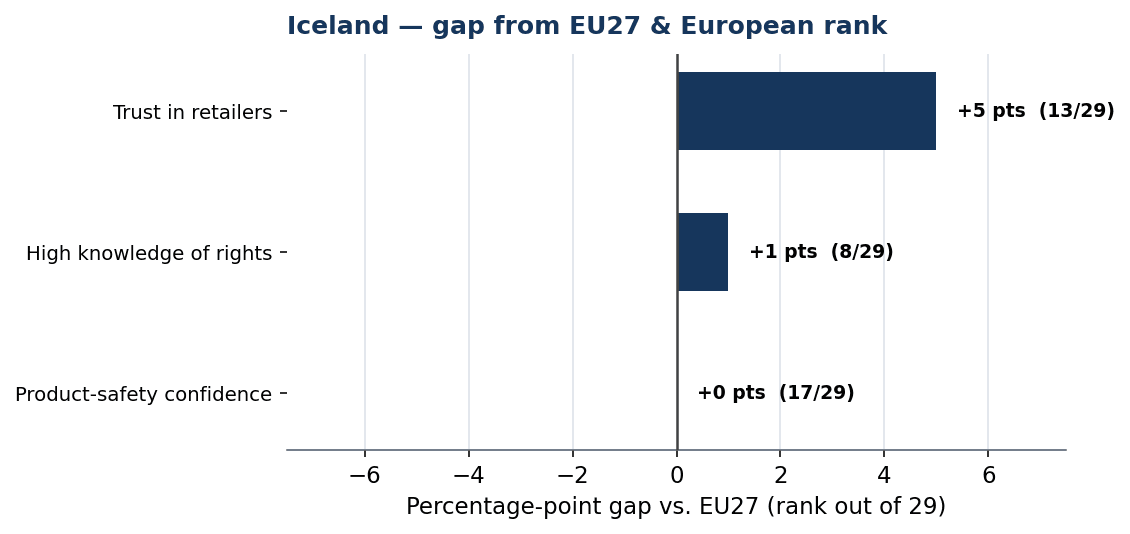
Figure: How far Iceland sits from the EU27 average on each indicator, with its rank out of 29 European markets.
InfoCons takeaway for readers in Iceland. Iceland’s relative strength is rights knowledge (8th in Europe), while its weakest pillar is product-safety confidence (17th of 29). Newcomers, exchange students and faculty should calibrate expectations accordingly: where the country ranks low, knowing your rights and the EU-wide redress channels (the European Consumer Centres Network, online dispute resolution, and the Safety Gate alert system) matters most.
Norway — InfoCons Consumer Protection Country Profile: Trust, Rights Knowledge & Product Safety
Norway (NO) is benchmarked here against all 28 other markets covered by the European Commission’s Consumer Conditions Scoreboard 2025. On the three pillars of the Knowledge, Trust & Product Safety chapter, Norway ranks 25th of 29 for trust in retailers, 2nd of 29 for rights knowledge and 3rd of 29 for product-safety confidence. Averaged across the three, it sits in the upper-middle of the European field.
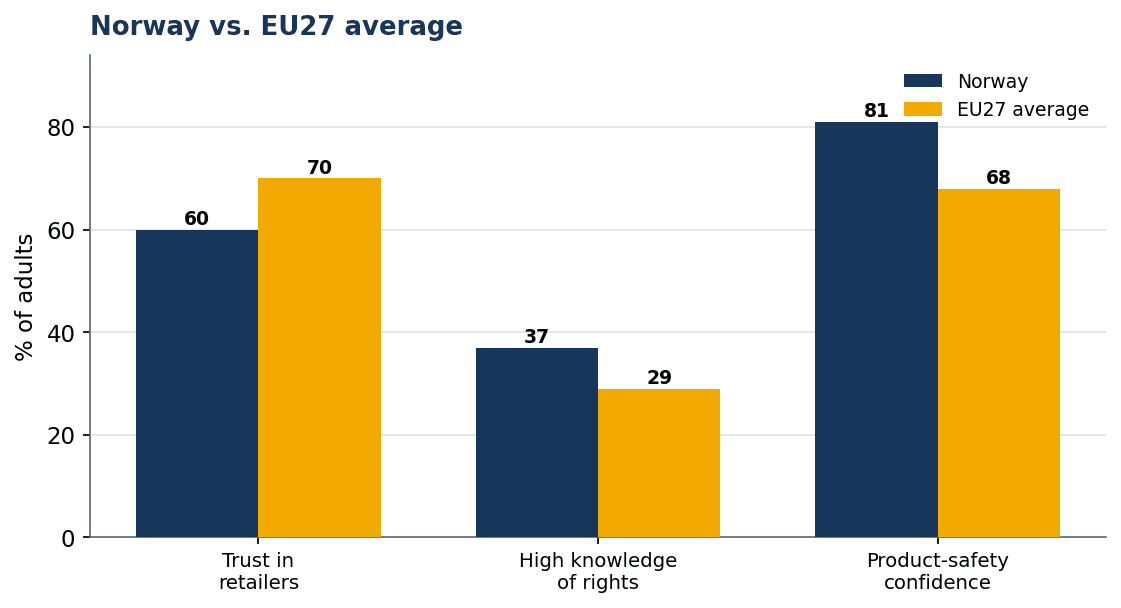
Figure: Norway versus the EU27 average on the three Knowledge, Trust & Product Safety indicators (% of adults, 2024).
Trust in retailers and service providers. 60% of consumers in Norway agree that retailers and service providers respect their rights, which is 10 percentage points below the EU27 average (EU27: 70%). That places Norway 25th out of 29 countries. For reference, Austria leads the continent on this measure (88%), while Greece trails the field (44%).
Knowledge of consumer rights. 37% of Norway’s consumers qualify as having HIGH knowledge of their rights – correctly answering at least three of the four test questions on cooling-off periods, one-sided contract changes, the two-year legal guarantee and unsolicited goods. That is 8 percentage points above the EU27 average (EU27: 29%), ranking Norway 2nd of 29. Denmark tops Europe here (43%); Greece records the lowest score (10%).
Confidence in product safety. 81% of consumers in Norway are confident that the non-food products on the market are safe (all safe or mostly safe), 13 percentage points above the EU27 average (EU27: 68%) and 3rd of 29. Finland is Europe’s safety-confidence champion (92%), with Greece again at the foot of the table (59%).
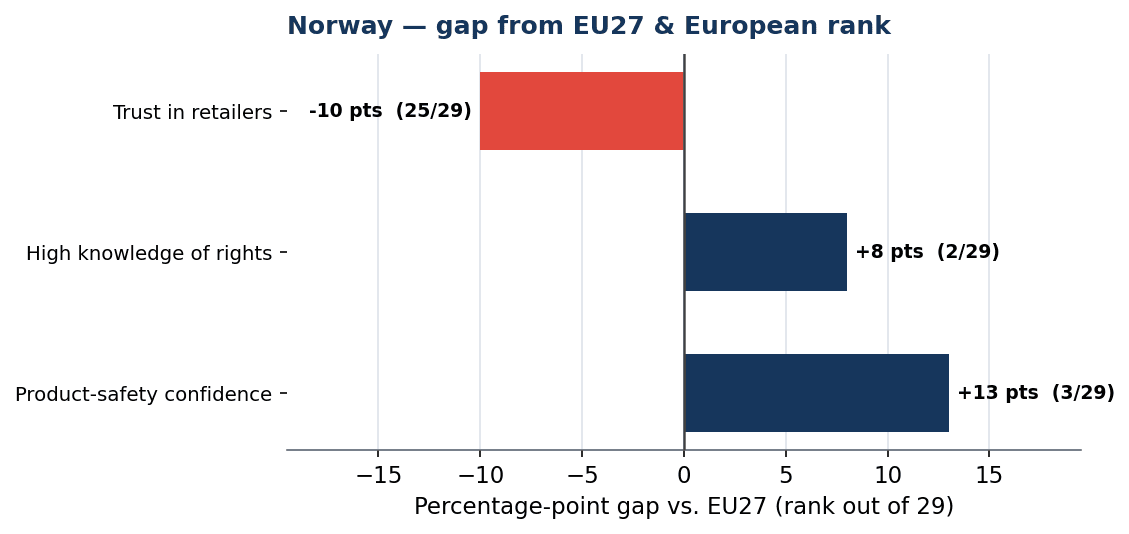
Figure: How far Norway sits from the EU27 average on each indicator, with its rank out of 29 European markets.
InfoCons takeaway for readers in Norway. Norway’s relative strength is rights knowledge (2nd in Europe), while its weakest pillar is trust in retailers (25th of 29). Newcomers, exchange students and faculty should calibrate expectations accordingly: where the country ranks low, knowing your rights and the EU-wide redress channels (the European Consumer Centres Network, online dispute resolution, and the Safety Gate alert system) matters most.
InfoCons Consumer Protection — What This Means for You
Across Europe the pattern is consistent: consumers feel reasonably protected and reasonably confident about product safety, but far too few actually know the rights that underpin that protection. Knowledge is the weakest pillar in almost every market. For anyone arriving in a new country, the practical lesson is simple – trust is earned locally, but rights are guaranteed EU-wide, and the markets where consumers know least are exactly where knowing your rights pays off most.
Wherever you live or study, the same EU-wide tools are available to you: the European Consumer Centres Network for cross-border disputes, online dispute resolution and out-of-court (ADR) bodies, the two-year legal guarantee on goods, the 14-day cooling-off period for distance purchases, and the Safety Gate alert system for dangerous products. Knowing they exist is the first and most powerful act of consumer self-protection.
Signature
InfoCons Consumer Protection & Product Safety Department
Data source: European Commission, Directorate-General for Justice and Consumers, Consumer Conditions Scoreboard 2025 (Knowledge, Trust & Product Safety chapter and Annex I country summaries). Analysis, ranking and visualisation by the InfoCons Consumer Protection & Product Safety Department.