
INFOCONS CONSUMER PROTECTION
27th of 29 for Redress: The Hard Truth About Getting a Consumer Problem Fixed in Greece — and How to Beat the Odds
A 2025 InfoCons Consumer Protection deep-dive into consumer problems, complaints and redress in Greece — in plain English for expats, exchange students and the academics who teach consumer law and European studies across the EU/EEA. Based exclusively on Section 6 (Experience of Problems & Redress) of the European Commission’s Consumer Conditions Scoreboard, 2025 Edition.
An InfoCons Consumer Protection country article • EU27 benchmark: 24% experienced a problem, 73% of those took action.
Buying something is easy; the real test of a marketplace is what happens when a purchase goes wrong. This InfoCons article reads the 2025 Consumer Conditions Scoreboard to show exactly where Greece stands — how often consumers hit a problem, whether they act on it, and how that compares with the rest of the EU/EEA and the EU27 average.
It is written for people living the single market in practice: expats settling in, exchange students arriving for a semester, and the academics and educators who teach consumer law and European studies in English-language programmes.
Snapshot: Where Greece Stands — InfoCons Consumer Protection
Three comparative views set the scene. The first maps Greece against all 28 other economies; the second benchmarks it head-to-head against the EU average; the third converts its standing into a simple 1-to-29 league position.
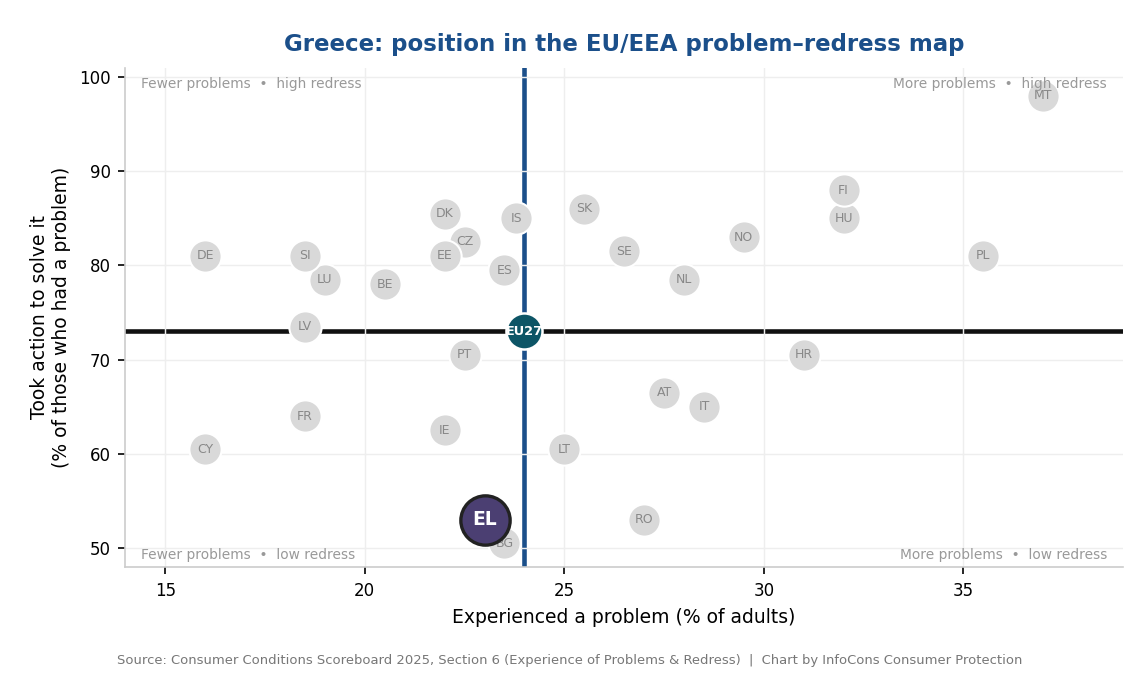
What this shows: every EU/EEA economy is plotted by how often consumers hit a problem (horizontal axis) against how often they act to fix it (vertical axis). The blue line marks the EU27 problem average (24%) and the black line the EU27 action average (73%); their crossing point is the EU27 benchmark. Greece (highlighted) falls in the ‘fewer problems / weaker redress’ quadrant, so its position relative to the EU average can be read at a glance against all 28 other economies.
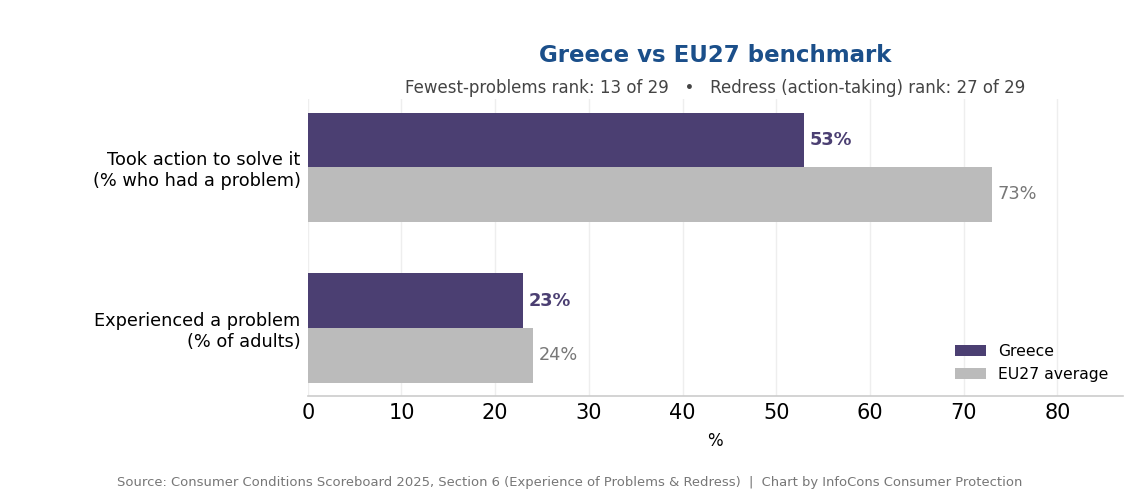
What this shows: a direct head-to-head between Greece and the EU27 average on the two headline behaviours, with the country’s rank out of 29 on each. The top pair compares the share of consumers who took action (53% vs 73%); the bottom pair compares the share who experienced a problem (23% vs 24%).
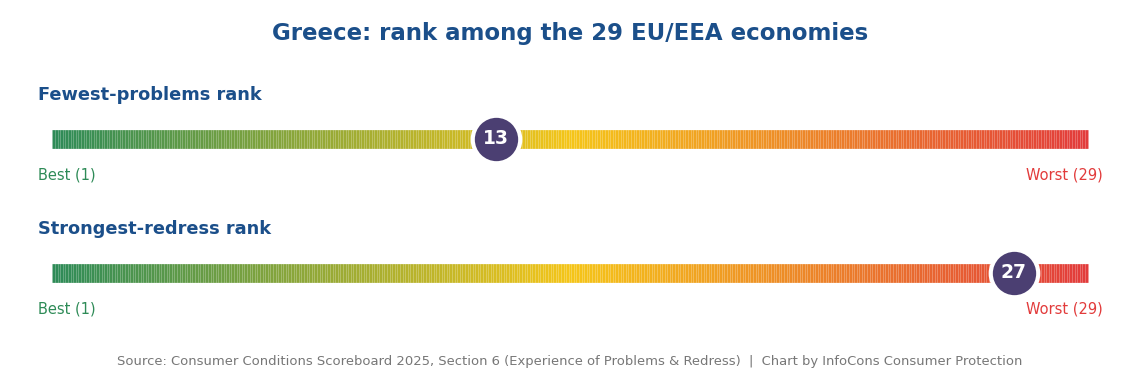
What this shows: where Greece lands on a 1-to-29 league scale for each behaviour — rank 1 (green) is best, rank 29 (red) is worst. The top track is the ‘fewest problems’ ranking (13th); the bottom track is the ‘strongest redress’ ranking (27th). It turns the country’s standing into an instantly readable position.
Incidence of Consumer Problems — InfoCons Consumer Protection
About 23% of adults in Greece report having experienced a problem with a domestic trader in the past 12 months for which they felt there was a legitimate cause to complain — 1 percentage point below the EU27 average of 24%. Ranked against the 29 EU/EEA economies in the scoreboard, Greece sits 13th on the ‘fewest problems’ measure. That makes its everyday marketplace comparatively calm for consumers. Incidence alone, however, says little about fairness: what matters next is whether consumers act when something goes wrong.
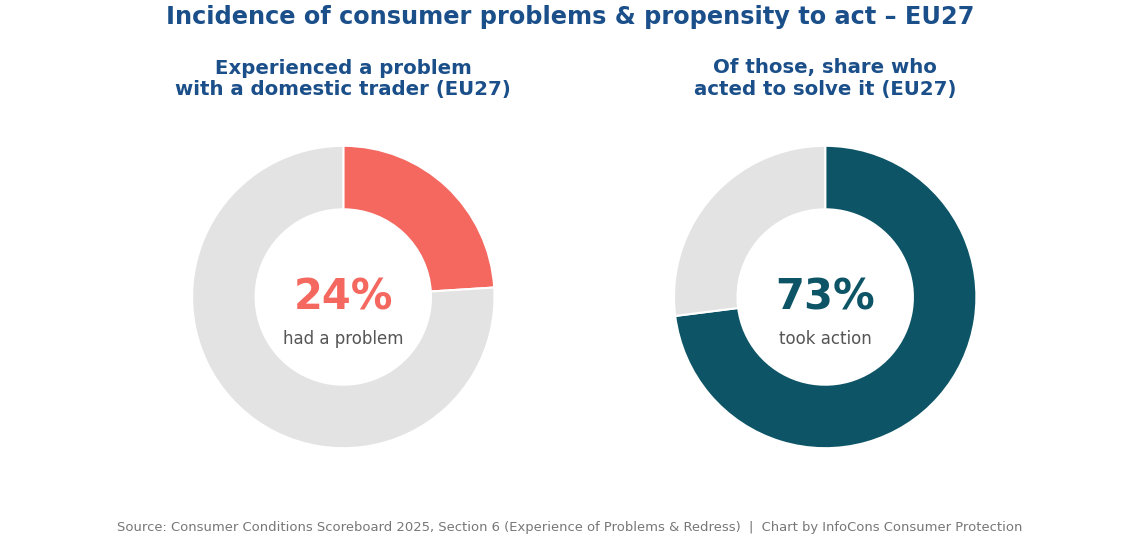
What this shows: the EU27 baseline — one in four adults hit a problem, and of those, roughly three quarters act to resolve it.
Taking Action & Redress Channels — InfoCons Consumer Protection
When a problem does occur, roughly 53% of affected consumers in Greece take action to resolve it — 20 percentage points below the EU27 benchmark of 73%, and 27th of 29 in the panel. This points to a weaker redress reflex, which can let poor practice go unchallenged. Across the EU, consumers who act overwhelmingly approach the retailer or service provider first (85%), followed by the manufacturer (32%); formal routes such as out-of-court dispute resolution (9%), the courts (5%) and collective redress (4%) remain comparatively rare. The chart below shows that EU-wide channel mix, which frames the practical options open to consumers in Greece.
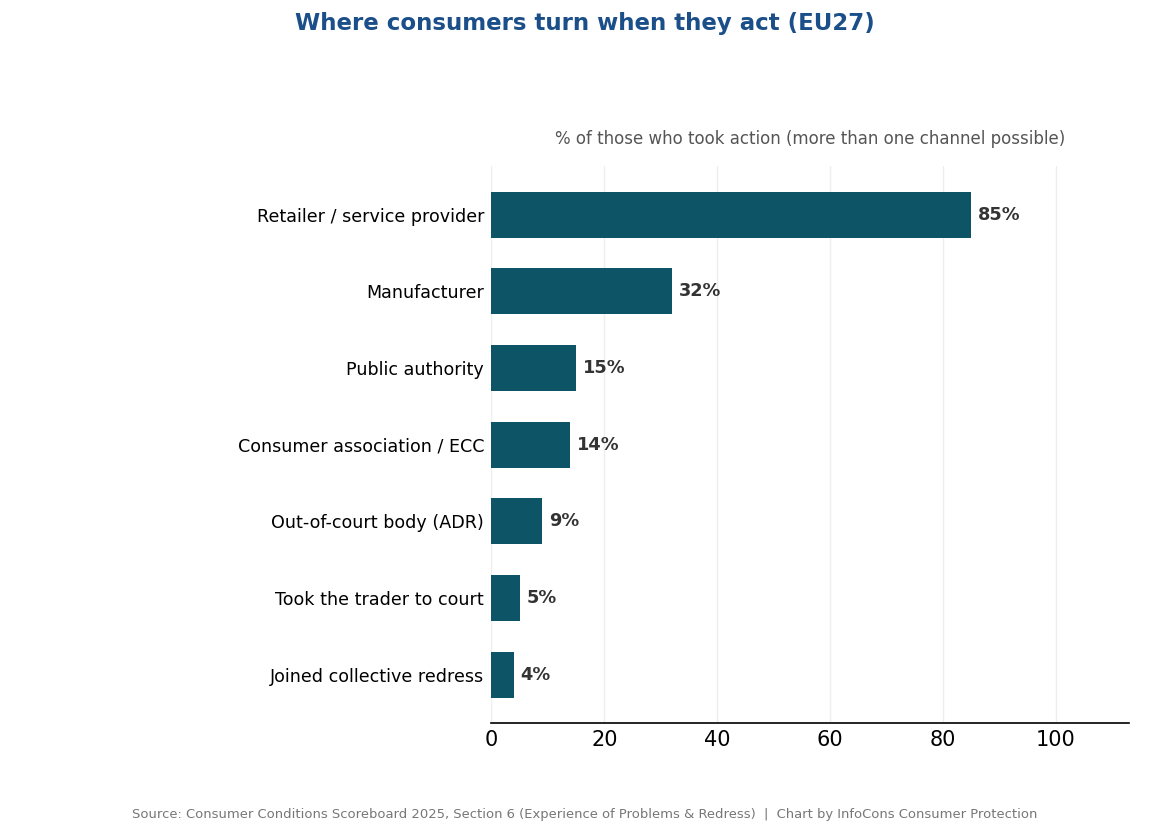
What this shows: of EU consumers who act on a problem, which routes they use. The retailer is the dominant channel; legal and collective routes are rare.
Why Consumers Stay Silent — InfoCons Consumer Protection
The scoreboard does not publish a country-by-country breakdown of why consumers stay silent, but the EU-wide pattern is highly relevant to anyone navigating the market in Greece. Among Europeans who had a problem yet did nothing, the leading barriers were the expectation that complaining would take too long (57%), doubt that it would yield a satisfactory outcome (51%), and the small value of the purchase (45%). Crucially for newcomers, 41% simply did not know where to complain and 33% were unsure of their rights as a consumer — information gaps that practical guidance can close, and exactly the kind of barrier InfoCons works to remove.
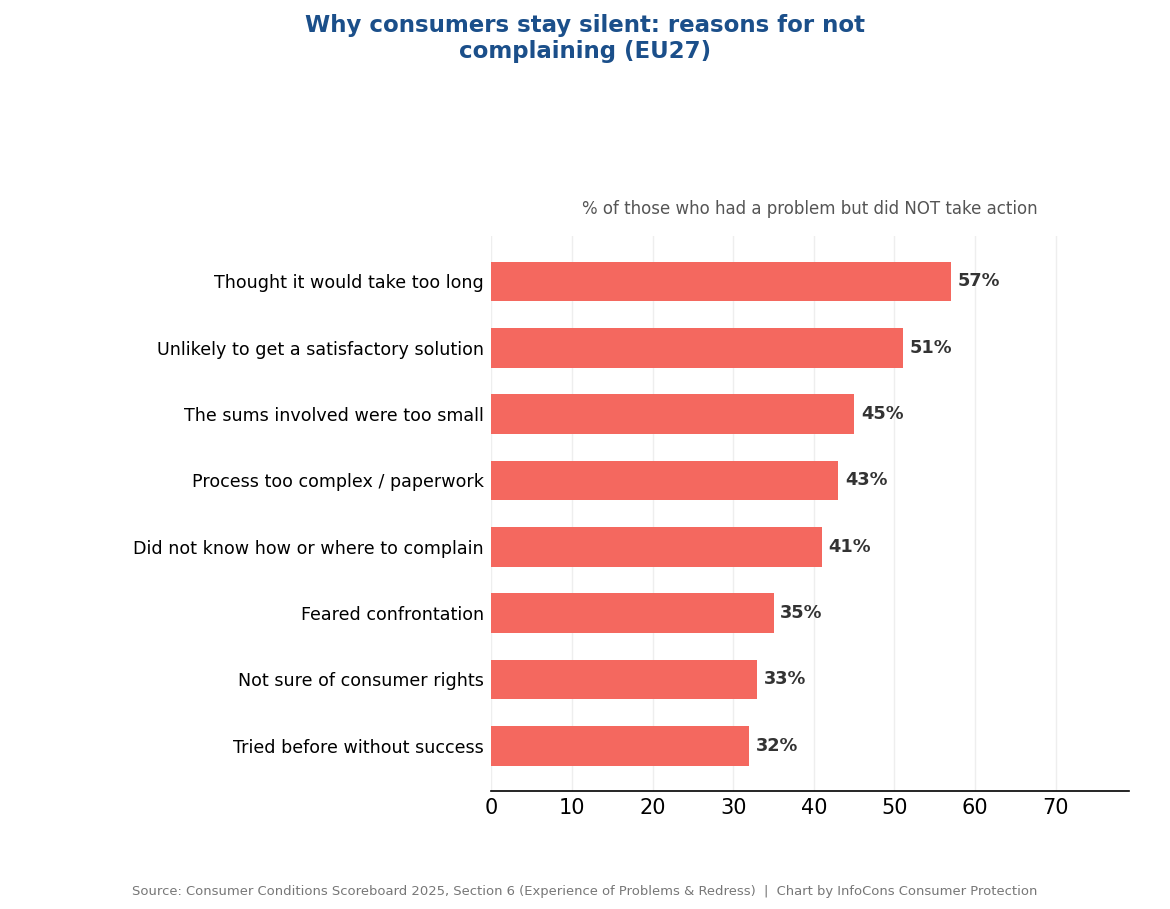
What this shows: among EU consumers who had a problem but did nothing, the barriers that held them back — mostly effort, low expectations and the small sums at stake.
Satisfaction with Complaint Handling — InfoCons Consumer Protection
Most complaints across the EU are still resolved, but satisfaction with how retailers handle them fell from 65% in 2022 to just 53% in 2024 — a twelve-point drop, and a decline recorded in 20 of the 27 Member States. For consumers in Greece, this is the trend to watch: resolution rates remain reasonable, yet the quality of the experience is slipping Europe-wide.
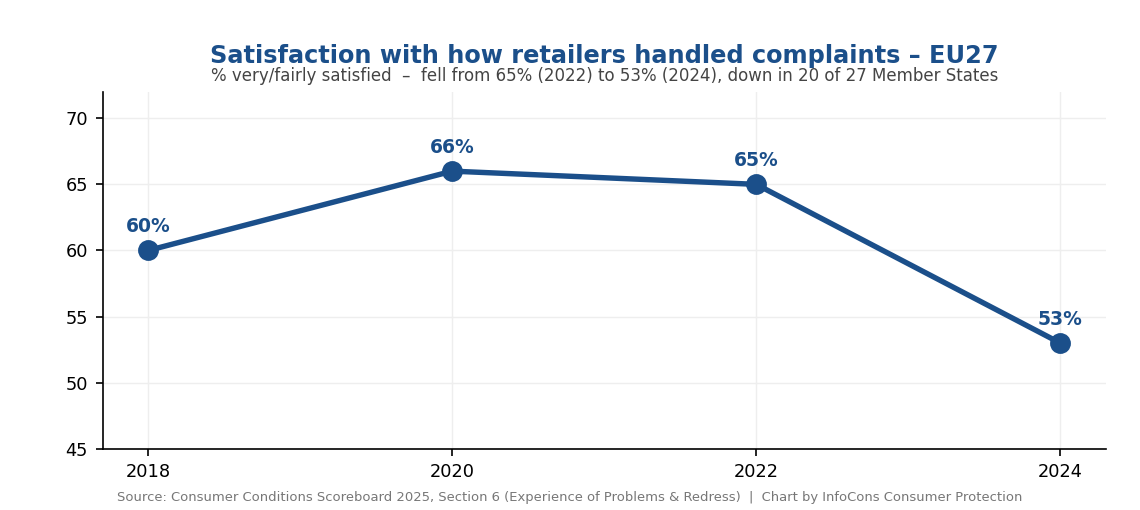
What this shows: the EU27 trend in satisfaction with how retailers handle complaints, with the sharp fall from 65% (2022) to 53% (2024).
Unfair Commercial Practices — InfoCons Consumer Protection
Unfair selling is a shared European challenge that shapes the risk environment in Greece too. Pressure selling via persistent calls or messages is the single most common practice (45% of adults), ahead of false claims of limited-time availability (38%), ‘free’ offers that actually carry charges (27%), fake lottery wins (24%) and contracts that are hard to cancel online (22%). Recognising these tactics is the first line of self-defence, and a core theme of InfoCons consumer education.
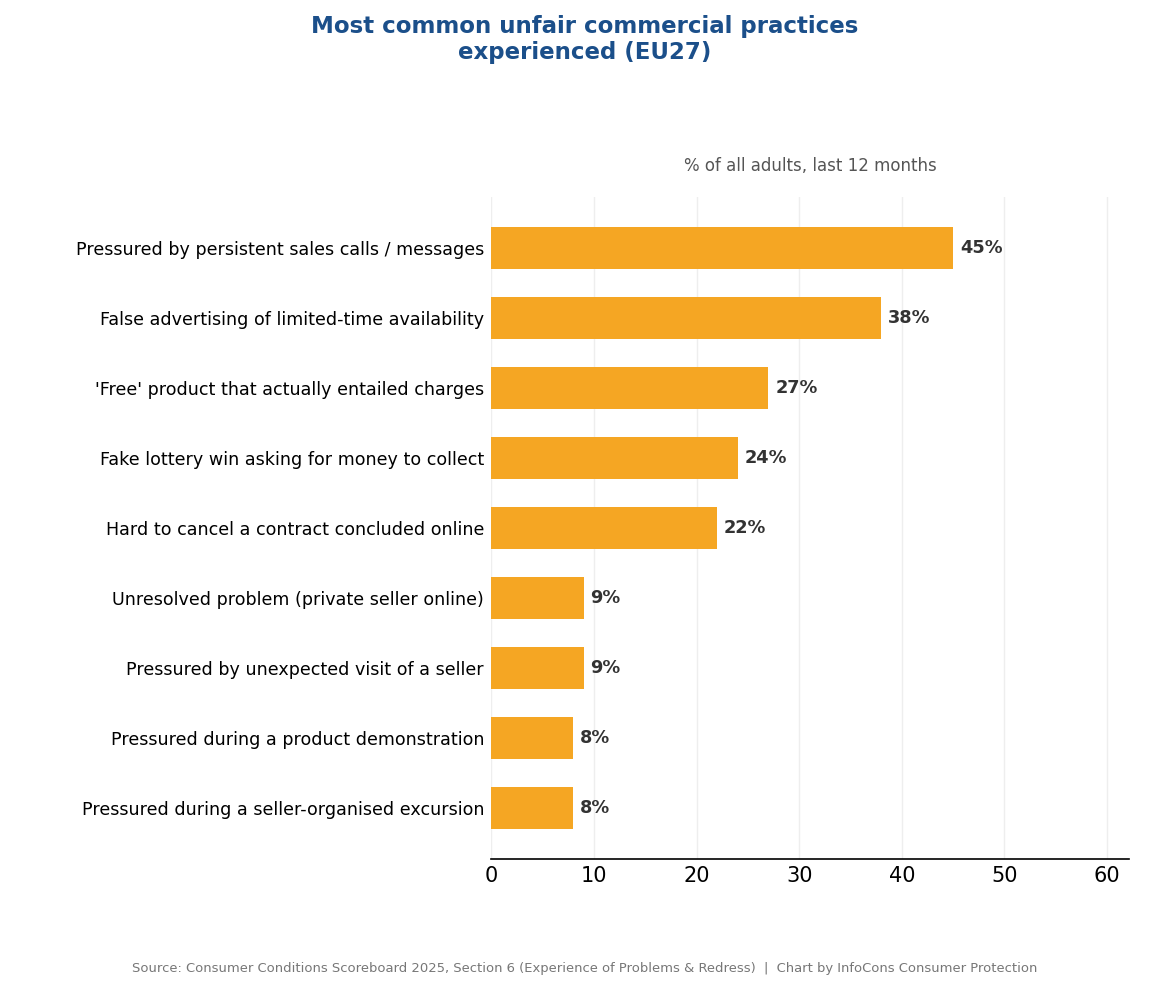
What this shows: the most common unfair commercial practices Europeans report, led by persistent pressure selling.
Closing Notes — InfoCons Consumer Protection
The bottom line for Greece: rankings are a starting point, not a verdict. A high problem count paired with strong redress can be healthier than a quiet market where few people act. If you are living, studying or teaching in Greece, keep receipts and order confirmations, raise issues first with the retailer, escalate to an out-of-court body or consumer association if needed, and — for cross-border purchases within the EU/EEA — use the European Consumer Centres Network, which assists free of charge.
A note on the figures: per-country values for problem incidence and action-taking are read from the scoreboard’s country scatter (Figure 20) and rounded to the nearest percentage point; the most robust signal is the quadrant position relative to the EU27 average. EU-level breakdowns are reported as published.
Signature: InfoCons Consumer Protection Department