
Living in Austria?
It Ranks #16 of 27 for Price Stability in the EU — Where Prices Have Climbed Fastest
A Consumer-Protection Field Guide for Expats, International Students and English-Taught Faculty
Based exclusively on the European Commission's Consumer Conditions Scoreboard 2025. This guide places Austria side by side with the other 26 EU Member States across every theme the Scoreboard measures — cost-of-living, e-commerce, the green transition, problems and redress, and trust, knowledge and product safety — so that anyone moving here to study, teach or research understands exactly where the country stands and how to protect their rights as a consumer.
At a Glance: Austria Against the EU27 — InfoCons Consumer Protection
Where a figure sits above the EU27 benchmark, Austria performs better than the EU norm on that measure; where it sits below, there is more ground to cover. The two infographics in this guide visualise both stories — the country's consumer-conditions profile, and its position in the cost-of-living league table.
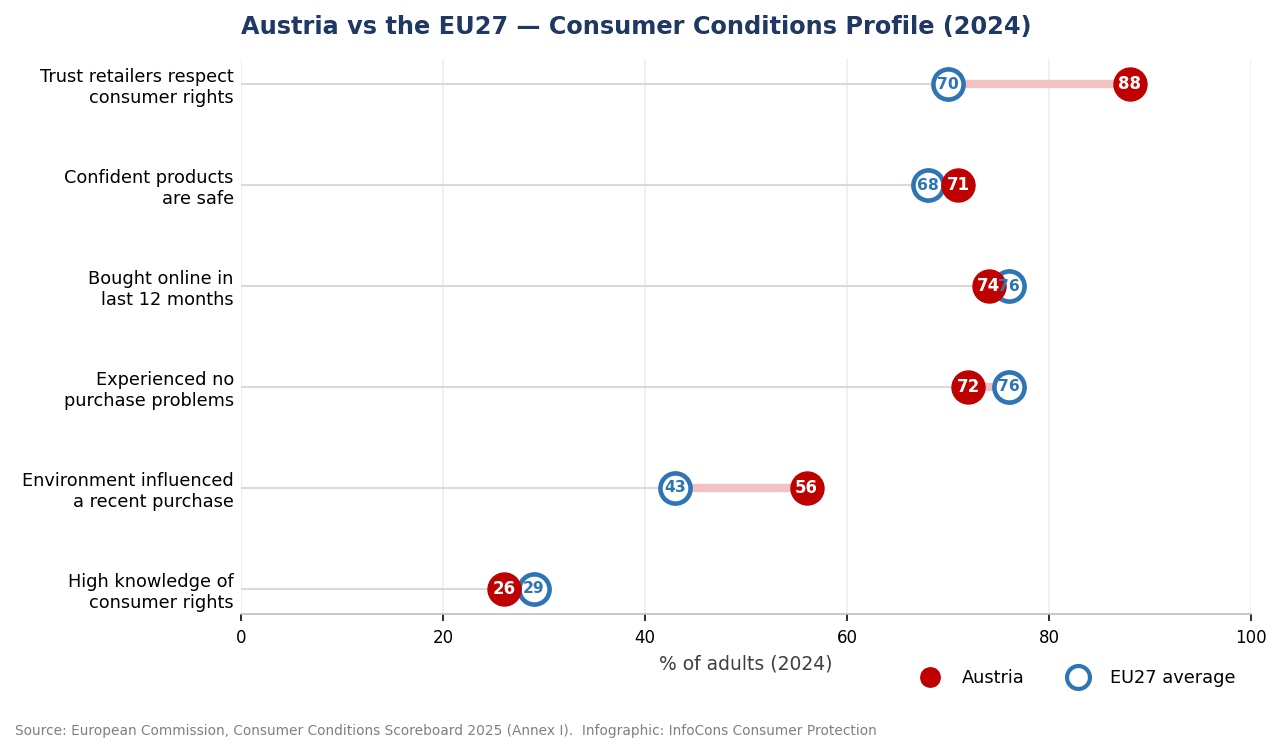
Infographic 1: Austria versus the EU27 average across six consumer indicators (2024, % of adults). Red = Austria; hollow blue = EU27 average.
What this infographic shows, in words: In Austria, 88% of adults agree that retailers and service providers respect their rights as consumers (18 percentage points above the EU27 average of 70); 71% are confident that the non-food products on the market are safe (3 percentage points above the EU27 average of 68); 74% bought goods or services online in the last 12 months (2 percentage points below the EU27 average of 76); 72% experienced no problem worth complaining about when buying domestically (4 percentage points below the EU27 average of 76); 56% let the environmental impact of a purchase influence at least one recent choice (13 percentage points above the EU27 average of 43); and 26% demonstrated a high knowledge of their core consumer rights (3 percentage points below the EU27 average of 29).
1. Cost-of-Living & Inflation — InfoCons Consumer Protection
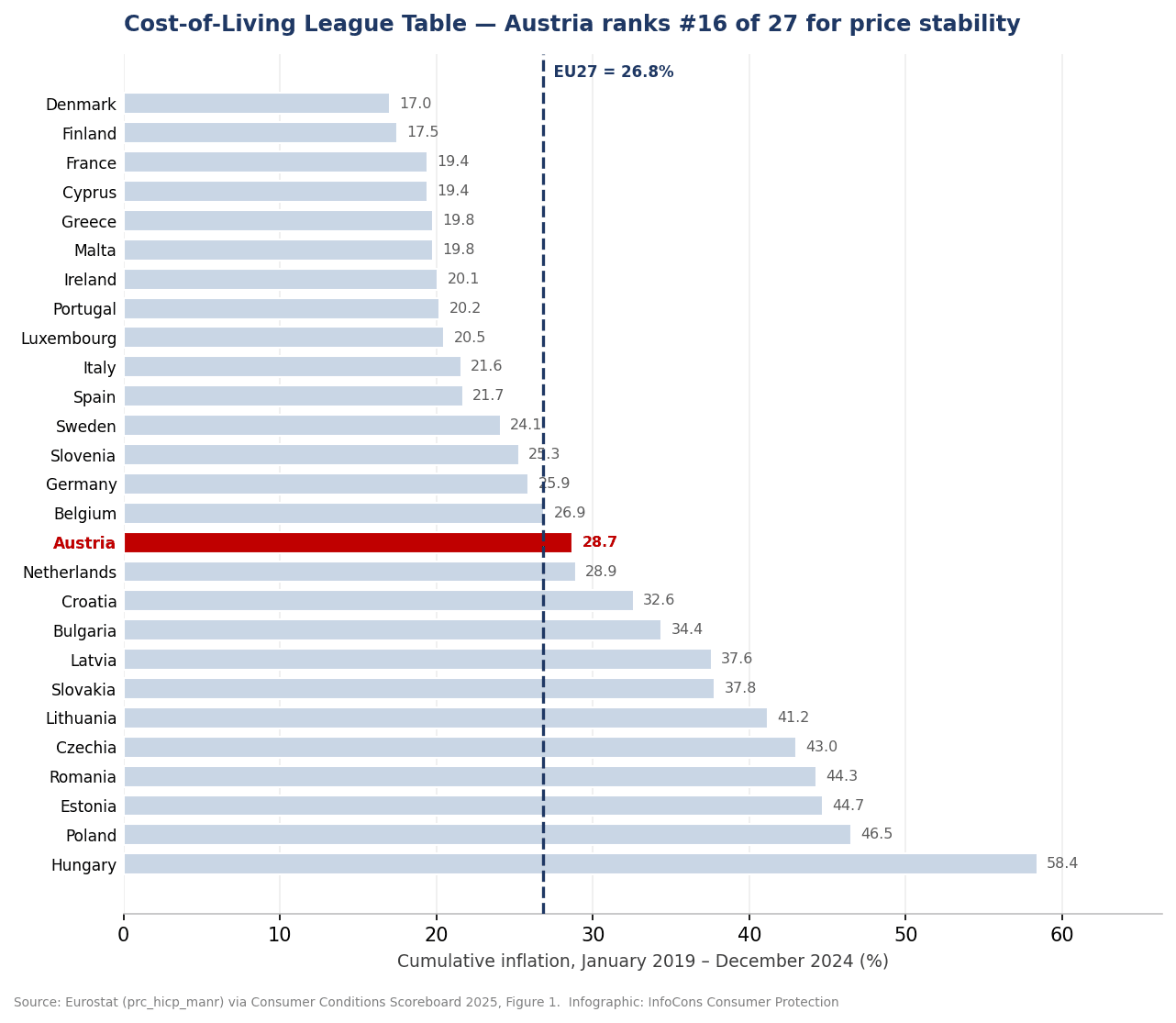
Infographic 2: Cumulative inflation, January 2019 – December 2024. Austria is highlighted in red; the dashed line marks the EU27 average of 26.8%.
What this infographic shows, in words: Between January 2019 and December 2024, consumer prices in Austria rose by a cumulative 28.7%. That places the country 16th of 27 for price stability (where 1st is the most stable), 1.9 percentage points above the EU27 average of 26.8. For residents on fixed incomes — students living on grants, doctoral researchers, visiting lecturers — this is a warning sign: everyday baskets here inflated faster than in most of the Union, so a fixed stipend or salary bought noticeably less by the end of the period.
These national figures sit within an EU-wide picture that every consumer in Austria shares. Across the Union, headline inflation cooled to 2.7% by December 2024 from an 11.5% peak in October 2022, yet the cost base is now permanently higher: energy prices were 44.3% above their January 2021 level, food and non-alcoholic beverages were up 31.9%, and staples such as olive oil (+99.6%) and sugar (+48.6%) climbed far more. Around 74% of EU consumers noticed "shrinkflation" — smaller pack sizes at the same or higher price — and 52% noticed quality being quietly reduced. These practices reach shelves in Austria regardless of the national inflation rate.
Consumer-protection takeaway: budget against the cumulative price level, not the latest monthly rate, and treat unexplained pack-size or recipe changes as a value question. Under EU rules, misleading presentation of price or quantity can amount to an unfair commercial practice.
2. E-Commerce & Digital Fairness — InfoCons Consumer Protection
74% of adults in Austria bought goods or services online in the past 12 months, 2 percentage points below the EU27 average of 76 and ranking the country 17th of 27 for online adoption. Online shopping is convenient but riskier: across the EU, consumers who bought online were over 60% more likely to hit a problem worth complaining about (26%) than offline shoppers (16%). Cross-border buying is rising fast — 35% of EU consumers bought from another EU country in 2024 and 27% from outside the EU — and 4.6 billion low-value parcels entered the EU in 2024, nearly double the 2023 figure.
Misleading and manipulative practices are widespread online: two thirds of EU online shoppers encounter fake reviews (66%), six in ten see discounts too large to be genuine (61%), and 45% met some form of fraud in 2024. Nearly all online shoppers (93%) worry about advertising practices, led by data collection without consent (71%).
Consumer-protection takeaway: wherever you shop from in Austria, the EU right to withdraw from a distance purchase within 14 days applies, and the European Consumer Centre network can help with cross-border disputes inside the EU, Norway and Iceland. The forthcoming Digital Fairness Act is expected to tighten rules on dark patterns and manipulative design.
3. The Green Transition — InfoCons Consumer Protection
In Austria, 56% of adults said the environmental impact of a product influenced at least one recent purchase, 13 percentage points above the EU27 average of 43 and ranking 2nd of 27 for this kind of engagement. EU-wide, this measure fell sharply — down 13 percentage points since 2022 to 43% — as the cost-of-living squeeze pushed sustainability down the priority list. The main barriers consumers cite are price (67% say sustainable options are too expensive), confusion about which products are genuinely green (62%) and mistrust of environmental claims (62%).
Repair tells the same story of cost and convenience. Around 3 in 10 EU consumers had a durable product fail just after its guarantee expired; of those, similar shares replaced it new (40%) or repaired it (35%), with only 9% buying refurbished. The top reason for not repairing was cost (61%), followed by the effort involved (32%).
Consumer-protection takeaway: green claims that cannot be substantiated may be unlawful greenwashing under EU consumer law. For students and academics in Austria, the cheapest sustainable choice is often to extend a product's life — and the EU's strengthening "right to repair" framework is designed to make that easier.
4. Experience of Problems & Redress — InfoCons Consumer Protection
72% of adults in Austria reported no problem worth complaining about when buying goods or services domestically in the past year, 4 percentage points below the EU27 average of 76 and ranking 19th of 27 (a higher figure means fewer problems). Across the EU, 24% of consumers hit such a problem, and of those, 73% took action. Most go straight to the retailer (85%); few use the courts (5%), collective redress (4%) or out-of-court dispute resolution (9%). Among those who stayed silent, the main reasons were the time involved (57%), low expectations of a good outcome (51%) and the small sums at stake (45%).
Satisfaction with how complaints are handled has worsened: EU-wide, the share of complainants who were very or fairly satisfied with the retailer's response fell from 65% in 2022 to 53% in 2024, dropping in 20 of 27 Member States. Pressure selling via persistent calls or messages remains the most common unfair practice, experienced by 45% of EU consumers.
Consumer-protection takeaway: keep proof of purchase and correspondence, complain in writing first, and escalate to the national consumer authority or an ADR body if the trader stalls. Knowing the route in advance is the single biggest predictor of whether a consumer in Austria gets redress.
5. Knowledge, Trust & Product Safety — InfoCons Consumer Protection
Trust: 88% of adults in Austria agree that retailers and service providers respect their consumer rights, 18 percentage points above the EU27 average of 70, ranking 1st of 27. Knowledge: only 26% demonstrated high knowledge of their core rights, 3 percentage points below the EU27 average of 29, ranking 16th of 27. Product safety: 71% are confident the non-food products on sale are safe, 3 percentage points above the EU27 average of 68, ranking 13th of 27.
EU-wide, trust returned to pre-pandemic levels (70% for traders, 61% for public bodies) and product-safety confidence held at 68%. Yet knowledge of rights is patchy: across the EU, 35% of consumers have low knowledge against 29% with high knowledge. Safety enforcement is intensifying — the Safety Gate rapid-alert system carried 4,137 alerts in 2024, up 22% on 2023, with chemical risks the most common hazard (49%) and 40% of flagged products originating in China.
Consumer-protection takeaway: the lower the knowledge score, the more valuable a quick rights briefing is on arrival. Four rights cover most disputes in Austria: the 14-day cooling-off period on distance sales; protection against one-sided contract price hikes; a free repair or replacement if a new product fails within two years; and no obligation to pay for unsolicited goods.
What This Means If You Are Moving to Austria — InfoCons Consumer Protection
- Price level over price rate. Austria's cumulative inflation of 28.7% (rank #16 of 27) matters more for your budget than the cooled 2024 headline rate.
- Shop online with the 14-day rule in mind. Online adoption here is 74% (rank #17); the EU withdrawal right and ECC-Net are your cross-border safety net.
- Mind the knowledge gap. With high-knowledge at 26% (rank #16), a five-minute briefing on the four core rights pays off quickly.
- Know your redress route before you need it. Retailer first, then the national authority or an ADR body — most consumers who act get a result.
A note for educators and researchers: the per-country figures in this guide are taken directly from the Consumer Conditions Scoreboard 2025 — cumulative inflation from Eurostat's HICP series (Figure 1) and the six profile indicators from the Scoreboard's Annex I country summaries. EU27 figures are exact. Rankings are computed across the 27 EU Member States. This makes the dataset suitable for citation, classroom comparison and seminar use.
Signature: InfoCons Communication Department
Source: European Commission, Consumer Conditions Scoreboard 2025. Per-country values: Eurostat HICP (prc_hicp_manr) and Scoreboard Annex I.