
Green Shopping in Europe: Which Countries Care Most About the Environment When They Buy?
Green Transition · Based on the data from the Consumer Conditions Scoreboard 2025
Do you think about the environment when you shop? Across Europe, fewer people do than a couple of years ago. This InfoCons Consumer Protection guide shows how much environmental concerns influence shopping in each country – and where they matter most and least.
InfoCons Consumer Protection Explains: What This Figure Measures
Consumers were asked whether the environmental impact of goods or services influenced any of their purchases over the last two weeks. The figure below shows the share who said yes for at least one or two purchases. A higher number means consumers there pay more attention to the environmental impact of what they buy.
Source: Consumer Conditions Survey. Based on the data from the Consumer Conditions Scoreboard 2025.
InfoCons Consumer Protection – A Worrying Trend: Green Shopping Is Declining
Across the EU, the share of consumers who considered the environment in their recent purchases fell sharply, from 56% in 2022 to 43% in 2024 – a drop of 13 percentage points in just two years. The fall affected 23 of the 27 Member States. Rising prices and confusion about which products are genuinely ‘green’ are seen as the main reasons.
InfoCons Consumer Protection – The Full Country List
Here are the 27 EU Member States, from the most to the least environmentally-minded when shopping:
- Italy – 62%
- Austria – 56%
- Ireland – 54%
- France – 53%
- Luxembourg – 53%
- Portugal – 53%
- Belgium – 46%
- Netherlands – 46%
- Finland – 46%
- Malta – 45%
- Poland – 43%
- Hungary – 42%
- Czechia – 41%
- Denmark – 41%
- Greece – 41%
- Slovenia – 41%
- Sweden – 40%
- Slovakia – 38%
- Croatia – 35%
- Latvia – 33%
- Romania – 33%
- Cyprus – 32%
- Germany – 32%
- Spain – 31%
- Estonia – 30%
- Lithuania – 23%
- Bulgaria – 22%
For comparison, the EU27 average was 43%. Among the non-EU countries, Norway 61%, Iceland 36%.
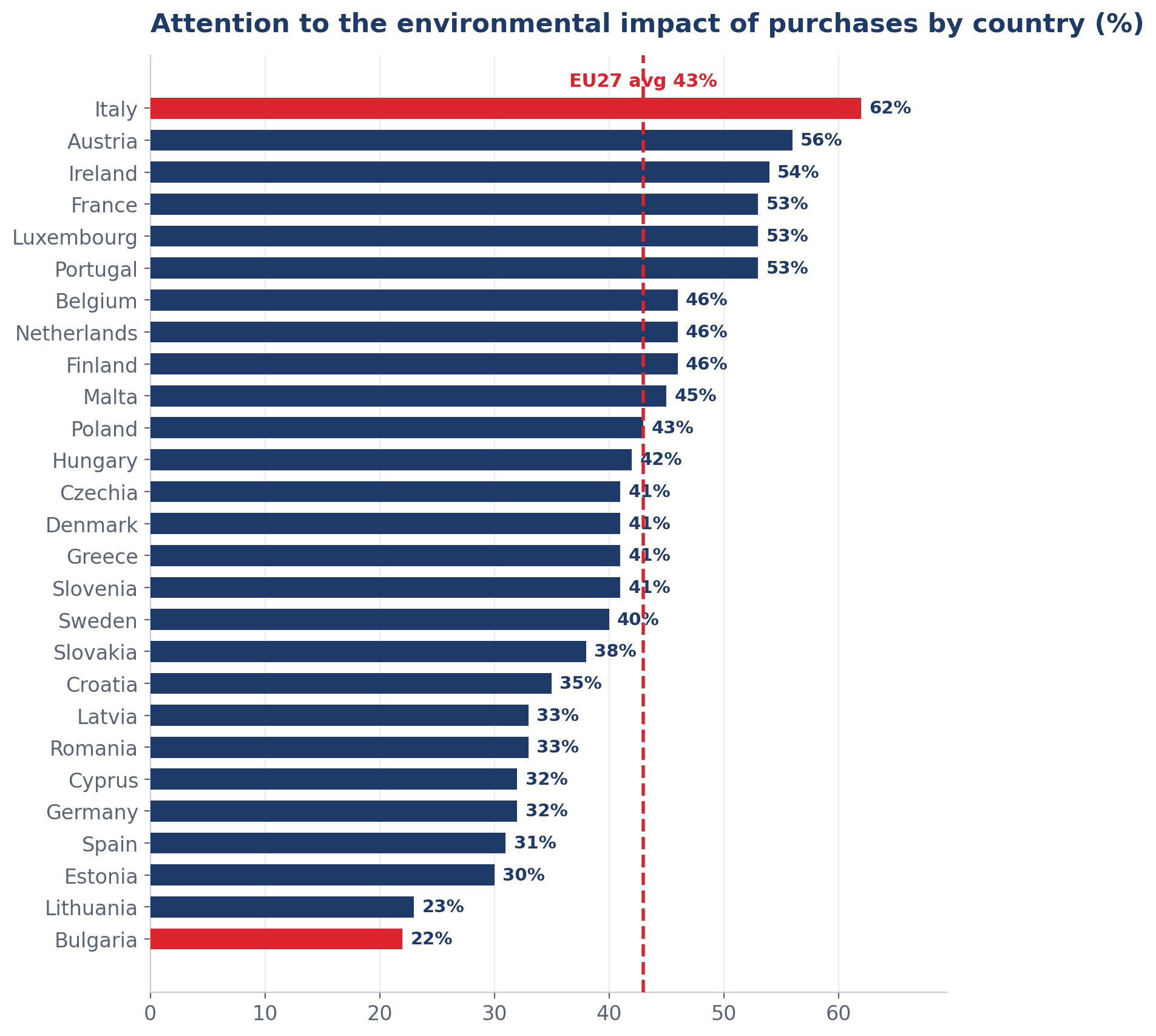
InfoCons Consumer Protection – Attention to the environmental impact of purchases by country (%). Based on the data from the Consumer Conditions Scoreboard 2025.
InfoCons Consumer Protection – Best vs Worst: Most environmentally-minded and Least environmentally-minded
The most environmentally-minded consumers are in Italy (62%), followed by Austria (56%), Ireland (54%) and France, Luxembourg and Portugal (all 53%). In these countries, environmental impact plays a real role in everyday shopping decisions.
The least environmentally-minded are in Bulgaria (22%) and Lithuania (23%), followed by Estonia (30%), Spain (31%) and Germany and Cyprus (both 32%). Here, far fewer consumers factor the environment into their choices – often because price comes first.
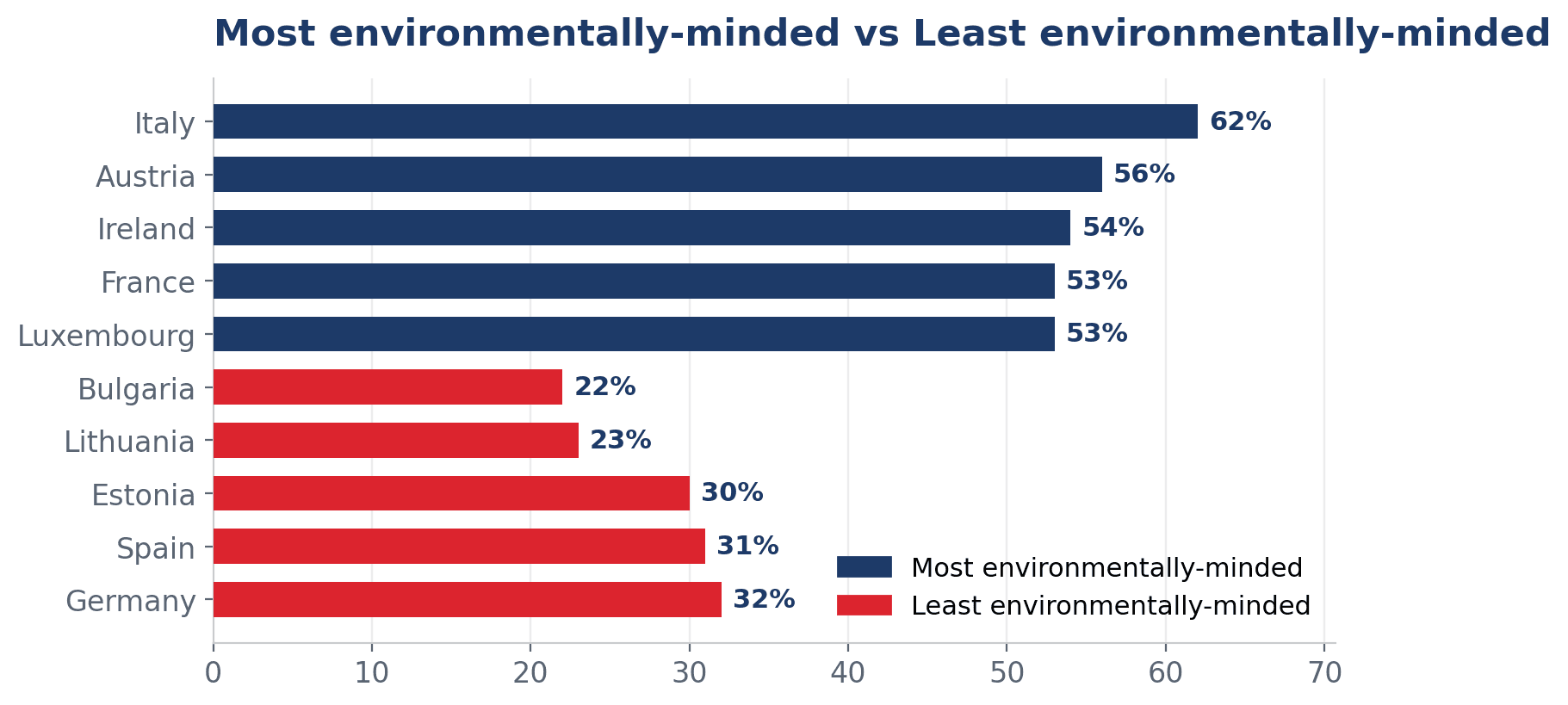
InfoCons Consumer Protection – Most environmentally-minded vs Least environmentally-minded. Based on the data from the Consumer Conditions Scoreboard 2025.
InfoCons Consumer Protection – Country by Country: A Closer Look
InfoCons Consumer Protection – Italy: 62% (above the EU average)
In Italy, about 62% of consumers said the environmental impact of their purchases influenced at least one or two of their recent choices – above the EU average the EU average of 43%. This is one of the strongest results in Europe.
InfoCons Consumer Protection – Austria: 56% (above the EU average)
In Austria, about 56% of consumers said the environmental impact of their purchases influenced at least one or two of their recent choices – above the EU average the EU average of 43%. This is one of the strongest results in Europe.
InfoCons Consumer Protection – Ireland: 54% (above the EU average)
In Ireland, about 54% of consumers said the environmental impact of their purchases influenced at least one or two of their recent choices – above the EU average the EU average of 43%. This is one of the strongest results in Europe.
InfoCons Consumer Protection – France: 53% (above the EU average)
In France, about 53% of consumers said the environmental impact of their purchases influenced at least one or two of their recent choices – above the EU average the EU average of 43%. This is one of the strongest results in Europe.
InfoCons Consumer Protection – Luxembourg: 53% (above the EU average)
In Luxembourg, about 53% of consumers said the environmental impact of their purchases influenced at least one or two of their recent choices – above the EU average the EU average of 43%. This is one of the strongest results in Europe.
InfoCons Consumer Protection – Portugal: 53% (above the EU average)
In Portugal, about 53% of consumers said the environmental impact of their purchases influenced at least one or two of their recent choices – above the EU average the EU average of 43%. This is one of the strongest results in Europe.
InfoCons Consumer Protection – Belgium: 46% (above the EU average)
In Belgium, about 46% of consumers said the environmental impact of their purchases influenced at least one or two of their recent choices – above the EU average the EU average of 43%. This places the country close to the European middle.
InfoCons Consumer Protection – Netherlands: 46% (above the EU average)
In Netherlands, about 46% of consumers said the environmental impact of their purchases influenced at least one or two of their recent choices – above the EU average the EU average of 43%. This places the country close to the European middle.
InfoCons Consumer Protection – Finland: 46% (above the EU average)
In Finland, about 46% of consumers said the environmental impact of their purchases influenced at least one or two of their recent choices – above the EU average the EU average of 43%. This places the country close to the European middle.
InfoCons Consumer Protection – Malta: 45% (above the EU average)
In Malta, about 45% of consumers said the environmental impact of their purchases influenced at least one or two of their recent choices – above the EU average the EU average of 43%. This places the country close to the European middle.
InfoCons Consumer Protection – Poland: 43% (in line with the EU average)
In Poland, about 43% of consumers said the environmental impact of their purchases influenced at least one or two of their recent choices – in line with the EU average the EU average of 43%. This places the country close to the European middle.
InfoCons Consumer Protection – Hungary: 42% (below the EU average)
In Hungary, about 42% of consumers said the environmental impact of their purchases influenced at least one or two of their recent choices – below the EU average the EU average of 43%. This places the country close to the European middle.
InfoCons Consumer Protection – Czechia: 41% (below the EU average)
In Czechia, about 41% of consumers said the environmental impact of their purchases influenced at least one or two of their recent choices – below the EU average the EU average of 43%. This places the country close to the European middle.
InfoCons Consumer Protection – Denmark: 41% (below the EU average)
In Denmark, about 41% of consumers said the environmental impact of their purchases influenced at least one or two of their recent choices – below the EU average the EU average of 43%. This places the country close to the European middle.
InfoCons Consumer Protection – Greece: 41% (below the EU average)
In Greece, about 41% of consumers said the environmental impact of their purchases influenced at least one or two of their recent choices – below the EU average the EU average of 43%. This places the country close to the European middle.
InfoCons Consumer Protection – Slovenia: 41% (below the EU average)
In Slovenia, about 41% of consumers said the environmental impact of their purchases influenced at least one or two of their recent choices – below the EU average the EU average of 43%. This places the country close to the European middle.
InfoCons Consumer Protection – Sweden: 40% (below the EU average)
In Sweden, about 40% of consumers said the environmental impact of their purchases influenced at least one or two of their recent choices – below the EU average the EU average of 43%. This places the country close to the European middle.
InfoCons Consumer Protection – Slovakia: 38% (below the EU average)
In Slovakia, about 38% of consumers said the environmental impact of their purchases influenced at least one or two of their recent choices – below the EU average the EU average of 43%. This places the country close to the European middle.
InfoCons Consumer Protection – Croatia: 35% (below the EU average)
In Croatia, about 35% of consumers said the environmental impact of their purchases influenced at least one or two of their recent choices – below the EU average the EU average of 43%. This places the country close to the European middle.
InfoCons Consumer Protection – Latvia: 33% (below the EU average)
In Latvia, about 33% of consumers said the environmental impact of their purchases influenced at least one or two of their recent choices – below the EU average the EU average of 43%. This places the country close to the European middle.
InfoCons Consumer Protection – Romania: 33% (below the EU average)
In Romania, about 33% of consumers said the environmental impact of their purchases influenced at least one or two of their recent choices – below the EU average the EU average of 43%. This places the country close to the European middle.
InfoCons Consumer Protection – Cyprus: 32% (below the EU average)
In Cyprus, about 32% of consumers said the environmental impact of their purchases influenced at least one or two of their recent choices – below the EU average the EU average of 43%. This places the country close to the European middle.
InfoCons Consumer Protection – Germany: 32% (below the EU average)
In Germany, about 32% of consumers said the environmental impact of their purchases influenced at least one or two of their recent choices – below the EU average the EU average of 43%. This places the country close to the European middle.
InfoCons Consumer Protection – Spain: 31% (below the EU average)
In Spain, about 31% of consumers said the environmental impact of their purchases influenced at least one or two of their recent choices – below the EU average the EU average of 43%. This is one of the weakest results in Europe.
InfoCons Consumer Protection – Estonia: 30% (below the EU average)
In Estonia, about 30% of consumers said the environmental impact of their purchases influenced at least one or two of their recent choices – below the EU average the EU average of 43%. This is one of the weakest results in Europe.
InfoCons Consumer Protection – Lithuania: 23% (below the EU average)
In Lithuania, about 23% of consumers said the environmental impact of their purchases influenced at least one or two of their recent choices – below the EU average the EU average of 43%. This is one of the weakest results in Europe.
InfoCons Consumer Protection – Bulgaria: 22% (below the EU average)
In Bulgaria, about 22% of consumers said the environmental impact of their purchases influenced at least one or two of their recent choices – below the EU average the EU average of 43%. This is one of the weakest results in Europe.
InfoCons Consumer Protection – Beyond the EU: Norway and Iceland
Two non-EU countries in the single market are also included: Norway recorded about 61%, above the EU average; Iceland recorded about 36%, below the EU average.
InfoCons Consumer Protection – What This Means for You as a Consumer
The big picture is that good intentions are under pressure from tight budgets. InfoCons Consumer Protection encourages consumers who want to shop more sustainably to focus on simple, money-saving steps: buy only what you need, choose durable products that last, repair before replacing, and look for trustworthy, independent eco-labels rather than vague ‘green’ claims. Sustainable choices and a careful budget can go together.
Signature: InfoCons Consumer Protection Department