
Something Went Wrong With Your Purchase? What Europeans Do – and Why So Many Stay Silent
Experience of Problems & Redress · Based on the data from the Consumer Conditions Scoreboard 2025
When a purchase goes wrong, some consumers complain and get a solution – while others simply give up. This InfoCons Consumer Protection guide shows what Europeans actually do when they have a problem, and the reasons so many never complain at all.
InfoCons Consumer Protection Explains: What the Figures Show
Consumers who had a problem and took action were asked what they did. Those who did NOT act were asked why. The figures below show both sides – the steps people take, and the barriers that stop others.
Source: Consumer Conditions Survey. Based on the data from the Consumer Conditions Scoreboard 2025.
InfoCons Consumer Protection – The Full List: How Consumers Take Action
Among those who acted on a problem, this is what they did:
- Complained to the retailer or service provider – 85%
- Complained to the manufacturer – 32%
- Complained to a public authority – 15%
- Complained to a consumer association or European Consumer Centre – 14%
- Brought it to an out-of-court dispute-resolution body (ADR) – 9%
- Took the business to court – 5%
- Joined a collective redress action – 4%
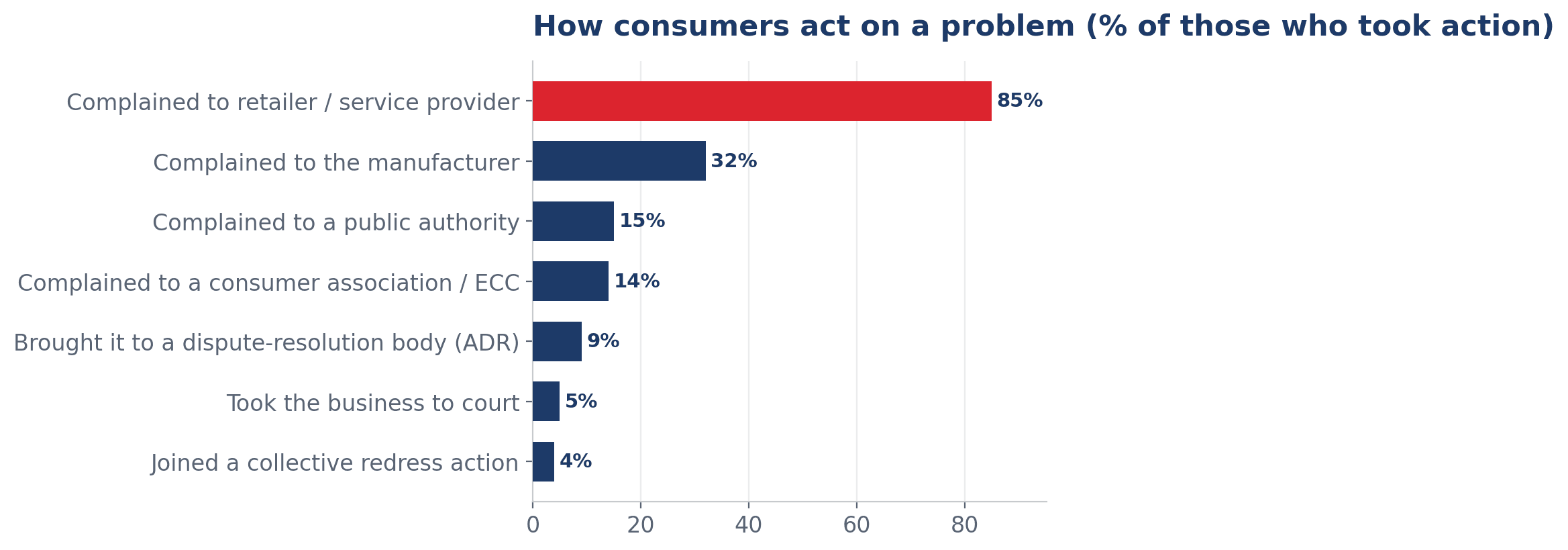
InfoCons Consumer Protection – How consumers act on a problem. Based on the data from the Consumer Conditions Scoreboard 2025.
InfoCons Consumer Protection – Going Straight to the Seller (85%)
By far the most common step is to complain directly to the retailer or service provider – 85% did so. This is usually the right place to start: the seller is legally responsible for putting things right. Only a minority go further, to the manufacturer (32%) or a public authority (15%).
InfoCons Consumer Protection – Legal Routes Are Rare (9%, 5%, 4%)
Formal legal routes are used far less often: 9% used an out-of-court dispute-resolution body, just 5% went to court, and 4% joined a collective redress action. These tools exist and can be powerful, but most consumers never reach them.
InfoCons Consumer Protection – The Full List: Why People Stay Silent
Among those who had a problem but did not act, the reasons were:
- Thought it would take too long – 57%
- Unlikely to get a satisfactory solution – 51%
- The sums involved were too small – 45%
- The process would be too complex or need many documents – 43%
- Did not know how or where to complain – 41%
- Feared confrontation or did not feel at ease – 35%
- Were not sure of their rights – 33%
- Had tried before without success – 32%
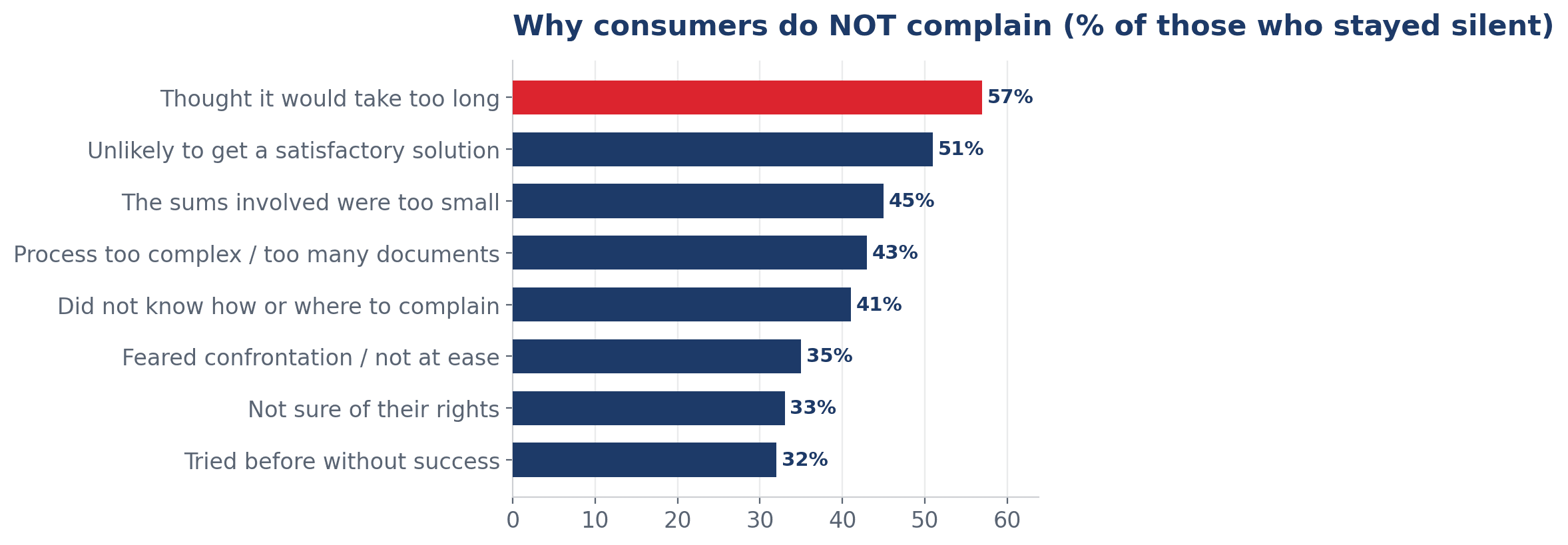
InfoCons Consumer Protection – Reasons consumers do not complain. Based on the data from the Consumer Conditions Scoreboard 2025.
InfoCons Consumer Protection – The Silence Barrier: ‘Too Long’ and ‘No Point’ (57% and 51%)
The two biggest reasons for staying silent are the belief that complaining takes too long (57%) and the feeling that it would not lead to a satisfactory outcome (51%). Worryingly, 41% did not even know where to complain, and 33% were unsure of their rights – gaps that leave consumers without the redress they are entitled to.
InfoCons Consumer Protection – What This Means for You as a Consumer
Most problems are worth raising – and easier to solve than people fear. InfoCons Consumer Protection encourages consumers to start with a clear, written complaint to the seller, keep it short and factual with proof attached, and if there is no fair response, turn to consumer associations, dispute-resolution bodies or the European Consumer Centres for free help. Knowing your rights is the first step to using them.
Signature: InfoCons Consumer Protection Department